A under-discussed backdrop to yesterday's election results—Britain today feels less pleasant, well-maintained and orderly than a decade ago: from potholes to phone-snatchers.
I've spent the past few months digging in to why for @TheEconomist.
A short 🧵 on what I've concluded.
I've spent the past few months digging in to why for @TheEconomist.
A short 🧵 on what I've concluded.

1/ But first, do read the full piece—linked below.
Bemoaning national decline in a data-free way is cathartic, but not all that helpful. I've tried to keep this all pretty closely tied to provable realities, things we can reliably measure.
economist.com/britain/2025/0…
Bemoaning national decline in a data-free way is cathartic, but not all that helpful. I've tried to keep this all pretty closely tied to provable realities, things we can reliably measure.
economist.com/britain/2025/0…
2/ Start with voters: Brits are not exactly tempermentally optimistic, but I still found this polling pretty shocking.
Across measures and parties, Brits reckon that their neighbourhoods and public services are appreciably worse than a decade ago.
Something is awry.
Across measures and parties, Brits reckon that their neighbourhoods and public services are appreciably worse than a decade ago.
Something is awry.

3/ The expert verdict is similar: here's what the @instituteforgov thinks on public services.
Stories of NHS dysfunction are hardly news, but the breadth of the problem and the particular issues with street-level services and policing are notable.
Stories of NHS dysfunction are hardly news, but the breadth of the problem and the particular issues with street-level services and policing are notable.

4/ You can see this in real-life outcomes, too.
Shoplifting is a particularly stark one, because businesses actually have a decent incentive to track it, even if they've given up reporting most thefts to the police.
Shoplifting is a particularly stark one, because businesses actually have a decent incentive to track it, even if they've given up reporting most thefts to the police.
https://x.com/ArchieHall/status/1917940988451975270
5/ Or ask any councillor about potholes. You'll likely hear that they've always been a problem, but never this bad.
Pothole compensation claims per council (via @AIA_Asphalt )
2016: 182
2017: 142
2018: 155
2019: 347
2020: 166
2021: 219
2022: 224
2023: 168
2024: 375
2025: 377
Pothole compensation claims per council (via @AIA_Asphalt )
2016: 182
2017: 142
2018: 155
2019: 347
2020: 166
2021: 219
2022: 224
2023: 168
2024: 375
2025: 377
6/ All this raises a particular challenge when taxes are at historic highs.
I thought @RogerGough2 put it well, but similar sentiments come up again and again in these sorts of conversations.
I thought @RogerGough2 put it well, but similar sentiments come up again and again in these sorts of conversations.

7/ So what's happened? A lot of the standard bogeymen (austerity, say, or immigration) aren't that persuasive when you dig in.
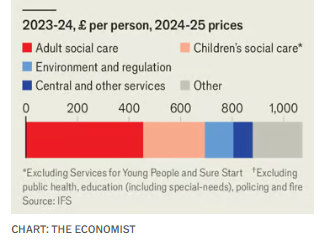
Take local gov't. Yes, budgets are down a bit after inflation and population growth. More important: under the hood they've been radically reshaped.
Take local gov't. Yes, budgets are down a bit after inflation and population growth. More important: under the hood they've been radically reshaped.

8/ Outside social care, where spending is up, budgets are down by over a third. Then throw in special-needs schooling, now radically more expensive, and temporary accommodation (often paying eye-watering rents).
The space for the typical business of local gov't is all but gone.
The space for the typical business of local gov't is all but gone.
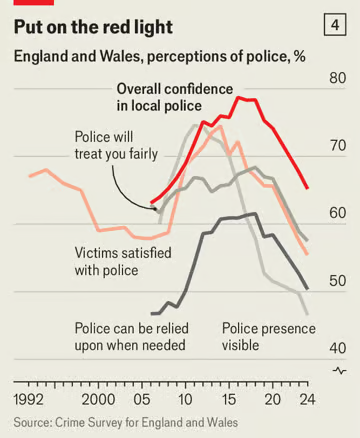
9/ Or take policing, where public confidence has plummeted.
Worth looking especially at that light gray line, for police visibility: people simply no longer see police officers in their neighbourhoods.
Worth looking especially at that light gray line, for police visibility: people simply no longer see police officers in their neighbourhoods.
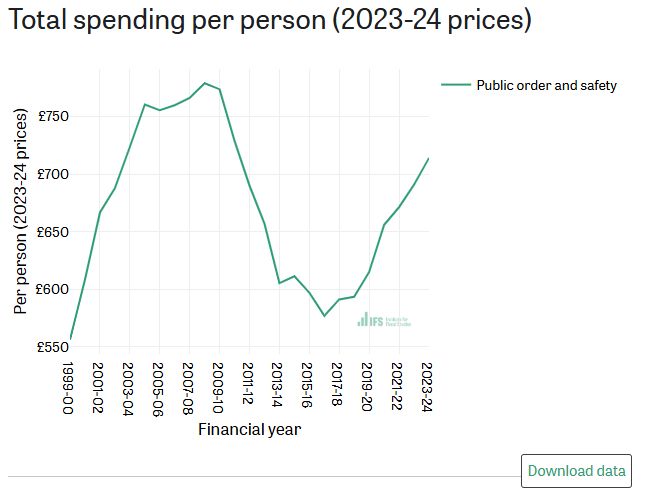
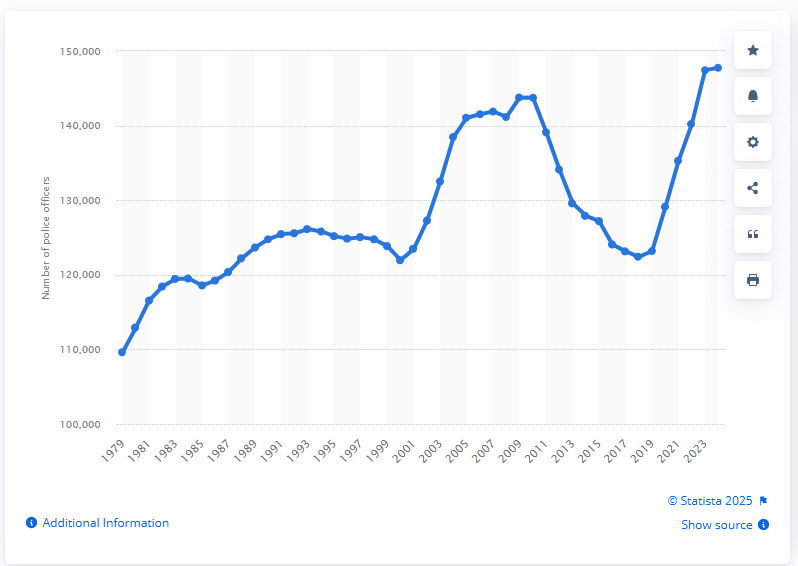
10/ There, again, overall budgets actually aren't down all that much.
But the austerity see-saw: cutting 20k fulltime police officers in the 2010s then rehiring 25k more less-experienced ones later, seems to have done deep damage.
But the austerity see-saw: cutting 20k fulltime police officers in the 2010s then rehiring 25k more less-experienced ones later, seems to have done deep damage.
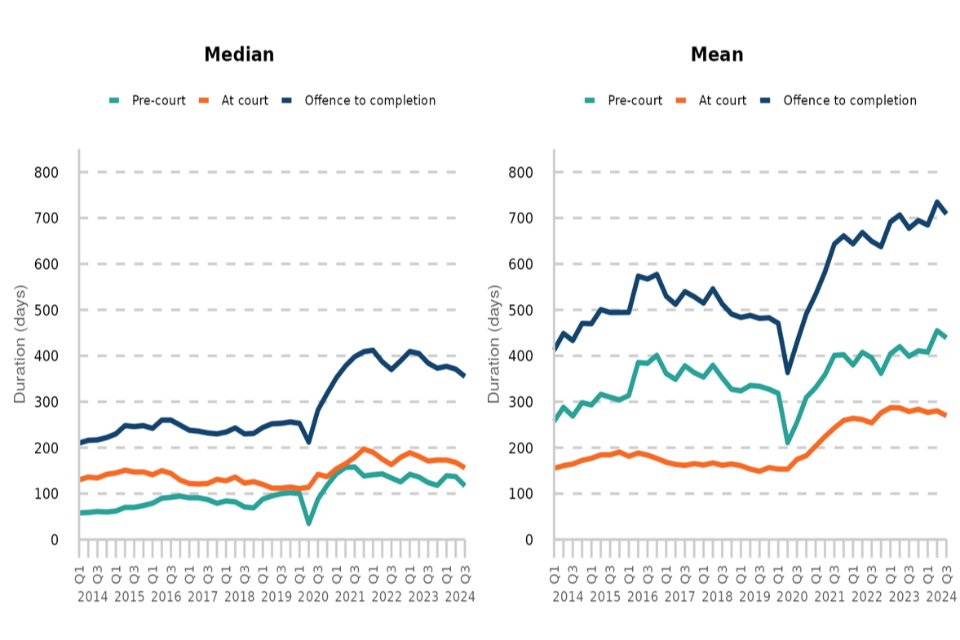
11/ Covid worsened things too—court backlogs are as bad as ever.
And at the end of the pipeline, my colleage @tom_sasse has written about how prisons are in a "doom loop":
economist.com/britain/2024/1…
And at the end of the pipeline, my colleage @tom_sasse has written about how prisons are in a "doom loop":
economist.com/britain/2024/1…
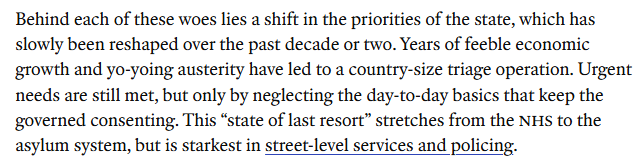
12/ Add all that up and you start to see a pattern, as I lay out in the accompaning leader.
Again and again, the British state has started to look more like a triage ward than a well-functional hospital.
Link: economist.com/leaders/2025/0…
Again and again, the British state has started to look more like a triage ward than a well-functional hospital.
Link: economist.com/leaders/2025/0…
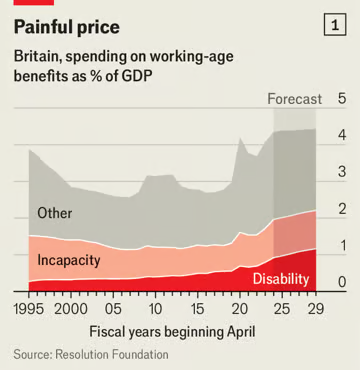
13/ There were real resonances here with the worklessness crisis I've written about previously: a new urgent spending-pressure emerges, and the British state struggles with cost control. So other functions get salami-sliced to oblivion.
Link: economist.com/britain/2025/0…
Link: economist.com/britain/2025/0…
13/ And you don't just have to look at the polling to see that. The public is voting with their wallets, too—private-sector alternatives to the state are doing exceptionally well.
Take the security business, which is seeing exponential growth.
Take the security business, which is seeing exponential growth.

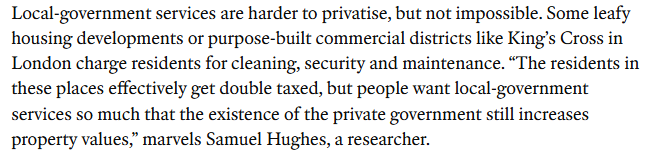
14/ This, as @SCP_Hughes lays out w/ privatised local-gov't, is a sort of double-taxation—one which plenty seem willing to pay to get services that work.
Shop-security works similarly; the cost of burly guards flows into the price of the chicken-breast packs they're protecting.
Shop-security works similarly; the cost of burly guards flows into the price of the chicken-breast packs they're protecting.
15/ Where does that leave Britain? Sorting out the NHS or the benefits system are colossal bureaucratic nightmares; important, but hard.
The good news, of a sort, is that having a real crack at making the public realm pleasant should not be that expensive, or take that long.
The good news, of a sort, is that having a real crack at making the public realm pleasant should not be that expensive, or take that long.
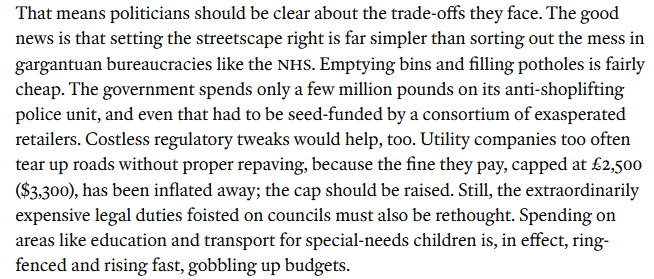
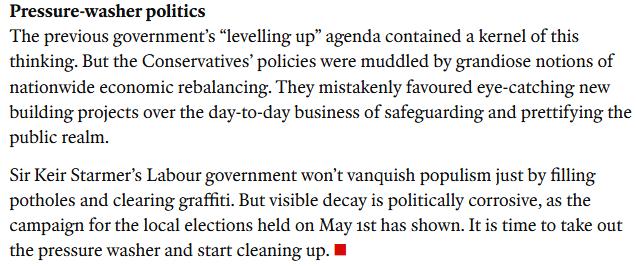
16/ Time, as I conclude in the leader, to get out the pressure-washer and take these issues seriously.
• • •
Missing some Tweet in this thread? You can try to
force a refresh