May 2025 Trading ⏫
As I began to look through my trading for the month, I wanted to share my thought process that led to me placing these trades in May, culminating in my performance thus far.
The Context:
I believe that context is extremely important as it provides insight into my headspace at the time. Here is a TLDR of my monthly performance recaps:
> Jan 2025 (MTD/YTD | 7.01%): Started the year cautious as I noted the changing market environment since Dec 2024. Adopted the mindset of ‘chipping up’ and selling into strength more aggressively – trying to build cushion to work with for the year.
> Feb 2025 (MTD/YTD | 8.82%/16.44%): Spent the first half of the month getting chopped up by my mistakes and unfortunately got caught in the Valentine’s Day $SERV gap down. Made up for it recognizing the market shift and shorted the market towards the end of Feb. Got into a ‘trading flow’ as trades came naturally as the opportunity set presented itself.
> Mar 2025 (MTD/YTD | 12.43%/30.92%): Continued my ‘trading flow’ and got traction shorting the US market. At the same time the HK equity market was running hot, and hence I adopted the strategy of Short US, Long HK.
> April 2025 (MTD/YTD | 0.08%/31.03%): Markets got ‘liberated’ and traded the April 07 capitulation low via $TQQQ mainly. Noticed losing focus towards the latter part of April and gave those gains back through overtrading. Finally gained some traction towards the final stretch of April as I positioned myself in the liquid ‘leaders’.
The purpose of bringing up these monthly recaps is to highlight three things:
> First key towards super-performance: Keeping the monthly drawdowns small. Doing so enabled me to bounce back quickly once I found my ‘trading flow’ again. As a recovering ‘boom and bust’ trader, I had no problem trading very aggressively when the time calls for it, but it was in controlling the drawdowns when I encounter trading friction. Thank you @CFlanders7, I literally meant it when I said meeting you was the ‘aha’ moment!
> Second key towards super-performance: Always bear in mind the following trading principles in order of most important to least important – preservation of capital, consistent profitability, and finally, pursuit of superior returns.
That was my approach especially given the market conditions in the first 4 months of the year. The long side was generally not conducive post DeepSeek gap down (preservation of capital), and the market generally favored short side trades after that. I was lucky to have had a playbook in shorting which allowed me to make progress (consistent profitability), all while waiting for the opportunity to swing hard on the long side when market conditions got better (pursuit of superior returns).
> May turned out to be the month I was looking for to pursue superior returns. Having built up a 31% return by April, that enabled me to be in the mindset to aggressively gun for it, and that would not be possible if I was flat for the year instead.
Now, on to some trades in May 🧵
As I began to look through my trading for the month, I wanted to share my thought process that led to me placing these trades in May, culminating in my performance thus far.
The Context:
I believe that context is extremely important as it provides insight into my headspace at the time. Here is a TLDR of my monthly performance recaps:
> Jan 2025 (MTD/YTD | 7.01%): Started the year cautious as I noted the changing market environment since Dec 2024. Adopted the mindset of ‘chipping up’ and selling into strength more aggressively – trying to build cushion to work with for the year.
> Feb 2025 (MTD/YTD | 8.82%/16.44%): Spent the first half of the month getting chopped up by my mistakes and unfortunately got caught in the Valentine’s Day $SERV gap down. Made up for it recognizing the market shift and shorted the market towards the end of Feb. Got into a ‘trading flow’ as trades came naturally as the opportunity set presented itself.
> Mar 2025 (MTD/YTD | 12.43%/30.92%): Continued my ‘trading flow’ and got traction shorting the US market. At the same time the HK equity market was running hot, and hence I adopted the strategy of Short US, Long HK.
> April 2025 (MTD/YTD | 0.08%/31.03%): Markets got ‘liberated’ and traded the April 07 capitulation low via $TQQQ mainly. Noticed losing focus towards the latter part of April and gave those gains back through overtrading. Finally gained some traction towards the final stretch of April as I positioned myself in the liquid ‘leaders’.
The purpose of bringing up these monthly recaps is to highlight three things:
> First key towards super-performance: Keeping the monthly drawdowns small. Doing so enabled me to bounce back quickly once I found my ‘trading flow’ again. As a recovering ‘boom and bust’ trader, I had no problem trading very aggressively when the time calls for it, but it was in controlling the drawdowns when I encounter trading friction. Thank you @CFlanders7, I literally meant it when I said meeting you was the ‘aha’ moment!
> Second key towards super-performance: Always bear in mind the following trading principles in order of most important to least important – preservation of capital, consistent profitability, and finally, pursuit of superior returns.
That was my approach especially given the market conditions in the first 4 months of the year. The long side was generally not conducive post DeepSeek gap down (preservation of capital), and the market generally favored short side trades after that. I was lucky to have had a playbook in shorting which allowed me to make progress (consistent profitability), all while waiting for the opportunity to swing hard on the long side when market conditions got better (pursuit of superior returns).
> May turned out to be the month I was looking for to pursue superior returns. Having built up a 31% return by April, that enabled me to be in the mindset to aggressively gun for it, and that would not be possible if I was flat for the year instead.
Now, on to some trades in May 🧵
The Market:
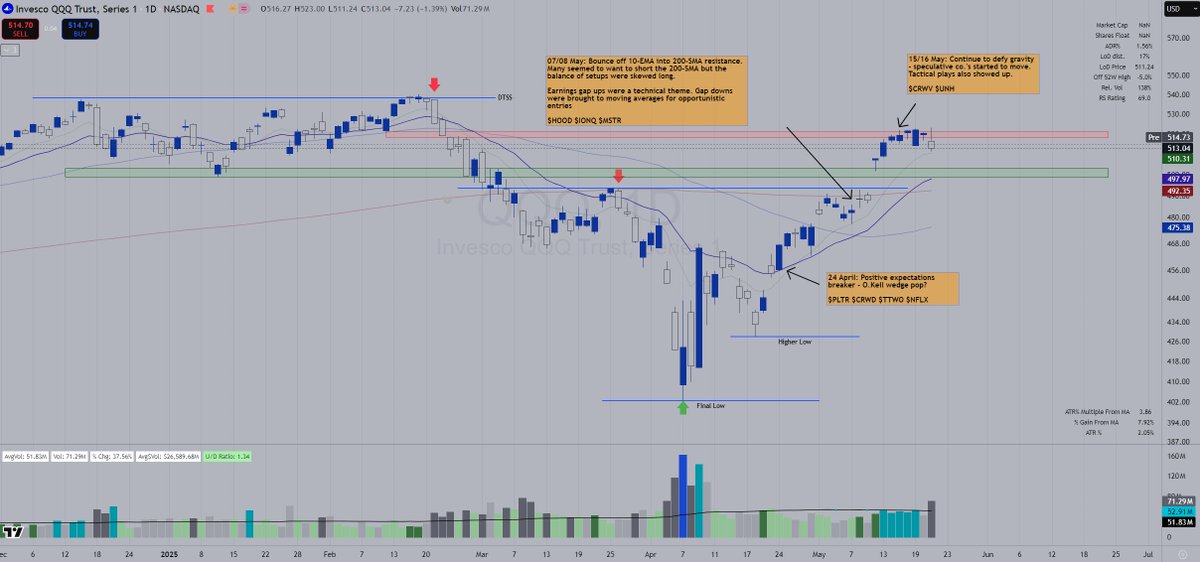
The April 07 capitulation low was the signal to tilt your bias towards the long side. Coming out of the weekend, fear was at an all-time high, friends were texting me on whether to capitulate, it was the end of the world!
However, what we saw was a gap down that immediately got bought up, AND leaders pulling off undercut and rallies with reference to left-side lows, many have also not even traded below the 200-SMA, showing huge relative strength because the $QQQ was trading below all key moving averages. (Look at $PLTR $CRWD $SPOT $HOOD $NFLX etc.)
The next thing we saw in the coming days was that price action in relation to the news flow began turning positive. There was everything to hate about the rally: hedge fund managers were underinvested, some even shorting! Yet, every single time a piece of bad news came out, price action did not go down. That smelled like news failure to me and spoke very loudly on market positioning.
With all that said, I did my best at the time to get positioned long late April, finally latching on to a couple of names which provided the initial cushion. As the month of May rolled in, I got into a trading flow as the setups presented itself and I was just trading – eventually getting myself into heavy margin and snowballing the return into what it is today.
The April 07 capitulation low was the signal to tilt your bias towards the long side. Coming out of the weekend, fear was at an all-time high, friends were texting me on whether to capitulate, it was the end of the world!
However, what we saw was a gap down that immediately got bought up, AND leaders pulling off undercut and rallies with reference to left-side lows, many have also not even traded below the 200-SMA, showing huge relative strength because the $QQQ was trading below all key moving averages. (Look at $PLTR $CRWD $SPOT $HOOD $NFLX etc.)
The next thing we saw in the coming days was that price action in relation to the news flow began turning positive. There was everything to hate about the rally: hedge fund managers were underinvested, some even shorting! Yet, every single time a piece of bad news came out, price action did not go down. That smelled like news failure to me and spoke very loudly on market positioning.
With all that said, I did my best at the time to get positioned long late April, finally latching on to a couple of names which provided the initial cushion. As the month of May rolled in, I got into a trading flow as the setups presented itself and I was just trading – eventually getting myself into heavy margin and snowballing the return into what it is today.
Palantir Technologies –
First Trade:
$PLTR was the biggest winner by far this swing cycle. I had actually got positioned earlier before this first trade but was whipped out (frustratingly). That said, the opportunity came, albeit unconventionally, and I took advantage of it.
I traded $PLTR on the 24th April when it had already broken out of the double bottom base. The $100 mark was a psychological level because that was exactly where it broke down when the market cracked wide open late February.
When looking at the 30-min chart, I noticed $PLTR breaking out of a very orderly flag pattern and set up a mini-pivot as it crossed back towards the 10/20 MAs (think O. Kell base and break). That was the opportunity to start my position with a violation of the $100 level as my selling guide.
As the stock opened, volume poured straight in which told me it wanted more upside, and I added to my existing position. The other thing I saw right at the open was that other stocks were similarly breaking out ($CRWD $TTWO $NFLX), and that gave me conviction to size into this trade, assuming that $PLTR was the liquid leader.
The other nuance that gave me conviction was that I had shorted $PLTR into that breakdown from late Feb to April – it was extremely difficult to do so compared to my other shorts, and unsurprisingly so as it was showing relative strength throughout the decline. Lastly, $PLTR formed a picture-perfect VCP intraday, that allowed me to add once again and sit comfortably with a big position in the $.
As $PLTR continued to trade higher into earnings, I began scaling out of my position, leaving a small piece as my lotto ticket.
Second Trade:
My second trade in $PLTR occurred post-earnings. The stock unsurprisingly gapped down, and I sold out of my remaining position at the open. That said, what I had noticed at that point of the market cycle was that earnings gap ups were working, and even stocks that gapped down on earnings (think $SPOT) were simply bought back up very quickly.
I surmised that perhaps $PLTR would do something similar, with the 20-EMA in sight to pull the trigger.
As $PLTR pulled into the 20-EMA, it undercut and rallied as suspected, and I bought on the basis of it turning on the 6/20 period MACD cross + the intraday higher low that followed through to the upside.
Eventually as the trade followed through higher, I noticed momentum in $PLTR waning, eventually selling out on the violation of the 10-EMA.
First Trade:
$PLTR was the biggest winner by far this swing cycle. I had actually got positioned earlier before this first trade but was whipped out (frustratingly). That said, the opportunity came, albeit unconventionally, and I took advantage of it.
I traded $PLTR on the 24th April when it had already broken out of the double bottom base. The $100 mark was a psychological level because that was exactly where it broke down when the market cracked wide open late February.
When looking at the 30-min chart, I noticed $PLTR breaking out of a very orderly flag pattern and set up a mini-pivot as it crossed back towards the 10/20 MAs (think O. Kell base and break). That was the opportunity to start my position with a violation of the $100 level as my selling guide.
As the stock opened, volume poured straight in which told me it wanted more upside, and I added to my existing position. The other thing I saw right at the open was that other stocks were similarly breaking out ($CRWD $TTWO $NFLX), and that gave me conviction to size into this trade, assuming that $PLTR was the liquid leader.
The other nuance that gave me conviction was that I had shorted $PLTR into that breakdown from late Feb to April – it was extremely difficult to do so compared to my other shorts, and unsurprisingly so as it was showing relative strength throughout the decline. Lastly, $PLTR formed a picture-perfect VCP intraday, that allowed me to add once again and sit comfortably with a big position in the $.
As $PLTR continued to trade higher into earnings, I began scaling out of my position, leaving a small piece as my lotto ticket.
Second Trade:
My second trade in $PLTR occurred post-earnings. The stock unsurprisingly gapped down, and I sold out of my remaining position at the open. That said, what I had noticed at that point of the market cycle was that earnings gap ups were working, and even stocks that gapped down on earnings (think $SPOT) were simply bought back up very quickly.
I surmised that perhaps $PLTR would do something similar, with the 20-EMA in sight to pull the trigger.
As $PLTR pulled into the 20-EMA, it undercut and rallied as suspected, and I bought on the basis of it turning on the 6/20 period MACD cross + the intraday higher low that followed through to the upside.
Eventually as the trade followed through higher, I noticed momentum in $PLTR waning, eventually selling out on the violation of the 10-EMA.


Tesla
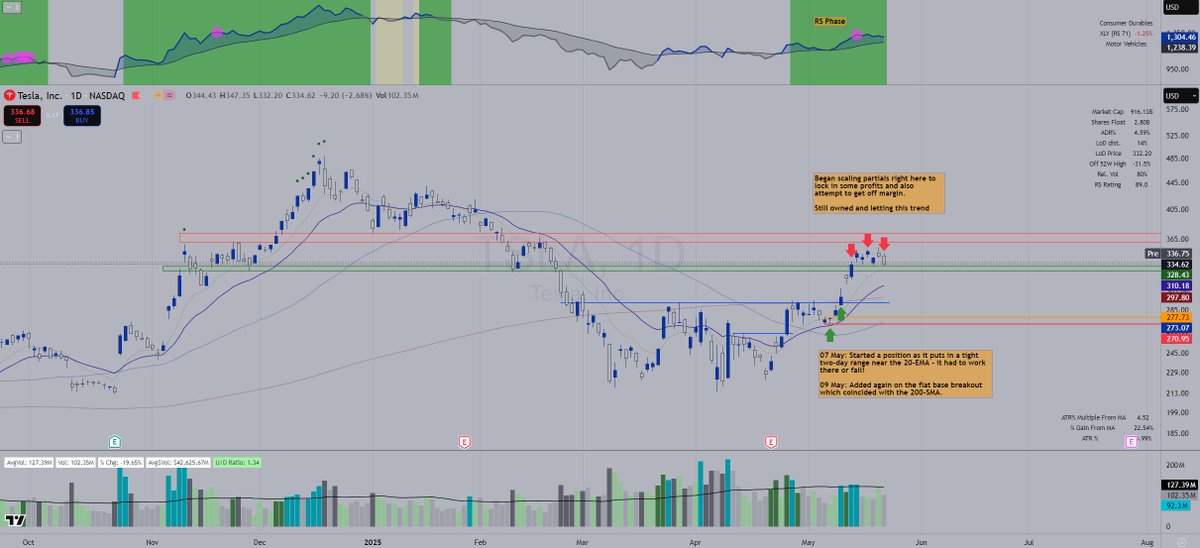
$TSLA was another nice winner that got on my radar when it reported poor earnings but did not continue making new lows. In fact, it began to show signs of bottoming out, eventually allowing for an entry at the beginning of May – I would consider this somewhat of a cheat setup as it builds out the right side of its base.
This was a pretty classic trade that worked out well and was relatively stress free to handle.
$TSLA was another nice winner that got on my radar when it reported poor earnings but did not continue making new lows. In fact, it began to show signs of bottoming out, eventually allowing for an entry at the beginning of May – I would consider this somewhat of a cheat setup as it builds out the right side of its base.
This was a pretty classic trade that worked out well and was relatively stress free to handle.
Robinhood Markets
$HOOD like $TSLA was also another classic trade, buying on the double bottom breakout and then scaling it into strength as appropriate.
$HOOD like $TSLA was also another classic trade, buying on the double bottom breakout and then scaling it into strength as appropriate.

CoreWeave
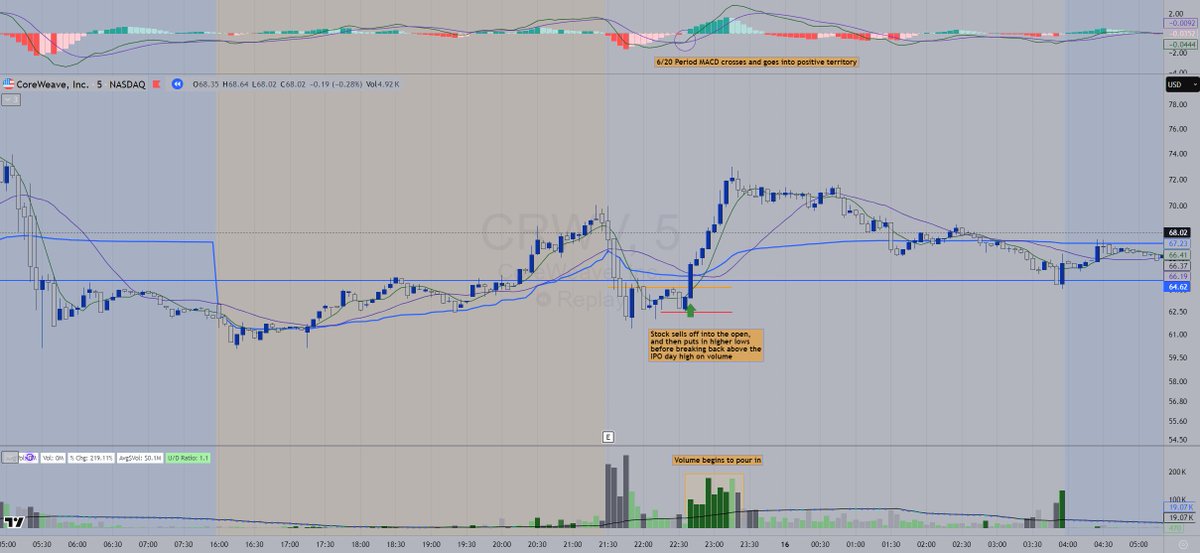
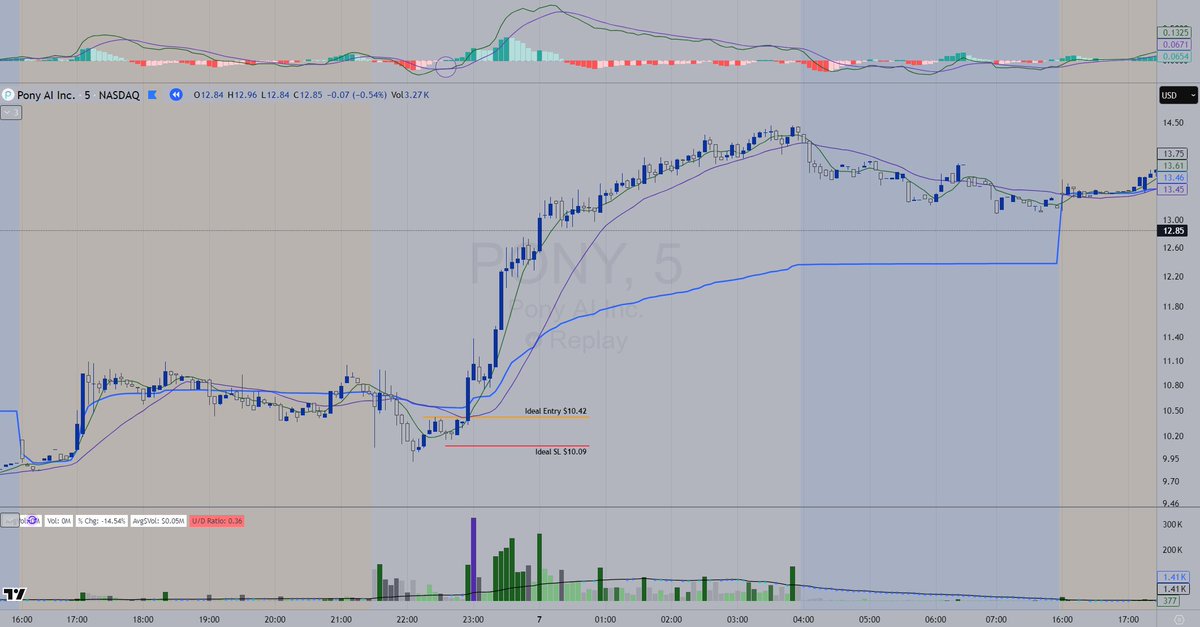
$CRWV was the ‘heater’ trade for me, and it got my attention because I noticed the fresher IPO plays working: trying $PONY (06 May) on the Uber partnership news and got stopped out, took it off my watchlist and then it proceeds to rip higher without me.
With that in mind, my attention was on this AI pureplay post earnings. Looking at the intraday chart, $CRWV proceeds to sell off right at the open, before moving sideways and ripping higher on volume. It did the exact same thing as $PONY!
$CRWV was the ‘heater’ trade for me, and it got my attention because I noticed the fresher IPO plays working: trying $PONY (06 May) on the Uber partnership news and got stopped out, took it off my watchlist and then it proceeds to rip higher without me.
With that in mind, my attention was on this AI pureplay post earnings. Looking at the intraday chart, $CRWV proceeds to sell off right at the open, before moving sideways and ripping higher on volume. It did the exact same thing as $PONY!

UnitedHealth Group
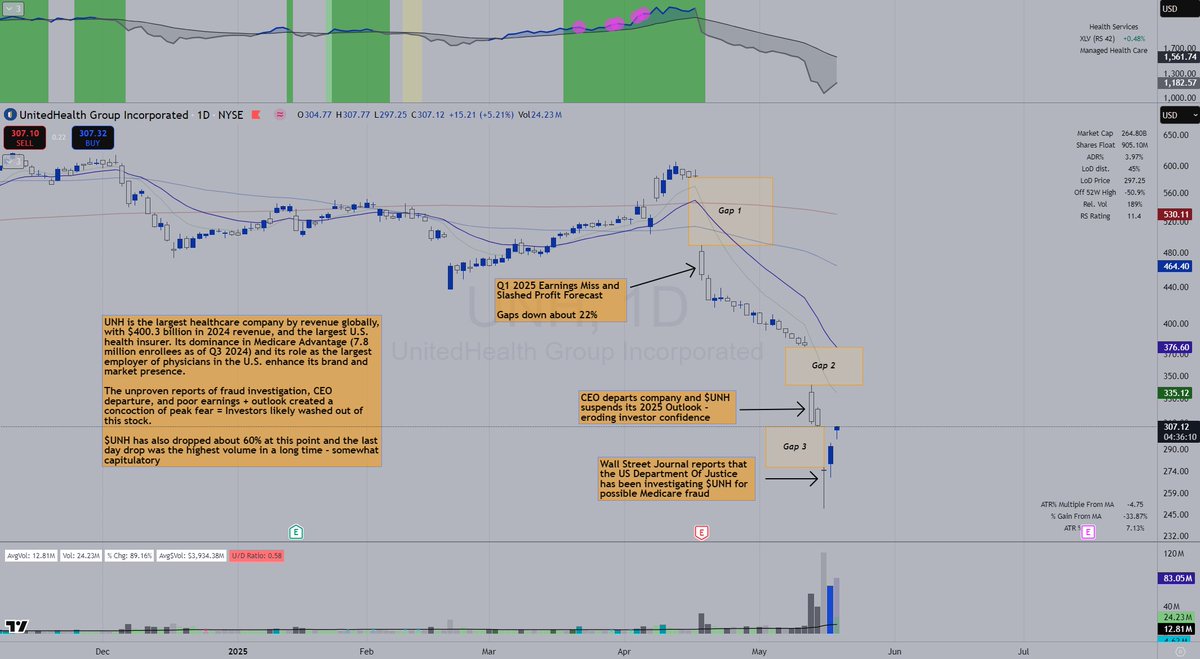
$UNH was a capitulation type setup, playing the ‘right side of the V’ concept. Prior to the capitulation style gap down, $UNH had already been the subject of multiple episodes of bad news. Things got very bad for this name as it dropped almost 60% in the span of a few weeks – that fear was what I sensed would culminate in making this a banger trade.
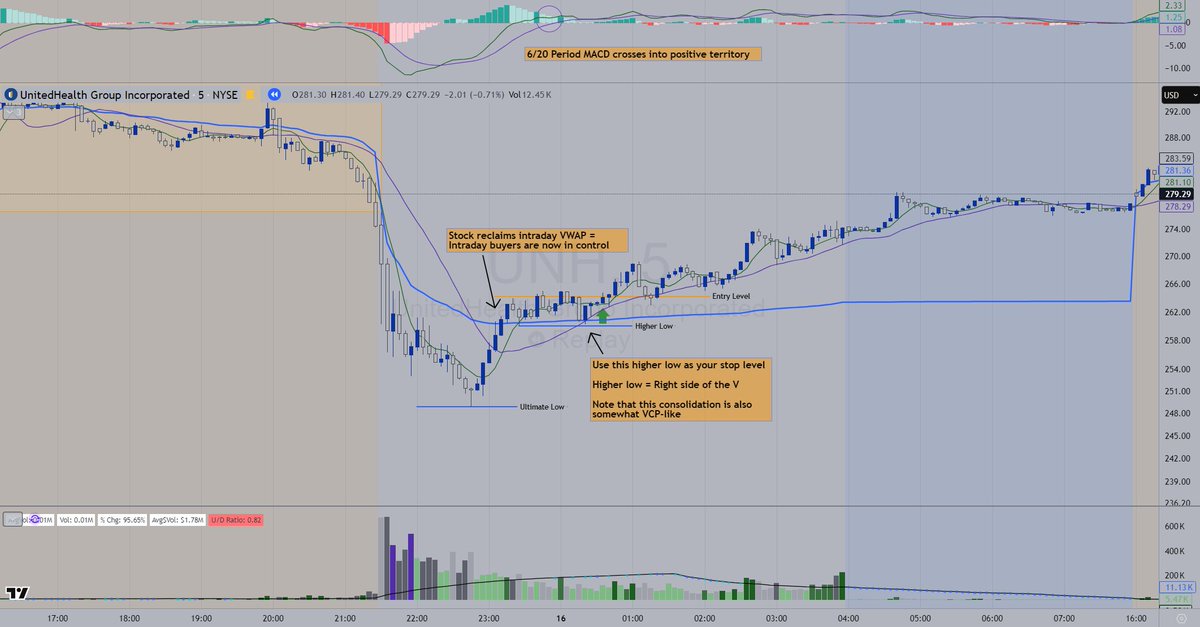
On the day that $UNH made its final gap down low, I was patiently watching it on the intraday 5-min chart to form a higher low. As it made its initial rally and tracked sideways, that was my cue to buy on the basis of: (1) The 6/20 period MACD already crossed and moving into positive territory, (2) The stock reclaiming intraday VWAP and then tracking sideways, and most importantly, (3) Looking like a VCP before breaking out of that consolidation, allowing me to define my entry and risk easily.
Another nuance, when looking at its respective sectoral ETF, the $XLV also staged an undercut and rally setup.
As the trade progressed, I slowly scaled out of my position, eventually taking the trade off as it violated the prior day’s low.
$UNH was a capitulation type setup, playing the ‘right side of the V’ concept. Prior to the capitulation style gap down, $UNH had already been the subject of multiple episodes of bad news. Things got very bad for this name as it dropped almost 60% in the span of a few weeks – that fear was what I sensed would culminate in making this a banger trade.
On the day that $UNH made its final gap down low, I was patiently watching it on the intraday 5-min chart to form a higher low. As it made its initial rally and tracked sideways, that was my cue to buy on the basis of: (1) The 6/20 period MACD already crossed and moving into positive territory, (2) The stock reclaiming intraday VWAP and then tracking sideways, and most importantly, (3) Looking like a VCP before breaking out of that consolidation, allowing me to define my entry and risk easily.
Another nuance, when looking at its respective sectoral ETF, the $XLV also staged an undercut and rally setup.
As the trade progressed, I slowly scaled out of my position, eventually taking the trade off as it violated the prior day’s low.


These few trades represented some of the bigger winners for May. To end this thread, I do have two things to say:
1. Super performance and monster returns are not exactly that glamorous.
What you don’t see is the state of intense focus/stress you will be in when chasing returns.
Being 300% long is exhausting due to the amount of attention needed to manage risk in real time while trusting your stocks and letting it run. That said, the afternoon naps, time spent with the kiddo, and copious amounts of exercise really helped! Which brings me to my next point…
2. Run your own race!
Comparison is the biggest thief of joy because we all have our own stories to live. Focus on just being a 1% better version of yourself everyday and over time you will be golden. I am literally the most ordinary person you will ever find, so if I can do it by hard work and never giving up, you most definitely can too!
Trust this was helpful! Am looking forward to keeping the momentum up for the month of June!
1. Super performance and monster returns are not exactly that glamorous.
What you don’t see is the state of intense focus/stress you will be in when chasing returns.
Being 300% long is exhausting due to the amount of attention needed to manage risk in real time while trusting your stocks and letting it run. That said, the afternoon naps, time spent with the kiddo, and copious amounts of exercise really helped! Which brings me to my next point…
2. Run your own race!
Comparison is the biggest thief of joy because we all have our own stories to live. Focus on just being a 1% better version of yourself everyday and over time you will be golden. I am literally the most ordinary person you will ever find, so if I can do it by hard work and never giving up, you most definitely can too!
Trust this was helpful! Am looking forward to keeping the momentum up for the month of June!
• • •
Missing some Tweet in this thread? You can try to
force a refresh