1/ Updated racial ingroup vs. outgroup feeling thermometer differentials from the ANES. In sum, while the 'curve has flattened', the attitudinal effects of the Great Awokening persist (at least wrt race). If you thought or hoped otherwise, sorry to disappoint.
2/ Average of all 3 differentials by race/ideological self-placement
3/ Averages for whites across the complete 7-point ideology scale
4/ One trend that *may* have decreased (at least somewhat), though, is the share of white liberals giving anti-white feeling thermometer scores (i.e., rating white people in the cool/negative region of the scale, and rating all other minority groups in the warm/positive region).
5/Trends in stereotype differentials shown the same pattern as those in feeling thermometers, with white liberals continuing to rate blacks as more peaceful and hardworking than whites
6/Same with white support for affirmative action. No decreases.
7/Someone pointed out (thanks again!) that I mislabeled Asians as Hispanics in the first chart. Here's a correction version.
8/ Only very modest/insignificant decreases in the share of whites who 'disagree' that "blacks should work their way up without special favors"
9/9 I'll stop here, as I don't want to give away too much of my upcoming presentation (though now you at least know the answer to the question in the title) ;p
• • •
Missing some Tweet in this thread? You can try to
force a refresh

Do Americans broadly oppose military action against Iran?
Recent polling suggests they do. A Reuters/Ipsos survey conducted May 15–18 found that 61% of Americans disapproved of U.S. military strikes against Iran, while 52% said the military action was not worth it.
But generic approval questions may not tell the whole story.
2/10
Our latest @fsuigc survey of 1,059 American adults (also conducted by Ipsos, May 19–28) approached the issue differently.
Instead of asking simply whether military action was “worth it,” we examined how Americans think about the tradeoffs involved—including the perceived threat posed by Iran, the prospects for diplomacy, and the costs people are willing to bear to prevent Iran from obtaining nuclear weapons.
The results paint a considerably more nuanced picture.
A short thread: 👇
3/10
First, baseline attitudes are hawkish on the Iranian nuclear threat itself:
58% of Americans—including 72% of Republicans and 46% of Democrats— say a nuclear-armed Iran would be a Very or Extremely serious long-term threat to the U.S. and its allies.
Only 12% say it’s “not too serious” or “not at all serious.”
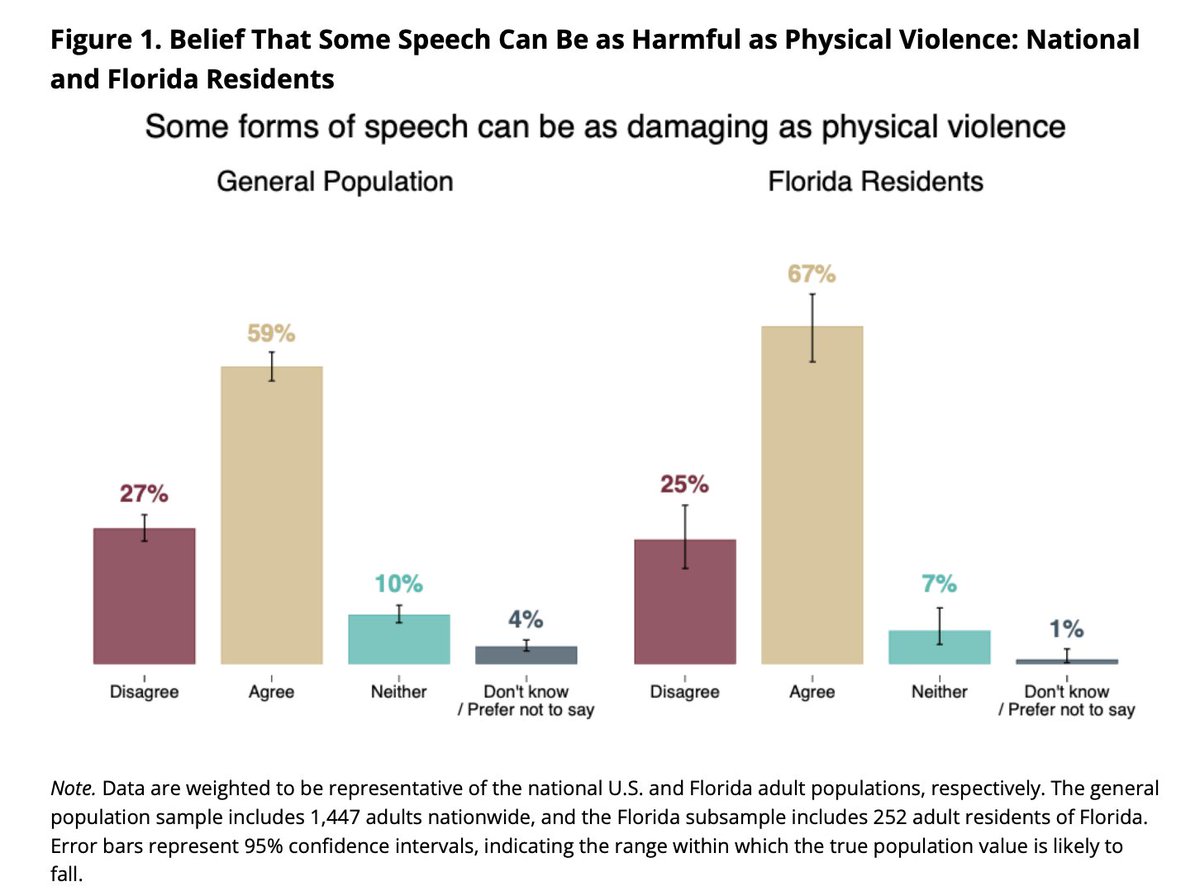
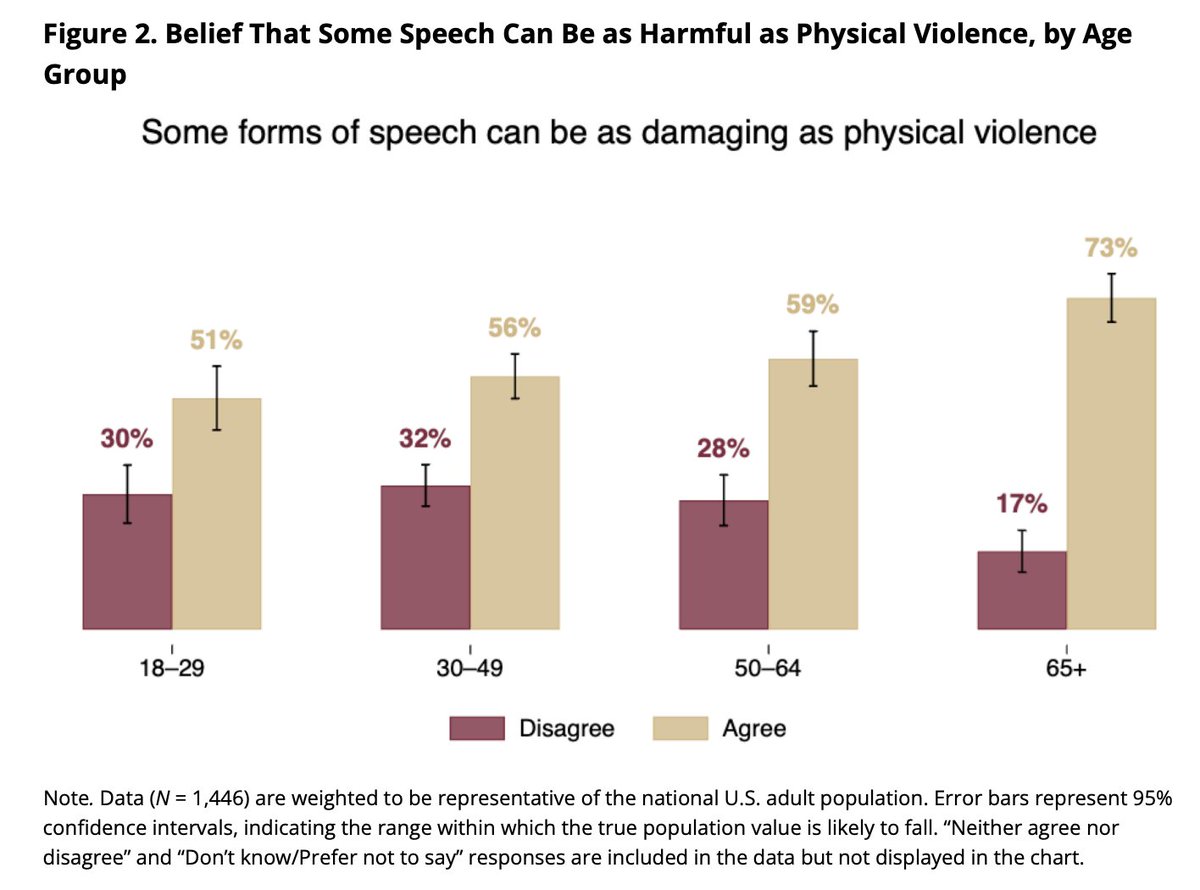
1/Thrilled to share @fsuigc’s latest report, based on a national survey of 1,447 U.S. adults we conducted in late September—one week after the assassination of Charlie Kirk.
We examine how Americans think about harmful speech and whether physical violence can ever be justified to stop its public expression.
1/ I'm delighted to finally share some of the work I've done since joining @fsuigc.
Last month, we published a report about political tolerance based on national survey data (N=1,004) we collected during the summer. In this study, we measure political tolerance as the willingness to interact with or accept people with opposing political views across different relational contexts. For comparison, we also measured tolerance towards ex-felons and flat earthers.
2/ As shown in the table below, across all contexts, people are much more willing to engage with people with opposing political views than the other two target groups. Regardless of the target group, though, openness tends to decline as the intimacy of an engagement increases. For instance, whereas 73% would engage in a social/recreational activity with political opponents (ex-Felon: 54%, flat-earther: 49%) without reservation, just 41% would be willing to date them (ex-Felon: 22%, flat-earther: 19%)
3/Consistent with this intimacy 'gradient', our analysis finds that our 7 tolerance items best fit a 3-factor structure, which is depicted in the table below.
2/ In fact, coverage linking Israel to “genocide” now exceeds that of every actual or widely recognized genocide of the last 40 years, including:
Rwanda (1994)
Darfur (2003–2008)
Bosnia (Srebrenica, 1995)
Myanmar (Rohingya, 2017–Present)
Yazidis (ISIS, 2014–2017)
3/ In The New York Times, for example, the spike in 2023–2024 mentions of “genocide” alongside “Israel” is more than 9x larger than the peak for Rwanda in the mid-1990s and nearly 6x the peak for the more recent Darfur genocide.
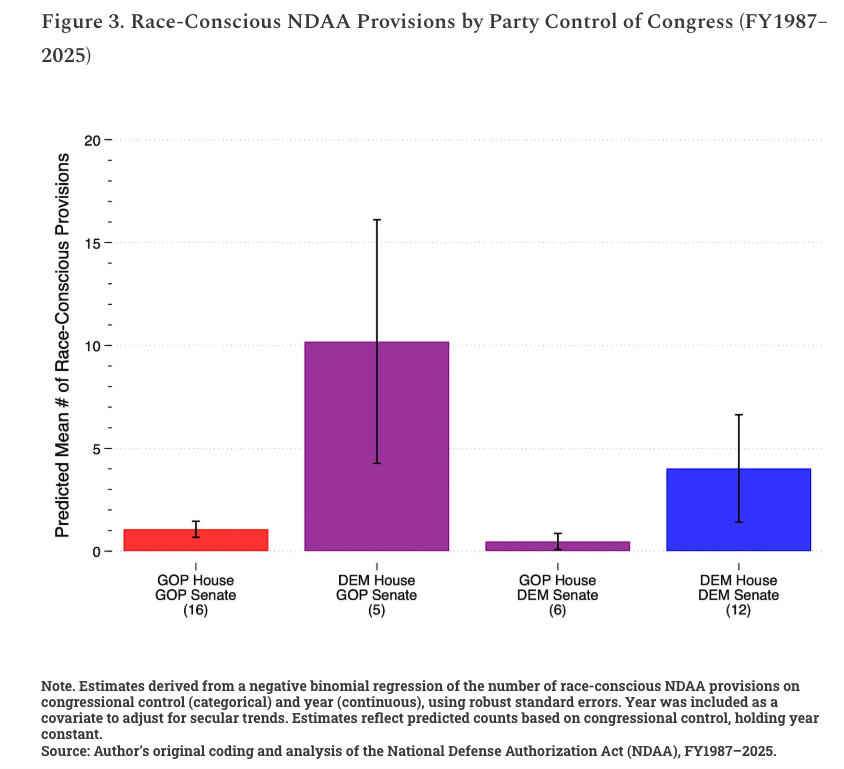
1/ One of the more counterintuitive findings in my latest article:
Historically, when Democrats only control the House, an average of just over 10 race-conscious provisions are added to the NDAA per year.
When they control both the House and Senate? That number drops to about 4.
But why?
2/ First, what makes the House so powerful here?
Simple: the House Armed Services Committee (HASC) writes the first draft of the NDAA.
If you control the House, you control the blueprint—and the early language that often survives reconciliation. That’s where ideological riders get embedded.
3/But why are more race-conscious provisions added under divided government?
While I can’t say for sure, my reasoning is this: when Democrats only control the House, the NDAA becomes one of the few legislative vehicles guaranteed to pass.
Standalone race-conscious or DEI bills are less likely to survive the Senate.
🚨1/ Just released what may be my most significant project to date:
The first in-depth, data-driven account of how racial preferences actually operated at a U.S. service academy (the U.S. Naval Academy)—and the recent federal court case that challenged them (and lost).
Published on my Substack, the report draws on thousands of pages of filings, depositions, internal admissions data, and expert reports from Students for Fair Admissions v. USNA—a case that flew under the radar, despite its profound constitutional and institutional stakes.
2/ The full report runs ~115 pages—so there’s a lot to unpack. Too much for a single thread.
Thus, over the coming days, I’ll be posting a series of threads, each walking through key sections.
Note that these threads are high-level summaries—many important details are left out. I strongly encourage reading the full report for the complete picture.
Here’s the outline for this series of threads:
Thread 1 (this one): What the internal data reveal about USNA’s use of race—and how the Academy tried (and failed) to discredit the revelations.
Thread 2: The government’s sweeping (and evidence-free) justification for race-based admissions—and why it collapses under scrutiny.
Thread 3: How a federal judge upheld the policy—and why his ruling still matters, even after Trump’s executive order rescinded the policy.
Thread 4: What can be done to permanently outlaw race-based admissions at the service academies—or at least make it far harder for future administrations to reinstate them.
3/ Thread #1: What the Data Reveal
Like Harvard, USNA didn’t deny using race in admissions. It simply described it as “limited” and non-determinative.
At the same time, USNA admitted it never even attempted to measure race’s impact on outcomes—begging the question: how can it call race a “limited” factor if it never quantified its effect?