The fake "mismatched" "gender identity" narrative has caused a mental health social contagion amongst adolescent girls, which is now resulting in thousands of double mastectomies; an atrocity. The medical profession need to tell the truth about autogynephilia. 🧵/24 

The narrative targeted at the public and children is that there are a class of "trans" people, even children, who have some internal "essence" or "gender identity" that has "mismatched". This is also the premise that the medical profession is using to prescribe treatments. 2/24
This isn't the truth about what the DSM says about "gender dysphoria", where the concept is first defined. Women and girls never used to be greatly represented as having "gender identity" disorder. Boys outnumbered girls 5:1. Men 2 or 3 times to 1. 3/24

"Gender dysphoria" in the DSM is related to atypical sexual orientation/sexuality. "Early-onset gender dysphoria" mostly desists at puberty and is related to nascent homosexuality, "late-onset gender dysphoria" begins at puberty and in males is related to "autogynephilia". 4/24



The two types of gender dysphoria in the DSM-5 correspond to Dr. Blanchard's research that male "gender dysphoria" was connected to atypical sexual orientation, being either homosexuality, or autogynephilia. Blanchard served on the DSM-4 for "gender identity disorders". 5/24

Autogynephilia is an inexplicable male paraphilia, which is defined as a male's "propensity to be sexually aroused by the thought of himself as a female". Autogynephilia clusters with specific other paraphiia, as Blanchard observed: 6/24
"Some paraphilias definitely cluster: autogynephilia and masochism, for example, and autogynephilia, masochism and what we might call “stuff fetishism”: fetishism for particular materials, like leather, silk, rubber… it’s not completely at random…" 7/24
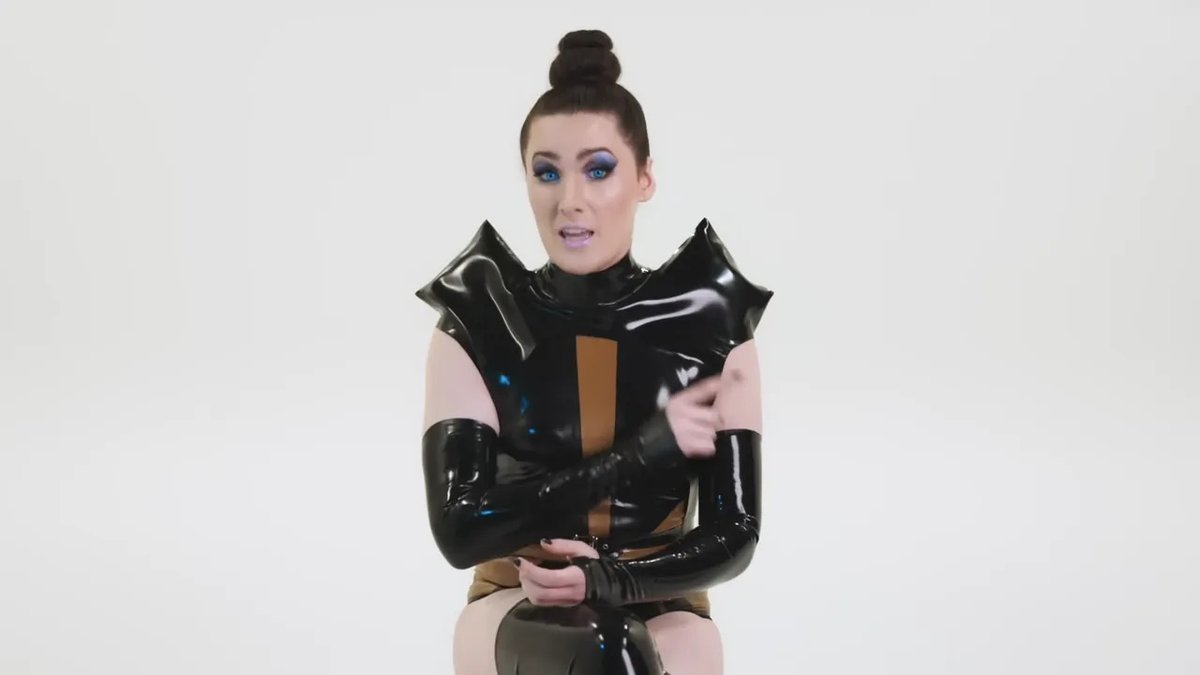
This makes autogynephilia easy to recognise. An apparent example of this "clustering" would be Abigail in the article "I came out as trans and made headlines", as Abigail has a preference for wearing rubber, which he does so on his YouTube channel. 8/24 bbc.co.uk/news/av/uk-566…
Another example of "stuff fetishism" is the often reported fascination with hosiery, "I had developed an intense fascination with like stockings and hosiery and ...due to the the texture…", "... wearing a tight black jumper and black tights… Adrenaline overwhelmed me”. 9/24
This is also reported in the following article: "At secondary school, she would wear tights under her school trousers, enjoying how they felt against her skin." 10/25theguardian.com/games/2021/apr…
In the same article, the Guardian naively report "stuff fetishism" as "gender euphoria", "She took out a silky nightgown and shrugged it on, feeling the instant, giddy rush of something she would later learn to call "gender euphoria"". 11/24
Dr. Upton shares the same preference for wearing hosiery and also appears to follow the DSM-5 pathway of "late-onset gender dysphoria" with autogynephilia; he is married, and is otherwise heterosexual. 12/24 dailymail.co.uk/news/article-1…

Blanchard noted that while "late-onset gender dysphoria" has its root in a paraphilia, is was not solely a sexual phenomenon; autogynephilia evidently has a great impact on personal identity development: 13/24
"... the concept of autogynephilia does not imply that autogynephilic males are always sexually aroused by the thought of themselves as women, or by dressing in women’s clothes..." 14/24
"...any more than a man in love always obtains an erection at the sight of his sweetheart, or pair-bonded geese copulate continuously." 15/24
Another feature that makes autogynephilia easy to recognise is "pseudo" bisexuality. This is not "true bisexuality", in the sense of being attracted to both men and women, but rather a male with autogynephilia may use men as a "prop" for the conceit of "being a woman". 16/24
As Blanchard writes: "In their fantasies of sexual interaction with men, bisexual gender dysphorics are primarily aroused by what is, for them, the symbolic meaning of such acts, namely, the thought that they themselves are women". 17/24
This is again apparently observable in the media: "Alice began dressing as a girl routinely, spoke openly about her bisexuality, and included her parents in the decision-making process to change her name after 17 years of living with a boy’s name". 18/24thetimes.com/uk/society/art…
The Cass Review should have covered autogynephilia in 2024, and should have recommended stopping the "mismatched" "gender identity" narrative being targeted at children, as it is obviously not the truth about this issue, and is causing a mental health social contagion. 19/24
A Freedom of Information request shows that the Cass Review received "lived experiences" about autogynephilia, marked "strictly confidentially", "where relevant anonymously", "not to be shared". It appears that autogynephilia was covered up. 20/24whatdotheyknow.com/request/inform…
This was done, perhaps, so that all the children still taking puberty blockers can be shifted from being clinical negligence claimants, to being "clinical trial candidates". The "trial" is open to all attending a "gender service", with an unprecedented no limit to places. 21/24

This would appear to be an unforgivable cover-up, as the NHS is still performing thousands of double mastectomies on women who have no supposed underlying medical indication of "gender dysphoria". 22/24dailymail.co.uk/news/article-1…
Surgeries that started with men with autogynephilia e.g. most likely Lili Elbe (1882-1931), are being performed on young women in great number. What the NHS is doing to young women, and many young men, is an atrocity. 23/24

I've raised this issue many, many, times with them privately. You need to stop these surgeries and the medical profession needs to tell the truth about autogynephilia. @wesstreeting @DHSCgovuk @NHSEngland Read more:
24/24 transpolicy.substack.com/p/objection-to…
24/24 transpolicy.substack.com/p/objection-to…
• • •
Missing some Tweet in this thread? You can try to
force a refresh