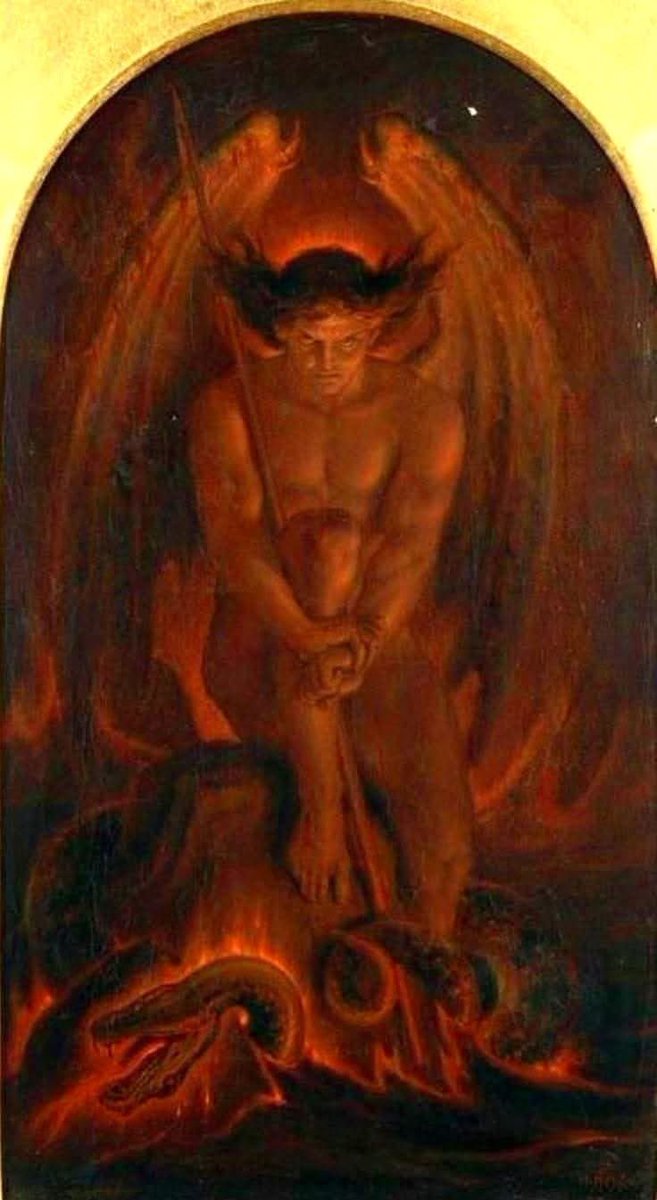
SAINTS WHO SAW HELL🔥
Witnesses to Eternal Justice 🧵
Throughout history, some saints have been granted visions of hell, serving as stark reminders of the consequences of unrepented sin & the reality of eternal separation from God.
These visions were not meant to inspire despair but to call humanity to conversion & deeper trust in God's mercy.
Below is a list of saints who witnessed hell & the profound lessons we can draw from their experiences.
1. ST. JOHN THE APOSTLE (1st Century)
Visionary of Revelation
In the Book of Revelation, St. John described visions of the final judgment, including the "lake of fire" where the unrepentant & Satan's followers are condemned (Revelation 20:10-15).
This apocalyptic imagery vividly portrays the eternal consequences of rejecting God.
John's vision serves as a warning about the urgency of repentance and fidelity to God.
2. ST. TERESA OF ÁVILA (1515–1582)
The Mystic Who Saw Hell’s Torments
St. Teresa of Ávila experienced a vision of hell during prayer.
She described being placed in a narrow pit, suffocating from the foul air & feeling indescribable terror & despair.
The vision was so intense that she said, “It is impossible to describe... I felt my soul being torn apart.”
This experience deepened her resolve to live a holy life & led her to reform the Carmelite Order to help save souls from such a fate.
3. ST. FAUSTINA KOWALSKA (1905–1938)
The Apostle of Divine Mercy’s Vision of Hell
In her diary, Divine Mercy in My Soul, St. Faustina wrote about being shown hell by an angel.
She described it as a place of great suffering, fire & eternal darkness.
She noted different levels of torment for souls based on their sins, with the greatest suffering being the loss of God.
Her vision inspired her mission to spread the message of Divine Mercy, urging sinners to repent & trust in God’s forgiveness.
4. ST. CATHERINE OF SIENA (1347–1380)
The Doctor of the Church Who Witnessed Hell’s Justice
St. Catherine of Siena was granted a vision of hell as part of her mystical experiences.
She described the intense suffering of souls who had rejected God’s love & emphasized the self-inflicted nature of their torment.
Her vision drove her to intercede fervently for sinners & to call for repentance in her writings & preaching.
5. ST. JOHN BOSCO (1815–1888)
The Educator’s Dream of Hell
St. John Bosco, renowned for his prophetic dreams, had a vision of hell while praying for the salvation of young souls.
He saw a vast, fiery chasm filled with lost souls & heard their cries of despair.
Many of these were youth who had died in sin, which deeply saddened him.
This vision motivated him to guide young people toward virtue & holiness, emphasizing confession & avoiding occasions of sin.
6. ST. PADRE PIO (1887–1968)
The Stigmatist’s Encounters with Hell
St. Padre Pio often spoke of his vivid spiritual experiences, including seeing hell.
He described the demons tormenting souls who had chosen to reject God’s mercy.
His accounts were detailed & focused on the anguish of separation from God.
These experiences fueled his ministry of hearing confessions & leading souls back to God through penance & prayer.
7. BLESSED ANNE CATHERINE EMMERICH (1774–1824)
The Visionary of the Passion
Blessed Anne Catherine Emmerich, a mystic & stigmatist, described visions of hell in her writings.
She saw souls being tormented by their sins & vividly portrayed the justice of God’s punishment for the unrepentant.
Her visions underscored the gravity of sin & the importance of repentance, inspiring readers to turn to Christ for salvation.
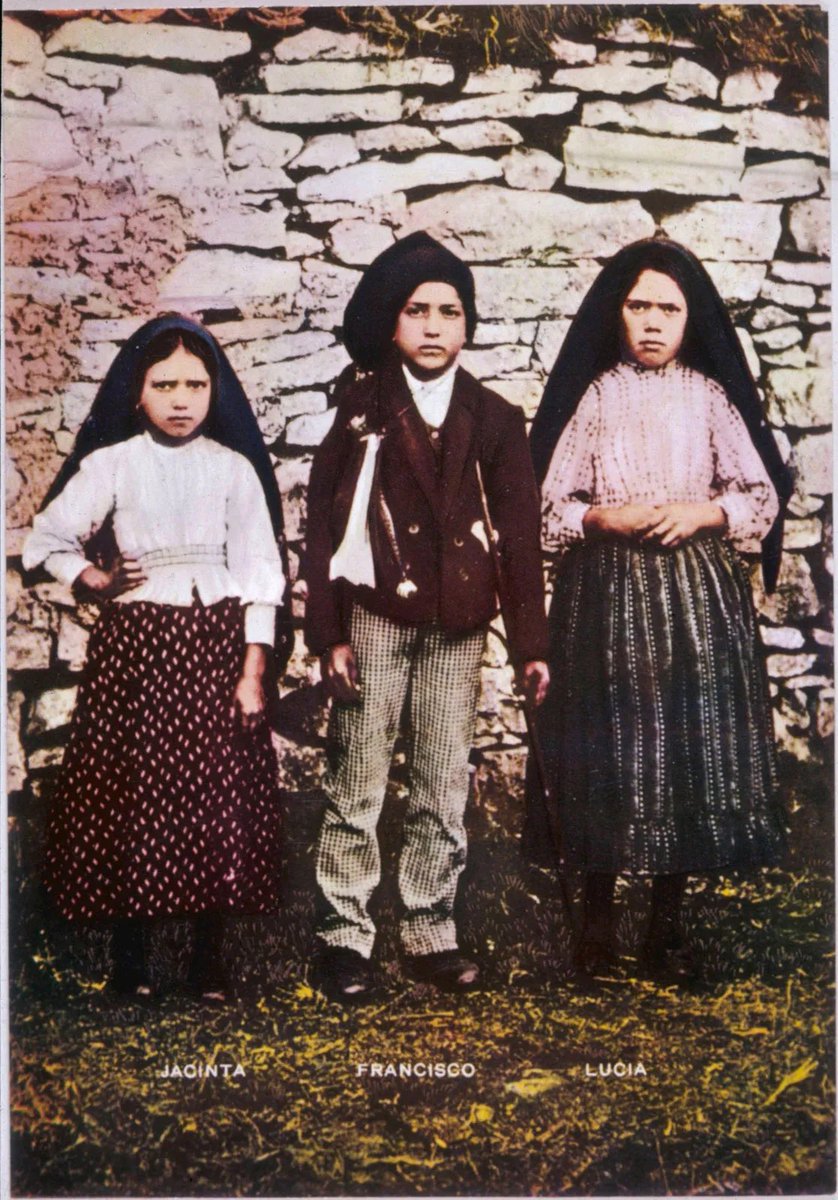
8. THE CHILDREN OF FATIMA (1917)
The Visionaries Who Saw Hell
During the apparitions of Our Lady at Fatima, Lucia, Jacinta & Francisco were shown a terrifying vision of hell.
They saw a vast sea of fire filled with demons & tormented souls. Our Lady told them, “You have seen hell where the souls of poor sinners go.”
This vision deeply impacted the children, particularly Jacinta, who offered many sacrifices for the conversion of sinners.
The message of Fatima continues to inspire prayer, penance & devotion to the Immaculate Heart of Mary.
9. ST. ALPHONSUS LIGUORI (1696–1787)
The Moral Theologian’s Teachings on Hell
While not a visionary in the same sense as others, St. Alphonsus wrote extensively about the reality of hell, drawing from his deep meditation & study of Scripture.
He described it as a place of eternal loss & suffering, urging his readers to avoid sin at all costs.
His writings remain a cornerstone of Catholic moral teaching, emphasizing the consequences of rejecting God’s grace.
10. ST. MARGARET MARY ALACOQUE (1647–1690)
The Devotee of the Sacred Heart
St. Margaret Mary, known for her revelations of the Sacred Heart of Jesus, was shown souls in hell who had rejected God’s mercy.
She described their anguish & urged devotion to the Sacred Heart as a remedy for sin.
Her vision reinforced the need for trust in God’s mercy & reparative acts of love for sinners.
LESSONS FROM THE SAINTS’ VISIONS OF HELL
1. The Reality of Hell:
The saints’
experiences confirm hell as a real and eternal separation from God for those who die in unrepented sin.
2. The Call to Conversion:
Visions of hell emphasize the urgency of repentance, prayer, and penance to avoid eternal punishment.
3. God’s Justice and Mercy:
While these visions highlight divine justice, they also point to God’s infinite mercy, always available to those who seek it.
4. A Call to Action:
These saints dedicated their lives to saving souls through prayer, preaching, and sacrificial love, urging others to do the same.
The saints who saw hell remind us of the stakes of our earthly choices and the eternal consequences of sin.
Their experiences serve as wake-up calls, urging us to embrace God’s mercy, live holy lives, and intercede for the salvation of others.
May their witness inspire us to strive for heaven and avoid the path that leads to eternal separation from God.
• • •
Missing some Tweet in this thread? You can try to
force a refresh

The late Fr. Pellegrino Maria Ernetti (1925-1994) shared the following in his book entitled:
‘The likes and dislikes of the Devil’
He was one of the more notable Exorcists of the Diocese of Rome who has written few books.
The diabolical catechesis here is collected from the words and arguments during the exorcism sessions that Fr. Pellegrino Maria Ernetti had in the presence of collaborators and registered in magnetic tapes.
WHAT PLEASES THE DEVIL MOST (DEVIL IS SPEAKING):
1) The Host in the hand - thus I can trample over your God, that God whom I have killed; and I can celebrate my masses (black masses) with my priests snatched from Him...
2) The Priest camouflaged. Thus I bring them where I want, in hotels and private homes looking for women and homosexuals, and have them to commit sacrileges, then I bring them to my kingdom where they will never escape from me (Loud laughters)
3) Priests and Bishops belonging to Freemasonry and to my Sects. Oh how many I bring to hell by means of money and women...How many become my faithful friends with money and women...I take as many of them as I wish, I bring them to my kingdom.
4) Short Skirts -- with which I catch men and women and I fill up my kingdom (long laughters, roaring with laughters). How happy I am...What a joy...How happy...!
5) Television...Well, television...It is my instrument, I have invented it to destroy the individual souls and families...I divide them, It breaks them up with my programs, subtle and penetrating...Oh, television is the center of attraction to which I attract also many priests, friars, sisters, especially in the small hours and then I make them cease to pray: hahahahahah...In a moment, I present myself to the whole world...They listen to me and they see me...My faithful servants help me very well, the magicians, the witches, the cartomants, the chiromants, the astrologers....Hahahaha
6) The Disco Clubs…What a nice thing…they are my golden palaces where I attract the best hopes of society, whom I make mine, destroying their souls and their bodies…How many thousands and thousands I bring with me with alcohol, with drugs, and with sex…Oh what a continuous harvest… I have rented them to many politicians, my faithful servants, to people consecrated…I am the true king of the world, and not your God, whom I have crucified.
7) Divorce…The separation of spouses, it was invented by me; I claim the ownership…It is one of my most intelligent discoveries…Thus I destroy the family and destroy society, where I am adored as true king of the world…Sex…Sex….Do not listen to that man hanging on the cross who gives you nothing…My kingdom is above all liberty of sensual pleasure, with which I reign on earth.
8) Abortion…The killing of innocents, what a masterful discovery! To kill the innocent instead of the guilty ones and the homicides of the Mafia! I destroy humanity and thus they end before birth, the worshippers of your false God…Hurrah!...
9) Drugs…It is the most tasteful food which I give to the young to eat thus reducing them to madness…Thus I do to them what pleases me…robbers…murderers…lustful, ferocious like me…Rulers of the world…My ministers…
+++++++++++++++++++++++++
10) Above all I like those Bishops and Priests who give me joy…who deny my real existence and my work in the world…and they are many…Oh what a joy…what a joy for me…I work peacefully and sure…Even the theologians today do not believe in my existence…How beautiful! What a joy! And thus they deny also that God who had come to destroy me…Instead I have won…I nailed Him on the Cross…Hahahaha! Good, these priests…Most wonderful these bishops…The best these theologians…They are all my little servants…I do with them what I want…Hahaha…! They are already mine…I bring them where I wish…Dressed like sextons…With the cigarette always in their mouth…Perfumed like dandies…Looking for easy women…With a car the last model…Full of money…They rebel against the dogmas of their false God…and of the false Church of that crucified, my victim…They are most faithful soldiers of my kingdom, full, of them…With them I spread confusion and mystify my people, whom I draw farther away from the false God…And I bring my kingdom of hatred and eternal despair…For ever with me, with me…Hahahaha!
How many of them I had listed in my sects…Encouraged by my career and by my money…I buy them easily…Because finally I managed to make them not love their God, nor that Woman (Mary) who pretends to have defeated me…”
11) The Politicians who declare themselves Christians, and yet they are not Christians because they are mine and at my service…Presenting themselves as Christians they manage to deceive many persons who follow them to where I cunningly lead them…They come with me to steal cheerfully the money of people…Money which is the fruit of effort and tears, for work done in suffering; money taken from poor families with unjust taxes, imposed by these politicians who fatten themselves, waste, spend and squander without restraint.
And yet I have them to make declarations of uprightness, of honesty, of goodness, of loyalty, of Christian sincerity to deceive even the priests and bishops with them…Money is my most efficacious weapon; priests and bishops close their eyes on these politicians, my servants and slaves…It is enough that they find money to build or restore churches, homes for orphans, beautiful and comfortable parochial houses…They are my most faithful sacristans, through whom I can penetrate in the houses of the clergy, obedient to my money…Are not these politicians who signed the approval of adultery, divorce and abortion? Yet the clergy…offer them the propaganda I desire…(laughter) (2/7)
12) The Politicians who call themselves secular are the forerunners of my kingdom…The lies masterly studied, the abuse of power diligently executed, the robbery in Mafia style, the maneuvers diplomatically done, the immorality diffused by means of press and mass media, the homicides, the kidnapping organized and executed under the threat of weapon, the spreading of different drugs through the most rigid conspiracy of silence, and many, many other crimes and social disorders.
These are all the works I execute through these politicians, my followers and most faithful servants…They have from me the special mandate to use all kind of means and the most devilish ways to destroy society; unfortunately, still linked to that Crucified whom I have hanged from the infamous wood…Destroy, destroy…!These politicians are my disciples and beloved followers because they are most obedient to my wish, unaware of it…They are those who organize the most active and underhand free mason lodges in every city and town, the most deceitful and daring, always offering money, careers and pleasures…They are those who receive my precise orders to penetrate and destroy the Church from within…continue to fall at the proposals and enticement of money and careers…My main ideal and project is to destroy the Church. Oh how happy…how happy! With these my most faithful politicians I have already started to destroy society at every level and in all environment, undermining the orders of public security, of economy, of diplomacy, of social relationships…Obviously always with my weapons of ambition, career, money, women, pleasures…Oh how happy! What a joy! What a victory! (Hahahaha…vulgar laughters)
13) I like in a particular manner the Judges and Magistrates who bear on their shoulder the motto “JUSTICE IS EQUAL FOR ALL” except for themselves! How good are these friends, how faithful these my slaves of justice! At long last I was able to politicize also the judges! Finally, I was able to buy them with money and under-table envelopes! How many innocent people I managed to have condemned for years and years…While my followers, considered murderers and rogues I see to it that they are absolved…I make them leave prison because they have to continue to expand my kingdom of disorder, homicides, robbery, drug pushing, kidnapping of persons and of children…What a marvel are these my politicized politicians. I have such an influence on them as to make them no longer recognize what is right from what is wrong…! They are today my specialized assault-unit against justice! What a marvel to be able to free from prison the Mafiosi and leave in jail the poor who are more or less innocent! How nice to set free the false repented with whom I act with more security! How nice to send to house-arrest those with whom I can better organize the destruction of society! Good, very good…Lost judges! And how many, how many pass over to my reign everyday, attracted by money and by career and by pride, my weapons…Loved and desired by them…(Long laughter…)! And those judges who do not want to surrender to me….I make them disappear…
And what is the never ending fighting among magistrates, if not the fruit of my presence and of my constant and insistent work? And what is the continuous fight among magistrates and politicians and the peace forces, if not the effect of the poison that I am able to constantly inject among them? (Laughter…) It is finished…It is the end…It is the end of the fictitious peace permitted by that clown-God, whom I have overcome and crucified…It is the end, the whole world is with me…I am already the king of the world…I am…! (3/7)
SAINT FRANCIS OF ASSISI CONVERTS VICIOUS MURDERERS🇻🇦 🧵 (1/4)
Taken From the Book The Little Flowers of St. Francis by W. Heywood
As St Francis went one day through the desert of Borgo di San Sepolcro, and was passing by a castle called Monte Casale, he saw a young man of noble mien, and elegant in appearance, coming towards him, who thus addressed him: "Father, I would willingly be one of thy monks." St Francis answered: "My son, thou art young, noble, and delicate; perhaps thou wouldst not be able to endure poverty and hardships."
The young man said again: "Father, are you not men, like me? If you, then, can support these things, through the grace of God I shall be able to do so likewise."
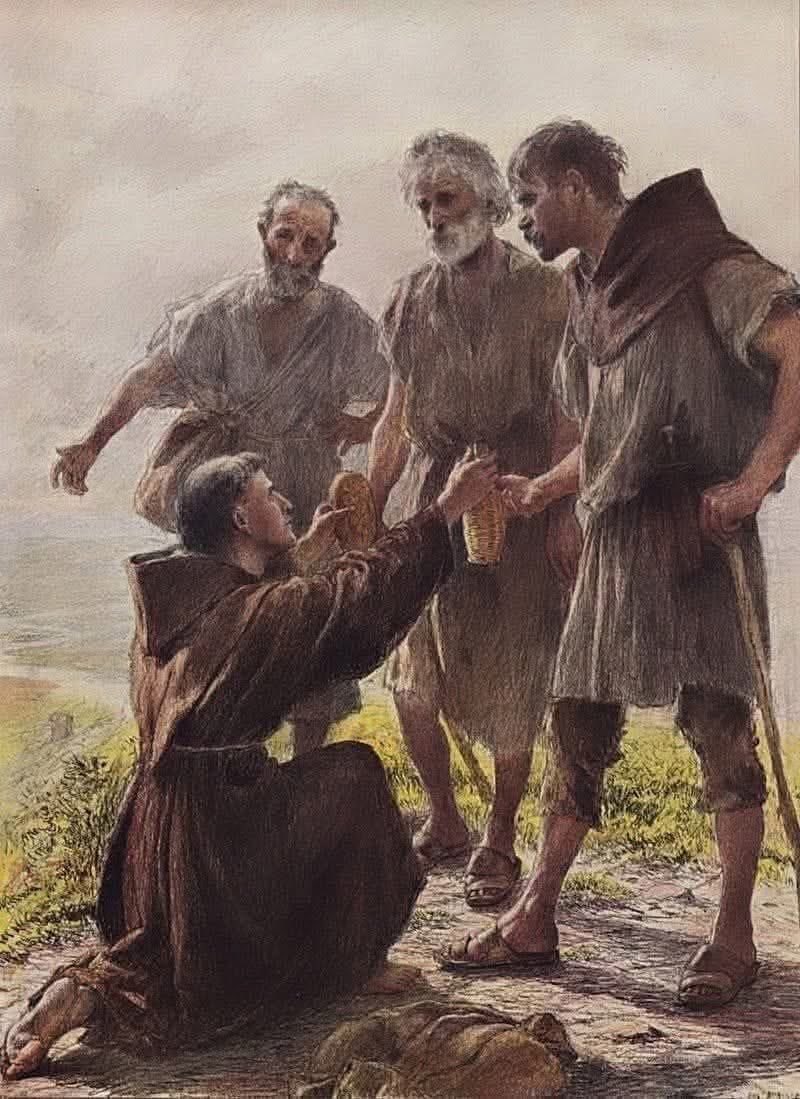
This answer greatly pleased St Francis, and giving the young man his blessing, he received him immediately into the Order, and gave him the name of Brother Angelo. And this young man was so remarkable and so distinguished, that shortly after he was named Guardian of the Convent of Monte Casale. At that time there were three famous robbers in that part of the country, who did much evil in all the neighbourhood. Coming one day to the said convent, they asked Brother Angelo, the guardian, to give them something to eat. The guardian, reproving them harshly, answered thus: "Cruel robbers and murderers, you are not ashamed to deprive others of the fruits of their labours, and you have the audacity to come here and devour that which is given in charity to the servants of God - you who are not worthy of the earth which bears you, for you neither respect man nor the Lord who made you. Go about your business, and do not appear here again." Then the robbers went away in anger, much troubled by these words.
Shortly after, St Francis arrived at the convent with a sack of bread and a little vessel of wine, which he and his companion had begged; and the guardian related to him how he had sent away the robbers. On this St Francis reproved him sharply, saying that he had behaved most cruelly, for sinners are brought back to God more easily by kindness than by harsh words.
"Wherefore," said he, "our Master Jesus Christ, whose Word we have promised to observe, says that the whole need not a physician, but they that are sick, and that he came not to call the just, but sinners, to repentance; for which reason he often sat down to meat with them. As, then, thou hast acted against charity, and against the Gospel of Christ, I command thee, in the name of holy obedience, to take with thee this sack of bread, which I have begged, and this little vessel of wine, and go after the robbers, over the hills and across the valleys, until thou meet with them. And when thou hast found them, give them from me this bread and wine; and then, kneeling down before them, thou shalt humbly confess thy fault, begging them, in my name, not to do evil any more, but to fear God and never again offend him. If they consent to this, I promise to provide for all their wants, and to give them continually both meat and drink; and when thou hast told them this, thou shalt humbly come back here." Whilst the guardian went on the errand of St Francis, the latter began to pray, asking God to touch the hearts of the robbers and bring them to repentance. The obedient guardian, having found out their retreat, presented to them the bread and wine, and said and did what St Francis had commanded; and it pleased God that as the robbers ate the bread of charity which St Francis had sent them, they reasoned thus among themselves;
"Alas for us, miserable men that we are! What pains await us in hell; for not only have we robbed, beaten and wounded our neighbours, but we have likewise taken away their lives, and yet for all these cruel deeds we feel no remorse of conscience, and no fear of God! and behold this holy friar who is come to us, for a few unkind words, which we merited most justly, has humbly confessed that he was wrong, and has brought us likewise bread and wine, with a most gracious promise from the holy St Francis. These men indeed are holy religious of God who merit his Paradise, and we are sons of perdition, worthy of the pains of hell; and each day we add to our perdition, and we know not whether yet, because of our sins we have committed hitherto, we can find mercy in the sight of God."
One of them having spoken thus, the other two answered, saying: "Most certainly thou speakest truly; but what are we to do?" "Let us go," said one of the others, "to St Francis; and if he gives us a hope that our sins may find mercy in the sight of God, we will do what he shall command us to save our souls from the punishment of hell." This counsel pleasing the others, they agreed to go immediately to St Francis; and having found him, they thus addressed him: "Father, because of the multitude of our sins we dare not look for mercy from God; but if thou hast a hope that he may have pity on us, we are ready to do what thou shalt order, and do penance for our sins with thee." Then St Francis bade them stay, and with much kindness and charity comforted them, giving them many proofs of the mercy of God, and promising them to ask the Lord to have pity on their sins. He told them that his mercy knows no bounds, and that were their sins without number the mercy of God is even greater, according to the word of the Gospel and of the Apostle St Paul, who says our Blessed Lord came into the world to save sinners. The three robbers on hearing these words resolved to renounce the devil and his works; and St Francis received them into the Order, in which they did great penance.
Two of them died shortly after their conversion, and went to heaven; but the third survived, and, reflecting on his sins, he did penance during fifteen years. Besides the ordinary fasts which he observed with the brethren, he fasted at other times three days in the week on bread and water, went barefooted, wore no other vestment but his tunic, and never slept after Matins. During this time St Francis passed from this miserable life. The converted robber having continued to do penance for many years, it so happened that one night, after Matins, he was visited by such a strong temptation to sleep, that he could neither pray nor watch according to his custom. At last, finding it impossible to resist any longer, he threw himself on his bed to sleep. No sooner had he laid down his head than he was rapt in spirit and led up into a very high mountain, on the side of which was a deep precipice bordered with sharp stones and large rocks all broken to pieces, so that the precipice was frightful to look at; and the angel who conducted the brother pushed him with such violence, that he fell into the abyss, and rolling down from stone to stone and from rock to rock, he reached the bottom shattered all to pieces, as it seemed to him. As he lay on the ground in this pitiable condition, the angel said to him: "Arise, for thou hast a much longer journey to take." And the brother answered: (2/4)
"Thou art both cruel and unreasonable. Thou seest that I am about to die from my fall, which has shattered me all to pieces, and thou tellest me to arise." On this the angel, coming near him, touched him, healing all his wounds. He then showed him an immense plain, full of sharp and pointed stones, covered with thorns and brambles, and told him that he was to run all over the plain, and cross it barefooted till he reached the other end, where was a burning furnace, which he was to enter. And the brother having crossed the plain with great pain and suffering, the angel ordered him to enter the furnace, as it was meet for him to do. The brother exclaimed: "Alas, what a cruel guide thou art! Thou seest that I am nearly dead, having crossed this horrible plain; and to rest me thou commandest me to enter this burning furnace"; and looking up, he saw all around many demons with iron pitchforks in their hands; and as he hesitated to obey the angel, they pushed him into the furnace. When he was in the furnace, he looked around and saw one who had formerly been his companion burning all over from head to foot; and he said to him: "O my unhappy companion, how camest thou here?" And he answered: "Go a little farther, and thou shalt find my wife; she will tell thee why we are damned." Then the brother, going a little farther, saw the said woman surrounded with flames; and he said to her: "O unfortunate and miserable woman, why are thou condemned to suffer such a cruel torment?" "Because," she answered, "at the time of the great famine which St Francis had foretold, my husband and I cheated the people, and sold them wheat and oats in a false measure. It is for this that I am condemned to burn in this dreadful place." Having heard these words, the angel who conducted the brother drew him out of the furnace, and said to him: "Prepare thyself now for a very horrible journey." Then the brother answered him sorrowfully: "O cruel guide, thou hast no compassion on me. Thou seest how I am almost burnt to death in this furnace, and thou preparest for me another horrible and dangerous journey." Then the angel touching him, he became whole and strong; after which he led him to a bridge, which it was impossible to pass without great danger, for it was slightly built, very narrow, and very slippery, without any parapets, while underneath there flowed a terrible river full of serpents, scorpions and dragons, which produced a great stench. Then said the angel to him: "Go over the bridge, as by all means thou must cross it." And the brother answered: "How can I cross it without falling into that dangerous river?" The angel said to him: "Follow me, and place thy foot where thou shalt see me place mine, and thou shalt cross it safely." Then the brother walked behind the angel as he had ordered him, and reached the middle of the bridge, when suddenly the angel flew away, and leaving the brother, went on to a very high mountain at a great distance from the bridge. When the brother saw whither the angel had flown, being without his guide and looking down, he saw all those terrible animals with their heads out of the water, and their mouths open ready to devour him, if he were to fall into the river; and he trembled much with fear, not knowing what to do or what to say, as he could neither go back nor go forward.
(3/4)
A “Marian Apparition” is a reported supernatural appearance by the “Blessed Virgin Mary”; who is also known as “Mother Mary”, “Mother of God”, and “Queen Mother”, as the mother of Jesus Christ of the New Testament Bible as the holy book of the Christians and Christian Churches.
The religious figure is often named after the town where it is reported, or on the sobriquet (or nickname) given to Mary on the occasion of the apparition. Most apparitions provide a message, wherein the Blessed Virgin speaks to the people through “Marian messages”.
Marian apparitions sometimes are reported to recur at the same site over an extended period of time. Among the majority of Marian apparitions, only one person or a few people report of having witnessed the apparition; but exceptions to this include: Zeitoun (Egypt), Fatima (Portugal), and Assiut (Egypt) wherein thousands claimed to have seen the Blessed Virgin Mary over a period of time.
Some Marian apparitions and their respective global icons have received a Canonocal coronation from the Pope (of the Roman Catholic Church of the Vatican City in Rome, Italy).
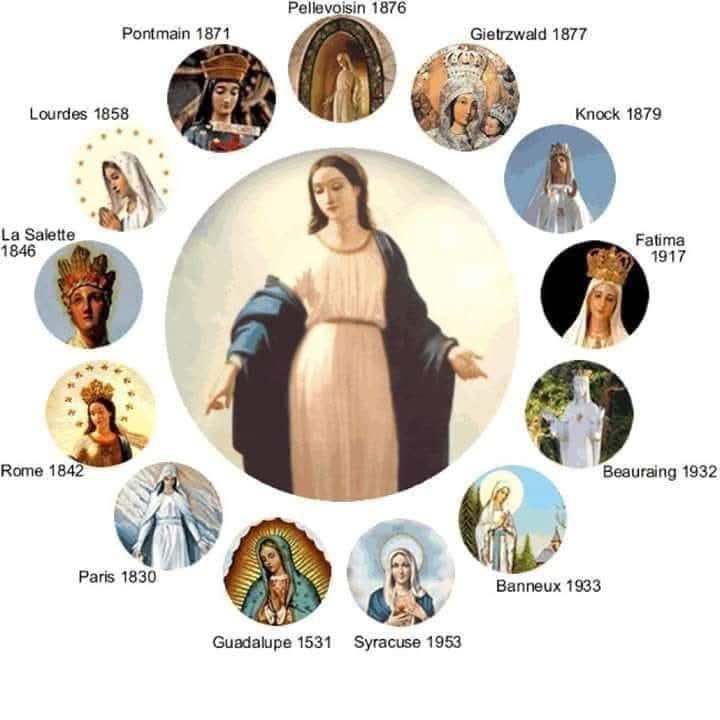
Through there has been hundreds to thousands of claims of Marian apparitions particularly between 19th-20th century – only a few have been approved by the Pope for veneration, such as:
1. “Our Lady of Guadalupe” (Mexico, 1531; or Our Lady the Pregnant Mother); Virgin Mary appeared to a Native American Indian named Saint Juan Diego and his tilma clothing had an imprint of the image of Mother Mary (as a pregnant mother); then caused the conversion of millions of Native American Indians to Christianity, and they gave up the religio-political practice of human sacrifice; Mother Mary proclaimed herself as “the Mother of the true God who gives life”;
2. “Our Lady of Poland” (Lezajsk, Poland, 1578; or Our Lady of Forests); a pious woodcutter saw a bright light in the forest and the Virgin Mary asked him to alert the authorities to establish a church in the forest;
3. “Our Lady of Siluva” (Lithuania, 1608; or Our Lady of Young Shepherds); a weeping Virgin Mary holding the Child Jesus appeared to young shepherds, then the town that lost its faith was restored to the Christian faith and a blind man was cured;
4. “Our Lady of Laus” (in Laus, France, 1664; or Our Lady of Happy Meetings); Virgin Mary appeared to a poor shepherdress and asked her to pray continuously for sinners;
5. “Our Lady of the Miraculous Medal” (Paris, France, 1830; or Our Lady of Miracles); Virgin Mary appeared three times to Saint Catherine Laboure (a novice nun) and she was commissioned to have the medal of the Immaculate Conception to spread the devotion; she also gave the prediction of the Paris Revolution, that happened 41 years after the apparition;
6. “Our Lady of Zion” (Rome, Italy, 1842; Our Lady of Conversion); Virgin Mary appeared in a vision to a man named Marie, an anti-Catholic Jew but converted to Christianity and joined the priesthood, then began a ministry for the conversion of Jews;
7. “Our Lady of La Salette” (France, 1846; or Our Lady of Protection); Virgin Mary appeared to shepherds in the mountains, and her appearance in sorrow called for conversion and penance for sins; she gave prophecies that Rome will lose faith and will become the seat of the Anti-Christ;
8. “Our Lady of Lourdes” (France, 1858; or Our Lady of Spiritual Healing); the Virgin Mary appeared to a young girl named Bernadette Soubirous under the title “Immaculate Conception” and many sick people became cured, as she called for penance and prayer for the conversion of sinners; a healing spring was established as a pilgrimage site for people worldwide;
9. “Our Lady Help of Christians” (Czech Republic, 1866); Virgin Mary appeared in a vision to an orphan named Magdalene who suffered serious illnesses; then she was immediately cured after the Marian apparitions;
10. “Our Lady of Hope” (Pontmain, France, 1871); Virgin Mary appeared to young students above a farm house beside the convent school; they made a banner design with Mother Mary’s message written at her feet – “Pray my children. God will hear you in a short time. My Son allows Himself to be moved by compassion”; then an invading army halted their invasion after soldiers have allegedly seen the Virgin Mary in the sky;
11. “Our Lady of Gietrzwald” (Poland, 1877; or Our Lady of Two Sisters); Virgin Mary appeared to young girls and encouraged them to return to prayer; a healing spring was established that brought the return of devotion among the villagers;
12. “Our Lady of Knock” (Ireland, 1879; or Our Lady of Fathers and Apostles); Mother Mary with Father Saint Joseph and Saint John the Beloved Apostle and the “Lamb of God with a Cross” appeared outside the village chapel enveloped with a bright light; and more than 25 people prayed as it was raining in the evening;
13. “Our Lady of Fatima” (Portugal, 1917; or Our Lady of the Holy Rosary); Virgin Mary appeared to young shepherds who identified herself as “Our Lady of the Rosary” and urged people to pray the holy rosary, and penance for the conversion of sinners; moreover, allegedly thousands witnessed the miracle of the dancing sun; messages known as “the three secrets” included revelations about the existence of hell as punishment for grave sinners, the need for the conversion and consecration of Russia to the Immaculate Heart of Mother Mary, and the prophecy that warns Christians that “Satan will introduce himself even to the highest summit of the Church”; then after a great war, an era of true peace shall be given to humanity and Mother Mary’s Immaculate Heart will triumph;
14. “Our Lady of Beauraing” (Belgium, 1932; or The Immaculate Virgin with the Golden Heart); Virgin Mary appeared to young children while playing at the playground of a convent school and she identified herself as “The Immaculate Virgin” and the “Mother of God, Queen of Heaven”; she called everyone for prayer for the conversion of sinners;
15. “Our Lady of Banneux” (Belgium, 1933; or Our Lady of the Poor); during winter, Virgin Mary appeared in a snow-covered garden while a young girl was inside a family’s cottage; then she called herself “The Virgin of the Poor” as she promised to intercede for the poor people, the sick, and suffering from oppression; and she was asked to establish a healing spring with clean water for pilgrims and they reported many cases of miraculous healings;
16. “Our Lady of Kibeho” (Rwanda, 1981; or Our Lady of the Word); Blessed Virgin Mary appeared to many children at a high school for girls and they were given visions of Jesus; she also appeared to young women and called herself “The Mother of God”; they were all asked to warn the people about a coming civil war, wherein after more than a decade, the war took place that took more than a million lives; etc.
As established in the Council of Trent (1545-63), the local bishop is the first and main authority in the judgement of the authenticity of Marian apparition claims. However, Vatican approval is not required for an apparition to be considered authentic.
Moreover, there were cases of negative judgments (or disapproval) that have later been changed to positive judgments (or approval and/or for further investigation) – for as long as the alleged Marian apparition has messages not contrary to the faith and morals of Christians; and that Mary (as the “Mother of God”) can be venerated to have stronger faith in God as the Holy Trinity (with God the Father Our Creator, God the Son Our Lord Jesus Christ, and The Holy Spirit) and in devotion to the Holy Family (through family love among all people).
Other Marian apparitions under investigation (but gained worldwide acclaim as devotions and/or with established pilgrimage sites), include the following:
1. “Our Lady of Zeitoun” (1968-1971, Cairo, Egypt; or Our Lady of the Christian Church); mass Marian apparition of Virgin Mary on top of the Coptic Orthodox Church of Saint Mary; as witnessed by thousands of non-Christians, primarily Muslims; the event was on record by video, television, and newspaper;
2. “Our Lady of Assiut” (2000-2001, Egypt; or Our Lady of All Churches); mass Marian apparition of Virgin Mary with a dove of the Holy Spirit above her; as witnessed by thousands of non-Christians, primarily Muslims; the event was on record by video, television, and newspaper;
3. “Our Lady of Akita” (Japan, 1973; or Our Lady of Warnings); Virgin Mary appeared in a vision to a nun that emphasized praying the holy rosary and penance with prophecies regarding persecution and heresy within the Catholic Church; the message of Mother Mary said, “If men do not repent and better themselves, the Father will inflict a terrible punishment on all humanity. It will be a punishment greater than the deluge, such as one will never have seen before. Fire will fall from the sky and will wipe out a great part of humanity”;
4. “Our Lady of Medjugorje” (Bosnia and Herzegovina, 1981; or Our Lady of Holy Books, Queen of Peace); Virgin Mary appeared in visions to young children - Ivan, Jakov, Marija, Mirjana, Vicka, and Ivanka - who wrote messages about mother’s love until they’re grown-ups; Mother Mary’s messages include the final battle between her son Jesus and the devil; and Blessed Mary required faith in her help from heaven, even if the country’s predominantly Muslim that uses the Quran but with Mother Mary as the only woman mentioned in their holy book;
5. “Our Lady of Walsingham” (England, 11th century; or Our Lady of the Royal Families); Virgin Mary appeared to a family man and was asked to build “The Holy House” in the rural town; the image is venerated by both Roman Catholics and Anglicans (or Church of England); but Mother Mary’s message includes the conversion of England to venerate the image of Mother Mary as “Queen Mother” carrying the Baby Jesus as “King Child” in heaven;
6. “Our Lady of the Pillar” (Zaragoza, Spain, 1st century; or Our Lady of Strong Support); Virgin Mary appeared to Apostle James the Greater and an image of a miniature “Mother Mary and Child” statue was requested to be made that was placed on top of a very large marble pillar;
7. “Our Lady of Manaoag” (Pangasinan, Philippines, 16th century; or Our Lady of Farmers); Virgin Mary, holding a rosary on her right hand and holding the Child Jesus on her left hand, appeared to a rural farmer to spread the devotion to the “mother and child” image; then a town was established for this and it endured wars throughout the years;
8. “Our Lady of Perpetual Help” (Rome, Italy, 15th century); Virgin Mary appeared to those who prayed in devotion to the religious icon that came from a monastery; then it was transferred to a public church for all people to venerate the “mother and child” image;
9. “Our Lady of the Snows” (Rome, Italy, 14th century; or Our Lady of Married Couples); Virgin Mary appeared in a vision to a married couple without a child, then they donated their possessions to honor her through charity; then the Roman Catholic church built the Basilica of St Mary Major, a large-scale cathedral church building to commemorate the vision of the couple;
10. “Our Lady of Mount Carmel” (England, 13th century; or Our Lady of the Scapular); Virgin Mary appeared to Saint Simon Stock, the General of the Carmelite Order; she ordered the devotion of wearing the brown scapular, or a string necklace with cloth having the image of the mother and child, with her promise of special help to those who wear it even if they’re non-Catholics or non-Christians;
July 18 thru 19 - Tonight is also the 63rd Anniversary of the alleged ‘Eucharistic Miracle of the Visible Host’ which suddenly appeared on the tongue of the visionary, Conchita Gonzalez. It occurred in the mountain village of San Sebastián de Garabandal (Cantabria), Spain 🇪🇸 between the late night until the early morning hours of July 18-19, 1962.
After being repeatedly asked by the children for a ‘miracle’ so that people might believe, the Archangel Michael finally consented and told visionary Conchita Gonzalez that on July 18, 1962, the invisible Holy Communion that he had been giving to her [and the other seers] would on that day, become visible on her tongue. She was to announce it fifteen (15) days in advance. (1/4)
Then about 1:30 in the early morning of July 19, Conchita left her house in ecstasy, turned a corner, and fell to her knees in a street adjacent to her house. A short time later Conchita put her tongue out.
Suddenly, faster than the human eye could detect, a bright white Host appeared on Conchita's tongue. (2/4)
An entrepreneur from Barcelona filmed everything with a borrowed camera and with the help of a light torch managed to take some small frames of the film, in which it showed the language of Conchita with the small wafer. At the same time there was also another person, Dr. Jacques Caux, who, with his professional film machine, waited anxiously for this moment. However, at the moment the host appeared, it could not record anything, remaining motionless in the face of such an event. According to him, that moment was the turning point in his life. (3/4)
c. 33: First Christian Pentecost; descent of the Holy Spirit upon the disciples; preaching of St. Peter in Jerusalem; conversion, baptism and aggregation of some 3,000 persons to the first Christian community.
St. Stephen, deacon, was stoned to death at Jerusalem; he is venerated as the first Christian martyr.
c. 34: St. Paul, formerly Saul the persecutor of Christians, was converted and baptized. After three years of solitude in the desert, he joined the college of the apostles; he made three major missionary journeys and became known as the Apostle to the Gentiles; he was imprisoned twice in Rome and was beheaded there between 64 and 67.
39: Cornelius (the Gentile) and his family were baptized by St. Peter; a significant event signaling the mission of the Church to all peoples.
42: Persecution of Christians in Palestine broke out during the rule of Herod Agrippa; St. James the Greater, the first apostle to die, was beheaded in 44; St. Peter was imprisoned for a short time; many Christians fled to Antioch, marking the beginning of the dispersion of Christians beyond the confines of Palestine. At Antioch, the followers of Christ were called Christians for the first time.
49: Christians at Rome, considered members of a Jewish sect, were adversely affected by a decree of Claudius which forbade Jewish worship there.
51: The Council of Jerusalem, in which all the apostles participated under the presidency of St. Peter, decreed that circumcision, dietary regulations, and various other prescriptions of Mosaic Law were not obligatory for Gentile converts to the Christian community. The crucial decree was issued in opposition to Judaizers who contended that observance of the Mosaic Law in its entirety was necessary for salvation.
64: Persecution broke out at Rome under Nero, the emperor said to have accused Christians of starting the fire which destroyed half of Rome.
64 or 67: Martyrdom of St. Peter at Rome during the Neronian persecution. He established his see and spent his last years there after preaching in and around Jerusalem, establishing a see at Antioch, and presiding at the Council of Jerusalem.
70: Destruction of Jerusalem by Titus.
88-97: Pontificate of St. Clement I, third successor of St. Peter as bishop of Rome, one of the Apostolic Fathers. The First Epistle of Clement to the Corinthians, with which he has been identified, was addressed by the Church of Rome to the Church at Corinth, the scene of irregularities and divisions in the Christian community.
95: Domitian persecuted Christians, principally at Rome.
c. 100: Death of St. John, apostle and evangelist, marking the end of the Age of the Apostles and the first generation of the Church.
By the end of the century, Antioch, Alexandria and Ephesus in the East and Rome in the West were established centers of Christian population and influence.
c. 107: St. Ignatius of Antioch was martyred at Rome. He was the first writer to use the expression, “the Catholic Church.”
112: Emperor Trajan, in a rescript to Pliny the Younger, governor of Bithynia, instructed him not to search out Christians but to punish them if they were publicly denounced and refused to do homage to the Roman gods. This rescript set a pattern for Roman magistrates in dealing with Christians.
117-38: Persecution under Hadrian. Many Acts of Martyrs date from this period.
c. 125: Spread of Gnosticism, a combination of elements of Platonic philosophy and Eastern mystery religions. Its adherents claimed that its secret-knowledge principle provided a deeper insight into Christian doctrine than divine revelation and faith. One gnostic thesis denied the divinity of Christ; others denied the reality of his humanity, calling it mere appearance (Docetism, Phantasiasm).
c. 144: Excommunication of Marcion, bishop and heretic, who claimed that there was total opposition and no connection at all between the Old Testament and the New Testament, between the God of the Jews and the God of the Christians; and that the Canon (list of inspired writings) of the Bible consisted only of parts of St. Luke’s Gospel and 10 letters of St. Paul. Marcionism was checked at Rome by 200 and was condemned by a council held there about 260, but the heresy persisted for several centuries in the East and had some adherents as late as the Middle Ages.
c. 155: St. Polycarp, bishop of Smyrna and disciple of St. John the Evangelist, was martyred.
c. 156: Beginning of Montanism, a form of religious extremism. Its principal tenets were the imminent second coming of Christ, denial of the divine nature of the Church and its power to forgive sin, and excessively rigorous morality. The heresy, preached by Montanus of Phrygia and others, was condemned by Pope St. Zephyrinus (199-217).
161-80: Reign of Marcus Aurelius. His persecution, launched in the wake of natural disasters, was more violent than those of his predecessors.
165: St. Justin, an important early Christian writer, was martyred at Rome.
c. 180: St. Irenaeus, bishop of Lyons and one of the great early theologians, wrote Adversus Haereses. He stated that the teaching and tradition of the Roman See was the standard for belief.
196: Easter Controversy, concerning the day of celebration — a Sunday, according to practice in the West, or the 14th of the month of Nisan (in the Hebrew calendar), no matter what day of the week, according to practice in the East. The controversy was not resolved at this time.
The Didache, whose extant form dates from the second century, is an important record of Christian belief, practice and governance in the first century.
Latin was introduced as a liturgical language in the West. Other liturgical languages were Aramaic and Greek.
The Catechetical School of Alexandria, founded about the middle of the century, gained increasing influence on doctrinal study and instruction, and interpretation of the Bible.
202: Persecution under Septimius Severus, who wanted to establish a simple common religion in the Empire.
206: Tertullian, a convert since 197 and the first great ecclesiastical writer in Latin, joined the heretical Montanists; he died in 230.
215: Death of Clement of Alexandria, teacher of Origen and a founding father of the School of Alexandria.
217-35: St. Hippolytus, the first antipope; he was reconciled to the Church while in prison during persecution in 235.
232-54: Origen established the School of Caesarea after being deposed in 231 as head of the School of Alexandria; he died in 254. A scholar and voluminous writer, he was one of the founders of systematic theology and exerted wide influence for many years.
c. 242: Manichaeism originated in Persia: a combination of errors based on the assumption that two supreme principles (good and evil) are operative in creation and life, and that the supreme objective of human endeavor is liberation from evil (matter). The heresy denied the humanity of Christ, the sacramental system, the authority of the Church (and state), and endorsed a moral code which threatened the fabric of society. In the 12th and 13th centuries, it took on the features of Albigensianism and Catharism.
249-51: Persecution under Decius. Many of those who denied the faith (lapsi) sought readmission to the Church at the end of the persecution in 251. Pope St. Cornelius agreed with St. Cyprian that lapsi were to be readmitted to the Church after satisfying the requirements of appropriate penance. Antipope Novatian, on the other hand, contended that persons who fell away from the Church under persecution and/or those guilty of serious sin after baptism could not be absolved and readmitted to communion with the Church. The heresy was condemned by a Roman synod in 251.
250-300: Neo-Platonism of Plotinus and Porphyry gained followers.
251: Novatian, an antipope, was condemned at Rome.
256: Pope St. Stephen I upheld the validity of baptism properly administered by heretics, in the Rebaptism Controversy.
257: Persecution under Valerian, who attempted to destroy the Church as a social structure.
258: St. Cyprian, bishop of Carthage, was martyred.
c. 260: St. Lucian founded the School of Antioch, a center of influence on biblical studies.
Pope St. Dionysius condemned Sabellianism, a form of modalism (like Monarchianism and Patripassianism). The heresy contended that the Father, Son and Holy Spirit are not distinct divine persons but are only three different modes of being and self-manifestations of the one God.
St. Paul of Thebes became a hermit.
261: Gallienus issued an edict of toleration which ended general persecution for nearly 40 years.
c. 292: Diocletian divided the Roman Empire into East and West. The division emphasized political, cultural and other differences between the two parts of the Empire and influenced different developments in the Church in the East and West. The prestige of Rome began to decline.
303: Persecution broke out under Diocletian; it was particularly violent in 304.
305: St. Anthony of Heracles established a foundation for hermits near the Red Sea in Egypt.
c. 306: The first local legislation on clerical celibacy was enacted by a council held at Elvira, Spain; bishops, priests, deacons and other ministers were forbidden to have wives.
311: An edict of toleration issued by Galerius at the urging of Constantine the Great and Licinius officially ended persecution in the West; some persecution continued in the East.
313: The Edict of Milan issued by Constantine and Licinius recognized Christianity as a lawful religion in the Roman Empire.
314: A council of Arles condemned Donatism, declaring that baptism properly administered by heretics is valid, in view of the principle that sacraments have their efficacy from Christ, not from the spiritual condition of their human ministers. The heresy was condemned again by a council of Carthage in 411.
318: St. Pachomius established the first foundation of the cenobitic (common) life, as compared with the solitary life of hermits in Upper Egypt.
325: Ecumenical Council of Nicaea (I). Its principal action was the condemnation of Arianism, the most devastating of the early heresies, which denied the divinity of Christ. The heresy was authored by Arius of Alexandria, a priest. Arians and several kinds of Semi-Arians propagandized their tenets widely, established their own hierarchies and churches, and raised havoc in the Church for several centuries. The council contributed to formulation of the Nicene Creed (Creed of Nicaea-Constantinople); fixed the date for the observance of Easter; passed regulations concerning clerical discipline; adopted the civil divisions of the Empire as the model for the jurisdictional organization of the Church.
326: With the support of St. Helena, the True Cross on which Christ was crucified was discovered.
337:Baptism and death of Constantine.
c. 342: Beginning of a 40-year persecution in Persia.
343-44: A council of Sardica reaffirmed doctrine formulated by Nicaea I and declared also that bishops had the right of appeal to the pope as the highest authority in the Church.
361-63: Emperor Julian the Apostate waged an unsuccessful campaign against the Church in an attempt to restore paganism as the religion of the Empire.
c. 365: Persecution of orthodox Christians under Emperor Valens in the East.
c. 376: Beginning of the barbarian invasion in the West.
379: Death of St. Basil, the Father of Monasticism in the East. His writings contributed greatly to the development of rules for the life of Religious.
I see Anne coming out of the garden. She is leaning on the arm of a relative, who is like her. She is obviously several months pregnant and she looks tired and her fatigue is not alleviated by the sultriness, just as this present heat is exhausting me.
Although the garden is shady, it is very hot and close. The air can be cut like a soft warm dough, it is so heavy. The sun's rays descend from a merciless blue sky and there is some dust making the atmosphere slightly dull. The weather must have been dry for a long time, because where there is no irrigation, the land is literally reduced to a very fine, almost white dust. Out in the open this shade of white is slightly pink, whereas it is a dark red-brown under the trees, where the soil is damp. Likewise the ground is moist along the small flower-beds, where rows of vegetables are growing, and around the rose bushes, the jasmines and other flowers, and particularly in the front of and along the beautiful pergola, which divides the orchard in two, up to the beginning of the fields, now stripped of their crops. The grass of the meadow, which marks the boundary of the property, is parched and thin. Only at its border, where there is a hedge of wild hawthorn, already completely studded with the rubies of its little fruits, is the grass greener and thicker. There are some sheep thereabouts with a young shepherd seeking pasture and shade.
Joachim is working around the rows of vines and olive-trees. There are two men with him, helping him. Although an elderly man he is quick and works eagerly. They are opening little channels at the end of a field to give water to the dry plants, and this water makes its way gurgling between the grass and the dry land. The flow forms circles that for one moment resemble a yellowish crystal and seconds later are only rings of wet soil, around the overloaded vine branches and the olive-trees.
Along the shady pergola, under which golden bees are buzzing, greedy for the sugar of the golden grapes, Anne moves slowly towards Joachim, who hastens towards her as soon as he sees her.
« You came so far? »
« The house is as hot as an oven. »
« And you suffer from it. »
« The only suffering of this last hour is that of a pregnant woman. The natural suffering of everybody: man and beast. Don't get too warm, Joachim. »
« The water we have been hoping for, for such a long time, and that for fully three days seemed so close, has not yet come and the country is parched. We are lucky to have a spring so near and so rich in water. I have opened the channels. It is a measure of relief for the plants which have withering leaves and are covered with dust: just enough to keep them alive. If it would only rain.»
Joachim, with the eagerness of all farmers, looks at the sky, while Anne, tired, cools herself with a fan that seems to be made of the dry leaf of a palm interwoven with many-coloured threads keeping it firm.
Anne's companion interrupts: « Over there, beyond the Great Hermon, fast clouds are arising. There is a northern wind. It will refreshen and perhaps bring rain. »
« The breeze has risen for three days and then it sets when the moon rises. It will do the same again. » Joachim is discouraged.
« Let us go back home. Even here one can hardly breathe, and in any case I think it is better to go back...» says Anne, who looks more olive-hued than usual, owing to a paleness which has come over her face.
« Are you in pain? »
« No. But I can feel the great peace that I experienced in the Temple when I was granted the grace, and which I felt once again when I knew I was pregnant. It is like an ecstasy, a sweet sleep of the body while the soul rejoices and calms itself in a peace that has no bodily parallel. I have loved and still do love you, Joachim, and when I entered your house and I said to myself:
myself: "I am the wife of a just man", I had peace: and I felt the same every time your provident love took care of your Anne. But this peace is different. Understand: I think that the soul of our father Jacob was invaded by a similar peace, like the soothing given by oil that spreads and appeases, after he dreamt of the angels. And, possibly more accurately, it is like the joyful peace of the Tobiahs after Raphael appeared to them. If I absorb myself in this feeling, it grows more and more in strength while I enjoy it. It is as if I were ascending into the blue spaces of the sky... And furthermore, I don't know the reason for it, but since I have had this peaceful joy in me, I have a song in my heart: old Tobiah's song. I think it was written for this hour... for this joy... for the land of Israel that receives it... for Jerusalem-sinner and now forgiven... But do not laugh at the frenzy of a mother... but when I say: "Thank the Lord for your wealth and bless the God of centuries, that He may rebuild His Tabernacle in you", I think that He Who will rebuild the Tabernacle of the true God in Jerusalem will be This One who is about to be born... And I also think that the destiny of my creature was prophesied and not the fate of the Holy City, when the song says: "You shall shine with a bright light: all the peoples of the world will prostrate themselves before you: the nations will come bringing gifts: they will worship the Lord in you and will hold your land as sacred, because within you they invoke the Great Name. You will be happy on account of your children, because they will all be blessed and they will gather near the Lord. Blessed are those who love you and rejoice in your peace..." And I am the first to rejoice, her happy mother... »
Anne changes colour, when saying these words and she lights up like something brought from the paleness of moonlight to the brightness of a great fire and vice versa. Sweet tears, of which she is unaware, run down her cheeks and she smiles in her joy. And in the meantime she moves towards the house, walking between her husband and her relative, who listen and, deeply moved, are silent.
They make haste because clouds driven by a strong wind, rush across and gather in the sky, while the plain darkens and shudders at the warning of a storm. When they reach the threshold of the dwelling, a first livid flash of lightning crosses the sky and the rumble of the first peal of thunder sounds like the roll of a huge drum that mingles with the arpeggio (1) of the first drops on the parched leaves.
They all go in and Anne withdraws, while Joachim, standing at the door, talks with the workers, who have in the meantime joined him: the conversation is about the longed for water which is a blessing for the parched land. But their joy turns into fear because a very violent storm is approaching with lightening and clouds threatening hail. « If the cloud bursts, it will crush the grapes and the olives like a millstone. Poor me! »
Joachim is also anxious for his wife, whose time has come to give birth to her child. His relative reassures him that Anne is not suffering at all. But he is agitated, and every time his relative or any other woman, amongst whom is Alphaeus' mother, comes out of Anne's room and goes back in again with hot water and basins and linens dried near the blazing fireplace in the large kitchen, he goes and makes enquiries, but he does not calm down despite their reassurances. Also the lack of cries from Anne worries him. He says: « I am a man and I have never seen a child being born. But I remember hearing that the absence of throes is fatal. »
It is growing dark and the evening is preceded by a furious & very violent storm: it brings torrential rain, wind, lightning, everything, except hail, which has fallen elsewhere.
One of the workers notices the ferocity of the gale: « It looks as if Satan has come out of Gehenna with his demons. Look at those black clouds!
You can smell sulphur in the air and you can hear whistling and hisses, and wailing and cursing voices. If it is him, he is furious this evening! »
The other worker laughs and scoffs: « A great prey must have escaped him, or Michael has struck him with a new thunderbolt from God, and he has had his horns and tail clipped and burnt. »
A woman passes by and shouts: « Joachim! It is coming. And it is happening quickly and well!» and she disappears with a small amphora in her hands.
The storm drops suddenly, after one last thunderbolt that is so violent that it throws the three men against the side wall; and in front of the house, in the garden, a black smoky cavity remains as its memory! Meanwhile a cry, one resembling the tiny plea of a little turtle-dove that for the very first time no longer peeps but cooes, is heard from beyond Anne's door. And at the same time a huge rainbow stretches its semicircle across the sky. It rises, or seems to rise, from the top of Hermon, which kissed by the sun, looks like a most delicate pinkish alabaster: it rises up in the clear September sky and through an atmosphere cleaned of all impurities, it crosses over the hills of Galilee and the plain to the south, and over another mountain, and seems to rest the other end on the distant horizon, where it drops from view behind a chain of high mountains.
« We have never seen anything like this! »
« Look, look! »
« It seems to enclose in a circle the whole of the land of Israel. And look! there is already a star in the sky while the sun has not yet set. What a star! It is shining like a huge diamond!...»
« And the moon, over there, is a full moon, three days early. But look how she is shining! »
The women arrive jubilant with a plump little baby wrapped in plain linens.
It is Mary, the Mother. A very tiny Mary, who could sleep in the arms of a child, a Mary as long, at most, as an arm, with a little head of ivory dyed pale pink.
Her tiny carmine lips no longer cry but are set in the instinctive act of sucking: they are so small that one cannot understand how they will be able to take a teat.
Her pretty little nose is between two tiny round cheeks, and when they get Her to open Her eyes, by teasing Her, they see two small parts of the sky, two innocent blue points that look but cannot see, between thin fair eyelashes. Also Her hair on Her little round head is a pinkish blond, like the colour of certain honeys which are almost white.
Her ears are two small shells, transparent, perfect. Her tiny hands... what are those two little things groping in the air and ending up in Her mouth? Closed, as they are now, they are two rose buds that split the green of their sepals and show their silk within. When they are open, as now, they are two ivory jewels, made of pink ivory and alabaster with five pale garnets as nails. How will those two tiny hands be able to dry so many tears?
And Her little feet? Where are they? For the time being they are just kicking, hidden in the linens. But now the relative sits down and uncovers Her... Oh, the little feet! They are about four centimetres long. Each sole is a coral shell, with a snow white top veined in blue. Her toes are masterpieces of Lilliputian sculpture: they, too, are crowned with small scales of pale garnet. But where will they find small sandals, when those little feet of a doll will take their first steps, sandals small enough to fit such tiny feet? And how will those little feet be able to go such a long way and bear so much pain under the cross?
But that for the time being is not known, and the onlookers smile and laugh at her kicking, at Her well shaped legs, at Her minute plumpish thighs that form dimples and rings, at Her little tummy, a cup turned upside-down, at Her tiny perfect chest.