Our nuclear installations have been badly damaged' — Iran FM spox Esmaeil Baghaei
From Hezbollah through Syria to the Houthis in Yemen the Israeli Air Force hammered the tentacles of the Islamic Revolutionary octopus and established air superiority over Iranian airspace in the first 72 hours of air operations. A lion rose and roared throughout the middle east.
Tehran must understand that as far as the United States is concerned nothing has changed. Iran must give up its nuclear strategic assets or face continued air operations.
Trump won’t call Israel back if Tehran backs out of nuclear talks with DC, or breaks the ceasefire with Jerusalem again. If DC gains intelligence that Iran is trying to mate a warhead we’ll be back at it.
The fragile ceasefire currently in place is based on the same progression as Israel’s war with Hamas. Except the Ayatollah threatens to hold the world captive in a tactical nuclear hostage crisis.
The CIA, forint partner assessments, and the IAEA, pooled intelligence rapidly that contested the preliminary low-confidence DIA’s snapshot leaked to a CNN investigator. The airstrikes had severely degraded Iran’s nuclear capabilities, with setbacks measured in years, rather than in the months window of the DIA leak assessment.
Classification is put in place to prevent opsec or diplomatic exposure. Evidence shows the agency conveyed it was a one-day snapshot lacking coordinated interagency corroboration. Leaking unvetted material posed clear national security and reputational risks at a national level, compounded by strategic risk scenarios activated by Iran’s nuclear posture.
After 36 hours of dangerous flight through enemy territory, US elite pilots returned from one the most raw displays of US precision engineered capability sets, previously unseen in combat and most of it unknown and unmatched in the world.
It’s never be a good moment to contradict the actions of the United States’ Commander in Chief with bad intel, when we’re all facing strategic consequences downstream. CNN corrected the record in its subsequent reporting.
70% of Iranians who strongly prefer secular governance according an Interior Ministry survey leaked in 2023, and other surveys. If the global community can agree that a theocracy such as Iran cannot pose strategic threats in the Gulf and globally, then concerted focus may be placed on them and their future.
That sort of international coordinationp at the Security Council is on the table. The international community has the authority within the Security Council to adopt a resolution invoking Article VII to form an international contact group for peaceful rights groups inside Iran. America is not just waving a big stick. It’s making offers and it always does.
But China invoked Resolution 487—passed in 1981 by every Security‑Council member, including the United States, in a vote to condemn Israel’s preventive strike on Iraq’s Osiraq reactor—to condemn the United States.
Instead it should come together to help the international community stabilize Iran for the Iranian people. It claims to be a champion of humanitarian rights. Do one thing to demonstrate that Xi Jinglin.
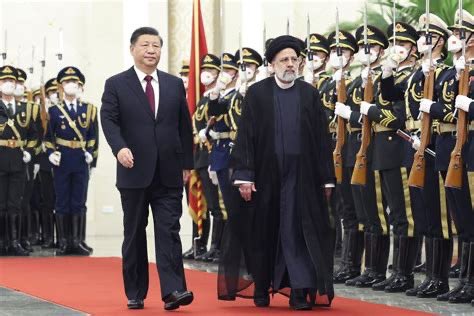
If 70% want Ali Khamenei out, then retire him from Supreme Leader and adopt an interim government protected by the Artesh. The Revolutionary Guards corp can support the security for an interim government under the conventional forces’ protection. That cooperation is a given of the parties agree on operational guidelines.
China can change its approach in return for guarantees on its $400 billion 25 year strategic energy deal signed in 2021. An Iranian state apparatus under an interim government can uphold international agreements.
Retire Ali Khamenei by formally separating the clerical regime from governance. He is a wicked man and has brought ruin upon millions of lives in Israel, across the region, and to his own people.
This can continue peacefully within Iran, but not in command of strategic weapons.
All the great clans and tribesmen’s elders, as appointed local representatives, can agree that secession is strictly forbidden, and that security cooperation through the Artesh continues smoothly.
People need to be able talk about their future and be heard—by each other, and by the world. Elections among representatives must determine the transition’s political composition in cooperative steps. Not a minority of theocrats or a dominant proxy of technocrats
With UN security council support for separation of clerics and state, the Ayatollah may be compelled let his people speak, and to step down as a cultural figure with clerics playing adjudicative roles among their 30% adherents. Religious courts can maintain jurisdiction over non-criminal matters among the Shia community. The state architecture is already robust to support secular governance.
But consider who needs to support this peaceful transition: China and Russia. That’s a pipe dream. Iran could be free, but major powers resist empowering the legitimate representatives of over 70 percent of the country. They choose to prop up a dangerous nuclear proliferator instead. They support the Ayatollah.
An Israeli military exercise will take place today (Thursday) from morning until afternoon in the Jordan Valley and Jezreel Valley regions.
There is no fear of a security incident.
The End, for now.
@threadreaderapp unroll
• • •
Missing some Tweet in this thread? You can try to
force a refresh

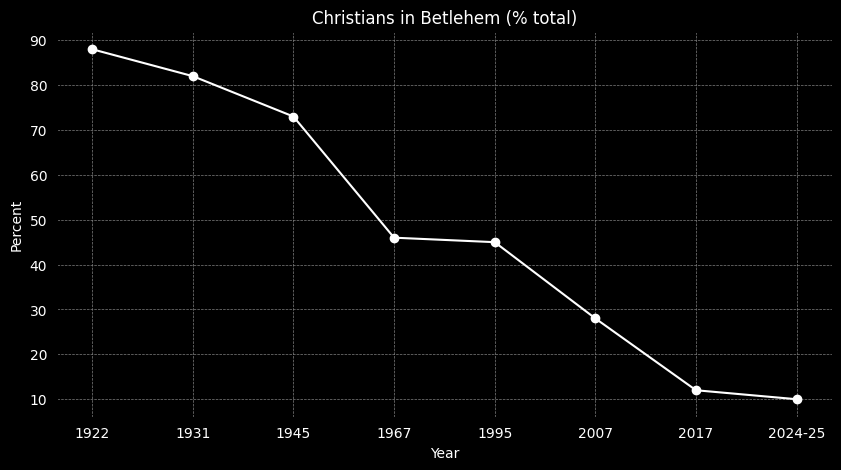
When Bethlehem was handed over to Palestinian Authority control on Dec 21, 1995, as part of the Oslo II Accord, Christians formed a large plurality, probably on the order of 35–45% of roughly 22,000 residents in the mid-1990s.
The last official census in 2017 was conducted by the Palestinian Central Bureau of Statistics (PCBS). It recorded no locality-level religious breakdown, but based on the Bethlehem Governorate data there were 23,165 Christians out of 212,191 total residents, or less than 12% of the governorate’s population.
Since then Bethlehem's Christian population has continued to sharply decline even as its overall population has climbed. Estimates for Bethlehem city proper in recent years vary with most independent sources placing the Christian population now between three to under four thousand within a total city population of 32,840 - 33,500 as of ‘24–‘25, or roughly 10%.
When is the “State of Palestine” going to conduct a new survey, with international verification?
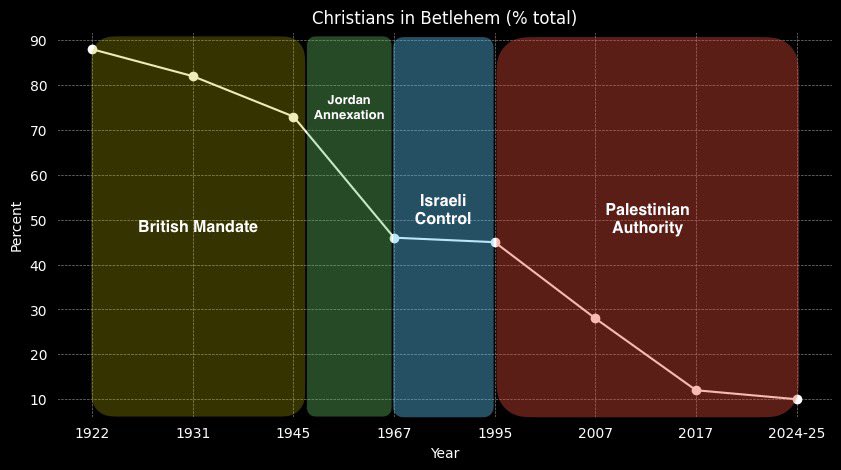
Mapping Christian pop'n decline in Bethlehem 1922-2025
Bottom Line Up Front: The only stable period for Bethlehem's Christian population in the last 103 years was witnessed under Israeli control between 1967 and 1995.
Execsum
Starting with Mandate census surveys in 1922, '31 and '45, which included township and religion breakdowns, then moving to the Israeli government's 1967 post-Six Day War census, and then working with the PA's Palestinian Central Bureau of Statistics 1997, 2007 and 2017 census surveys and supporting UN body reports, I constructed a reasonably reliable picture of Bethlehem's Christian population over the last century plus. 1995 remains a floating percentage bounded between 46% and 40%, estimated in my graph at 45% based on trend, with caveats noted. Current figures also have to be extrapolated in the absence of any census but is bounded within the 10-12% range by multiple reports and sources as discussed ...
1922–1945: 88% to 73%
The earliest data point is taken directly the British Mandate census from ‘22 for the town, which shows 6,658 residents with 5,838 Christians, 818 Muslims, so 87.7% Christian (1). In '31 the percentage declined to about 82% (2), and by ‘45 the Gov of Palestine's Village Statistics volume shows a drop to 73% with 8,820 inhabitants: 6,430 Christians and 2,370 Muslims (3).
1967–1995: 46% to 40-45%
Immediately after the 1967 Six-Day War, Israel's Central Bureau of Statistics conducted a full census and published this as “Census of Population 1967: West Bank of Jordan, Gaza Strip, North Sinai and Golan Heights”, in several volumes, with detailed tabulations by locality, religion, sex, and other variables. The Levy Economics Institute has digitised these volumes which constitute the first modern census reports (4). For an easily accessible summation for Bethlehem, the Jewish Virtual Library’s Bethlehem page states: “In the 1967 census taken by Israel authorities, the town of Bethlehem proper numbered 14,439 inhabitants, its 7,790 Muslim inhabitants represented 53.9% of the population, while the Christians of various denominations numbered 6,231 or 46.1%” (5). This late 60s snapshot marks the first time the clear Christian majority of the Mandate-era dropped below the 50% mark during Jordan's annexation of Judea and Samaria.
Under post-war Israeli control, the number of Christians in Bethlehem enjoyed a period of relative stability between ‘67 and ‘95, when under Oslo II, against local Christian pleas to Rabin’s government opposing the move, the area was handed over to Palestinian Authority control. The Palestinian Central Bureau of Statistics (PCBS) 1997 census gives Bethlehem city between 21.7–21.9k people but no religion based breakdown (6,7); PCPSR-Philos and multiple church sources converge on “about 40% Christian in 1998” (8,11–14).
That implies c. 8.5–9k Christians, i.e. low-40s percent for 1995. I would put the number at closer to the 45% mark on overall trend, but this is not a precise figure and I have to dig further to see if this portion of my graph and claim can be better anchored. What is repeatedly cited is 40% by 1997–8 across multiple Christian and Palestinian sources (8,11–14). Still, even at 40% the number of Christians translates to about 8,800 (of the 22k figure), a marked increase from 1967’s 6,231 (4,5).
Note that PCBS treats “urban Bethlehem” as the tri-cluster of Bethlehem, Beit Jala and Beit Sahour plus their municipal boundaries but distinguishes it from rural villages and the three refugee camps, Aida, Azza, and Dheisheh. Later ARIJ/OCHA–UNSCO work, explicitly citing the 1997 census, gives the “urban Bethlehem” population as 44,880, which is just the sum of those three municipalities in the 1997 tables (6–8). In that larger pool the 2004 OCHA-UNSCO report puts Christians and Muslims at roughly parity. But in the Bethlehem-row of that locality table PCBS records a population of just under 22,000 as cited above.
2007–2025: 28% to 10%
The 2007 data point rests primarily on the PCPSR-Philos reconstruction of Christian demography in Judea, Samaria and Gaza (11). Using PCBS census data and its own fieldwork with local councils and churches, the Palestinian Center for Policy and Survey Research (PCPSR) notes that Bethlehem’s Christian share fell to 28% by 2007, with Christians declining to only 1.2% of the total Palestinian population but remaining concentrated in Bethlehem and a few other towns (8-11).
The next hard statistical anchor is the 2017 PCBS census, which is the last official census conducted in the area. PCBS doesn't publish religion by locality but it does give a religious breakdown at governorate level. For Bethlehem Governorate it records 23,165 Christians out of 212,191 inhabitants, just under 11 percent (9). Bethlehem city’s Christian share has to be inferred.
The National Catholic Reporter piece from December 2016 quotes mayor Vera Baboun that “by 2016, the Christian population dipped to just 12 percent” in Bethlehem and its surrounding villages and that “today there are just 11,000 Christians” in Bethlehem (12). Friends of the Holy Land’s 2018 gathering report states 18% for Bethlehem’s Christian share (13). Lee’s AIJAC article in early 2019 uses a comparable framing, noting that since the PA took over the city in 1995 “the Christian percentage of the city’s population has plummeted from 40 per cent to 12 per cent,” and that the city’s population of c. 27,000 in 2017 was 23% higher than in 1998 (14).
A Reuters 2024 Bethlehem Christmas piece picks up the same thread, stating that “as of a 2017 census, the overall population of Bethlehem was 215,514 with only 23,000 Christians among them,” and infers a Christian share “around 10%” at Bethlehem scale (15). PCBS’s 2021 projected mid-year population tables by locality have Bethlehem city rising from 28,343 in 2017 to c. 33k by 2025 (16).
Summary of sourcing and method description
➤ 1922, 1931, 1945 are taken directly from the British Mandate censuses.
➤ 1967 is anchored in the Israeli West Bank census. Israel Central Bureau of Statistics. (1967). Census of population 1967: West Bank of Jordan, Gaza Strip, North Sinai and Golan Heights.
➤ 1995–98 is extrapolated and bounded by the 1997 PCBS census and the 2004 OCHA/UNSCO Bethlehem study (“urban Bethlehem” Christian/Muslim parity across the tri-city cluster), combined with the PCPSR–Philos reconstruction and church reporting, which placed Bethlehem around 40% Christian in '97–'98.
➤ 2007 is taken from the PCPSR–Philos reconstruction.
➤ 2017 is from the last official governorate-level PCBS census and the separately published Bethlehem-governorate report.
➤ 2024–25 are extrapolated from PCBS locality projections against press and church estimates of Christian share, including NCR, Friends of the Holy Land, AIJAC and Reuters.
(See endnotes for apa7s and urls)
——— 1. Barron, J. B. (1923). Palestine: Report and general abstracts of the census of 1922. Government of Palestine. users.cecs.anu.edu.au/~bdm/yabber/ce… 2. Mills, E. (1932). Census of Palestine 1931: Population of villages, towns and administrative areas. Government of Palestine. all4palestine.org/UploadFiles/Pa… 3. Government of Palestine, Department of Statistics. (1945). Village statistics, April 1945. Government of Palestine. users.cecs.anu.edu.au/~bdm/yabber/ce… 4. Perlmann, J. (n.d.). The 1967 Census of the West Bank and Gaza Strip: A digitized version. Levy Economics Institute of Bard College. levyinstitute.org/palestinian-ce… 5. Jewish Virtual Library. (n.d.). Bethlehem. Retrieved December 7, 2025. jewishvirtuallibrary.org/bethlehem 6. Palestinian Central Bureau of Statistics. (1999). Population, housing and establishment census 1997: Final results, population report, Palestinian Territory (First part). Ramallah, Palestine: PCBS. pcbs.gov.ps/Downloads/book… 7. Palestinian Central Bureau of Statistics. (1999). Localities in Bethlehem Governorate by type of locality and selected indicators, 1997. Ramallah, Palestine: PCBS. pcbs.gov.ps/Downloads/book… 8. Office for the Coordination of Humanitarian Affairs, & Office of the Special Coordinator for the Peace Process in the Middle East. (2004, December). Costs of conflict: The changing face of Bethlehem. unispal.un.org/pdfs/Beth_Rep_… 9. Palestinian Central Bureau of Statistics. (2017). Preliminary results of the population, housing and establishments census 2017 (Table 3: Population by governorate and religion). Ramallah, Palestine: PCBS. pcbs.gov.ps/Downloads/book… 10. Palestinian Central Bureau of Statistics. (2019). Population, housing and establishments census 2017: Housing report – final results, Bethlehem Governorate. Ramallah, Palestine: PCBS. pcbs.gov.ps/Downloads/book… 11. Palestinian Center for Policy and Survey Research. (2020). Migration of Palestinian Christians: Drivers and means of combating it. Ramallah, Palestine: PCPSR. pcpsr.org/en/node/806 12. Lidman, M. (2016, December 19). Bethlehem’s declining Christian population casts shadow over Christmas. National Catholic Reporter. ncronline.org/bethlehems-dec… 13. Birmingham Diocesan Trust. (2018, October 3). Record numbers attend FHL’s national gathering in support of Christians in the Holy Land. birminghamdiocese.org.uk/news/record-nu… 14. Lee, A. (2019, January 2). Israel is not Bethlehem’s enemy. Australia/Israel & Jewish Affairs Council. aijac.org.au/featured/israe… 15. Lubell, M., & al-Mughrabi, N. (2024, December 1). Another bleak Christmas in Bethlehem as Christian families quit West Bank. Reuters. reuters.com/world/middle-e… 16. Palestinian Central Bureau of Statistics. (2021, May 30). Projected mid-year population for Bethlehem Governorate by locality 2017–2026. Ramallah, Palestine: PCBS. pcbs.gov.ps/statisticsIndi…
Seismic Implications of Israel’s Intelligence Intercept of Hamas-Qatar Coordination
Newly seized internal Hamas files by Israeli forces reveal close coordination between Hamas and Qatar aimed at derailing U.S. President Donald Trump’s 2019–2020 Middle East peace initiative (the “Deal of the Century”) and undermining Arab-Israeli normalization efforts. These materials confirm Qatar’s support was crucial to Hamas’s survival and operational capacity over the years – enabling Hamas’s October 7, 2023 attack. This intelligence windfall, obtained from Hamas facilities and translated from Arabic by Israeli military intelligence, offers a rare firsthand look at Hamas’s strategic alliance with its most important state backer.
One intercepted document details an emergency meeting in Doha in June 2019 between Qatar’s Emir Tamim bin Hamad Al Thani and Hamas leader Khaled Mashaal, convened as the Trump peace plan loomed¹. In that meeting, the emir acknowledged the likelihood that certain Arab states (such as Saudi Arabia) might normalize relations with Israel, prompting Mashaal to urge Qatar to “cooperate in order to resist… and thwart” the U.S. initiative.
Another memo from December 2019 recounts Hamas politburo chief Ismail Haniyeh telling Qatar’s then-foreign minister that “the Qatari grants are Hamas’s main artery,” confirming Doha’s financial support kept Hamas afloat. These candid exchanges – now corroborated by captured documents – confirm that Qatar not only passively sympathized with Hamas’s opposition to the peace plan, but actively coordinated strategy and sustenance for the group during the plan’s rollout.
Collectively, the revelations will intensify Saudi and Emirati pressure on Doha within GCC fora, reinforcing the post-2021 Al-Ula rapprochement’s conditional character. Riyadh will seek to harden its own firewall from Qatari interference.
USIC, Treasury and allied financial-crime units will assess contemporaneous proof that Qatari cash transfers—exceeding $1 billion between 2012-18 alone—were not humanitarian stop-gaps but an acknowledged “main artery” for Hamas operations. This finding invites statutory review under 31 U.S.C. § 5318A, heightening the probability of secondary sanctions on Qatari banking channels and risk-weighted de-risking by Western correspondent banks.
As Israeli and allied intelligence services further construct a forensic map of cash, courier, and influence nodes linking Doha to Gaza expect accelerated designation of front companies, tighter monitoring of qatari-routed crypto lanes, and potential interdiction of Qatari-purchased fuel or construction supplies entering Gaza—concretely constricting Hamas’ replenishment cycle.
Because the correspondence boasts of pushing Cairo “out of the picture” in favor of Qatar, Egypt is incentivized to reassert its Rafah-corridor veto and reclaim primacy over Gaza access negotiations. This could manifest in stricter passenger screening, deeper intelligence sharing with Israel, and a harder public line against Hamas in Arab League venues.
The revelation arms Israel and the United States with documentary proof that a state actor bankrolled the 7 October attack planning. Expect amplified public-diplomacy campaigns linking Qatari funding to civilian casualties, thereby eroding Doha’s reputational shield and complicating its international media partnerships, especially ahead of the 2026 FIFA World Cup legacy push.
For Donald Trump, the papers substantiate his claim that outside actors conspired to sink his “realistic two-state solution” unveiled in January 2020. Congressional hawks will likely cite the material when reconsidering continued CENTCOM basing at Al-Udeid or future arms packages to Qatar, injecting bilateral friction into the 2026 NDAA cycle.
Multinationals exposed to Qatari sovereign wealth or project finance now face higher counter-party due-diligence thresholds. Auditors will need to reassess Qatari holdings to avoid material-support liabilities.
—-
1, Times of Israel Staff. (2025, June 8). Report: Documents found in Gaza show Hamas-Qatar coordination against Trump peace plan. The Times of Israel. timesofisrael.com/liveblog_entry…
2, Hunnicutt, T., Mills, A., & Pamuk, H. (2024, November 8). After Hamas rejection of hostage deal, U.S. asked Qatar to expel the group. Reuters. reuters.com/world/middle-e…
3, Avitan Cohen, S. (2025, May 16). ‘Qatar is Hamas’: Behind Qatar’s diplomatic mask. Israel Hayom. israelhayom.com/2025/05/16/qat…
4, Merlin, O. (2025, June 5). Grassroots campaign in Israel targets Qatar’s ties to Hamas, support of terror. The Jerusalem Post. jpost.com/israel-news/ar…
Qatar and Qatari-aligned media, like Al Jazeera, have denied allegations of funding Hamas in the past. Doha’s government has long maintained that its financial transfers to Gaza are humanitarian and that its contacts with Hamas serve to mediate conflicts – a narrative now directly at odds with the intercepted documents. Qatar and Qatari-aligned outlets such as Al Jazeera have repeatedly rejected allegations that Doha bankrolls Hamas, portraying them as politically motivated fabrications (1, 2). The International Media Office restated that position in an April press release that condemned “false media reports regarding ongoing mediation efforts between Hamas and Israel”.
When Israeli investigators opened a corruption probe in March, a Qatari foreign-ministry source likewise told Reuters the affair was “another smear campaign” (3). As of 9 June, the ministry’s public feed and Al Jazeera’s newswire show no tailored rebuttal to Channel 12’s June document leak; wire-service inquiries have so far gone unanswered, and the Times of Israel report that relayed the leak cites no Qatari response. Doha-based commentary continues to frame such disclosures as information warfare: a March Doha News analysis warned that “demonization of Qatar’s mediation efforts also harms U.S. interests,” charging Israeli and Western officials with scapegoating Qatar (4). This line echoes earlier pro-government social-media claims that Israeli forces can “forge any papers they seize,” intended to cast doubt on chain-of-custody.
Western services view the tranche differently. The documents were recovered during battlefield exploitation, processed by Israeli military intelligence, and align with long-standing U.S. assessments that Qatar has hosted Hamas’s exiled leadership since 2012 under a tacit arrangement brokered by Washington. Following a failed hostage negotiation, Washington privately asked Doha in November 2024 to expel the group’s leaders—an appeal that underscores growing scepticism inside the U.S. government 6. More recently, Israeli officials have urged Qatar to “stop playing both sides,” as Jerusalem increasingly treats Doha as an adversary rather than a facilitator.
Thus, the implications of these newly seized documents and their revelations are geostrategically tectonic. Qatar – an influential Gulf state officially designated a Major Non-NATO Ally of the United States has been further exposed, not as a self-styled neutral facilitator, but as an active conspirator with Hamas against a core U.S. foreign-policy objective.
Confronted with this evidence, Qatari officials are likely to downplay the intelligence haul as "fabricated," taken out of context, or as exaggerations by Israel. Qatar’s priority is to preserve its international image and its unique position as a go-between in the regional crises it funds. To that end, it may quietly adjust some behaviors (for example, increasing transparency of aid to Gaza or temporarily relocating a few Hamas figures) to placate Western critics, but it is unlikely to fundamentally break ties with Hamas absent sustained international pressure. The coming months will test whether Qatar can continue its balancing act.
The persistent disconnect between Qatar’s assurances and its actions will not be lost on Western intelligence. U.S. and European agencies are now reassessing the extent of Qatar’s duplicity: sharing of intelligence with Doha may be curtailed, and pressure is likely to mount (mostly behind closed doors) for Qatar to curb its support to Hamas. Nonetheless, open confrontation with Qatar is unlikely in the near term – Washington DC will calibrate its response, mindful of Qatar’s role as a host to U.S. military assets, a critical intelligence sharing hub and a mediator in past crises.
———
1, International Media Office of the State of Qatar. (2025, April 3). Statement in response to false media reports regarding ongoing mediation efforts between Hamas and Israel. imo.gov.qa/media-centre/p…
2, Time Staff. (2024, December 18). International press groups contest Israeli labeling of Al Jazeera reporters as terrorists. Time. time.com/7098857/israel…
3, Holland, S., & el Dahan, M. (2025, March 31). Netanyahu taps new domestic intelligence chief amid Qatar probe; Doha calls allegations a smear campaign. Reuters. reuters.com/world/middle-e…
4, Doha News Staff. (2025, March 12). Demonisation of Qatar’s mediation efforts also harms U.S. interest, PM says. Doha News. dohanews.co/demonisation-o…
----
April 2025 Statement from Qatar’s International Media Office in response to false media reports regarding ongoing mediation efforts between Hamas and Israel - imo.gov.qa/media-centre/p…
OPERATION “LAST CHANCE” SNAPSHOT BRIEF: LaRouche’s Alleged 1977 Plot Against Zbigniew Brzezinski & David Rockefeller
Origins of the Threat
On August 17, 1977, Gordon Novel—an inmate in Fulton County Jail—alerted the FBI to a purported assassination plot dubbed “Operation Last Chance.” He claimed Lyndon LaRouche’s U.S. Labor Party aimed to assassinate President Carter’s National Security Advisor Zbigniew Brzezinski and financier David Rockefeller, in order to avert thermonuclear war.
Rapid Escalation & the McLean Breach
A week later, on August 24, two unidentified men posing as “White House Security Police” confronted Brzezinski’s mother at the family residence in McLean, Virginia. Although they fled after threatening her, the timing of the incident mirrored Novel’s warnings. This triggered a multi-agency effort involving the FBI, U.S. Secret Service, and Fairfax County Police. ADT Security staff—scheduled to visit the residence the following day—were interviewed but cleared. Despite confirming the seriousness of the intrusion, the FBI learned that Brzezinski did not qualify for Secret Service protection; Fairfax County police instead provided on-the-ground security.
Key Actors & Roles
• Lyndon LaRouche – Politically extreme, paranoid over nuclear war, and known to run his group with the structure and ambitions of a small intelligence service.
• Gordon Dwayne Novel – Volatile, seeking leverage on his own firearms charges. Initially presented himself as a direct LaRouche contact, later admitted he received plot details secondhand.
• Georgia Police Officer – A suspended Powder Springs cop, dispatched overseas by arms dealer Mitchell WerBell to provide security for LaRouche in Wiesbaden. He confirmed he and LaRouche discussed the feasibility of assassinating high-level U.S. officials, though he claimed LaRouche sounded irrational.
• Mitchell Livingston Werbell - LaRouche’s circle had ties to paramilitary figures like ex-OSS operative Mitchell WerBell, known for mercenary contracting and arms trafficking. He dispatched the Georgia police officer to West Germany as LaRouche’s security detail which heightened agency concerns that this was more than political posturing—that the network was capable of leveraging specialized skills or transnational paramilitary networks. While the U.S. Labor Party categorically denied any assassination plan, intelligence gleaned from phone calls and interviews indicated otherwise.
Abrupt Closure & Implications
By late October, after the story leaked to the media, the FBI abruptly wound down its investigation although it was never covered by media and remained a relic of history until now. A redacted intelligence document, shared with the White House and Secret Service, was deemed “dispositive,” and “Operation Last Chance” was closed administratively. What remains is a snapshot of how a fringe political group, allegedly aided by paramilitary veterans, could orchestrate or threaten high-level violence under an ideological framework. The LaRouche network’s subsequent expansion into pseudo-intelligence activities underscores the lingering possibility of “grey-zone” capabilities aligned with extremist goals.
For the Complete Story:
See the full FBI UNCLASSIFIED | Operation “Last Chance” – Lyndon LaRouche’s Alleged Assassination Plot Against Zbigniew Brzezinski and David Rockefeller (August 1977). The expanded report includes detailed interviews, cross-agency memoranda, and archival context about LaRouche’s organizational structure, the McLean residence breach, and how federal investigators balanced skepticism of a manipulative informant with credible indicators of a legitimate assassination plot.
SOURCE FILE: FBI FOIA/PA 1424779-000
DOCUMENT RANGE: Zbigniew Brzezinski Part 01, pp. 307–538
RELEASED: 2023 (Original Request: 2018)
URL: vault.fbi.gov/zbigniew-brzez…
PICTURED: a snapshot of the FBI’s initial August 17, 1977 4 page report.
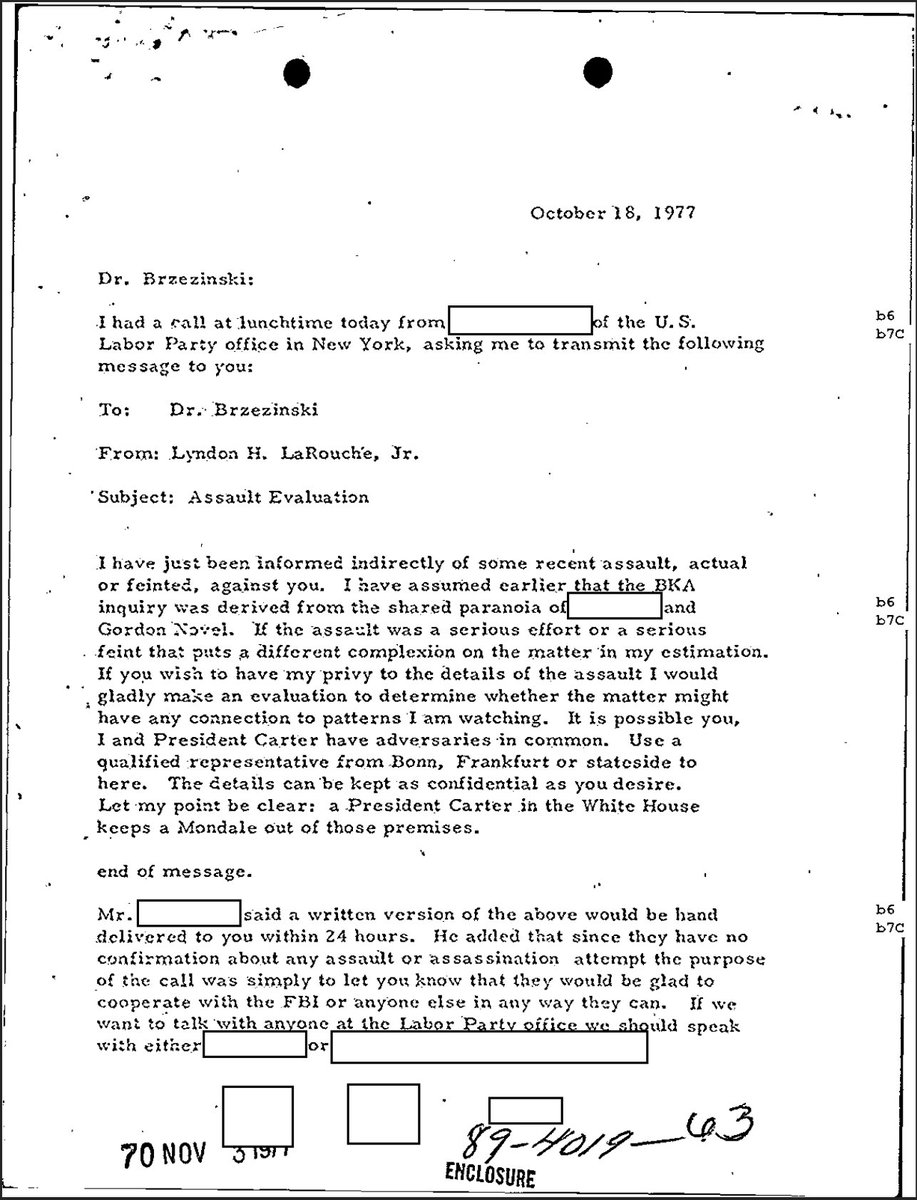
And to top it all off—this masterpiece of weaponized narcissism: LaRouche’s October 18, 1977 message to Brzezinski—delivered via a U.S. Labor Party operative in New York—reads like a Cold War fever dream. Equal parts false flag, unsolicited threat assessment, and unsolicited alliance offer, its peak LaRouche: evasive, insinuating, and cloaked in the language of self-aggrandized strategics.
Here is a man under investigation for an assassination plot, offering to help the target of the plot evaluate whether the threat might be credible. As if he’s just another actor in the loop. As if he belongs at the table. A historic artifact of delusion dressed in pseudo-diplomatic prose, with a side of veiled warning: A President Carter in the White House keeps a Mondale out of those premises. An epic relic of Cold War history.
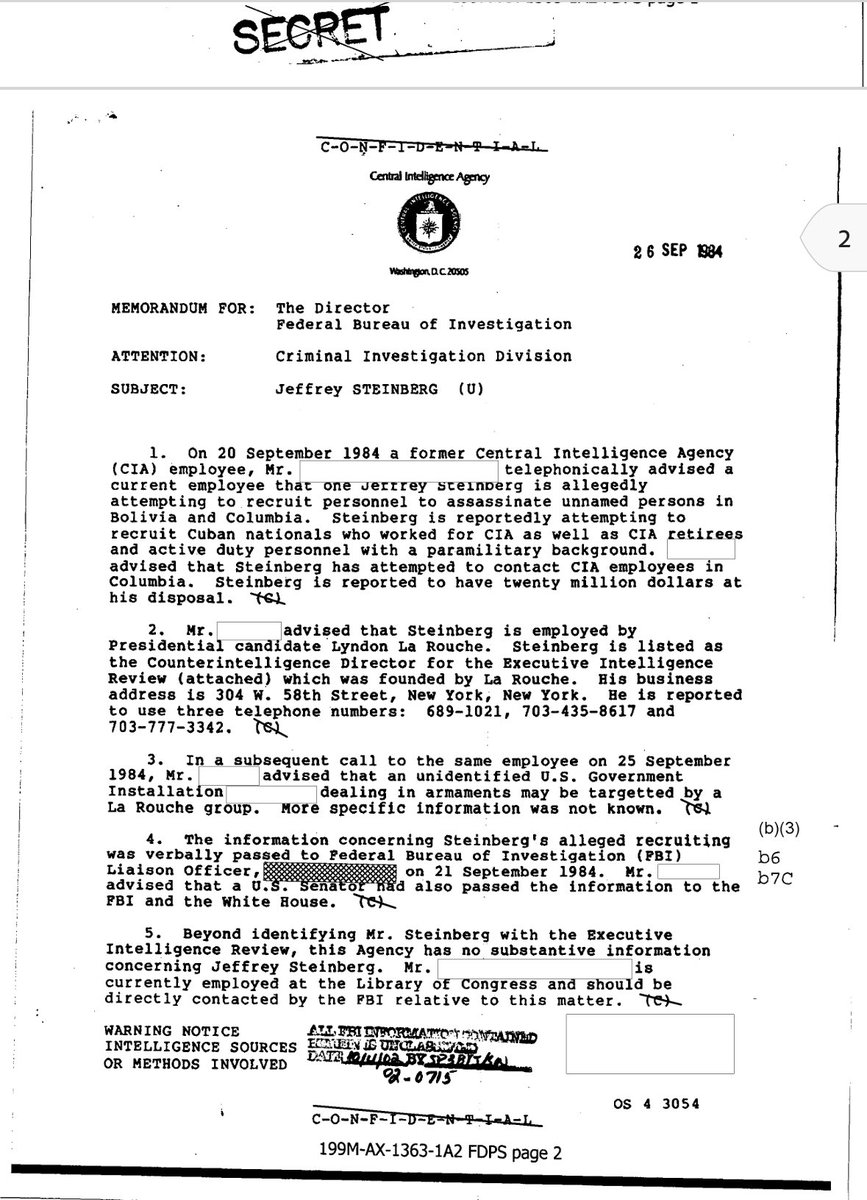
1984 CIA referal to FBI: “Jeffrey Steinberg is allegedly attempting to recruit personnel to assassinate unnamed persons in Bolivia and Columbia. Steinberg is reportedly attempting to recruit Cuban nationals who worked for CIA as well as CIA retirees and active duty personnel with a paramilitary background.”
Another previously uncovered report on LaRouche’s network involves an internal CIA memorandum dated 26 September 1984 referencing Jeffrey Steinberg’s alleged attempts to recruit paramilitary operatives for activity in Bolivia and Colombia—you can see clear continuity in the intelligence community’s concerns regarding LaRouche’s network well after Operation Last Chance.
The CIA memo shows that by the mid-1980s, elements within LaRouche’s organization (in this case, Steinberg, identified as “Director of Counterintelligence” for Executive Intelligence Review) had broadened their reach to alleged overseas paramilitary ventures in Latin America. This lines up with earlier glimpses from 1977 (e.g., Mitchell WerBell’s involvement) that LaRouche’s circle was courting mercenary or guerrilla ties. It reinforces the pattern of the group’s stepping beyond mere political or conspiratorial rhetoric into deeper, operationally-oriented realms.
Steinberg reportedly had “20 million dollars at his disposal” for these operations, indicating a claimed or actual financial reservoir big enough to fund large-scale paramilitary action. While the earlier Operation Last Chance was domestic in focus (i.e., an alleged plot against U.S. officials), this 1984 memo underscores the network’s appetite for global infiltration and mercenary recruitment—further hinting that LaRouche’s outfit saw itself as a quasi-intelligence agency rather than a mere fringe political group.
The CIA specifically shared the Steinberg intelligence with the FBI and the White House, indicating heightened interagency concern. The reference to a U.S. government installation “dealing in armaments” that might be targeted by LaRouche associates underscores a pivot from “offensive plotting” to espionage or infiltration activities. If Operation Last Chance in 1977 was a first big red flag, this 1984 Steinberg matter was a renewal of alarm: the puzzle remains consistent—LaRouche’s orbit harnessing paramilitary or intelligence-style outreach.
The CIA did not treat these claims as wholly baseless—a consistent theme. Though the memo’s author states the Agency “has no substantive information” on Steinberg personally beyond his position in LaRouche’s group, they nonetheless pass the allegations on to the FBI, underscoring that, in intelligence channels, “where there’s smoke, there may be fire.” This posture echoes the FBI’s stance in 1977—discomfort with the credibility or motives of the informant (in 1977, Gordon Novel) but also an imperative to run out the leads.
Central Intelligence Agency. (1975). Jeffrey Steinberg report [Declassified document]. CIA Reading Room. cia.gov/readingroom/do…
In a rare event on July 13, 2024, Mohammad Deif, the elusive and influential leader of Hamas’ military wing, emerged from tunnels in the Khan Yunis, his birthplace and stronghold, to meet with Rafa'a Salameh, the commander of the Khan Yunis brigade, in the vicinity of West Khan Yunis. According to Saudi sources, an intelligence coup within his inner security circle led to someone providing critical information about his movements to Israel. The ensuing operation, involving both signals intelligence (SIGINT) and such human intelligence (HUMINT), presented a rare opportunity for his elimination.
Speaking at the Palmachim Airbase, the IDF Chief of Staff, Lieutenant General Herzl Halevi, revealed today that the combined “advanced intelligence capabilities of the ISA and the Intelligence Directorate (J2) and the very high-quality planning and implementation capabilities of the Israeli Air Force” made the operation possible.
The operation was conducted with an extraordinary level of secrecy. To minimize the risk of a leak, the Israeli forces did not notify their U.S. counterparts about the operation. This rare level of operational security underlined the importance and high stakes associated with the mission to eliminate Deif.
Known for his elusiveness, Deif rarely emerged from his tunnels, making each appearance a rare and critical opportunity for Israeli intelligence. His complacency likely stemmed from ongoing hostage negotiations and the designation of West Khan Yunis as a safe zone. This sense of security led him to believe he could exploit a window to move freely in an area densely populated with 80,000 refugees, assuming the IDF would avoid targeting him there.
Israel had previously refrained from targeting Deif in the deep tunnels of Khan Yunis, wary he might survive such an attack. Salameh did not meet Deif in the tunnels to avoid compromising Deif’s hiding place. As the commander of Hamas’ military operations, Deif was issuing directives for continued activities in Khan Yunis, likely discussing another impending Hamas operation with Salameh.
Following the strike, Prime Minister Netanyahu shared in his press conference that, “At midnight, when the head of the Shin Bet presented to me the details of the operation, I wanted to know three things: that according to the intelligence there are no hostages in their vicinity, the extent of the collateral damage, and the type of weapons in the attack. When I received answers that reassured me, I approved the action.”
—— The Strikes
The initial strike precisely targeted the section of the building where Rafa'a Salameh and Mohammad Deif were located. A second bomb then demolished the entire structure. The IDF implemented a belt of fire around the strike sector to thwart any rescue efforts. A bunker-penetrating ordnance was deployed to ensure no escape via tunnels beneath the compound. This operation reportedly involved the largest amount of explosives ever used in an Israeli targeted elimination. The kill zone is estimated to have a 50-meter radius.
Videos from the scene depict individuals buried under three meters of dirt up to 40 meters away from the explosion. The primary cause of death was the explosive blast within a 100-meter diameter of the epicenter, while beyond that, some were buried alive by debris. Damage from debris extended as far as 100 meters from the strike epicenter.
“Mohammed Deif was afraid to die, so he hid in a way that even damaged his ability to command,” explained IDF Chief of Staff Lieutenant General Herzl Halevi in remarks delivered today. “He hid behind and sacrificed the people and civilians around him, using them as shields, though very few were harmed,” added the Chief of Staff.
There are rumors that Deif’s body is being held in a hospital in Khan Yunis. However, as Chief of Staff Halevi noted, “It is still too early to conclude the results of the strike, which Hamas is trying to conceal.”
The Chief of Staff emphasized that “according to the intelligence available to us at the time of the strike, there were no hostages in the compound. According to the information that emerged after the strike, no hostages were harmed.”
—— Implications
Mohammad Sinwar, the younger brother of Yahya Sinwar, the commander of the southern Gaza Strip, is expected to succeed Deif as the head of Hamas’ military wing. This event signifies a major blow to Hamas, with only the Sinwar brothers, the Rafah Brigade, and the Gaza Brigade remaining operational.
The death of Mohammad Deif impacts not only the operational capabilities of Hamas but also strikes at the heart of its symbolic and ideological strength. His ability to evade Israeli forces for decades added to his legendary status among Hamas’ ranks, and his elimination leaves a void that affects both the group’s morale and its operational coherence.
Beyond the immediate conflict, Deif was an iconic figure of the Palestinian cause internationally, with his name and image synonymous with the fight against Israeli occupation. His death is a global event with significant implications for the Palestinian narrative.
—— IDF Briefing
Chief of Staff Halevi asserted this evening, “We are determined to continue to pursue senior Hamas officials, those who planned and carried out the October 7 massacre, and dedicated their lives to the murder of innocents.”
“These eliminations are one part of the continuous and changing military pressure that the IDF is applying in all parts of the Gaza Strip,” added Halevi, stressing that these operations are “all supported by high-quality and up-to-date intelligence.”
“This is critical for the systematic dismantling of the Hamas terrorist organization; it is also very important for the creation of the conditions for an agreement to return the hostages,” said Halevi.
“We found him; we will also find those next in line,” vowed Halevi this evening.
—— Documentation of the Strike
Video footage of the strikes showed voluminous sand plumes flung tens of meters into the air from the elimination site.
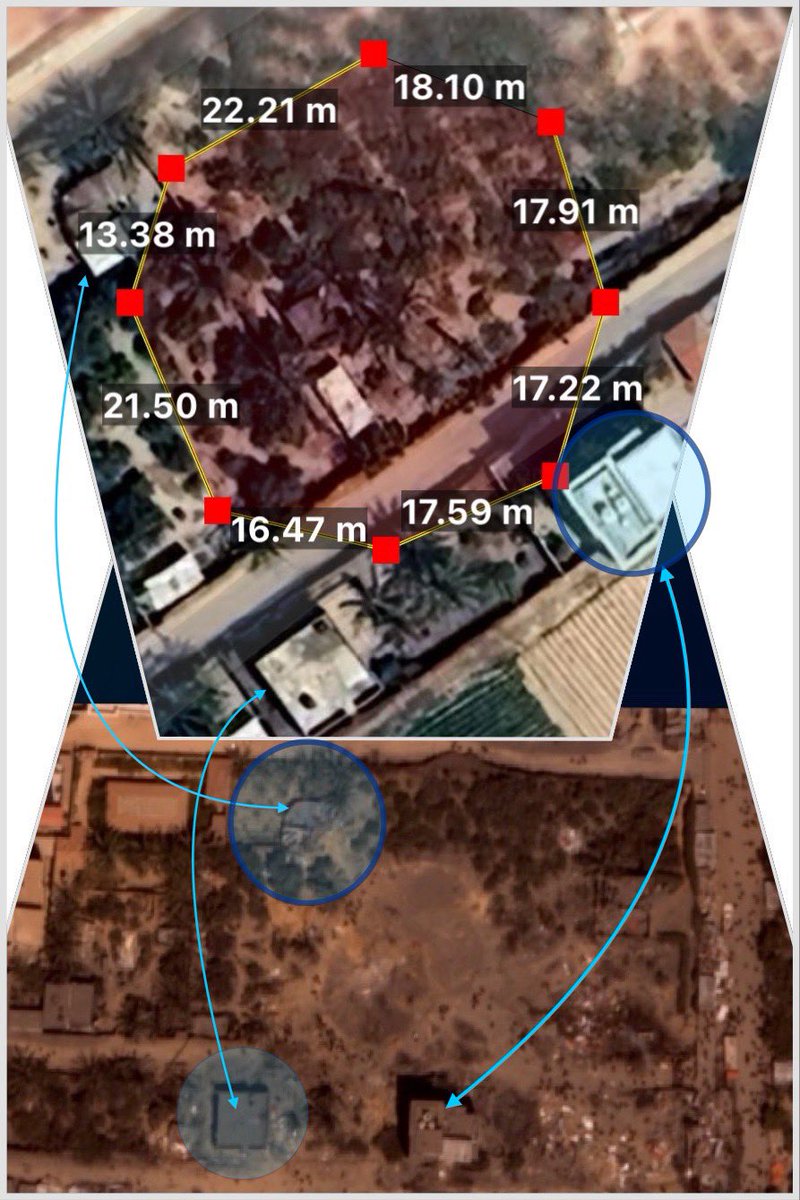
Note: Landmarks mapped in Image 1 reveal that the visible crater and immediate blast perimeters at the strike site comprise approximately 25 meters in radius, suggesting an immediate impact perimeter of 157.08 meters, with an area of 1,963.50 square meters.
Highlighted in Image 2 is a 50 meter radius, spanning significantly beyond the crater and visible blast perimeter, which the IDF’s released satellite imagery (Image 3) shows with intact structures.
This geospatial analysis does not support the assessment of an immediate blast impact with a 50 meter radius. Instead, it suggests a 50 meter diameter, or 25 meter radius as shown.
For side-by-side reference:
The left plate is the IDF’s officially released targeting satellite image, pre-strike.
The center plate is Google Earth's satellite imagery updated on 7/8/24.
The right plate is the IDF’s post-strike satellite imagery.
02:00 IST UPDATE: ICRC seen in bid to do damage-control over Hostage Crisis as widespread complicity in Hamas' Abuse of Humanitarian Norms, continues to unravel -November 23, 2023
The International Committee of the Red Cross (ICRC) is scrambling to do ‘damage control’ in the wake of findings implicating their organization and the World Health Organization (WHO) in concealing Hamas' use of Shifa Hospital for terror operations, as detailed in a New York Post article by senior analyst at FDD, Richard Goldberg earlier today [4].
The implications under international law, of key officials of these organizations' roles, and their complicity in running cover for Hamas operations in civilian humanitarian infrastructure, poses the serious risk of loss of protected status under the rules of armed conflict. Fabrizio Carboni, the Middle East regional director for the ICRC, is accused of spreading disinformation about the situation in Gaza hospitals. Similarly, the WHO is alleged to have pressured Israel to avoid Shifa Hospital, falsely claiming it was non-functional and that patients were dying as a consequence [4].
On Monday, November 20 Reuters and Times of Israel reported that the president of ICRC, Mirjana Spoljaric, flew to Qatar for face to face meetings with Ismail Haniyeh, who chairs Hamas' Political Bureau. Spoljaric subsequently held separate discussions with authorities from the state of Qatar. These meetings, later confirmed in statements by the ICRC, aimed to address the urgent protection of all victims in the conflict and to alleviate the difficult humanitarian situation gripping the Gaza Strip. The ICRC raised various issues with Hamas leadership seeking commitments pertaining to the release of hostages and the orderly evacuation of civilians from zones of active combat operations [2], [3].
This came on the heels of the IDF exposing a 55m long section of Hamas’ tunnel network under Al Shifa, and signaling the ‘next phase’ of Operation Iron Swords expanding to the South of Gaza and Khan Younis in its announcement last weekend by Israel Defense Minister Yoav Gallant [9].
Netanyahu and the Israel War Cabinet presented these developments as an assurance to the families of hostages that progress was being made, and to Israel's US allies as evidence of the criticality of IDF’s strategic move on Al-Shifa hospital in the preceding days.
Yesterday the IDF exposed the extent of the tunnel network under Al Shifa releasing an uncut 10 minute video of what appears to be a complex subterranean network extending hundreds of meters across Al-Shifa and the surrounding area. Meanwhile pressure mounted on the ICRC, UNWRA, WHO et al, to secure access to the hostages through its network of aid workers on the ground.
The ICRC stated that it has been actively seeking access to the hostages, in order to deliver medication, and facilitate communication between the hostages and external parties [3]. This is part of a critical provision for the hostage deal wherein Netanyahu and the Israeli War Cabinet are seeking to secure a certified list of the hostages, and direct confirmation of their status. However reports have been circulating that Hamas is refusing ICRC access to the hostages, to provide proof of life, and will not guarantee the hostages are delivered ‘alive’, the primary reason for news of the deal stalling yesterday. Israel's National Security Council chairman, Tzachi Hanegbi per the Times of Israel said yesterday “The negotiations for the release of our hostages are constantly progressing... The release will begin according to the original agreement between the parties, and not before Friday."
Amidst these revelations, and the growing risk of the deal failing, both the ICRC and the World Health Organization (WHO) have been frantically moving to amend their stance in relation to Hamas, following over a decade of what is emerging as complicity to conceal war crimes - namely the militarization of humanitarian infrastructure - and widespread humanitarian abuses in the Gaza strip. In a statement made Monday the ICRC distanced themselves from the process, seeking to clarify their role in the hostage crisis: “The ICRC is not a negotiator. We are a neutral and impartial humanitarian organization and do not take part in any negotiations or political deals between the sides” [6].
The ramifications are seismic for the ICRC, UNRWA, WHO and other NGO’s as they find themselves embroiled in one of the biggest hostage crises in history involving 240 multi national and Israeli nationals, and an historic scandal over widespread human rights abuses in a region where they had a free hand for over decade.
On the ground, the prospects of the deal remain uncertain. Hamas has lost many of its commanders and consequently have lost control over Gaza. There are other factions, like Islamic Jihad, and various gangs that are understood to have custody of the hostages. The leadership in Qatar are seen as unable to effectively control those groups through Yahya Sinwar, the chief of Hamas who is believed to be borrowed in subterranean infrastructure in South Gaza, Over the last 48 hours videos have emerging of ‘White Flag’ mobs stampeding through the streets of Southern Gaza chanting anti-Hamas slogans. Moreover, there is the challenge of how the ICRC can access every hostage in the midst of ongoing combat operations and IDF surveillance.
If Hamas cannot provide the ICRC with access to the hostages in order to provide proof of life, and refuses to guarantee the hostages are delivered alive, then the deal may continue to stall. A prospect which Netanyahu and his government have been trying to convey to its US counterparts and the families of hostages in Israel, knowing from experience how uncertain a deal was to materialize with Hamas.
As of the latest update the Qatari foreign ministry announced that a hostage deal between Israel and the Gaza-based Hamas terrorist group would begin at 7 a.m. on Friday [6].
Shortly after the Prime Minister's Office released a statement on behalf of the Office-Coordinator for the Hostages and Missing, Brigadier General Gal Hirsch:
“Pursuant to the arrival of a list of the names of the hostages who are due to be released first in the first stage of the outline that has been agreed upon, liaison officers have informed all of those families whose loved ones appear on the list, as well as all of the hostages' families..” [7].
The first 13 hostages much anticipated release on Friday Gaza 4 PM remains uncertain as Jerusalem Post reported 4 hours ago:
“On Thursday evening IDF Spokesperson R.-Adm. Daniel Hagari noted that no aspect of the hostage deal is set in stone "until it happens...it is subject to changes," he said in a daily briefing as Israel vehemently rejected a Hamas demand for Israeli forces to retreat and withdraw from the Shifa Hospital in Gaza, N12 reported on Thursday. As per the report, the Palestinian terrorist group's request came as a last-minute demand in the Qatar-mediated deal to release some 13 hostages for four days of ceasefire in the Strip” [8].
"Prime Minister Benjamin Netanyahu held a security discussion with members of the War Cabinet, this evening, at the Kirya in Tel Aviv."
X Press Link:
As of the time of this writing the agreement is set to go into effect in 5 hours at 0700 IST
RELATED ARTICLES:
- IDF MOUNTS PRESSURE FOR THE RELEASE OF HOSTAGES AS NEGOTIATIONS STALL OVER 5 DAY TACTICAL PAUSE - November 18 2023
- OPERATION IRON SWORDS DAY 43 | DEFENSE MINISTER ANNOUNCES ‘NEXT PHASE’ - November 19 2023
---
Sources/Citations
---
1. Times of Israel - 2. Reuters - 3. ICRC - 4. How many aid groups knew Hamas was hiding in a hospital and lied about it? - The NY Post
5. ICRC - The ICRC is not a negotiator. | … 6. Qatar Foreign Ministry - … 7. Prime Minister’s Office Israel - 8. Jerusalem Post - Israel rejects Hamas ceasefire demand to evacuate Gaza's Shifa - report
9. @danlinnaeus - OPERATION IRON SWORDS DAY 43 | DEFENSE MINISTER ANNOUNCES ‘NEXT PHASE’
*Not an endorsement of the view being reported: I was in a space with a Palestinian journalist this weekend who had some unique albeit coherent views on the Gaza situation. Among many interesting points, he made the arguably controversial remark that, in his view, the IDF should not enter Southern Gaza after the anticipated 4-5 day pause. When asked why, he explained his conviction that the citizens will now revolt against Hamas and remove them, themselves, and that this uprising would lead to markedly superior outcomes for Israel and the hostage situation. This interesting video was posted yesterday afternoon.
As a result of Oct 7 Hamas must be cleared from Gaza. IDF split Gaza from Negev to sea, as they did in 2014, and this was declared with 6 million leaflets dropped, and more than 20,000 direct calls made to citizens leading up to tactical air strikes and ground operations.
The tactical criticality of this split is clear: to collapse Hamas’ tunnel network, isolate combatants and shut down Hamas’ military capability in the Northern Gaza zone, thereby moving one step closer to securing the civilian areas in the vicinity of the Israeli border so their communities can begin to rebuild: the world forgets the 250,000 Israelis currently internally displaced who cannot return to rebuild their homes, or bury their dead in their hometowns. But Israel and the IDF will not.
Hamas has consistently prevented Gaza civilians from evacuating, executing them as collaborators. I refer you to the massacre on Al Rasheed beach of Nov 3rd where Hamas massacred dozens of civilians, when they abandoned their blockade to the south as IDF forces began to move into Gaza.
The tragic consequences you see scattered in media clips and photos are the direct result of Hamas’ strategy and the stated desired result of Hamas’ officials. They have made numerous statements to this effect regarding their stance on the protection of Gaza civilians which can be (much too briefly) summarized as follows:
1. Mousa Abu Marzouk stated that Hamas' tunnels in Gaza are for protecting its members, not civilians, aligning with their strategy of using civilians as human shields [#1].
2. Abu Marzouk argued that protecting Gaza's refugee population, comprising 75% of its people, is the UN's responsibility, not Hamas's, and mentioned Israel's obligations under the Geneva Convention [#2,#3].
3. Yahya Sinwar admitted during a 2016 uprising that Hamas uses women and children as human shields [#4].
4. Hamas leadership instructed civilians to ignore IDF evacuation advice, using them to shield against Israeli attacks [#5].
These so called “leaders” of the Gaza people, who have not held an election since 2006, collectively stole $11bn in funds and live in luxury in London and Doha and elsewhere, but they did not spend $1 to build a bomb shelter for their people; and they openly call for the blood of their own people, while directing their men to execute ‘collaborators’ who do not wish to be martyred preferring to evacuate to safer areas.
They do this strategically and precisely so that their bots and ignorant fanatics can post these devastating images of slain and maimed civilians on the internet in order to pressure the international community to act against Israel. This is what the Jihadis support. This is who they are.
They think the world is blind and stupid, but to many they are like ostriches with their heads in the sand. Their rear end sticks out like a sore thumb for the whole world to see, with the embarrassing exception of the Global Left; the world sees them. The world knows them. And mark my words, the world will scrape the depravity of Hamas from its shoe on the sidewalks of history and march forward without them.
To all those who cannot or will not wake up and snap back to reality in understanding the depth of the nefariousness western civilization now faces, preferring to grand stand for a sectarian death cult, so be it. So be it.
But note carefully that in the last few days the IDF reiterated their objective to clear Hamas from the strip and issued public calls to evacuate Khan Younis to designated safe-zones. Listen to them. They are prosecuting a war as per their mandate to the State of Israel and its people, and they will not falter to complete their mission, without compromise, without half measures. Policymakers and the public must face reality and move decisively to pressure Hamas to let civilians evacuate accordingly.
War is hell. It is morally repugnant to contribute in any manner to making it more so.
Sources: 1. Hamas officials admit its strategy is to use Palestinian civilians as human shields - FDD 2. WATCH: Hamas Official Says Group Doesn't Give Civilians Shelter Because That's the UN's Job - Free Beacon 3. Top Hamas official declares group is not responsible for defending Gazan civilians - The Times of Israel 4. Hamas officials admit its strategy is to use Palestinian civilians as human shields - FDD 5. Hamas officials admit its strategy is to use Palestinian civilians as human shields - FDD
BREAKING | Israeli Defense Minister Yoav Gallant issues statements regarding the next stage of the operation in the Gaza Strip, announcing that the Israel Defense Forces had completed the capture and clearing of the western part of Gaza City, removing Hamas operatives and assets from the area. This accomplishment marks the beginning of the "next phase" of the operation[#1].
During a situational assessment briefing with the IDF Deputy Chief of Staff and other senior officers, Gallant updated findings at the Al-Shifa hospital in Gaza. The IDF has identified evidence of significant underground infrastructure beneath the hospital compound which are not currently cleared, as well as information suggesting a connection between Hamas activities in the hospital and Hamas’s hostages.
Gallant emphasized the IDF's coordination between air, sea, and land forces, supported by comprehensive intelligence, underscoring the mission criticality of expanding the operation, increasing pressure on Hamas, and neutralizing their infrastructure, operatives, and leadership to enhance the odds of returning abductees. Galant concluded by asserting that force is the only modality understood by Hamas [#2].
Gallant’s statements reflect a strategic shift in the IDF's approach to the conflict in Gaza, focusing on rapid response to urban reconnaissance , precision force multiplication, and counter-insurgency ground operations to achieve their objectives, while signaling a tactical reconnoiter southward of IDF in expanding operations.
### Sources/Citations 1. Gallant: IDF has cleared out western Gaza City, moving to 'next phase' of ground operation - The Times of Israel, [URL]()