Dr Helen Fry | WWII Historian Profile picture
Jun 30, 2025 7 tweets 4 min read Read on X
As British Forces pushed past Bayeux, the grim task of burying thousands of fallen Allied soldiers in Normandy commenced.

Harry Rossney painted war cemetery signboards and carved inscriptions on numerous graves.

This was the reality of his duties:
(🧵) Image
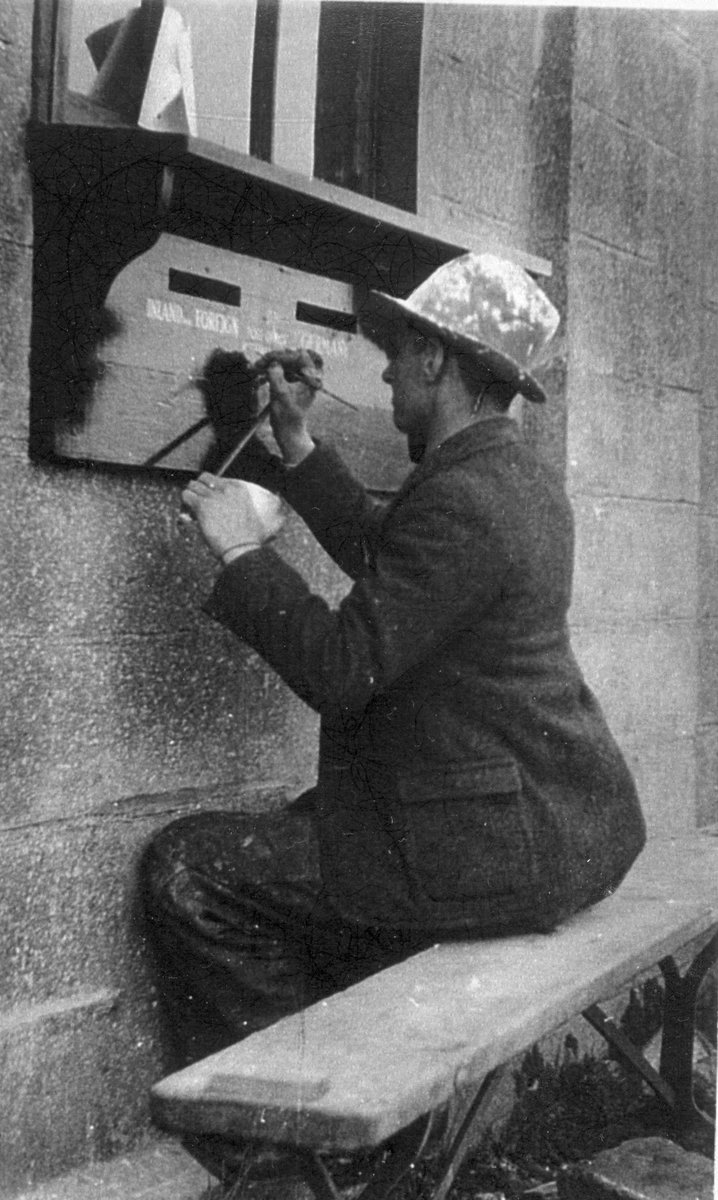
The harsh realities of war were ever-present for Harry Rossney, a sign-writer by trade, who moved from 93 Company of the Alien Pioneer Corps to 32 Graves Registration Unit in Bayeux.

He oversaw and trained the workforce tasked with sign-writing temporary grave markers, later replaced by white stones from the Imperial War Graves Commission (now the Commonwealth War Graves Commission).

Rossney also hand-painted large signboards for war cemeteries across Normandy, including Bayeux, Ranville, and Hottot.

(continued)Image
He describes that period:

"I was ordered to join 32 Graves Registration Unit (32 GRU) in Bayeux immediately. No argument, no requests, no alternatives. With heavy heart I left my old mates of 93 Company – this oasis of fellow Jewish-German and Austrian refugees who understood and felt the same, had the same outlook, accents and humour.

I felt shattered and very alone. When they told me what I had to do, my heart sank to my boots. Bury the dead. Create a workshop to paint white metal crosses and sign-write every dead soldier's name, number, regiment and religion. We came face-to-face with the price of war each and every day. But someone had to do it. The dead numbered in their thousands."

(continued)Image
"Our unit, which was responsible for about eighteen British war cemeteries, occupied a single-storey house with garage, garden and space behind. It consisted of a handful of selected specialists, local French labourers and a dozen German POWs.

Tools were in short supply, so the POWs made their own brushes and rulers. Two other German refugees joined our unit, a non-Jewish artist Walter Nessler who had refused to toe the Nazi party line, and Jack Dalton, originally a paint-sprayer.

I made it my business to hand-letter every big nameboard for each cemetery, white lettering on black, large enough to be seen from a clear distance."

(continued)Image
"One day whilst in Normandy, close to Hottot, one of our cemeteries, I stumbled across a hastily dug shallow grave with a small wooden cross, and a German helmet with a neat sniper's bullet hole in the temple. The name read 'Heinz Brand'. I was shocked. It was none other than my school friend from Berlin. He had been no Nazi, but had obviously fought in the German Army."

(continued)Image
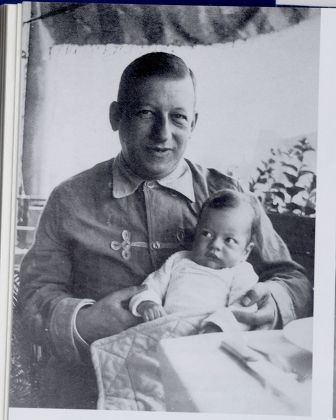
Harry Rossney, one of 10,000 German Jews who fought for Britain in WWII, later engraved temporary wooden crosses for fallen soldiers buried in places like Bayeux. He performed this duty daily for a year, paying tribute to the fallen.

Proud of his six-year service in the British Army, Harry found the loss of so many young lives deeply harrowing. As a Jew, he faced the painful irony of his Christian cousins dying for Hitler at Stalingrad.

Though Harry is now gone, his wartime contributions and artistic legacy in honouring soldiers in British war cemeteries in France endure.

(continued...ending)Image
Did Harry Rossney’s story of tending war graves resonate with you?

If his wartime experiences taught you something new, please consider following me @DrHelenFry for more authentic WWII stories.

I have plenty more to share.

(end). Image

• • •

Missing some Tweet in this thread? You can try to force a refresh

 

Keep Current with Dr Helen Fry | WWII Historian

Dr Helen Fry | WWII Historian Profile picture

Stay in touch and get notified when new unrolls are available from this author!

Read all threads

This Thread may be Removed Anytime!

PDF

Twitter may remove this content at anytime! Save it as PDF for later use!

Try unrolling a thread yourself!

how to unroll video
  1. Follow @ThreadReaderApp to mention us!

  2. From a Twitter thread mention us with a keyword "unroll"
@threadreaderapp unroll

Practice here first or read more on our help page!

More from @DrHelenFry

Jan 22
Curt Ascher was one of Hitler’s few serious political opponents during the 1930s.

On 2 October 1937, Curt was taken to Dachau concentration camp.

This is that tragic story:
(🧵) Image
On 2 October 1937, Curt was taken to Dachau concentration camp, a little over five miles north-west of Munich.

His name is listed in the camp Zugangsbücher (intake books) as prisoner number 12792. These books are now held at the National Archives and Records Administration in Washington, DC.

The entry shows that he was born on 12 December 1882 in Glatz–Oberschlesien and imprisoned in Dachau on 2 October 1937.

(continued)
Dachau was the first concentration camp to be built, in 1933 on Hitler’s instructions, initially for political opponents of the regime, who were kept there for ‘their own protective custody’. It was set up to act as a deterrent to scare the German people into submission to the Nazi ideology; few survived it.

Surrounded by a barbed-wire electric fence, watchtowers and a moat, the complex consisted of stark lines of huts, a parade ground and a disinfectant hut for clothing. It had a prison (which became known as the ‘bunker’), a prison yard and a whitewashed wall against which many prisoners were shot.

The camp commandant, Theodor Eicke, ran a brutal regime under squads of SS death’s head units. There was a strict daily schedule with harsh punishments for the slightest step out of line. Until 1938, most inmates were, like Curt, political prisoners of the state – mostly communists and social democrats.

(continued)
Read 9 tweets
Jan 12
Jane Sissmore, MI5’s first female officer, led its Soviet espionage unit by 1929.

Her MI6 career was derailed when double agent Kim Philby sidelined her, fearing she would expose his treachery.

Let's explore:
(🧵) Image
Kathleen Jane Sissmore, later Mrs Archer, joined MI5 as a clerk in 1916 at 18, rising swiftly due to her determination.

Described as ‘a strong character, very straight, well-principled, industrious’ by her headteacher, she trained as a barrister while working full-time.

Her organisational skills earned her an MBE in 1923, and by 1924, she was called to the Bar.

In 1928, she became controller of MI5’s Registry, a remarkable feat in a male-dominated field.

(continued)
By 1929, Sissmore led MI5’s Soviet espionage department, earning praise from Vernon Kell in 1935 for her ‘brilliant and devoted efforts.’

Marrying Wing Commander John Archer in 1939, she became MI5’s only female officer during wartime.

In 1940, her interrogations of Soviet defector Walter Krivitsky at London’s Langham Hotel produced a model report, offering MI5 its ‘first insight into the machinery of the Russian Secret Service.’

(continued)
Read 7 tweets
Jan 7
At only 19 years old, Joan Miller went from an ordinary typist job to being recruited as a spy by MI5 in 1939 to infiltrate the Right Club.

From Wormwood Scrubs’ grim cells to Blenheim Palace, she outsmarted fascists by posing as one of their own.

This is her story:
(🧵) Image
Nineteen-year-old Joan Miller, from an affluent background, faced a challenging childhood with socialite parents who gambled away their wealth and later divorced.

Raised by nannies and educated at boarding school, she spent holidays with relatives. After school, she worked as a typist at Elizabeth Arden, rising to the advertising department.

Recruited to MI5 in 1939 by school friend Janet Withers, Miller joined the Registry, tracking subversive individuals and groups.

(continued)
In September 1939, Miller joined MI5’s transport section and was relocated to its secret headquarters at Wormwood Scrubs prison, moved from Thames House due to invasion fears.

The prison’s grim conditions—unventilated cells with lingering odours—tested staff morale. To cope, a ladies’ hairdresser visited, and women were allowed trousers due to open staircases.

By October 1940, MI5 shifted to Blenheim Palace, dubbed ‘the country office’, offering a stark contrast.

(continued)
Read 6 tweets
Jan 6
Countess Yvonne de la Rochefoucauld worked for SOE’s F Section during WW2.

She and her husband were both arrested—he died in a Nazi prison camp, while she survived brutal torture.

She was awarded Britain’s King’s Medal for Courage.

This is her remarkable wartime story:
(🧵) Image
Countess Yvonne de la Rochefoucauld was a French civilian working for SOE’s F Section.

In 1940, while serving in a French hospital, she was arrested and imprisoned by the Germans.

Released the following year, she immediately joined the resistance in Normandy—using her skills as a doctor to treat many wounded airmen near her home.

(continued)
In January 1943, Yvonne de la Rochefoucauld joined the Robin circuit as courier & liaison officer—transporting arms and explosive switches.

Back in her Paris flat, she sheltered British escapers and SOE W/T operator “Justin” (Capt. G.A. Cohen), helping him decode messages. During his transmissions, she stood watch for German patrols.

In July 1943, she made a sacrifice: allowing herself to be arrested so that he could safely escape back to England.

(continued)
Read 8 tweets
Jan 3
In 1938, a rogue pilot, his girlfriend, and a hidden camera flew over Nazi Germany—and changed spycraft forever.

Their images, taken from a hangar near London, laid the foundation for modern intelligence.

This is the story of Sidney Cotton:
(🧵) Image
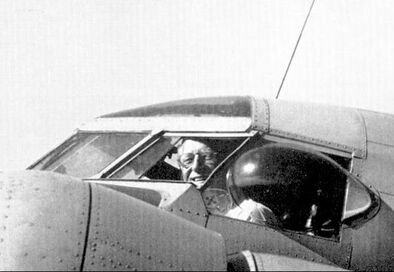
In 1938, MI6 recruited Sidney Cotton to pioneer aerial reconnaissance of Germany’s rearmament.

He set up his fledgling unit in a hangar at Heston Airfield, west of London.

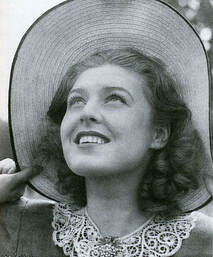
His girlfriend, Pat Martin (pictured), a skilled photographer, joined him on covert flights over Germany, capturing images of military sites critical to British intelligence.

(continued)Image
Throughout late 1938 and into 1939, Cotton revolutionised photographic reconnaissance and overhauled the organisation of photo interpretation.

He pioneered the recruitment of civilian women as photographic interpreters (PIs) for this demanding, high-stakes analysis.

(continued) Image
Read 7 tweets
Dec 21, 2025
Operation Valkyrie was the 1944 plot to assassinate Hitler with a bomb hidden inside a briefcase.

Agent Rita Winsor and defector Otto John met in Lisbon's shadowy streets at night to plan the attack.

The attempt was unsuccessful.

Here's what happened:
(🧵) Image
New information in declassified files sheds light on one particular complex MI6 operation from Lisbon that involved Rita Winsor, the defector Otto John (an MI6 asset) and the plot to assassinate Hitler in July 1944.

Otto John, a lawyer working for the German airline Lufthansa, used his position to fly to Lisbon and elsewhere, to meet his British handlers Rita Winsor and Graham Maingot, without suspicion.

Codenamed Whiskey, Otto John had already met twelve times with them in the two years leading up to Operation Valkyrie.

He is believed to have acted as an intermediary between the German resistance chief Colonel Georg Hansen and MI6.

(continued)
One night during 1944, in a quiet back street of Lisbon, Rita Winsor, as a handler of German defectors, collected Otto John and drove him around the dark, dimly lit streets of the Portuguese capital.

He explained to her about a planned assassination of Hitler for July 1944.

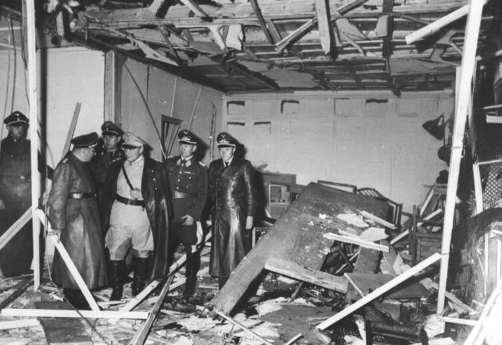
Winsor heard from him how a growing number of prominent anti-Nazis in Germany were planning Operation Valkyrie, an assassination plan to be carried out whilst Hitler was meeting at the Wolf’s Lair, his headquarters on the Eastern Front, near Görlitz (now in Poland).

(continued)
Read 7 tweets

Did Thread Reader help you today?

Support us! We are indie developers!


This site is made by just two indie developers on a laptop doing marketing, support and development! Read more about the story.

Become a Premium Member ($3/month or $30/year) and get exclusive features!

Become Premium

Don't want to be a Premium member but still want to support us?

Make a small donation by buying us coffee ($5) or help with server cost ($10)

Donate via Paypal

Or Donate anonymously using crypto!

Ethereum

0xfe58350B80634f60Fa6Dc149a72b4DFbc17D341E copy

Bitcoin

3ATGMxNzCUFzxpMCHL5sWSt4DVtS8UqXpi copy

Thank you for your support!

Follow Us!

:(