APOLLO 13 was released 30 years ago today. One of the most popular films of Tom Hanks, and a huge hit on its release, the tale of how the film came to the screen is worthy of the extraordinary real life mission…
1/36
1/36


In 1994, “Lost Moon: The Perilous Voyage of Apollo 13” published, written by Jeffrey Kluger and astronaut Jim Lovell. It was an account of Lovell’s experiences aboard Apollo 13, a spaceflight that malfunctioned leaving the crew in a fight for survival to get back to Earth.
2/36
2/36


A bidding war was sparked between Hollywood studios before the book was even published, and Ron Howard’s Imagine Entertainment won the rights. Howard took it to Universal and pre-production started, with Howard as director.
3/36
3/36


Jim Lovell had known of the potential of a movie adaptation and liked the idea of Kevin Costner playing him. As such, screenwriters William Broyles Jr and Al Reinert wrote the script with Costner in mind as Lovell.
4/36
4/36


Howard wasn’t interested in Costner. John Travolta asked if he could play Lovell, but Howard wasn’t interested in that, either. Knowing Tom Hanks was an Apollo space mission buff, he sent him the script. Hanks liked it and accepted the role.
5/36
5/36


When Hanks joined the cast, the real Lovell sent him a telegram saying “Welcome aboard Apollo 13.” And Lovell’s wife, Marilyn, has said Hanks’ mannerisms in the film are exactly like the real Jim.
6/36
6/36


Hanks wanted the film to be accurate to the smallest detail. One day, he dragged Howard and producer Brian Grazer out of bed so to watch an astronaut crew in action. Howard was not happy when he realised Hanks just wanted to watch walk across a parking lot.
7/36
7/36


Ron Howard wanted Gary Sinise in the film and said he had his pick of any of the astronauts aside from Lovell. He chose Ken Mattingly, the astronaut left behind due to German measles. Sinise said he chose that character as the crew wouldn’t have got home without him.
8/36
8/36


John Cusack, Charlie Sheen and Michael Keaton were all considered as astronaut Fred Halse before Howard screen tested Bill Paxton and decided to go with him.
9/36
9/36


In casting the youngest member of the crew Jack Swigert, Val Kilmer turned the part down. Brad Pitt turned the part down to make Se7en. Howard asked Kevin Bacon, and he accepted.
10/36
10/36


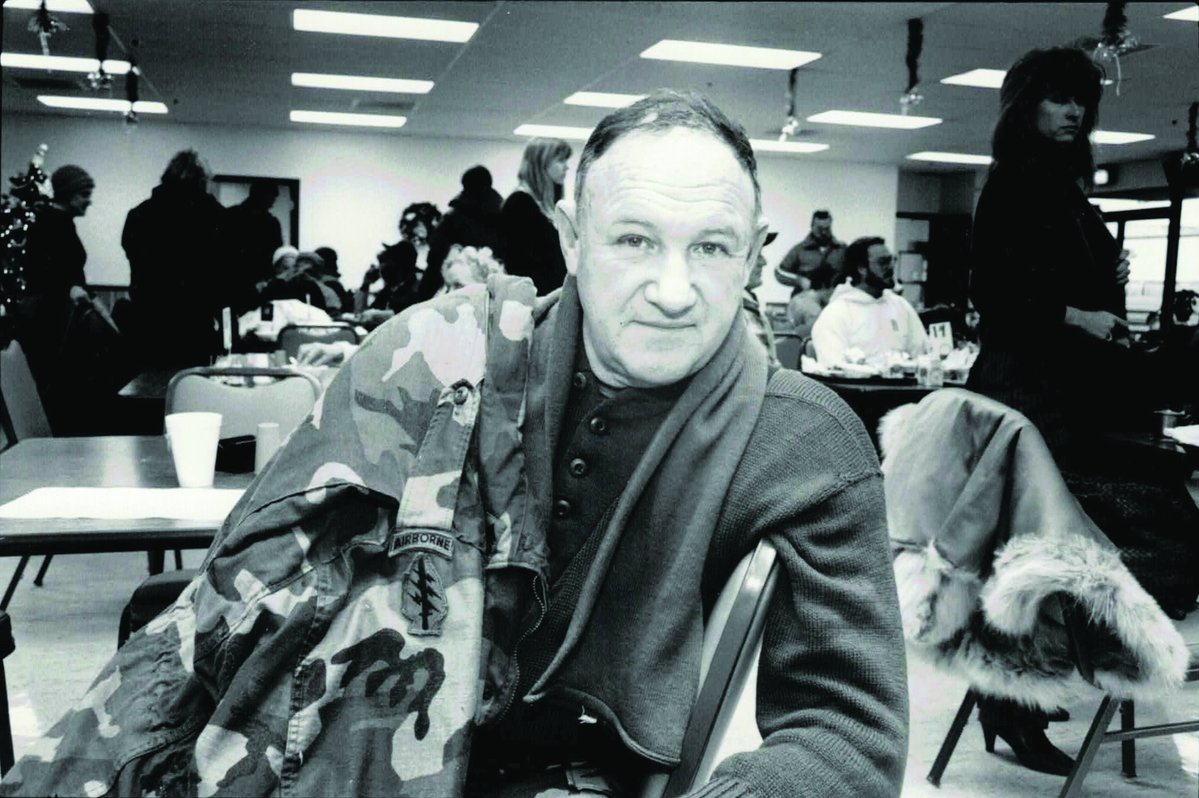
Ed Harris initially turned down the part of Flight Director Gene Kranz as he didn't see what he could bring to the part. Howard called him and passionately explained the importance of the character, and Harris accepted.
11/36
11/36


With the cast in place, Howard had John Sayles do rewrites based on his and Hanks’ feedback. Sayles brought in personal elements like the scenes with Lovell's mother in the nursing home.
12/36
12/36


The writers took some lines directly from mission transcripts. With the line “Houston, we have a problem” what happened was Swigert said “Okay Houston, we’ve had a problem here.” When control asked him to repeat Lovell said “Houston, we’ve had a problem.”
13/36
13/36


Howard later said some commenters had criticised the “hokey, Hollywood moment” when Marilyn Lovell loses her wedding ring. However, this actually happened, and Marilyn said she recovered the ring.
14/36
14/36


It was a family affair for Ron Howard. His brother, Clint Howard, played the role of flight controller Seymour Liebergot. His father played a priest, his mother played Jim Lovell's mother, and his wife and daughter (Bryce Dallas Howard) were crowd members.
15/36
15/36


There some issues. The cost of the spacesuits went over budget to $30k each and 3 days of production were lost when the software which controlled the monitors in the Houston control room crashed and wouldn’t work properly.
16/36
16/36


In the film, Jim’s daughter Barbara is upset because of the breakup of the Beatles, which happened three days before the mission. Howard was refused the rights to The Beatles though, so Barbara listens to Jimi Hendrix instead.
17/36
17/36


Another musical reference, the crew plays Spirit in the Sky after the launch. In real life they actually listened to Also Sprach Zarathustra from Stanley Kubrick's 2001: A Space Odyssey. The film also inspired the name of their command module, Odyssey.
18/36
18/36


At the Lovells' Apollo 11 landing party, Pete Conrad jokingly congratulates Lovell, Haise and Mattingly for their jobs as Apollo 11 backup crew. In real life, Lovell and Haise were the backups for Neil Armstrong and Buzz Aldrin for the iconic moon landing.
19/36
19/36


The Time Magazine 'Men of The Year' cover we see is a real magazine, covering Apollo 8 orbiting the moon. However, it has been edited, replacing the original image of Lovell with one of Tom Hanks. The other astronauts are unchanged.
20/36
20/36


The Senator questioning Lovell about the cost of the space program is played by played famous producer Roger Corman. Corman gave Howard his break in films by producing Howard’s first feature as director, Grand Theft Auto.
21/36
21/36


The Mission Control set was a carbon copy of the original. Howard wanted to film in the original Mission Control room in Houston, now a historic landmark. Unfortunately, it was too small to be used for a film production.
22/36
22/36


Production designer Michael Corenblith and his team took precise measurements of every part of the room and replicated it in Hollywood. One of the real flight controllers, Jerry Bostick, left the set one day looking for the elevator, forgetting it wasn’t real.
23/36
23/36


To simulate weightlessness in the module, Howard thought about using wires and harnesses, until his pal Steven Spielberg suggested he look into the KC-135, a NASA-owned plane that creates zero gravity by manoeuvring 45 degrees up and then plummeting.
24/36
24/36

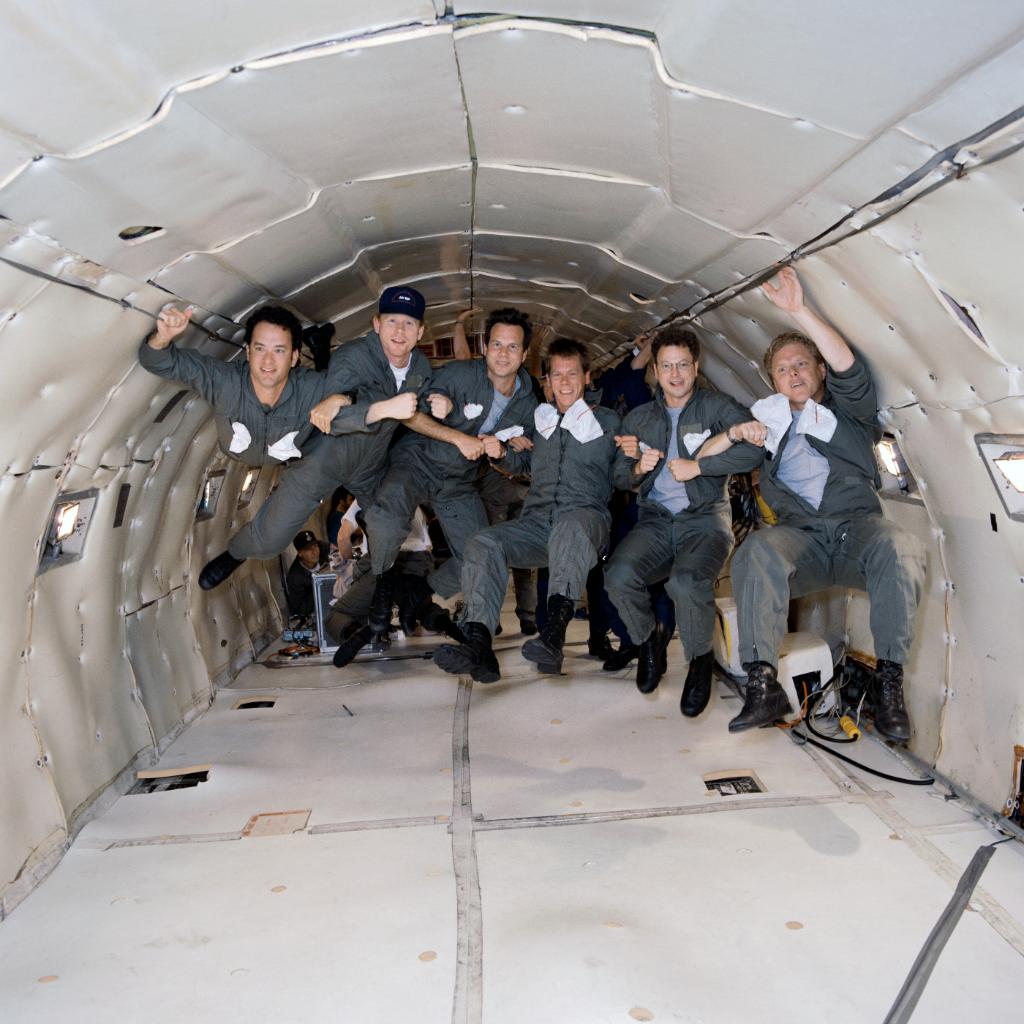
Filming in the zero-gravity plane could only happen in 25 second bursts. The plane performed 612 dives, giving filmmakers 54 minutes of footage in a weightless environment. For some scenes the actors sat on see-saws that created an illusion of no gravity.
25/36
25/36
The plane was given the nickname “The Vomit Comet.” Fred Haise really did throw up in space from the effects of a virus. They created this using Beef-a-Roni for vomit. And, after losing a bet with Hanks, Paxton ate what was left in the can.
26/36
26/36


There was some great miniature and models effects work done on the film too.
27/36
27/36
Astronaut Tom Jones was a consultant on the film. He told Howard the argument between Haise and Swigert would never happen, but Howard said "in showing a tense moment in a film, we can only show a sweaty forehead so many times".
28/36
28/36


Ron Howard says Apollo 13 is his favourite film of his, and the launch the sequence he’s most proud of: "I think as a filmmaker, that might be the most cinematic thing I've done." After seeing the film, Buzz Aldrin asked him Howard if NASA could use footage of the launch.
29/36
29/36


In some scenes where Earth can be seen from the windows of Apollo 13, Howard used real photos taken by Lovell and Bill Anders on the Apollo 8 mission. When Lovell saw the film, he found it so convincing, he thought Howard had uncovered secret NASA footage.
30/36
30/36


Ed Harris said he based his portrayal of Gene Kranz's reaction to the astronauts' survival on an interview with the real Kranz who, even decades later, started to break down when he talked about it.
31/36
31/36


The Captain of the U.S.S. Iwo Jima who shakes hands with Lovell is played by the real Jim Lovell. Howard asked Lovell if he'd like to be in the film as the ship's Admiral and Lovell agreed but "I retired as a Captain; a Captain I will be" and wore his old uniform.
32/36
32/36


After a test screening, an audience member left a comment card which said the film treat the audience with "total disdain" with its "typical Hollywood" ending. “Terrible. More Hollywood BS. They would never survive” the card said.
33/36
33/36
On a budget of $52m, the film grossed a whopping $355m so was a huge success. It was the number one film in the United States for three weeks and nominated for 9 Oscars. Ron Howard’s most successful movie.
34/36
34/36


Things turned out okay for the two Jim Lovell’s too. Because it was shown in the film, the real Lovell’s checklist book sold for $388,375 in a 2011 auction. And in 1996, Tom Hanks had an asteroid named after him – the 12818 Tomhanks (1996 GU8).
35/36
35/36


To finish, some great behind the scenes pics from Apollo 13…
36/36
36/36


If you liked our story on the making of APOLLO 13, please share the opening post😀
https://x.com/ATRightMovies/status/1939623192890388641
Our latest podcast is on THE BRIDGE ON THE RIVER KWAI. Full of big laughs and opinions so please give it a listen😀
alltherightmovies.com/podcast/the-br…
alltherightmovies.com/podcast/the-br…
• • •
Missing some Tweet in this thread? You can try to
force a refresh