BACK TO THE FUTURE was released 40 years ago today. One of the most beloved movies of the 1980s, and the film that made Michael J. Fox a movie star, the behind the scenes story is pretty heavy…
1/45
1/45


Robert Zemeckis and Bob Gale had been long time filmmaking collaborators since meeting at USC film school. By the early 1980s they had two movies under their belt but were looking for a big hit.
2/45
2/45


Rummaging round his parents’ basement one weekend, Gale came across his dad’s old high school yearbook and wondered if they would’ve been friends as 17 year olds. He mentioned this to Zemeckis who, keen on the idea of a time travel tale, thought it had potential.
3/45
3/45


Zemeckis and Gale fleshed the idea out into a story: a high school kid is thrown back in time; he meets his parents; his mother falls in love with him. They pitched the idea to Columbia Pictures president Frank Price, and he commissioned them to write a screenplay.
4/45
4/45


They wrote a script and called it Back To The Future, but Columbia rejected it. Zemeckis and Gale showed the script to the Exec Producer of Used Cars – Steven Spielberg. He said “It was unusual but based on principles like family and the generation gap. It was terrific.”
5/45
5/45


Spielberg wanted his production company, Amblin Entertainment, to make the film, but Zemeckis and Gale didn’t want to become known as the guys who only only got jobs because they were friends with Steven Spielberg. Instead, they sent it round every studio in Hollywood.
6/45
6/45


Columbia said it was “Too sweet.” Universal said “Time travel movies don’t make any money.”And Disney said it was “Too incestuous.” In total, the script for Back To The Future was rejected by studios 44 times.
7/45
7/45


Unable to sell the script, Zemeckis got a job directing Romancing The Stone. It was a big hit and suddenly, everybody wanted Back To The Future. Zemeckis/Gale took it back to the man who believed in it all along – Spielberg – and struck a distribution deal with Universal.
8/45
8/45


The first role to cast was lead Marty McFly. Zemeckis’ first choice was Michael J. Fox. At the time, though, Fox was working on sitcom Family Ties. They wouldn’t release Fox to do Back To The Future, so Zemeckis had no choice but to go through the typical casting process.
9/45
9/45


Johnny Depp, John Cusack, Charlie Sheen and Ben Stiller (below) all auditioned. Ralph Macchio turned the role down. Head of Universal Sid Sheinberg came up trumps though, by finding the man for the job…
10/45
10/45
Eric Stoltz had auditioned too. Zemeckis liked him but wasn’t 100% convinced. Sheinberg thought he was perfect, though. He was so confident that he told Zemeckis to hire Stoltz and if it didn’t work out, they could replace him.
11/45
11/45


Filming started with Stoltz, and there were issues immediately. Zemeckis felt they weren’t getting the laughs needed. Lea Thompson has told a story about the table read where Stoltz said “It’s not a comedy. My family remembers a different history to me. It’s a tragedy!”
12/45
12/45


6 weeks into filming, Zemeckis showed Spielberg what they’d shot with Stoltz. Spielberg agreed it wasn’t working so they went to Sheinberg. Stoltz was fired and Zemeckis has since called it “The worst moment of my career.” Some footage of Stoltz as Marty still exists…
13/45
13/45
Zemeckis went back to Family Ties and asked again if they could release Michael J. Fox. Showrunner Gary Goldberg let Fox read the script. He loved it and begged Goldberg to let him make the movie. Goldberg agreed, on condition the Family Ties schedule was not affected.
14/45
14/45


As such, Fox worked on Family Ties and Back To The Future at the same time. He rehearsed for Family Ties from 8am to 6pm, then went to the Back to the Future set where he would rehearse and shoot until 3:30 a.m. This schedule lasted two months.
15/45
15/45
In casting the inventor of time travel, Doc Emmett Brown, John Lithgow, Dudley Moore, and Jeff Goldblum were all considered. Producer Neil Canton had worked with Christopher Lloyd on The Adventures of Buckaroo Banzai Across the 8th Dimension and suggested him.
16/45
16/45


They sent Lloyd the script but, with aspirations of being a serious actor, he threw it in the trash. Zemeckis met with Lloyd and impressed him when he explained his vision for the film. Lloyd then showed the script to friends who all advised him to take it, so he did.
17/45
17/45


Lloyd told Zemeckis he wanted to base the character on Albert Einstein and a conductor called Leopold Stokowski. Zemeckis liked the idea, and said to go ahead.
18/45
18/45


When casting Marty, Zemeckis and Spielberg had went to the set of The Wild Life to see Eric Stoltz. Lea Thompson was also in the film. They watched her in a couple of scenes and loved her. Zemeckis auditioned her as Lorraine Baines/McFly very quickly.
19/45
19/45


Zemeckis was a fan of her from the start but as soon as he saw Thompson playing middle-aged Lorraine, he knew she was the one. It took three hours in make-up to turn 23-year-old Thompson into 47-year-old Lorraine.
20/45
20/45
Lorraine’s love interest is George McFly. Crispin Glover auditioned and Zemeckis and Gale wanted him as George immediately. Bob Gale said: “From his very first audition, we only ever wanted Crispin. There was no doubt - he was George McFly.”
21/45
21/45


Glover had a reputation for being a little odd. One evening, Lea Thompson went to his to practice lines. When she got there, she found that all of the rooms were painted entirely black and there was no furniture in the whole apartment except for a steel operating table.
22/45
22/45


Thomas F. Wilson is school bully Biff Tannen. He improvised lines like "make like a tree and get outta here" and "butthead." Over the years he was asked the same questions by fans so often, he wrote a song that answered them all…
23/45
23/45
There were many script changes:
- Marty’s surname was originally McDermott
- The climax took place at a nuclear test site in Nevada (storyboards below)
- The script ended with George looking at a 1955 newspaper with a pic of Marty and saying “It can’t be. But it is…”
24/45
- Marty’s surname was originally McDermott
- The climax took place at a nuclear test site in Nevada (storyboards below)
- The script ended with George looking at a 1955 newspaper with a pic of Marty and saying “It can’t be. But it is…”
24/45


Doc Brown had a pet chimp called Shemp. This was changed to a dog called Einstein by Sheinberg, who told Zemeckis and Gale “No film with a chimp ever made money.” When Gale said “what about Every Which Way But Loose?” Sheinberg said “that’s an orangutan, not a chimp.”
25/45
25/45


It’s not mentioned in the film but Zemeckis and Gale had a back story for how Marty and Doc know each other. Marty snuck into Doc’s lab when he was 13. Doc caught him and gave Marty a part-time job to help with experiments and look after his dog.
26/45
26/45


Sid Sheinberg did not like the title Back To The Future and sent a memo to Zemeckis and Gale asking to change it to “Spaceman From Pluto.” Luckily, Spielberg stepped in. He replied with a memo that said: “Thanks for your humorous memo. We all got a big kick out of it.”
27/45
27/45

In original drafts the time machine was a room that Marty would go into and be zapped back in time. That changed to a 1950s refrigerator that Marty would climb into to go back in time. Zemeckis scrapped the idea when he worried about children climbing into refrigerators.
28/45
28/45

Zemeckis then had the idea of using a car as it meant the time machine could be mobile. He wanted something that looked futuristic and cool, so the DeLorean was brought in. After the movie came out, John DeLorean wrote Zemeckis a letter expressing his gratitude…
29/45
29/45


The DeLorean time machine was designed by the acclaimed concept artist Ron Cobb and then brought to life by the effects team, headed by Kevin Pike…
30/45
30/45
ILM created the moment the DeLorean travels through time.
- Two gasoline tracks were set on fire and the footage sped up
- A stuntman-driven DeLorean was superimposed on top
- Sparks and smoke were added digitally
31/45
- Two gasoline tracks were set on fire and the footage sped up
- A stuntman-driven DeLorean was superimposed on top
- Sparks and smoke were added digitally
31/45


The Director of Photography was Dean Cundey, who had worked with Zemeckis on Romancing The Stone.
32/45
32/45


Zemeckis hired Alan Silvestri (Romancing The Stone) as composer but Spielberg wasn’t convinced. He heard the orchestra warming up playing a big dramatic and said “that’s it! that’s what it needs to be!” and Zemeckis said, “yeah, that’s the main theme Alan’s sent us.”
33/45
33/45


Huey Lewis was asked by Zemeckis and Gale to write a song for the film but weren’t weren’t pleased with the first song. Lewis said, “We did this too, but it’s got nothing to do with time travel.” That was The Power of Love, and became a worldwide number 1.
34/45
34/45


Lewis himself has a cameo in the movie as the teacher who brings Marty’s Battle of the Bands audition to an abrupt end…
35/45
35/45


There was friction between Glover and Zemeckis, for a few reasons. Glover wanted 47-year-old George to have hair “like Henry Spencer in Eraserhead.” Zemeckis said they couldn’t do that as it wouldn’t match the previous days’ footage. Glover said “Brando never matched.”
36/45
36/45


At the end of shooting, Glover questioned the ending. He thought the McFly’s shouldn’t be financially well off when Marty goes back to 1985, and said to Zemeckis, “love should be the reward, not money.” Here’s Crispin Glover telling the story…
37/45
37/45
The film opens with the camera panning round Doc’s lab. One of the timepieces has a man hanging from the hands of a clock. This depicts a scene from Harold Lloyd’s 1923 comedy Safety Last! and also foreshadows the end where Doc finds himself hanging from the clock tower.
38/45
38/45


There’s a deleted scene from the first act where a girl guide forces George to buy a whole case of peanut brittle. That’s where his bowl of brittle in the dinner scene comes from.
39/45
39/45


Filming the parking scene, the crew played a prank on Fox. They filled the liquor bottle with alcohol but didn’t tell him. This was his reaction…
40/45
40/45
Fox took guitar lessons from a musician called Paul Hanson. Hanson praised Fox for his work ethic and being a quick study.
41/45
41/45
Music supervisor Bones Howe put out a casting call to find a singer who sounded like Michael J. Fox. Musician Mark Chapman saw the ad, won the part, and that’s who we hear singing Johnny B. Goode. Chapman has his own band, Jack Mack and the Heart Attack.
42/45
42/45


When the movie was previewed for a test audience, ILM hadn’t finished the final flying DeLorean shot, and the end of the film was black and white. Zemeckis was nervous, but the audience roared and cheered anyway. Who can blame them…
43/45
43/45


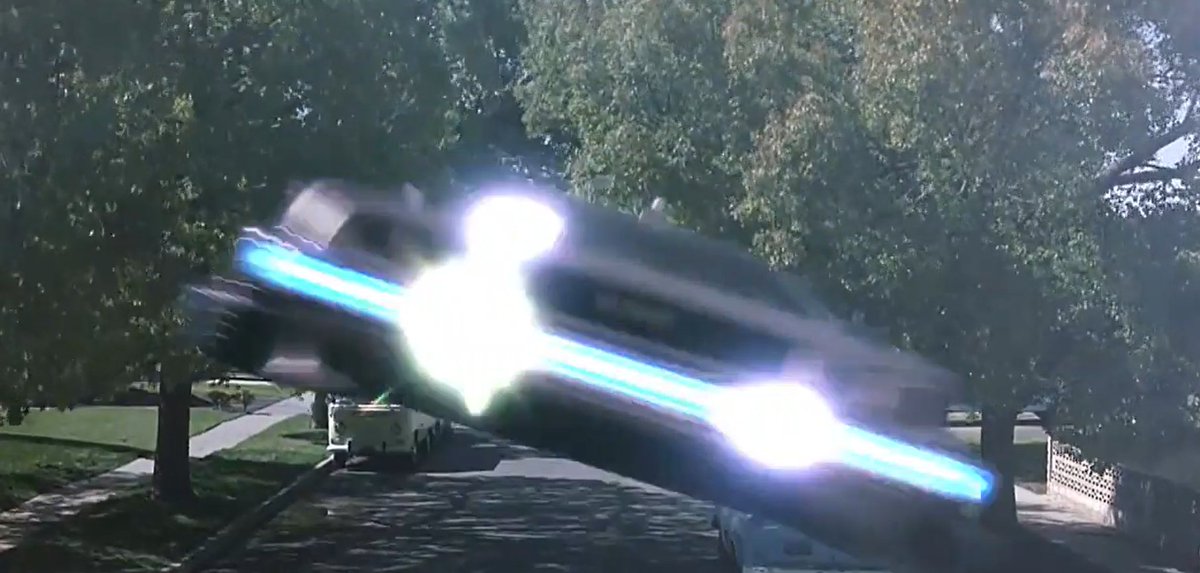
The film made Fox a movie sensation overnight, was nominated for 3 Oscars and in taking $389m at the box-office, was the highest-grossing movie of the year. Today it is regarded as a stone-cold classic.
44/45
44/45


To end on Back To The Future, some great behind the scenes pics…
45/45
45/45


If you liked our making of story of BACK TO THE FUTURE, please share the opening post.
https://x.com/ATRightMovies/status/1940714694404379073
Our latest podcast is on THE BRIDGE ON THE RIVER KWAI. Full of big laughs and opinions, so please check it out.
alltherightmovies.com/podcast/the-br…
alltherightmovies.com/podcast/the-br…
• • •
Missing some Tweet in this thread? You can try to
force a refresh