🧵1/21 🚨 WAKE UP THREAD: Three seemingly separate movements are converging to create the most dangerous techno-feudal empire in human history. What I've been warning about for YEARS is happening NOW. Let me break down what they don't want you to see...
2/21 🎭 First, meet GAME~B: Marketed as a "new civilizational operating system" for human flourishing, it's actually a Hegelian dialectic trap. They say Game A (current reality) is "rivalrous" and doomed, so we MUST transition to their collectivist "anti-fragile" utopia
3/21 💭 But here's the trick: Game~B doesn't exist yet. It's pure theory. Meanwhile, they plan to "extract the technology" from our current system (Game A) to build their paradise. How is taking our technology NOT extractive? Classic doublespeak.
4/21 🌑 Enter the DARK ENLIGHTENMENT: Curtis Yarvin (Mencius Moldbug) and Nick Land created this anti-democratic philosophy that views democracy as "inefficient". Their solution? Replace it with CEO-monarchs running countries like corporations
5/21 🏰 Yarvin's "Cathedral" theory claims media, academia, and government form an unelected power structure controlling society through cultural consensus. His answer? Destroy it all and install techno-authoritarianism. Sound familiar?
6/21 🌐 Third piece: Balaji Srinivasan's NETWORK STATE. Start with online communities, crowdfund territory globally, then seek diplomatic recognition as sovereign entities. It's Galt's Gulch meets blockchain—digital exit from nation-states entirely
7/21 💰 Here's where it gets sinister: The same Silicon Valley oligarchs funding ALL THREE movements. Peter Thiel mentored JD Vance, invested in Yarvin's Urbit, and champions anti-democratic ideas. Marc Andreessen praises Yarvin's work. Elon Musk implements the agenda
8/21 🔗 The connections run DEEP: Thiel gave Vance $15 million for his Senate run after transforming him from Trump critic to MAGA loyalist. Vance co-founded Rockbridge Network with TheoBro board members[previous context]. Now he's a heartbeat from the presidency.
9/21 ⚡ Remember Nick Land's ACCELERATIONISM? "Speed up capitalism until it collapses, then something better emerges". They're not trying to fix the system—they're intentionally crashing it to build their techno-feudal replacement
10/21 🧬 The Augustus Doricko case shows their MO: Mix Christian nationalism with techno-optimism, claim divine mandate for weather control, then fund it through Thiel's network[previous context]. "Stewardship" becomes justification for playing God with climate systems.
11/21 🏛️ Yarvin's DOGE influence is undeniable: His RAGE (Retire All Government Employees) concept directly inspired Musk's Department of Government Efficiency. They're not reforming bureaucracy—they're replacing democracy with corporate governance
12/21 📊 As I've warned: This isn't about left vs right—it's about techno-feudalism vs human freedom. They use Hegelian dialectics to manufacture crises, then offer pre-planned "solutions" that consolidate their power
13/21 🎯 The Network State isn't liberation—it's digital serfdom. Instead of geography-based nations with democratic accountability, you get ideology-based enclaves controlled by crypto-plutocrats. Exit becomes the new voice, but only for those who can afford it.
14/21 👁️ Game B's "collective intelligence" and "emergent coherence" are euphemisms for algorithmic governance. They want AI systems making decisions, not messy human democracy. It's technocracy dressed up as spiritual evolution
15/21 🔥 The Dark Enlightenment's "hyper-racism" and eugenics aren't bugs—they're features. Land explicitly advocates "positive eugenics through genetic selection".These aren't fringe ideas anymore; they're policy blueprints for the tech elite
16/21 ⛪ The TheoBros add religious cover to techno-authoritarianism[previous context]. "Angelically sanctioned anabolism" and divine mandates for cloud-seeding make tech tyranny seem spiritually justified. It's Calvinism meets Silicon Valley supremacy.
17/21 🌩️ Doricko's Rainmaker perfectly embodies this fusion: Geoengineering startup backed by Thiel Fellowship, mixing weather control with Christian stewardship theology[previous context]. When their Texas operation preceded deadly floods, they claimed no connection. Coincidence?
18/21 🏭 This is TECHNO-FEUDALISM in action: Platform monopolies extract rent from our data and labor while we become digital serfs. Facebook, Google, Amazon aren't companies—they're the new feudal lords of the information age.
19/21 🚨 The END GAME: Replace democratic nation-states with corporate-controlled network states, governed by AI systems designed by tech oligarchs who believe they're genetically superior. Exit Democracy, Enter Digital Serfdom.
20/21 💡 @CourtenayTurner has been sounding the alarm: These movements aren't separate—they're three faces of the same techno-feudal revolution. Game~B provides the utopian marketing, Dark Enlightenment supplies the anti-democratic theory, Network State offers the escape hatch.
21/21 🔊 The time for cognitive liberty is NOW. Recognize the dialectical manipulation. Reject false choices. Demand transparency. Protect human agency. Because once they "phoenix the republic," there's no going back. 🔎Learn more @ courtenayturner.substack.com/p/the-phoenix-…
• • •
Missing some Tweet in this thread? You can try to
force a refresh

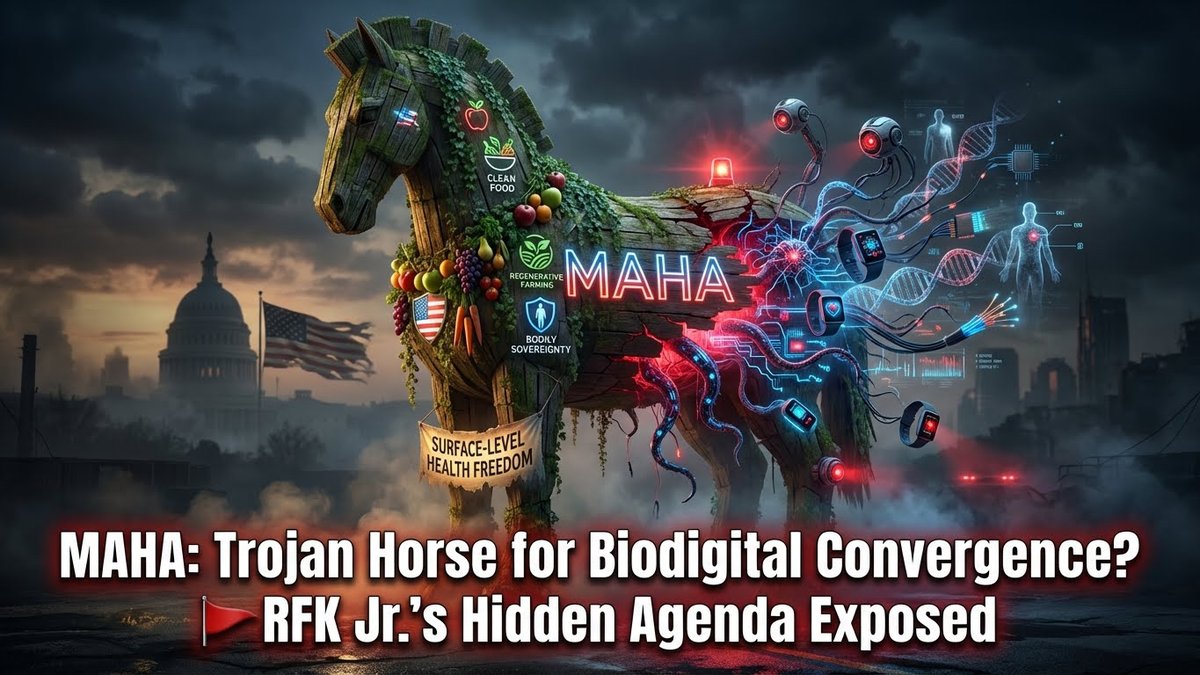
🚨Warning About MAHA – It’s Really MABA in Disguise (Make America Biotech Accelerate)🚨
🧵1/12
Friends, I've been sounding the alarm on this – long before Trump even took office again. I warned that RFK Jr. could be a Trojan Horse for AI-driven precision medicine and the full-on biodigital convergence agenda. Now, with MAHA rolling out and RFK’s Jr’s statements on MABA and wearables, my concerns are proving to be on target.
🧵2/12
The message of Make America Healthy Again (MAHA) sounds wonderful on the surface – clean, real food, regenerative agriculture, less toxic chemicals, and pushing back against Big Pharma's pill-pushing empire. We SHOULD all advocate for that! True health freedom starts with sovereignty over our bodies and what we put in them.
🧵3/12
But here's the red flag: They're not just stopping Big Pharma – they're replacing it with something far more insidious: mass adoption of wearables as the "key" to MAHA. RFK Jr. himself said he wants every American wearing a wearable within four years, with massive HHS ad campaigns pushing them.
There’s a straight line IMO from HG Wells World Brain, Oliver Reiser’s Cosmic Humanism, to Buckminster Fuller’s Spaceship Earth, to SRI’s Changing Images of Man, to David Temple’s First Values First Principles of Evolving Perenialism.
Here’s a thread 🧵 tracing the intellectual through-line from planetary mind and collective intelligence to evolving humanism, incorporating Vernadsky and Teilhard de Chardin as foundational figures.
2/10
The Evolution of Planetary Consciousness: A Hidden Thread 🧵
A remarkable lineage of thinkers envisioned humanity evolving toward unified global mind, cosmic purpose, and conscious planetary stewardship.
From the Noosphere to CosmoErotic Humanism, here’s the through-line.
3/10
Édouard Le Roy, alongside Vladimir Vernadsky and Teilhard de Chardin, helped coin the term noosphere, conceptualizing it as Earth's thinking layer, a stage where human consciousness and knowledge become a dominant geological force, transforming the biosphere. Le Roy, a French philosopher and mathematician, saw this as humanity's collective mind shaping the planet, a concept later linked to cyberspace and the internet as its material manifestation, representing a new evolutionary stage of planetary development.
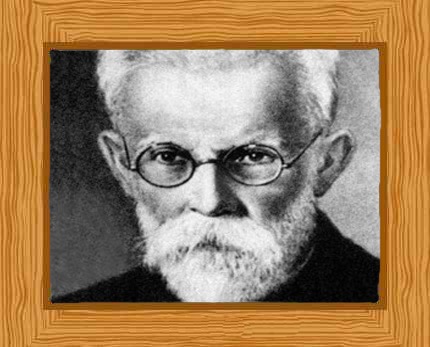
Vladimir Vernadsky (1920s–1940s) like Chardin was influenced by Edouard Le Roy, was a Russian scientist who defined the biosphere — life transforming the planet — and foresaw the noosphere: a sphere of human thought enveloping Earth, where collective reason guides evolution.
The seed of planetary mind.
🧵Thread on Joscha Bach & Evolutionary Dynamics: From AI Visions to Shocking Epstein Ties 🧠🤖💥 1/8 🚨 Breaking: Joscha Bach, ex-MIT Media Lab & Harvard evolutionary dynamics whiz, is back in the spotlight amid explosive Epstein email leaks. With a PhD in cognitive science, Bach’s work probes how minds evolve as computational beasts. His Harvard gig? Modeling evolution in complex systems. Dive into his bio: edge.org/memberbio/josc…
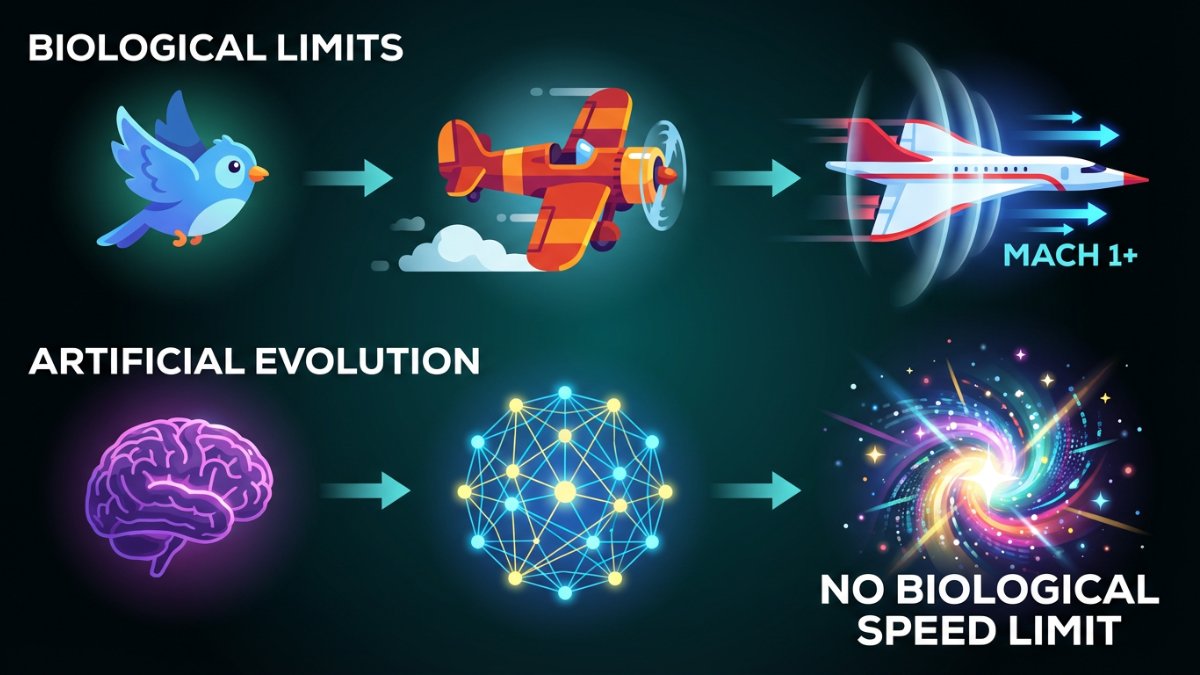
2/8 In his 2015 Edge.org response to "What Do You Think About Machines That Think?", Bach drops a bomb: AI won't just match us—it'll eclipse human intelligence by solving the mind's puzzle piecemeal, scaling far beyond biology's limits. Planes outfly birds; AI will outthink us in speed, accuracy, and scope. Link: edge.org/response-detai…
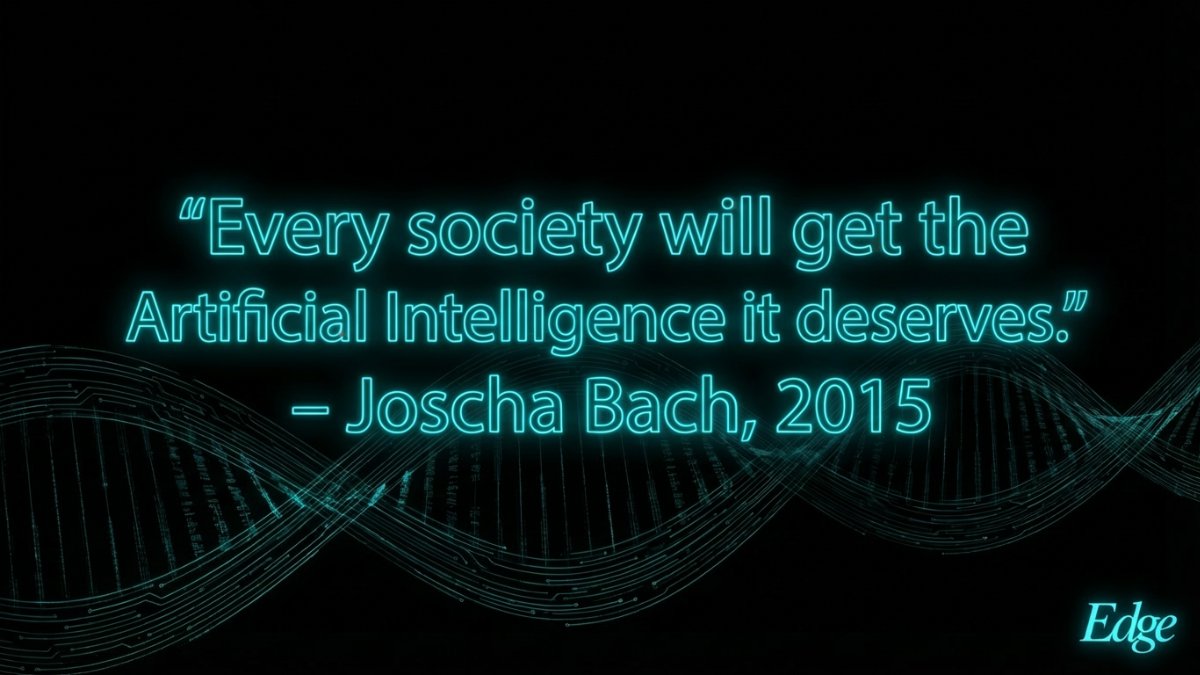
3/8 Bach ties this to evolutionary dynamics: Intelligence is a tool for goal-reaching, forged in primate survival hacks, but stripped of inherent motives in machines. Creators imprint their intent—benevolent orgs birth helpful AI; destructive ones, digital nightmares. His chilling line? "Every society will get the Artificial Intelligence it deserves." Echoes Darwin in silicon: Tech evolves with our flaws or fixes.
Michel Foucault, a central figure in post-structuralism, engaged extensively with Neo-Kantian philosophy, which revived and reinterpreted Immanuel Kant's ideas in the late 19th and early 20th centuries, emphasizing epistemology, logic, and the construction of knowledge without direct reference to an empirical "thing in itself" (the noumenon or Ding an sich).
His early work, including lectures in the 1950s on Kant's transcendental subject and his 1961 doctoral thesis introduction to Kant's Anthropology from a Pragmatic Point of View, critically analyzed Kantian themes like enlightenment, reason, and the limits of human knowledge. Foucault's archaeology of knowledge, as seen in The Order of Things (1966) and The Archaeology of Knowledge (1969) amzn.to/3Jclk59, adopts Neo-Kantian anti-realism—treating objects of knowledge as produced through discursive formations rather than as given realities—drawing indirectly from the Marburg School (e.g., Hermann Cohen and Paul Natorp) via French sociology, phenomenology, and thinkers like Ernst Cassirer.
This influence manifests in his concept of the "episteme," a historical a priori structuring what counts as valid knowledge, akin to Neo-Kantian notions of "validity" (Geltung) and the infinite task of producing meaning through regional sciences. Later, Foucault shifted toward genealogy, incorporating Nietzschean power dynamics while retaining Neo-Kantian bracketing of empirical reality.
Foucault's engagement with Neo-Thomist Catholic Scholasticism—a 19th-20th century revival of Thomas Aquinas's medieval philosophy integrated with Catholic theology—is more indirect and methodological. He did not directly critique Neo-Thomism, but his analyses of power, particularly pastoral power in lectures like those in 1975-1976, examine religious institutions and confessional practices as mechanisms of governance, drawing parallels to Scholastic traditions of authority and reason.
Scholars have applied Foucault's historical methodology to Scholastic thought, as in Philipp W. Rosemann's Understanding Scholastic Thought with Foucault (1999) (I'll post a link for that book below 👇), which uses Foucauldian concepts like the "episteme" and the "Outside" to analyze medieval intellectual culture, binaries (e.g., mythos/logos, Christian folly vs. Greek wisdom), and practices like university methods and manuscript transmission.
Jacques Derrida, known for deconstruction, also rooted his work in Neo-Kantian traditions, particularly through indirect influences from the Marburg School via structuralism, phenomenology, and French Neo-Kantians like Léon Brunschvicg. His concept of différance—an originary delay that defers presence and meaning—echoes Cohen's notion of "origin" (Ursprung) as an infinite productive task, banishing ontology in favor of textual constitution of the world. Derrida's grammatology, as a science of writing producing ideal objects, draws from Husserl's Origin of Geometry (interpreted in Neo-Kantian terms) and Saussure's linguistics, reversing speech/writing hierarchies while emphasizing validity independent of empirical context.
This anti-realist stance, where "there is no outside-text," aligns with Marburg's focus on discursive production and ethical intersubjectivity, later extended in his ethics influenced by Levinas and Scheler.
Derrida's ties to Neo-Thomist Catholic Scholasticism are subtler, often through theological and phenomenological lenses rather than direct critique. His work on gift, hospitality, and negative theology engages Christian motifs, positioning him as a "theologian" in some interpretations, with deconstruction challenging metaphysical binaries akin to Scholastic debates on faith and reason.
Phenomenology's connections to Neo-Thomism (e.g., via Husserl and Heidegger) inform Derrida's lifelong dialogue with these thinkers, critiquing modernity while echoing Thomist concerns with essence and existence. However, direct engagements are limited, with scholars noting parallels in his political philosophy and critiques of presence that resonate with Catholic intellectual traditions.
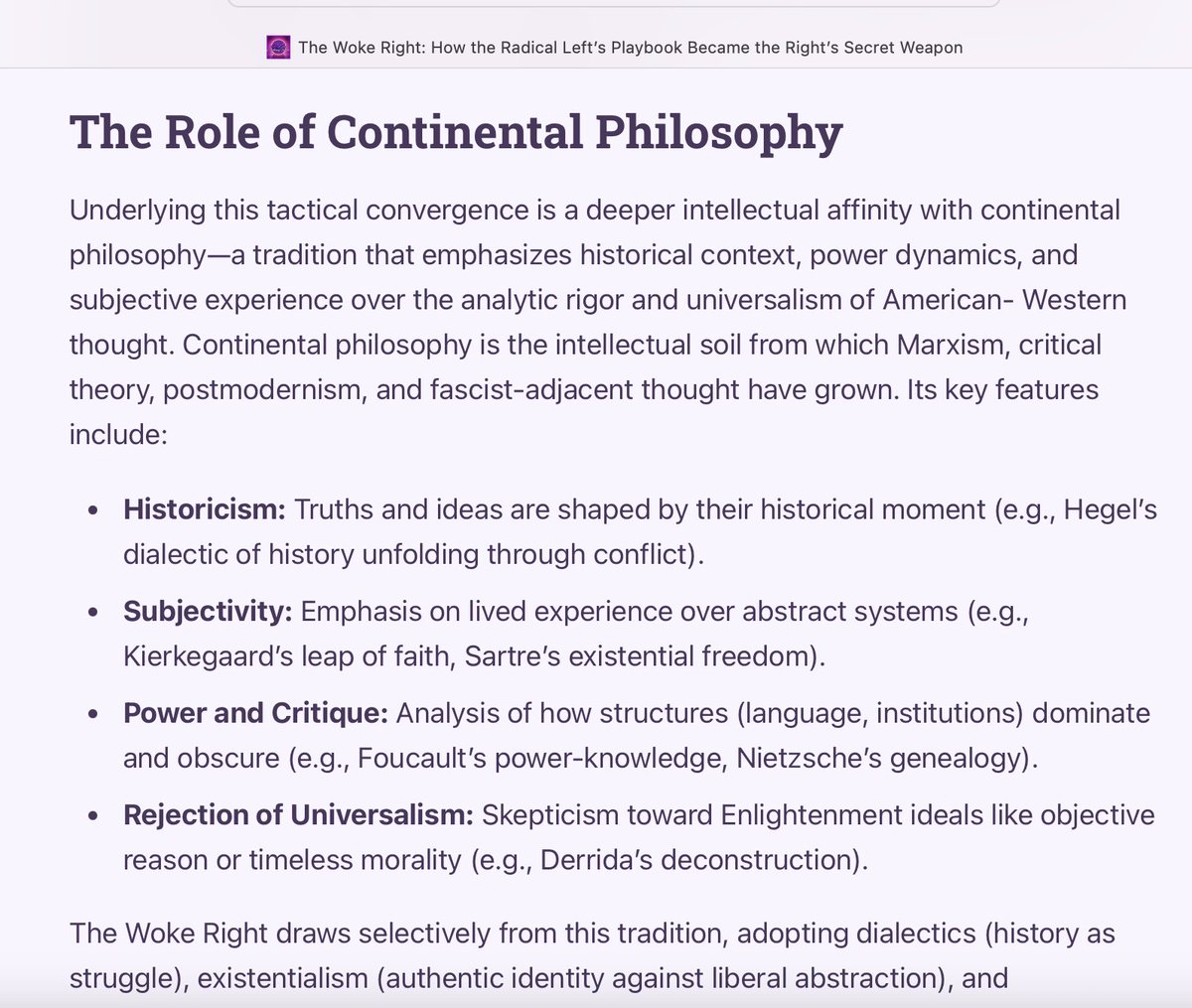
Both Foucault and Derrida were instrumental in shaping Continental Philosophy (I previously did a long thread on that which I can link as well plus a substack article on it), a broad tradition encompassing phenomenology, existentialism, structuralism, and post-structuralism, originating in 19th-20th century Europe and emphasizing historical context, subjectivity, and critiques of metaphysics over analytic precision.
Foucault's genealogies of power, knowledge, and institutions (e.g., in Discipline and Punish and History of Sexuality) attempted to deconstruct Enlightenment rationality, revealing how discourses produce subjects and norms. Derrida's deconstruction interrogated binary oppositions and logocentrism, influencing literary theory, ethics, and politics by showing how meaning is deferred and contingent. Their Neo-Kantian-inflected anti-realism enhanced Continental Philosophy's focus on historicity, power, and the limits of reason, bridging earlier thinkers like Kant, Hegel, Nietzsche, Husserl, and Heidegger.
Paleo-Conservatism, an American strain of conservatism emphasizing tradition, Christian ethics, nationalism, regionalism, and limited government, draws indirectly from Continental Philosophy's conservative dispositions, which critique Enlightenment universalism and modernity. Originating in the Counter-Enlightenment (e.g., Vico, Herder, de Maistre), this tradition influenced 19th-20th century Continental thought through Romanticism, Lebensphilosophie, and Nietzsche, fostering anti-liberal, anti-egalitarian views in the "conservative revolution" (e.g., Moeller van den Bruck, Jünger).
Foucault and Derrida's postmodern critiques of power, truth, and metaphysics provided tools for challenging liberal managerialism and universal standards, which paleo-conservatives adapted to oppose globalism and cultural relativism. Thinkers like Leo Strauss, influenced by Continental antimodernism (e.g., Heidegger, Schmitt), migrated these ideas to U.S. conservatism, emphasizing human finitude, tradition, and community over individual rights, aligning with paleo-conservative skepticism of neoconservatism and liberal internationalism.
Post-Liberalism, a contemporary critique of liberalism from both left and right, emerges from Continental Philosophy's challenges to universalism, progress, and relativism, advocating rooted communities, custom, and cultural specificity. Its origins trace to the Frankfurt School's Dialectic of Enlightenment (Horkheimer and Adorno), which Foucault and Derrida extended by exposing liberalism's totalitarian tendencies through discursive power and deconstruction of norms. Continental figures like Schmitt (nomos of the earth, friend-enemy distinction), Heidegger (radical conservatism), and the conservative revolution provide frameworks for post-liberal emphases on sovereignty, geopolitics, and anti-legalism, rejecting Kantian imperatives and Enlightenment materialism in favor of spiritual "care for the soul" (Patočka). British post-liberalism draws from these sources, critiquing liberalism's "forgetting" of customary law and promoting value creation over profit, influencing movements like the alt-right and illiberal states. Thus, Foucault and Derrida's contributions to Continental critiques of modernity fueled post-liberalism's renaissance on the right, shifting from left-leaning postmodernism to conservative applications.
🧵 1/25: 🚨EXPOSED: The "Game B" Conspiracy – A Trojan Horse for Technocracy, Transhumanism, & Elite Control! Funded by Epstein, rooted in eugenics, & amplified by the Intellectual Dark Web. This isn't sci-fi—it's the blueprint for rewriting humanity. Buckle up! #GameB #Epstein #Transhumanism
2/25: It all starts with the Weinstein brothers' "last questions" in 2018 via the Edge Foundation. Bret asks: "Can humans set a non-evolutionary course that's game theoretically stable?"— escape evolutionary traps? Eric: "Does something unprecedented happen when we finally learn our own source code?"— What if we hack our own "source code"? Sounds utopian, but it's a veil for "conscious evolution"—elite-driven redesign of society & biology. 😱
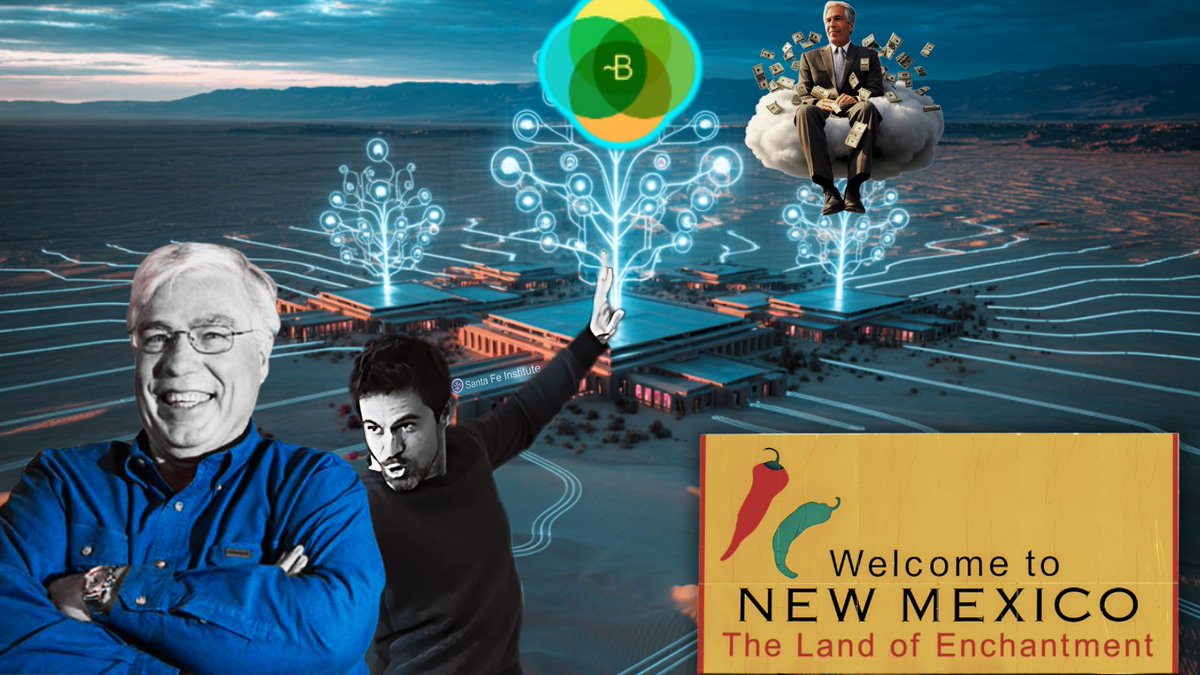
3/25: Game B origins trace to Santa Fe Institute (SFI), where Epstein donated $275K. Jim Rutt (ex-chair) & Jordan Hall (ex-trustee) birthed it post-2008 crisis. Early talks with Weinsteins on "Economic Manhattan Project." From think tanks to "civilizational redesign"—but who's really pulling strings?
1/21 👀 Please PAY ATTENTION beautiful souls! 🚨 a thread 🧵👇🏻
While you were distracted by the latest political theater, the Trump administration quietly prepared to launch on July 4, 2025 – Independence Day. The symbolism isn't lost on me. They're declaring independence FROM your autonomy.AI.gov
2/21 In just 16 days, the most comprehensive AI surveillance system in U.S. history goes live. This isn't just another government website – it's the digital infrastructure for technocratic control over every aspect of your life.
3/21 Let me break down what AI.gov REALLY is: A centralized command center that will give federal agencies unprecedented power to monitor, analyze, and control through three terrifying components:
• AI Chatbot "Assistant"
• Unified API (connecting ALL systems)
• CONSOLE Analytics (real-time monitoring)
Does this sound like a control grid that could use a social credit system to lock you into a digital prison?