On the morning of July 23, 2007, Jennifer Hawke-Petit was captured on CCTV at a bank in Cheshire, Connecticut. She was alone, withdrawing $15,000 after telling staff her family was being held hostage at the Petit family home. A bank employee immediately called police to report the ongoing crime. These would be the last moments Jennifer was ever seen alive.
On the evening of July 22, 2007, Dr. William Petit was sitting on a porch chair at his family home in Cheshire, Connecticut. Two men, Steven Hayes and Joshua Komisarjevsky, who had targeted the house after seeing Jennifer Hawke-Petit and her daughter Michaela shopping earlier that day, approached. Komisarjevsky later admitted he had followed them home and chosen the house because it seemed affluent and easy to access.
After midnight, the two men entered the home through an unlocked basement door. They first encountered Dr. Petit asleep on the couch and bludgeoned him with a baseball bat, then tied him up in the basement.
They then proceeded upstairs, where they bound Jennifer Hawke-Petit and her daughters, 17-year-old Hayley and 11-year-old Michaela, in their bedrooms. Over the next several hours, the intruders searched for money and waited for banks to open.
In the morning, around 9 a.m., Hayes took Jennifer to a local bank. Jennifer entered alone and told the teller her family was being held hostage, asking for $15,000 to satisfy her captors. Steven Hayes waited outside in her vehicle. A bank employee discreetly called 911, reporting the hostage situation and providing details about the car.
Jennifer and Hayes returned to the house. Meanwhile, police arrived near the Petit residence and began surveillance but chose not to immediately intervene, hoping to avoid provoking violence inside.
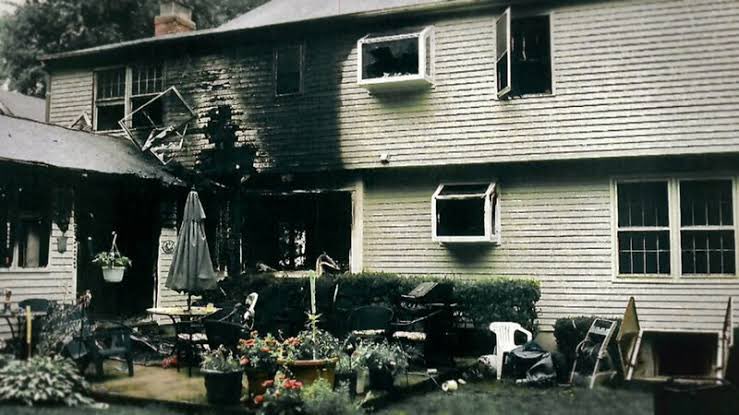
Back at the house, the situation escalated. Hayes sexually assaulted Jennifer, and Komisarjevsky sexually assaulted 11-year-old Michaela. Hayes then strangled Jennifer to death. Gasoline was poured throughout the home, and the men set it on fire.
Dr. Petit, severely injured but conscious, managed to free himself and escape through the basement door to a neighbor’s yard to get help. Hayley and Michaela, still tied to their beds upstairs, died from smoke inhalation as the fire spread.
Hayes and Komisarjevsky attempted to flee the scene in the family’s vehicle but were quickly apprehended by police at the end of the driveway.
Steven Hayes was convicted in 2010 and sentenced to death, later changed to life without parole when Connecticut abolished the death penalty retroactively in 2015. Joshua Komisarjevsky was also convicted and sentenced to death in 2011; his sentence was similarly converted to life without parole.
Dr. William Petit survived but lost his entire immediate family. He later remarried and became an advocate for victims’ rights, founding the Petit Family Foundation in honor of his wife and daughters.
Since August 16, 2016, both Steven Hayes and Joshua Komisarjevsky have been transferred from Connecticut to separate maximum-security prisons in Pennsylvania under an interstate corrections compact. This move was made for “reasons of safety and security”
Steven Hayes, now age 62, is incarcerated at SCI Benner Township, where in 2019 he publicly came out as transgender and is known to be receiving hormone therapy.
Joshua Komisarjevsky, age 44, is housed at SCI Mahanoy. He attempted suicide by hanging shortly after arriving in Pennsylvania.
Both men are held under extremely restrictive conditions. They are moved to a new cell at least every 90 days, their cells are searched twice weekly, and any movement out of cell is closely supervised

• • •
Missing some Tweet in this thread? You can try to
force a refresh

Imagine a father, filled with joy, taking a photograph of his daughter and her new boyfriend during a long awaited visit home. He frames the shot, they smile, and he captures the happy moment.
Now imagine the gut wrenching truth. The "boyfriend" is the man who kidnapped her, the man who tortures her, and his daughter is so terrified and brainwashed that all she can do is stand there and smile for the camera.
The story behind this single, unbelievable photograph is one of the most disturbing cases of psychological control you will ever hear. Thread 🧵
It’s a story that sounds like something from a horror movie, but for seven long years, it was Colleen Stan's reality. It starts with a decision any young person might make, a simple act of trust that led to an unimaginable nightmare.
In May of 1977, 20 year old Colleen Stan was trying to get from Oregon to a friend's birthday party in California. She was hitchhiking, and when a friendly looking young couple with a baby in their car pulled over, she felt a wave of relief. It seemed like the safest possible ride. The couple was Cameron and Janice Hooker. But soon after she got in the car, the friendly atmosphere vanished. Cameron pulled off onto a remote road, threatened her with a knife, and forced her head into a heavy, soundproof box he had built, silencing and disorienting her.
He took her back to their mobile home in Red Bluff, California, where her new life began. For the next seven years, Colleen was forced to live as their slave, given the new name "K." For much of that time, for up to 23 hours a day, her world was a coffin sized wooden box, built to slide under the couple’s waterbed. She was let out only to be tortured and abused.
But what kept her a prisoner wasn't just the box. It was a terrifying lie. Cameron Hooker, a master manipulator, convinced her that he was part of a powerful, secret organization he called "The Company." He told her this satanic cult was always watching, and if she ever tried to escape or disobey, they would not only find her, but they would brutally murder her entire family. Colleen, isolated and traumatized, believed him. The fear of "The Company" was a more powerful prison than any physical lock.
Hooker's brainwashing became so complete that after a few years, he started letting her out of the box for longer periods to act as a nanny and housekeeper. He grew so confident in his total control that in 1981, he allowed her to do the unthinkable: visit her family. He drove her to her parents' home and introduced himself as her boyfriend, "K." The visit was surreal. Her family was overjoyed to see her, but they could tell something was wrong. During that visit, her own father took a smiling photo of Colleen standing next to Cameron Hooker, the man who was holding her captive. Terrified of what "The Company" would do to them, she said nothing, and returned to her life of abuse.
In December 2009, Susan Powell, a vibrant 28-year-old mother of two young boys, vanished from her quiet suburban home in West Valley City, Utah, after what her husband described as a spontaneous midnight camping trip in a blizzard—leaving behind a puzzle of clues, a devastated family, and a case that spiraled into unimaginable tragedy, still haunting investigators and true crime followers to this day. Thread 🧵
In July 2008, about a year and a half before her mysterious disappearance, Susan Powell quietly turned on a camera in her West Valley City, Utah, home and began recording a video that would later haunt her loved ones—a meticulous documentation of her family’s possessions, laced with subtle hints of the turmoil brewing in her marriage to Josh Powell, all on the advice of an attorney preparing for what might come next. Susan, then 28, walked through her modest house with the camera, narrating as she went. She started in the living room, pointing out everyday items like furniture and decor, but her voice carried an undercurrent of unease. “This is a video of all our assets in case something happens to me,” she said at one point, her words now chilling in hindsight.
She cataloged expensive possessions—the family computer, jewelry, even the trees in the yard she’d planted herself—explaining their value and condition. But woven in were glimpses of deeper issues: she mentioned broken CDs and missing necklaces, implying they’d been deliberately damaged, and alluded to a strained relationship with Josh, who she described as controlling and distant. Friends later revealed Susan had confided fears about her safety, even drafting a secret will that read, “If I die, it may not be an accident, even if it looks like one.” The video, shot amid growing marital discord, seemed like a safeguard for divorce or worse, capturing a woman methodically protecting her future amid quiet desperation.
Susan Cox Powell grew up in a close-knit Mormon family in Washington state, where she met Joshua “Josh” Powell in 2000 at a church event. They married quickly in 2001, and by 2004, they’d moved to Utah for Josh’s job opportunities. Susan worked as a stockbroker at Wells Fargo, known for her warm smile, dedication to her kids—Charlie, born in 2005, and Braden in 2007—and her love of crafting and journaling. But behind the facade of a happy family, cracks were forming.
Josh was controlling, often belittling Susan, mismanaging their finances (they filed for bankruptcy in 2007), and showing little affection; Susan confided in friends via emails and notes about feeling trapped, even writing a secret will in 2008 that read, “If I die, it may not be an accident, even if it looks like one.” She was planning to leave him, but stayed for the boys. On December 6, 2009, the day started normally: Susan attended church, then hosted a neighbor, JoVanna Owings, for an impromptu pancake dinner. Susan mentioned feeling unwell, possibly from food poisoning, and rested on the couch while Josh and the boys played in the snow outside. Owings left around 5 PM, noting the family seemed fine.
In 2003, pizza delivery driver Brian Wells robbed a PNC Bank in Erie, Pennsylvania, with a live bomb locked around his neck, claiming he was forced into it; the device exploded during a police standoff, killing him, as part of an impossible scavenger hunt orchestrated by co-conspirators led by Marjorie Diehl-Armstrong. Thread: 1/4
On August 28, 2003, Wells, 46, delivered two pizzas to a remote TV tower site in Erie, where he was ambushed, fitted with a triple-banded collar bomb containing two pipe bombs, and given handwritten notes with instructions for a timed scavenger hunt: rob the bank for $250,000, follow clues to obtain keys to unlock the bomb, or it would detonate. Investigators later determined the bomb could not have been removed or deactivated in time, making survival impossible from the start. He robbed the bank for $8,702 but was apprehended by police shortly after. 2/4
Wells told police he was coerced by “a group of black men” at the delivery site and begged for help to remove the bomb, saying it was set to explode. As bomb squad technicians approached, the device beeped and detonated at 3:18 PM, killing him instantly by severing his jugular vein; the event was captured on camera but not broadcast live due to a technical issue, though footage leaked later. The notes warned against calling police and included threats like “Act Now, Think Later or You Will Die.” 3/4
On April 10, 2018, 16-year-old Kyle Jacob Plush made a desperate 911 call after becoming trapped in his minivan at a Cincinnati school parking lot, pleading for help in what would become the last moments of his life.
Kyle Jacob Plush was born on September 30, 2001, in Cincinnati, Ohio. He was a 16-year-old sophomore at Seven Hills School, known for his interest in problem-solving and activities like tennis.
On April 10, 2018, around 3:00 p.m., Kyle Plush parked his family’s 2004 Honda Odyssey minivan in the school’s Hillsdale campus parking lot in Cincinnati to retrieve tennis gear from the rear cargo area. While reaching over the third-row bench seat, the seat unlatched, flipped backward, and trapped him upside down with his head in the rear well and legs against the rear door, compressing his chest.
At 3:14 p.m., Plush used Siri on his iPhone to call 911. He reported, “Help! I’m stuck in my van… I need help!” and mentioned being at “Seven Hills,” but could not hear the dispatcher due to his position and hung up after nearly three minutes of pleading and background noises of banging and screaming. Dispatchers attempted callbacks but reached voicemail.
At 3:21 p.m., the call was dispatched as an unknown trouble incident. Two Cincinnati police officers arrived at 3:26 p.m., searched the parking lot for 11 minutes, checked several vans, but did not locate Plush or hear distress signals, closing the incident at 3:37 p.m. A Hamilton County sheriff’s deputy also responded around the same time, briefly checked the area, and left after speaking with the officers.
At 3:35 p.m., Plush made a second 911 call, stating, “I’m trapped inside my gold Honda Odyssey van in the… parking lot of Seven Hills. This is not a joke… Send officers immediately. I’m almost dead,” and later, “I probably don’t have much time left. Tell my mom I love her if I die.” He again could not hear the dispatcher, and the call was not documented or relayed to officers on scene.
Around 9:00 p.m., Plush’s father, Ronald Plush, located the minivan using the Find My iPhone app after Kyle did not return home and discovered his body inside. Plush was pronounced dead at the scene.
At first glance, this footage looks like two buddies casually unwrapping Christmas gifts under a tree. But it’s far darker: On December 22, 1990, burglars Von Lester Taylor and Edward Deli broke into the Tiede family’s remote Utah cabin, rifled through presents, and filmed themselves with the family’s camcorder—moments before unleashing deadly horror.
On December 22, 1990, the Tiede family was vacationing at their remote cabin near Oakley, Utah, for the holidays. The family members included father Rolf Tiede (age 51), mother Kaye Tiede (49), grandmother Beth Potts (76, who was Kaye’s mother), and daughters Linae (20) and Tricia (16). While some family members were out in Salt Lake City, two parolees—Von Lester Taylor (25) and Edward Steven Deli (22)—broke into the cabin.
Taylor and Deli had absconded from a halfway house. Taylor had been paroled for aggravated burglary. Their goal was to commit burglary. Once inside, they used the family’s camcorder to film themselves going through belongings and opening Christmas presents under the tree.
Taylor had told a friend by phone that he planned to shoot people if needed. First to return were Kaye Tiede, Beth Potts, and daughter Linae. Taylor and Deli confronted them at gunpoint. Taylor shot and killed Kaye and Beth. Shortly after, Rolf arrived with daughter Tricia. Taylor held Rolf at gunpoint, took about $105 from him, and shot him in the head. Taylor and Deli then doused Rolf and parts of the cabin with gasoline and set it on fire. Despite his injuries, Rolf survived and escaped on a snowmobile to get help.
Taylor and Deli kidnapped the two daughters, Linae and Tricia, forcing them into the family’s vehicle and fleeing. After Rolf alerted authorities, police began a high-speed chase. The chase ended when the vehicle crashed near Layton, leading to a shootout where Deli was wounded in the leg. Taylor surrendered, and both men were arrested. The daughters were rescued physically unharmed.
In court, Taylor pleaded guilty on May 2, 1991, to two counts of aggravated murder. On May 22, 1991, a jury recommended the death penalty, and he was sentenced to death by lethal injection, which he chose. Deli went to trial and was convicted on May 14, 1991, of two counts of second-degree murder because one juror doubted his direct role in the shootings. On June 3, 1991, Deli received seven consecutive terms of five years to life for nine felony offenses. On August 21, 1991, the Utah Board of Pardons and Parole ruled he would serve life without parole. Ballistics showed two guns were used—a .44-caliber and a .38-caliber—and testimony indicated Deli handled the .44-caliber.
A black Mercedes-Benz was seen wildly chasing a silver Toyota RAV4 through Manhattan streets, driving the wrong way and ramming it until it spun out onto the sidewalk—but what was this all about? Full story in the thread below.
On September 3, 2022, around 5 p.m., in Manhattan’s Upper East Side near East 92nd Street and Second Avenue, New York, Denis Piters, 29, from the Bronx, and Christian Santana, 32, from the Bronx, used a stolen black Mercedes-Benz to chase a silver Toyota RAV4 driven by a man they targeted, believing he carried a large amount of cash.
The chase involved driving the wrong way on streets and ramming the Toyota multiple times, causing it to spin out and be pushed onto the sidewalk. After pinning the Toyota, one suspect exited the Mercedes, pointed a gun, banged the pistol on the victim’s windshield, and stole a bag containing $9,000 in cash. The suspects then drove off and abandoned the Mercedes a few blocks away. No injuries were reported.
Police recovered fingerprints and a Cash App debit card bearing Piters’ name from inside the abandoned Mercedes, which led to their identification.
Santana was arrested on September 21, 2022. Piters was arrested on September 28, 2022. Both were charged with robbery and reckless endangerment. Piters faced additional charges of criminal use of a firearm and criminal possession of stolen property.
Piters was held at Rikers Island on $250,000 bail, which he could not post. Santana was released on $75,000 bond.