Why Do Hindus Wear Tilaka?
Ever noticed the forehead marks worn by saints and devotees?
🧵#Thread They are not random- they are deeply symbolic, spiritually scientific, and rich in tradition.
Here’s a visual breakdown of the divine geometry of Tilaka.👇
Ever noticed the forehead marks worn by saints and devotees?
🧵#Thread They are not random- they are deeply symbolic, spiritually scientific, and rich in tradition.
Here’s a visual breakdown of the divine geometry of Tilaka.👇
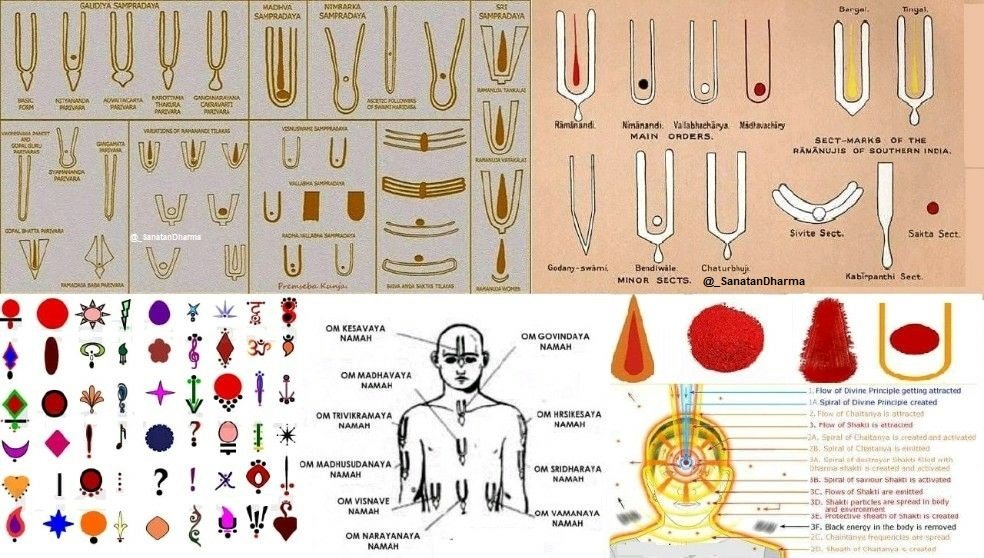
1. What Is a Tilaka?
A Tilaka is a vertical or horizontal mark worn on the forehead (and sometimes other body parts) using sacred ash, sandalwood, kumkum, or clay.
It marks devotion
It protects the Ajna Chakra
It shows spiritual identity & lineage
A Tilaka is a vertical or horizontal mark worn on the forehead (and sometimes other body parts) using sacred ash, sandalwood, kumkum, or clay.
It marks devotion
It protects the Ajna Chakra
It shows spiritual identity & lineage
2. More Than a Symbol -It’s Energy Alignment.
Tilaka is applied on the Ajna Chakra (Third Eye)-the energy center of intuition and inner vision.
It channels divine consciousness
Activates spiritual focus
Shields from negative vibrations
Tilaka is applied on the Ajna Chakra (Third Eye)-the energy center of intuition and inner vision.
It channels divine consciousness
Activates spiritual focus
Shields from negative vibrations
3. Tilaka Across Sampradayas (Traditions)
Each Hindu Sampradaya (lineage) has a unique Tilaka style:
Shaiva: Horizontal tripundra (vibhuti/ash)
Vaishnava: Vertical Urdhva Pundra (sandal/chandan)
Shakta: Red kumkum or sindoor
Each Hindu Sampradaya (lineage) has a unique Tilaka style:
Shaiva: Horizontal tripundra (vibhuti/ash)
Vaishnava: Vertical Urdhva Pundra (sandal/chandan)
Shakta: Red kumkum or sindoor
4. Vaishnava Tilakas -A Divine Map of Devotion.
From the Ramanuja Sampradaya to Gaudiya Vaishnavism, each tradition has a unique U-shaped Tilaka, symbolizing:
Vishnu’s lotus feet.
Tulasi leaf.
Lakshmi’s presence.
Surrender to the Lord.
Examples: Gaudiya: Two vertical lines + tulasi leaf.
Madhva: Two lines + central red line.
Ramanuja: White U + central red/saffron line.
From the Ramanuja Sampradaya to Gaudiya Vaishnavism, each tradition has a unique U-shaped Tilaka, symbolizing:
Vishnu’s lotus feet.
Tulasi leaf.
Lakshmi’s presence.
Surrender to the Lord.
Examples: Gaudiya: Two vertical lines + tulasi leaf.
Madhva: Two lines + central red line.
Ramanuja: White U + central red/saffron line.
5. Shaiva Tilaka-The Sacred Tripundra
Lord Shiva’s devotees wear 3 horizontal ash lines on the forehead:
It represents:
Destruction of ego
Mastery over body, mind & speech
Purity through renunciation
The dot (bindu) often represents Parvati/Shakti.
Lord Shiva’s devotees wear 3 horizontal ash lines on the forehead:
It represents:
Destruction of ego
Mastery over body, mind & speech
Purity through renunciation
The dot (bindu) often represents Parvati/Shakti.
6. Shakta Tilaka-The Divine Feminine Flame.
In Shakta tradition (worship of Devi), the Tilaka is often:
A vertical red line, dot or triangle
Made of kumkum or sindoor
It activates Shakti Tattva
Symbol of divine feminine energy & kundalini.
In Shakta tradition (worship of Devi), the Tilaka is often:
A vertical red line, dot or triangle
Made of kumkum or sindoor
It activates Shakti Tattva
Symbol of divine feminine energy & kundalini.
7. Science of Tilaka: Not Superstition
As per Ayurveda and Yoga, the spot between eyebrows is the marma sthan -the Ajna Chakra.
Tilaka helps:
Reduce stress
Focus the mind
Shield the aura
Align your spiritual frequencies.
As per Ayurveda and Yoga, the spot between eyebrows is the marma sthan -the Ajna Chakra.
Tilaka helps:
Reduce stress
Focus the mind
Shield the aura
Align your spiritual frequencies.
8. Each Shape Has a Meaning
In the image above, you see:
Triangle - Shakti
Circle -Wholeness
Trishul or U - Bhakti & surrender
Square -Stability
Bindu - Consciousness center
It’s spiritual geometry -not just art.
In the image above, you see:
Triangle - Shakti
Circle -Wholeness
Trishul or U - Bhakti & surrender
Square -Stability
Bindu - Consciousness center
It’s spiritual geometry -not just art.
9. The 12-Point Tilaka Mantra
Vaishnavas often apply 12 Tilakas on different body parts, chanting names of Lord Vishnu:
1. OM Keshavaya Namah (forehead)
2. OM Narayanaya Namah (chest)
3. OM Vasudevaya Namah (back)
Each point is an invocation of divine protection.
Vaishnavas often apply 12 Tilakas on different body parts, chanting names of Lord Vishnu:
1. OM Keshavaya Namah (forehead)
2. OM Narayanaya Namah (chest)
3. OM Vasudevaya Namah (back)
Each point is an invocation of divine protection.
10. Final Thought: Not Just a Mark -A Meditation,Wearing Tilaka isn't cosmetic.
It's a declaration that: “My body is a temple.”
“My mind is devoted.”
“My forehead carries divinity.”
When worn with bhava (devotion), even a simple dot becomes divine.
🔁 If you learned something divine: Retweet.
🧡 If you honor this ancient wisdom: LIKE
🤝 For more threads on Sanatan Dharma: Follow @_SanatanDharma 🚩.
It's a declaration that: “My body is a temple.”
“My mind is devoted.”
“My forehead carries divinity.”
When worn with bhava (devotion), even a simple dot becomes divine.
🔁 If you learned something divine: Retweet.
🧡 If you honor this ancient wisdom: LIKE
🤝 For more threads on Sanatan Dharma: Follow @_SanatanDharma 🚩.
• • •
Missing some Tweet in this thread? You can try to
force a refresh