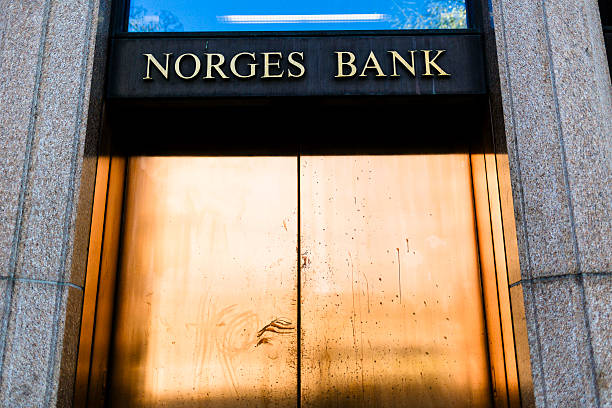
BREAKING: Norway's $2 trillion wealth fund ran a 12-month AI experiment.
They gave Claude access to their entire investment workflow.
Result: 213,000 hours saved. 20% productivity boost.
But what they found hiding in the data changed everything:
A Thread 🧵
They gave Claude access to their entire investment workflow.
Result: 213,000 hours saved. 20% productivity boost.
But what they found hiding in the data changed everything:
A Thread 🧵


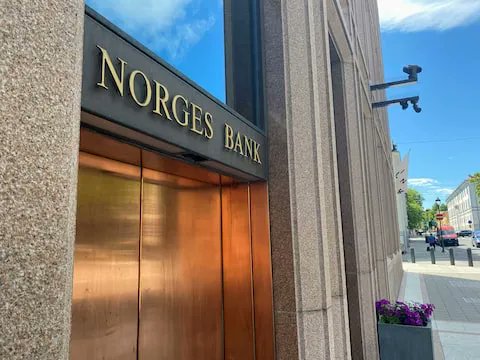
Meet Nicolai Tangen, CEO of NBIM - the world's largest sovereign wealth fund.
700 employees managing $2 trillion in assets.
In 2022, he made a strategic decision that would reshape their entire operation.
But first, he had to address significant organizational resistance...
700 employees managing $2 trillion in assets.
In 2022, he made a strategic decision that would reshape their entire operation.
But first, he had to address significant organizational resistance...

Tangen began systematically advocating for AI adoption across his 670-person team.
The challenge? Most investment professionals viewed AI as potentially disruptive to established workflows.
Traditional analysts were spending days on tasks that seemed impossible to automate.
Then Claude was introduced...
The challenge? Most investment professionals viewed AI as potentially disruptive to established workflows.
Traditional analysts were spending days on tasks that seemed impossible to automate.
Then Claude was introduced...
The first major breakthrough came with their Snowflake data warehouse integration.
Portfolio managers could suddenly query complex datasets using natural language.
What previously required technical SQL expertise now took seconds.
But this was just the initial phase...
Portfolio managers could suddenly query complex datasets using natural language.
What previously required technical SQL expertise now took seconds.
But this was just the initial phase...

Next, they implemented automated earnings call analysis.
Claude could process hours of executive commentary and extract key insights efficiently.
Risk managers were analyzing significantly more companies in the same timeframe.
Meanwhile, something important was happening behind the scenes...
Claude could process hours of executive commentary and extract key insights efficiently.
Risk managers were analyzing significantly more companies in the same timeframe.
Meanwhile, something important was happening behind the scenes...
NBIM monitors news for 9,000 companies across 16 languages.
Before Claude: Teams of analysts, days of manual work.
After Claude: Minutes of automated analysis with structured insights.
The efficiency gains were substantial, but they discovered an unexpected pattern...
Before Claude: Teams of analysts, days of manual work.
After Claude: Minutes of automated analysis with structured insights.
The efficiency gains were substantial, but they discovered an unexpected pattern...
The Investment Simulator revealed a critical insight:
Human portfolio managers were making predictable behavioral decisions that impacted returns.
AI could identify these patterns with 95% accuracy.
The fund was experiencing losses due to cognitive biases...
Human portfolio managers were making predictable behavioral decisions that impacted returns.
AI could identify these patterns with 95% accuracy.
The fund was experiencing losses due to cognitive biases...
Here's where Tangen made his most decisive move:
"It can't be voluntary. If you don't use AI, you will never be promoted."
He implemented mandatory AI adoption across all 700 employees.
The organizational response was mixed...
"It can't be voluntary. If you don't use AI, you will never be promoted."
He implemented mandatory AI adoption across all 700 employees.
The organizational response was mixed...
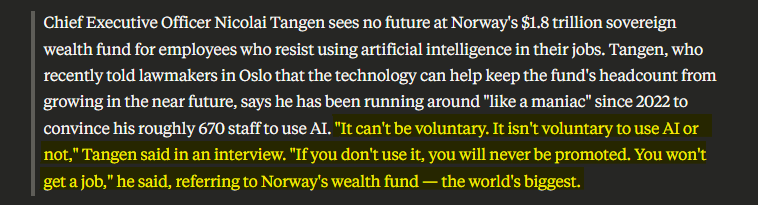
But the measurable results were compelling:
• 20% productivity gains (213,000 hours saved annually)
• $100 million in trading cost savings
• 95% accuracy in voting decisions
• 49 million transactions optimized globally
The business case was clear.
• 20% productivity gains (213,000 hours saved annually)
• $100 million in trading cost savings
• 95% accuracy in voting decisions
• 49 million transactions optimized globally
The business case was clear.
The voting system became particularly effective.
They input 40-50 page executive compensation documents into Claude with their guidelines.
AI recommendations achieved 95% accuracy.
Even their notable "no" vote on Elon Musk's $56 billion Tesla package was AI-assisted.
They input 40-50 page executive compensation documents into Claude with their guidelines.
AI recommendations achieved 95% accuracy.
Even their notable "no" vote on Elon Musk's $56 billion Tesla package was AI-assisted.
Today, 100% of NBIM employees use Claude.
They're targeting $400 million in annual cost savings.
The fund that once struggled with efficiency is now leading AI adoption in asset management.
The key lesson wasn't just about technology...
They're targeting $400 million in annual cost savings.
The fund that once struggled with efficiency is now leading AI adoption in asset management.
The key lesson wasn't just about technology...
It was about understanding human decision-making.
The AI didn't just automate processes - it identified costly behavioral biases.
Portfolio managers learned their emotional decisions were predictable and measurable.
AI became their analytical partner, not their replacement.
The AI didn't just automate processes - it identified costly behavioral biases.
Portfolio managers learned their emotional decisions were predictable and measurable.
AI became their analytical partner, not their replacement.
Tangen's framework for other executives:
"Don't make AI voluntary. Measure everything. Start with specific use cases."
He's now implementing selective hiring - prioritizing AI-skilled staff for new positions.
The strategy is clear: Build capabilities systematically.
"Don't make AI voluntary. Measure everything. Start with specific use cases."
He's now implementing selective hiring - prioritizing AI-skilled staff for new positions.
The strategy is clear: Build capabilities systematically.
P.S. If you're an SMB company in the healthcare or BFSI sector…
I've built an AI platform that helps you spot problems in your business before they happen.
Curious which insights could save you millions?
You can book a demo here, and we'll map it out: predixtions.com
I've built an AI platform that helps you spot problems in your business before they happen.
Curious which insights could save you millions?
You can book a demo here, and we'll map it out: predixtions.com
Thanks for reading.
If you enjoyed this post, follow @karlmehta for more content on AI and politics.
Repost the first tweet to help more people see it:
Appreciate the support.
If you enjoyed this post, follow @karlmehta for more content on AI and politics.
Repost the first tweet to help more people see it:
Appreciate the support.
https://twitter.com/20891198/status/1947284189461782807
• • •
Missing some Tweet in this thread? You can try to
force a refresh