Finally got my hands on the copy of "13 Days in China", a diary of an Indian soldier, Gadhadhar Singh, of Hindu Rajput caste, sent to China by Britain as a mercenary.
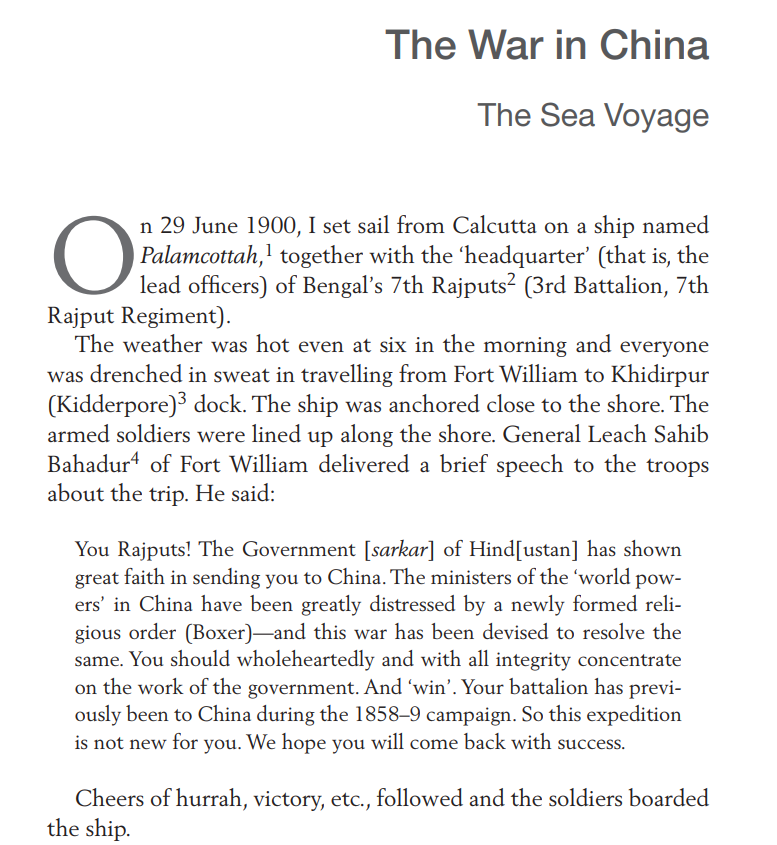
The diary begins with his account of General Edward Leach giving a briefing to Rajputs being sent to China.
It seems that Indians were well aware in those days that China was an ancient country.
Singh expresses his concern, he fears that what happened to Aryavarta [India], may also happen to China.
According to him, China losing the Sino-Japanese War exposed its weakness. (1894-95).

The Indian regiment arrives in Hong Kong. Description of the Hong Kong docks.
He left his shillings on the ship and only had rupees with him.
No Chinese local or govt official accepted the rupees.
In the end, he ended up meeting a few Parsis in Hong Kong, who gladly exchanged the rupees for dollars.
Hong Kong also was unaffected by turmoil in mainland.
The Indian contingent arrives in Tianjin.
Description of Tianjin being devastated by the Eight Nation Army.
He ends up sympathizing with the Chinese and talks of a "Hind-Cheen".
He meets with an Irish mercenary who offers him a lime drink and says that "You too are not an Englishman but are coming to wage war on Chinese", the Irishman then says that he should not sympathize with the Chinese because they don't deserve pity.
Japanese ferocity at Tianjin.
Singh explains the Japanese mentality.
• • •
Missing some Tweet in this thread? You can try to
force a refresh

Birather, after too long I've come to realise that Gandhi may have been a deeply flawed man but he was a noble soul. Yes, he called Africans uncivilized but it was the Indian Ambulance Corps under him that treated injured Zulu rebels because no white doctors were willing.
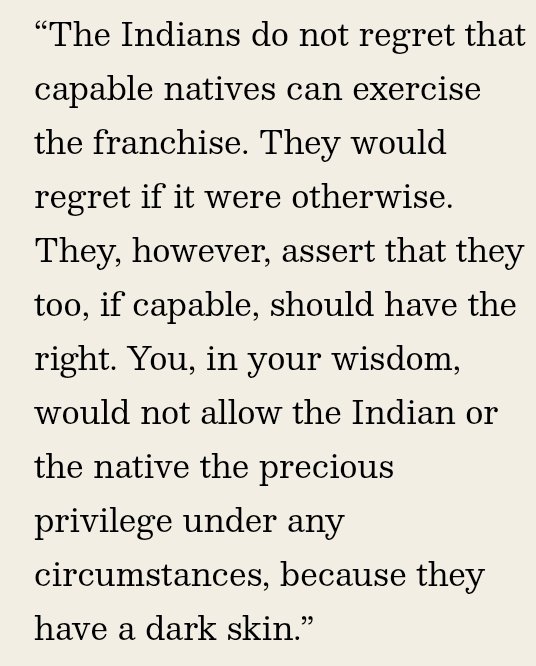
This was him in 1894 arguing that "natives" (Africans, in this case) should be allowed to vote.
Gandhi was born in a world where the Empire was the nation for most Indians. England had turned into a mother country for most of India. The Durbar of 1903 saw thousands line up to see Curzon. Nobody even thought of independence. 1857 was a distant memory.
BLR emerged as a hub after Infy, HCL, & Wipro established their HQ. That happened because the Indian govt invested in the city by setting up HAL, BEL, HMT, and other PSUs. Prior to that HH Krishna Wodeyar, William Ramsay, and JRD Tata together built IISc.
Infosys was found by a Kannada Brahmin, HCL was found by a Tamil Chettiar, Wipro was founded by a Khoja Islmaili. Half the companies operating in BLR are American. JRD Tata was a Parsi.
If everyone thought along regional/caste lines none of that would be possible.
That could happen because the Government and people of Karnataka were not petty and saw business as win win.
Do not fall for the current stock of Indian politicians. All of them are drunk on power and will fuck you over just to win an election.
India has the 3rd largest trade deficit (loss of $79B). The only countries worse than India are US & UK ($971B and $101B). And they're both extremely developed and run the intl financial system.
Think of the fact that we drain close to $100B dollars annually.
50% of that is importing energy and raw materials.
85-90% of India's oil is imported. We have negligible oil reserves.
The downstream effect is this: all our social services, civic services, administration, police force, schools, everything is underfunded. Cost cutting becomes a necessity. Scarcity becomes a way of life.
ISRO gives dosas to its scientists for a Moon landing than a hike.
Blackpill is realising that women will eventually have to be phased out. 50% of the pop but has lower IQ, lower strength, useless in war, programmed to Chagnonpill causing breakdown of society.
Once artificial wombs are developed, homosexuality needs to be instituionalized.
Part of the reason why women are like this is because the human reproductive process is extremely taxing on them, so they have evolved ways.
If we could make reproduction less taxing, it would solve these issues.
When I say artificial wombs, I do not mean some advanced futuristic industrial tech, I mean something that can be biologically integrated with humans.
Beavers have genetic memory to build dams, a beaver born in a human house, which has never seen a river, starts building dams.
One thing I notice is that many people fundamentally misunderstand India's affirmative action system.
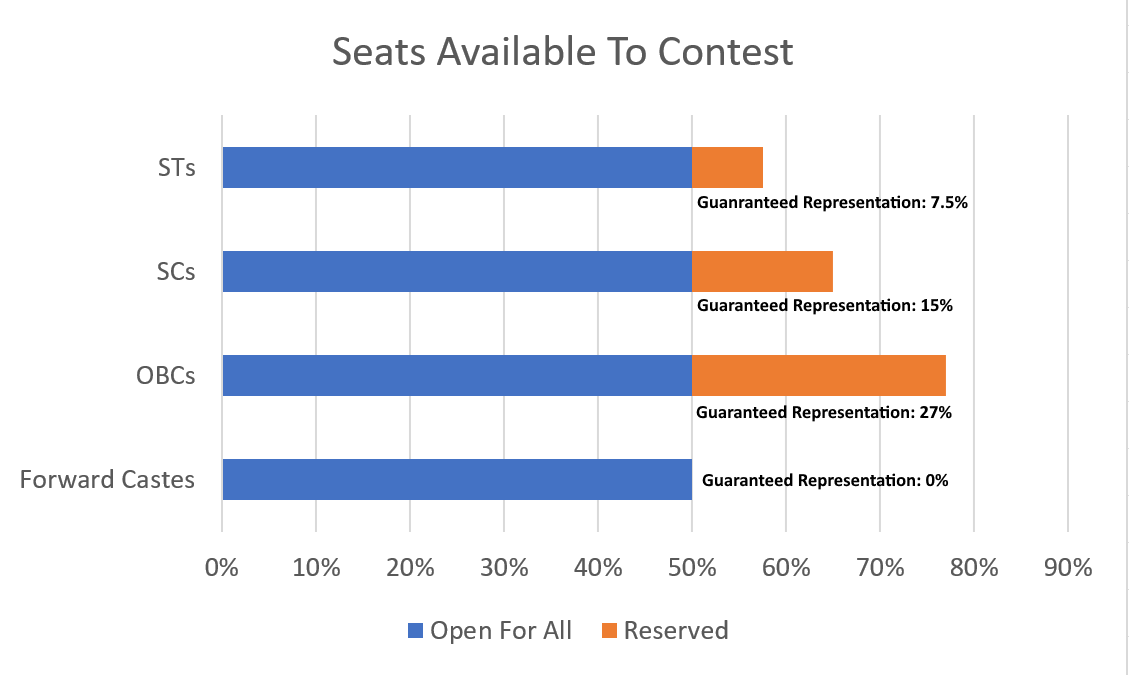
OBCs do not get 27%, they get 77%. 77% of seats are open for them to contest. SCs do not get 15%, 65% of seats are open for them, for STs it is 57.5%.
On the contrary, UCs get exactly 0% of guaranteed representation, so only 50% are open for them.
If there is an overrepresentation of UCs in the 50% OPEN, then that means the problem is the poor performance of other groups academically. For this, one needs better, cheaper schools, better healthcare and so on. Crippling standards would just lead to excusing worse performance.