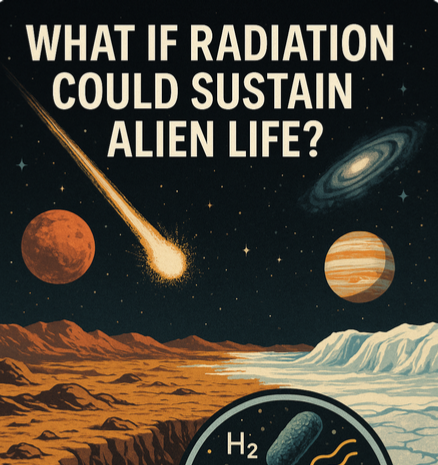
🚨What if the key to alien life isn't sunlight or warmth but radiation?
Scientists may have just found the power source for life on Mars, Europa, and Enceladus and it’s cosmic.
Let’s talk about the Radiolytic Habitable Zone🧵👇
Scientists may have just found the power source for life on Mars, Europa, and Enceladus and it’s cosmic.
Let’s talk about the Radiolytic Habitable Zone🧵👇
2/
Forget the Goldilocks Zone.
Life as we know it depends on sunlight, warmth, and liquid water.
But researchers now propose a new kind of habitable zone deep beneath icy worlds and dead planets, powered by radiation.
It’s called the RHZ.
Forget the Goldilocks Zone.
Life as we know it depends on sunlight, warmth, and liquid water.
But researchers now propose a new kind of habitable zone deep beneath icy worlds and dead planets, powered by radiation.
It’s called the RHZ.
3/
Galactic Cosmic Rays (GCRs) are high energy particles from deep space.
When they slam into the surface of a planet or moon, they don’t just destroy everything, they actually create.
They trigger a chemical cascade called radiolysis.
Galactic Cosmic Rays (GCRs) are high energy particles from deep space.
When they slam into the surface of a planet or moon, they don’t just destroy everything, they actually create.
They trigger a chemical cascade called radiolysis.
4/
Radiolysis is when radiation hits water, it breaks apart H₂O into radicals and electrons kind of like molecular shrapnel.
These byproducts include solvated electrons, Hydrogen gas (H₂) and peroxides, and microbes LOVE these as fuel.
Radiolysis is when radiation hits water, it breaks apart H₂O into radicals and electrons kind of like molecular shrapnel.
These byproducts include solvated electrons, Hydrogen gas (H₂) and peroxides, and microbes LOVE these as fuel.
5/
Life thrives on this stuff on Earth.
Desulforudis audaxviator is a microbe found 2.8 km underground in a South African gold mine.
It survives on nothing but radiolysis from natural uranium decay.
There's no light or oxygen there, just radiation powered life.
Life thrives on this stuff on Earth.
Desulforudis audaxviator is a microbe found 2.8 km underground in a South African gold mine.
It survives on nothing but radiolysis from natural uranium decay.
There's no light or oxygen there, just radiation powered life.
6/
So what if similar life exists on other worlds?
New simulations by researchers using the GEANT4 particle toolkit reveal that Mars, Europa, and Enceladus all receive enough GCR radiation to support life beneath the surface.
So what if similar life exists on other worlds?
New simulations by researchers using the GEANT4 particle toolkit reveal that Mars, Europa, and Enceladus all receive enough GCR radiation to support life beneath the surface.
7/
They modeled everything from GCR flux, water or rock content, electron production, ATP generation and biomass density, and I have to tell you, the numbers are insane. So if you are wondering, what all of this means...
They modeled everything from GCR flux, water or rock content, electron production, ATP generation and biomass density, and I have to tell you, the numbers are insane. So if you are wondering, what all of this means...
8/
Let's look at the results:
Maximum potential biomass (cells/cm³):
Enceladus: 43,000
Mars: 10,000
Europa: 4,000
All just beneath the surface meaning that life could literally be thriving just meters away from our instruments.
Let's look at the results:
Maximum potential biomass (cells/cm³):
Enceladus: 43,000
Mars: 10,000
Europa: 4,000
All just beneath the surface meaning that life could literally be thriving just meters away from our instruments.
9/
Some known Earth bacteria grow nanowires to absorb electrons from their environment.
Others eat electrons directly from metals.
Alien microbes could do the same absorbing solvated electrons like a battery recharging from radiation.
Some known Earth bacteria grow nanowires to absorb electrons from their environment.
Others eat electrons directly from metals.
Alien microbes could do the same absorbing solvated electrons like a battery recharging from radiation.
10/
This flips the idea of habitability on its head. With no need for sunlight, or geothermal vents.
Just consistent cosmic radiation hitting ice or rock.
This creates the Radiolytic Habitable Zone and it might be far more common than we thought.
This flips the idea of habitability on its head. With no need for sunlight, or geothermal vents.
Just consistent cosmic radiation hitting ice or rock.
This creates the Radiolytic Habitable Zone and it might be far more common than we thought.
11/
The paper recommends exploring Mars' polar ice caps.
Sampling fissures on Enceladus, and targeting thin crust zones on Europa. Testing for electron powered life and conducting lab experiments with low electron flux. This is actionable.
The paper recommends exploring Mars' polar ice caps.
Sampling fissures on Enceladus, and targeting thin crust zones on Europa. Testing for electron powered life and conducting lab experiments with low electron flux. This is actionable.
12/
This is peer-reviewed astrobiology, published by @Cambridge_Uni.
Radiation may not just destroy life after all, it may ignite it.
Welcome to the age of radiolysis-powered biospheres.
Source:
cambridge.org/core/journals/…
Tag someone who still thinks we need sunlight for life.
🧵 /End.
#Astrobiology #Mars #Europa #Enceladus #AlienLife #UAP #Space #Radiolysis
This is peer-reviewed astrobiology, published by @Cambridge_Uni.
Radiation may not just destroy life after all, it may ignite it.
Welcome to the age of radiolysis-powered biospheres.
Source:
cambridge.org/core/journals/…
Tag someone who still thinks we need sunlight for life.
🧵 /End.
#Astrobiology #Mars #Europa #Enceladus #AlienLife #UAP #Space #Radiolysis
• • •
Missing some Tweet in this thread? You can try to
force a refresh