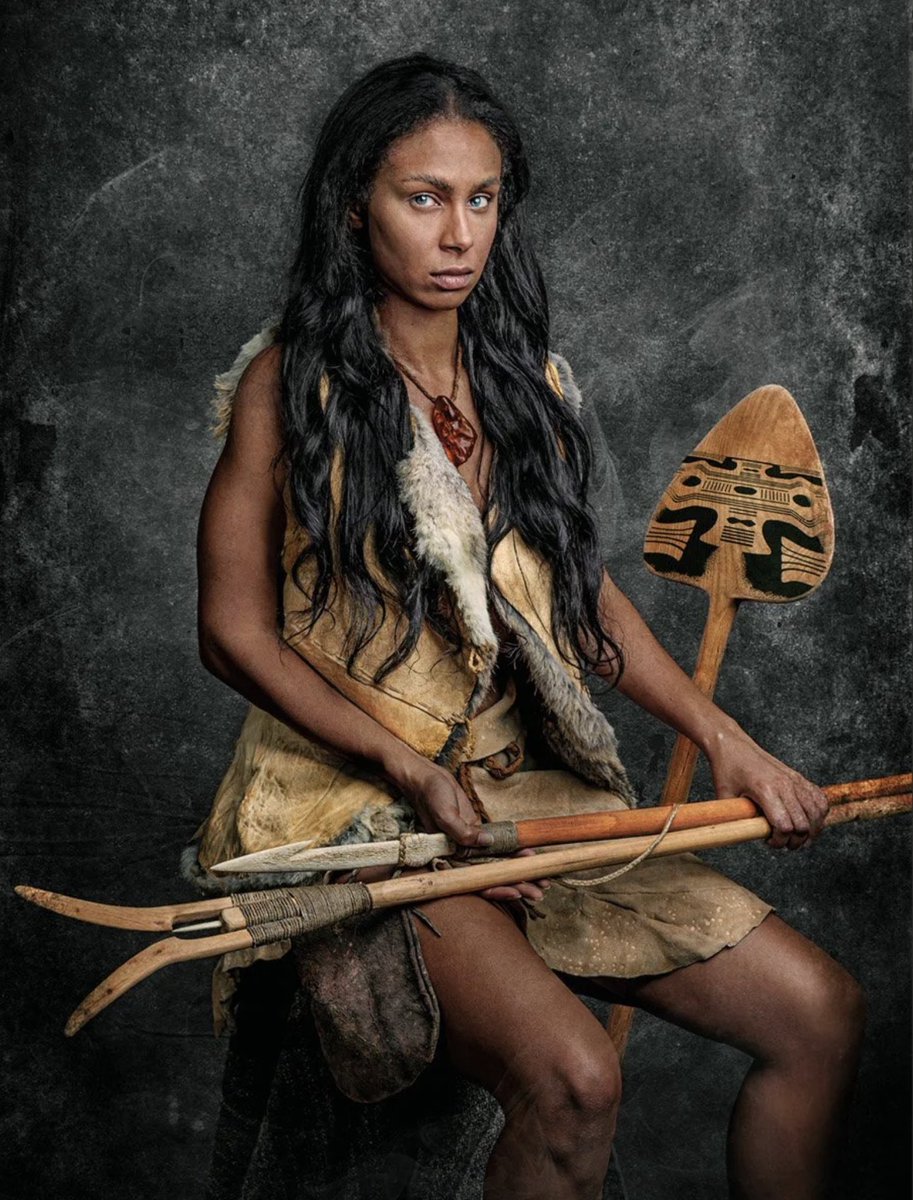
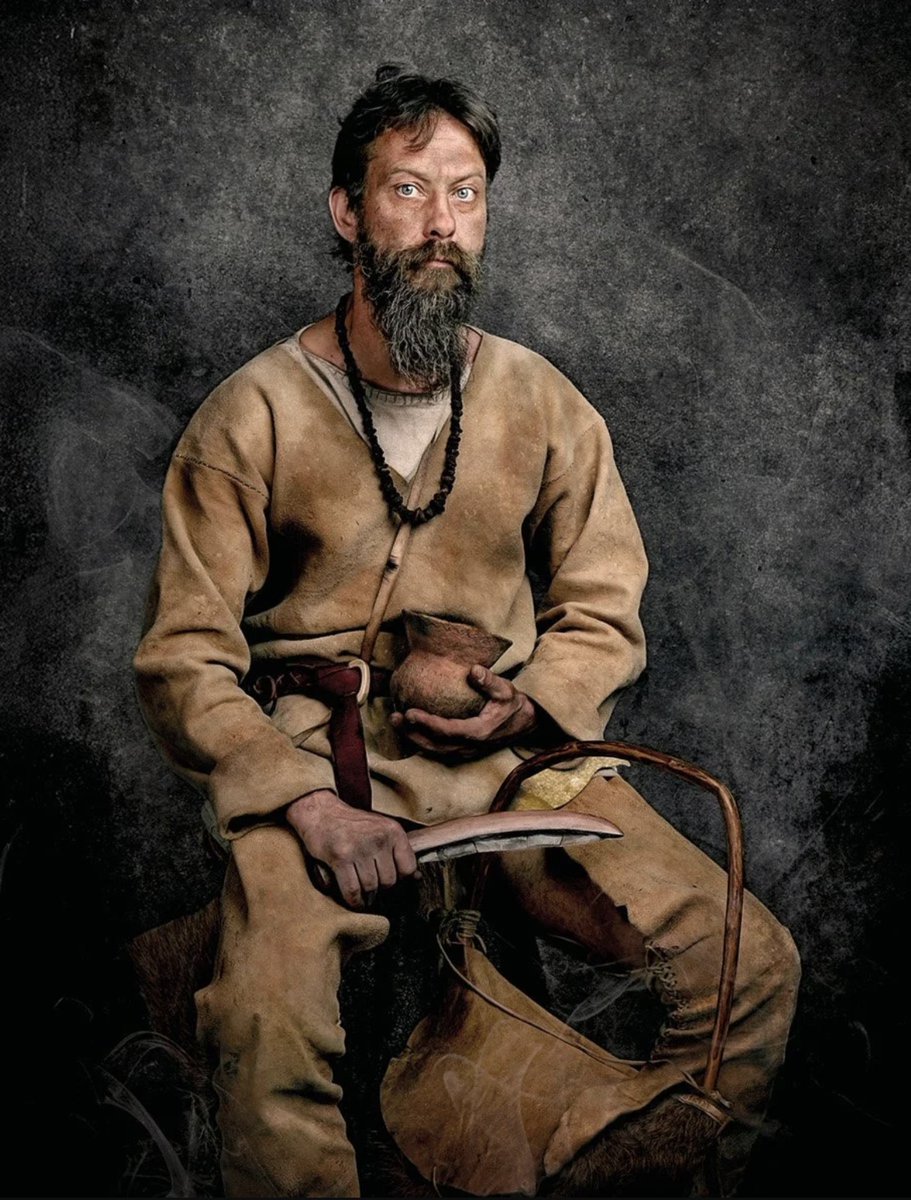
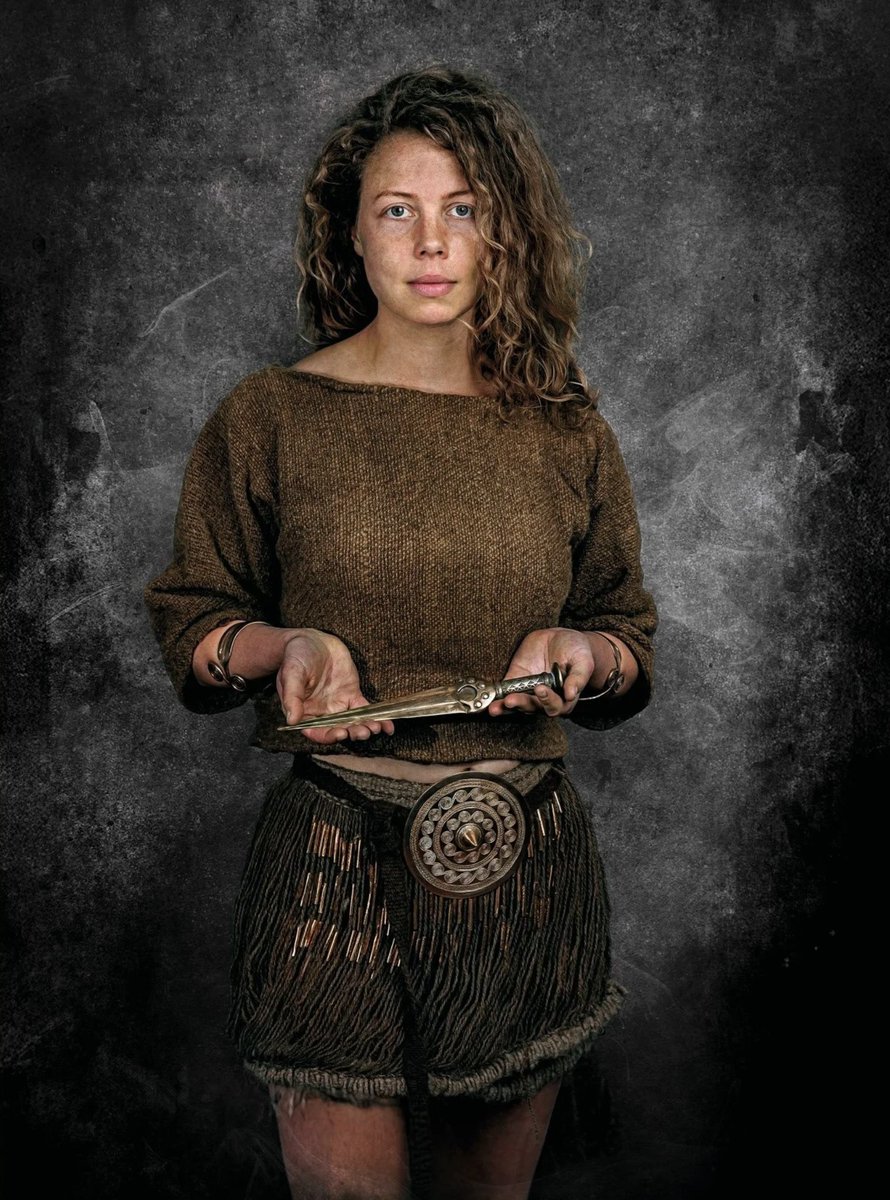
A preprint for a new large study by Silva et al titled "Genomic history and selection in Roman and early medieval Britain” uses new data with 1039 ancient samples and new methods to confirm what previous studies have found about our island history.
Namely that the Romans didn’t affect us much but the Anglo-Saxons did. There are also some surprising findings in there... 🧵
-Roman Britain had strong genetic continuity with Iron Age Britain overall.
~80% of Roman-era skeletons are native Britons.
-The other ~20% (mostly 200s–300s CE) include Scythians/Sarmatians, Gauls, Germans & southern Europeans — mostly in cities & military contexts, matching Roman policy of using non-local troops on frontiers.
- Matrilocality (women staying local, NOT matriarchy) confirmed in multiple Durotriges sites + Yorkshire.
-Men from tribes practising matrilocality in Yorkshire left home and mixed with neighbouring girls, while women stay put.
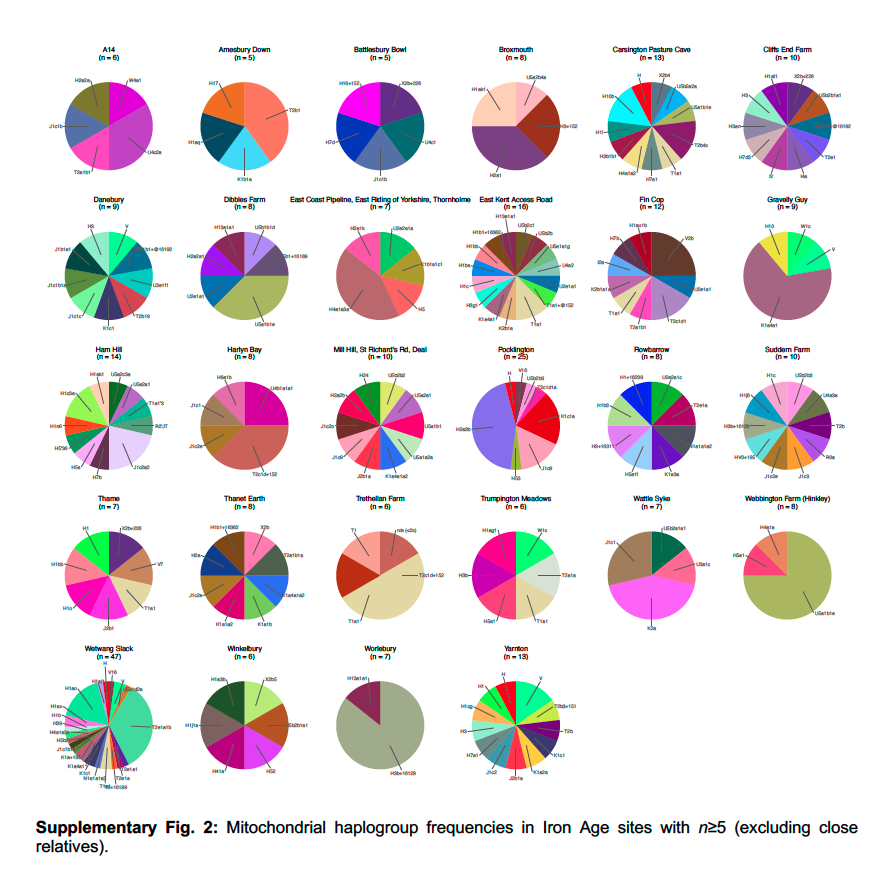
-In some cases such tribes (with reduced mitochondrial haplogroup diversity as on pie charts) were more inbred - Sporadic cousin marriage disappeared in Roman times (except for a couple examples in Somerset).
-No lasting genetic impact from foreigners in Roman times
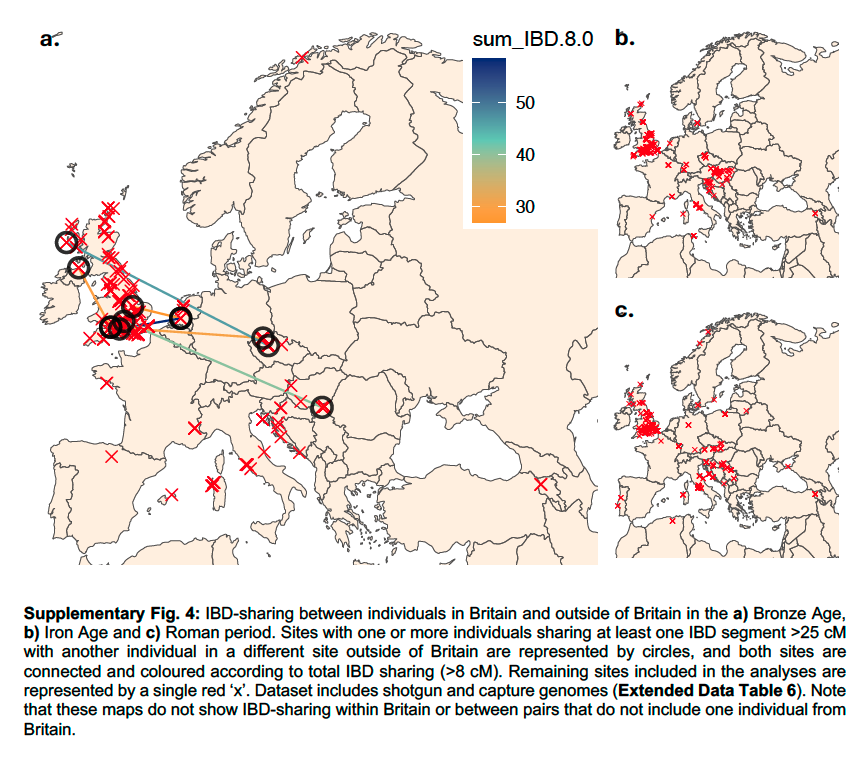
-Sporadic Germanic ancestry existed in Roman British military elites but nothing compared to the scale in post-Roman Britain

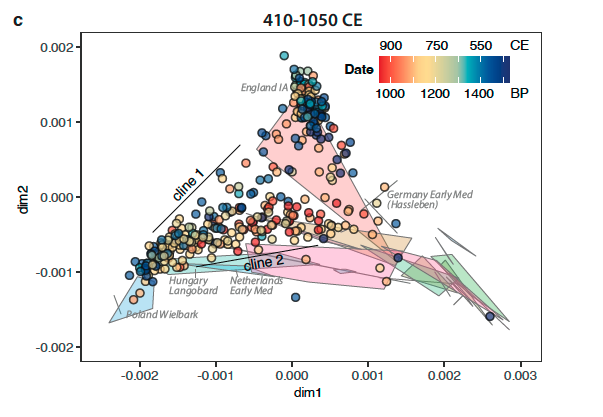
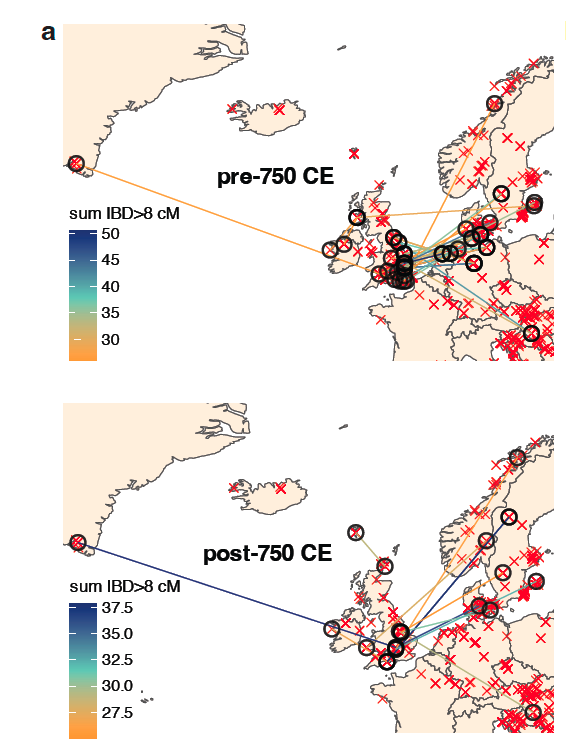
-They confirm results of prev studies showing both Anglo-Saxon migration and following introgression of a French like ancestry this paper calls “central/southern European.”

- Early 5th–6th c samples are often pure “Early Medieval Britain I” ( PC way to say "Anglo-Saxons" from North-Sea coast of Germany and Denmark) types.
-Majority of individuals in England model as mostly this source in this period - mixing with britons initially rare.
-Also found samples with affinities to other Germanics = Langobards in Hungary and Frisians.
From 8th - 10th century, different ancestry is found, relating more to a "central European” source, best modelled with samples from a 4th c. Alemannic cemetery near Strasbourg on the French/German border.
-The Alemanni are only a match because they are Germanised Gauls, but in my opinion the source in England is obviously more northerly Franks near the Rhine
- This aligns with recent isotopic findings of increased, possibly female-mediated, movement from the Rhineland regions in the 7th and 8th centuries
-So the “French” ancestry in England is largely from Germanic people, which is why there is only Germanic material culture coming into Britain in this period.
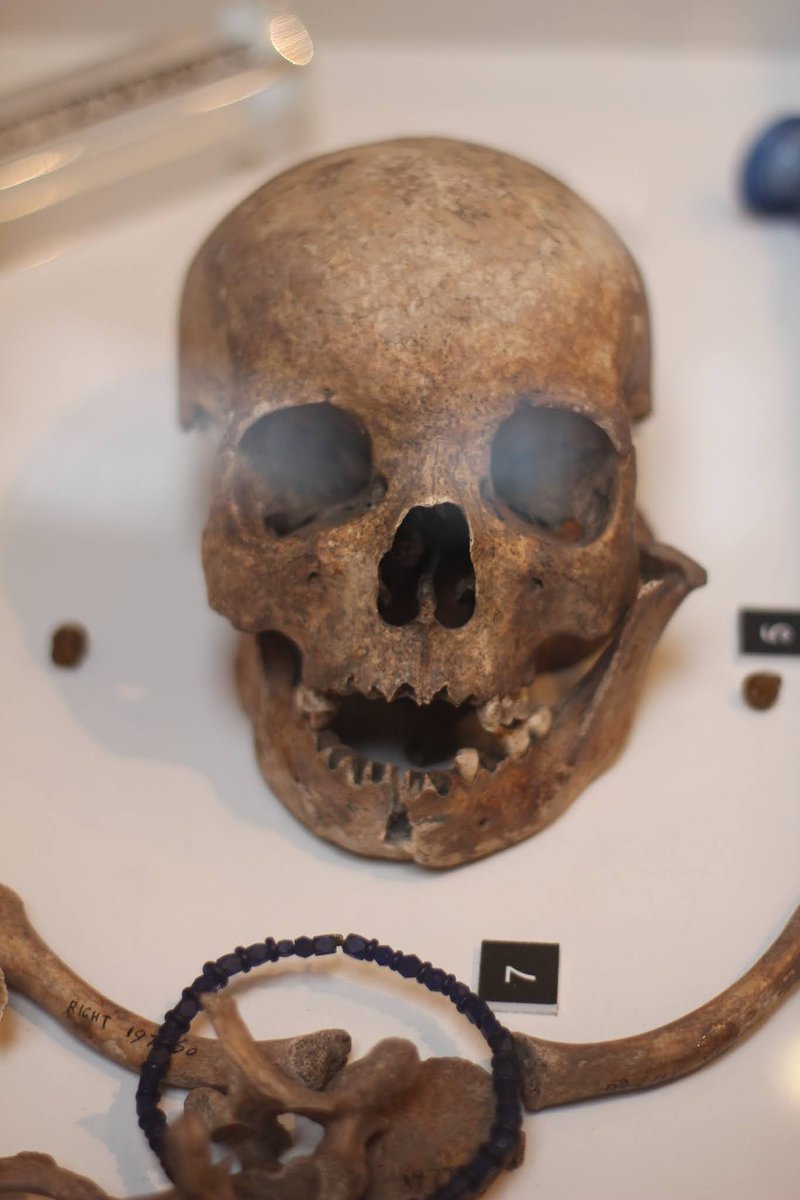
For the last 16 years this supposedly "black" Roman Briton from York called "Ivory Bangle Lady" has been rammed down our throats as an example of the alleged diversity of our island history and of the presence of black people in ancient times.
For over three years the Francis Crick institute has been sitting on her DNA and not revealing whether she really was black or not. I have been saying all these years "I bet she isn't black, and will formally apologise if I am wrong."
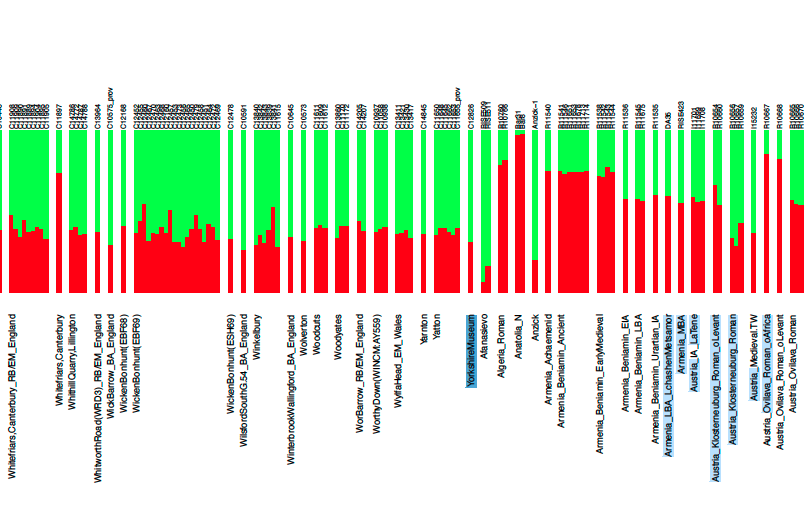
Now a new MASSIVE paper on Roman and medieval British DNA by Silva et al 2026 has been published and buried in the supplements is a little sample from York Museum sequenced by Crick and labelled C12826. The entry for this sample includes archaeological context tying it directly to the Yorkshire Museum collection, specifically the high-status late Roman female burial from Sycamore Terrace, York (Eboracum) which is the exact provenance of the Ivory Bangle Lady (excavated 1901, with characteristic ivory/jet bangles and other grave goods) and is dated to 4th c AD, just like her. I am pretty sure this is her and that they tried to keep this quiet. Let's make sure everyone knows!
You can see her on the K=2 admixture plot, Supplementary Fig. 5. The green part represents native Brythonic ancestry, and the red part represents continental European ancestry. There is no Sub Saharan black ancestry or North African ancestry.
All the academics who counter signalled me owe me an apology. All the pompous media organisations like the BBC should issue a formal apology to the public for misrepresenting our ancestors and our history with their WOKE historical revisionism.
This comes soon after the recent revelation that the other skeleton, Beachy Head lady, which the BBC and others have insisted was a "Great black Briton" from Roman times, was actually just a white Briton.
The moors of Denmark and North Germany preserve numerous Iron Age Germanic offerings. While bog bodies may be executed criminals (see Tacitus), and individual deposits of weapons and jewellery, hair and animals are thought to be offerings to the gods, other explanations are proposed for the deposits of vast numbers of bows, arrows, armour, swords, shields, horses and even boats.
One explanation is that because many Germanics from Scandinavia had to pass through this region in order to serve in the Roman army beyond the limes, they probably raided en route and were sometimes killed by locals (Angles) who offered the defeated forces to the bogs. Indeed many of the bog finds in Denmark are non-local.
These maps (see pic) show the origins of the "spoils of war" deposited in the bogs of Nydam and Thorsberg.
Clearly there was two-way traffic from Germany and Scandinavia passing through the land of the Angles who were not always friendly towards itinerant mercenaries!
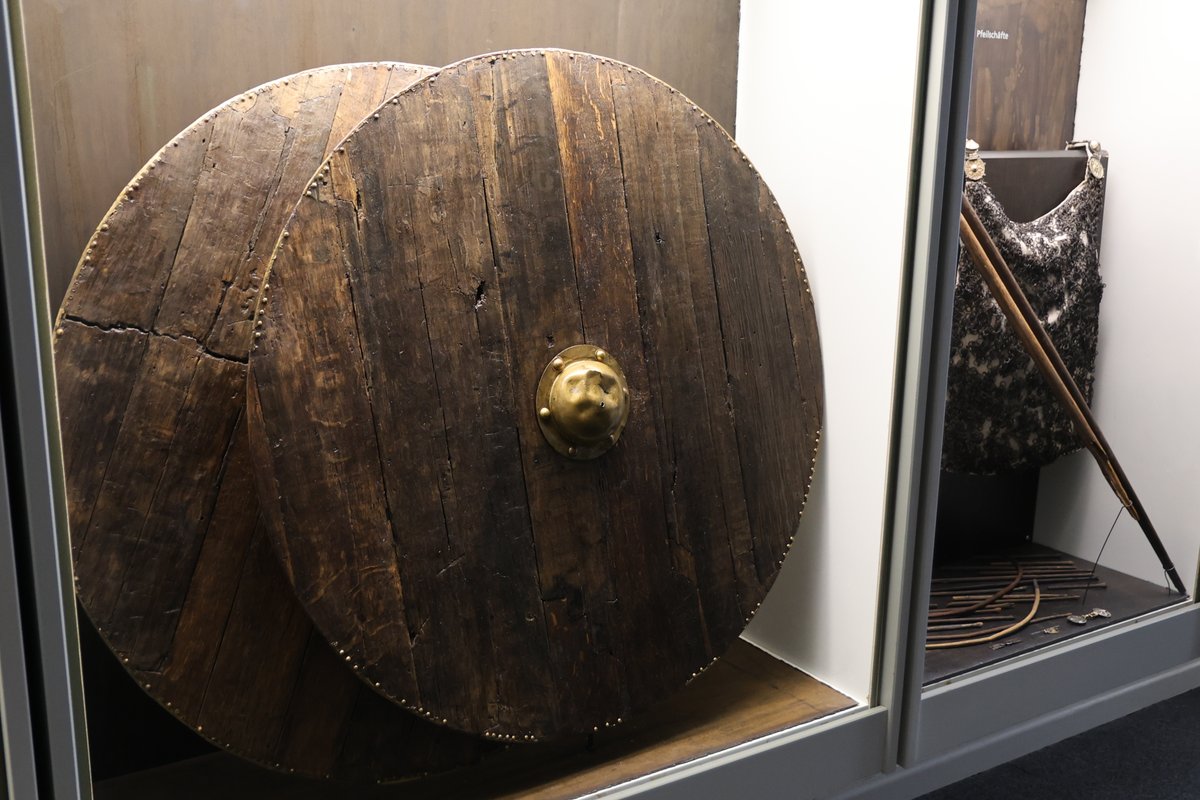
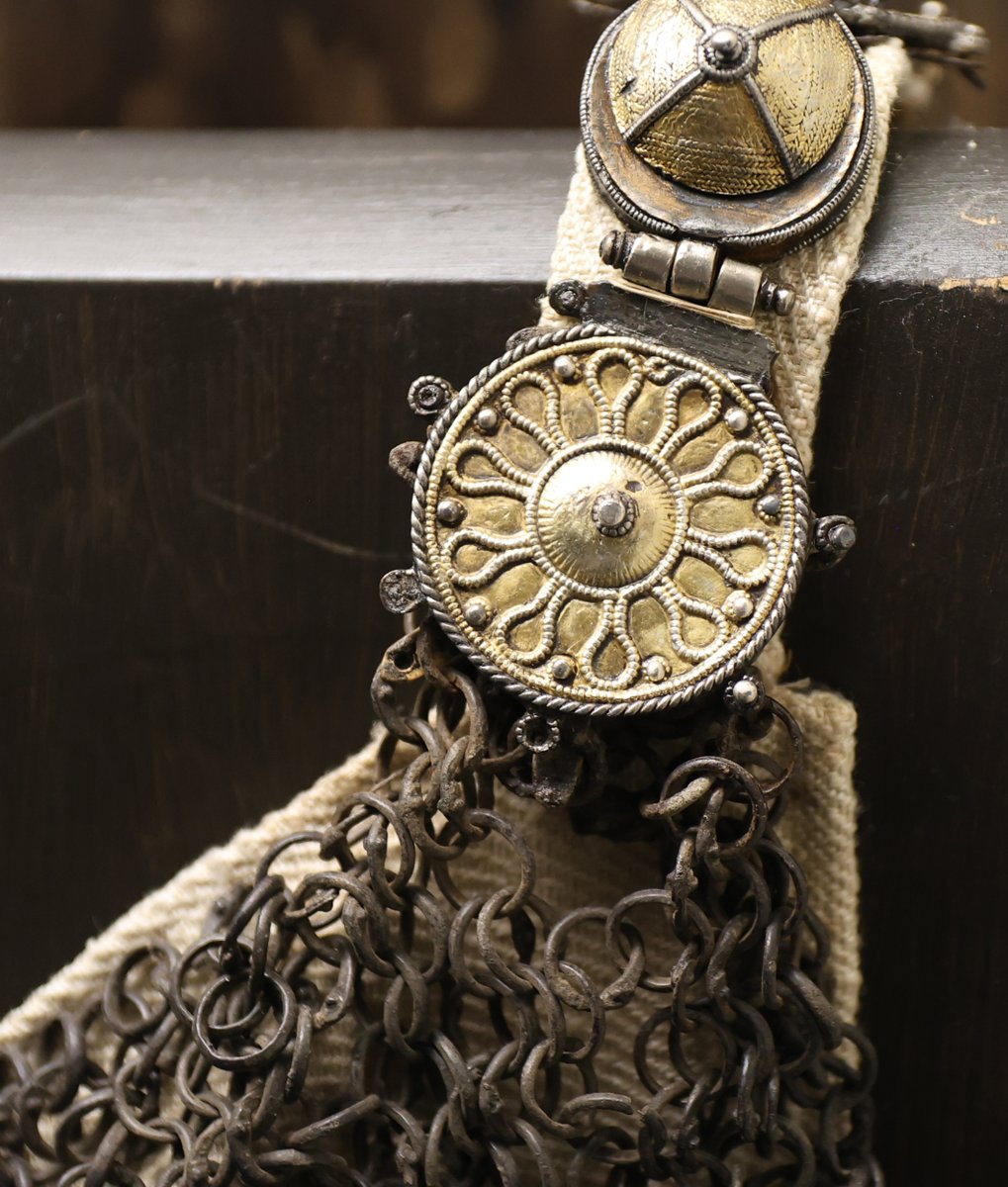
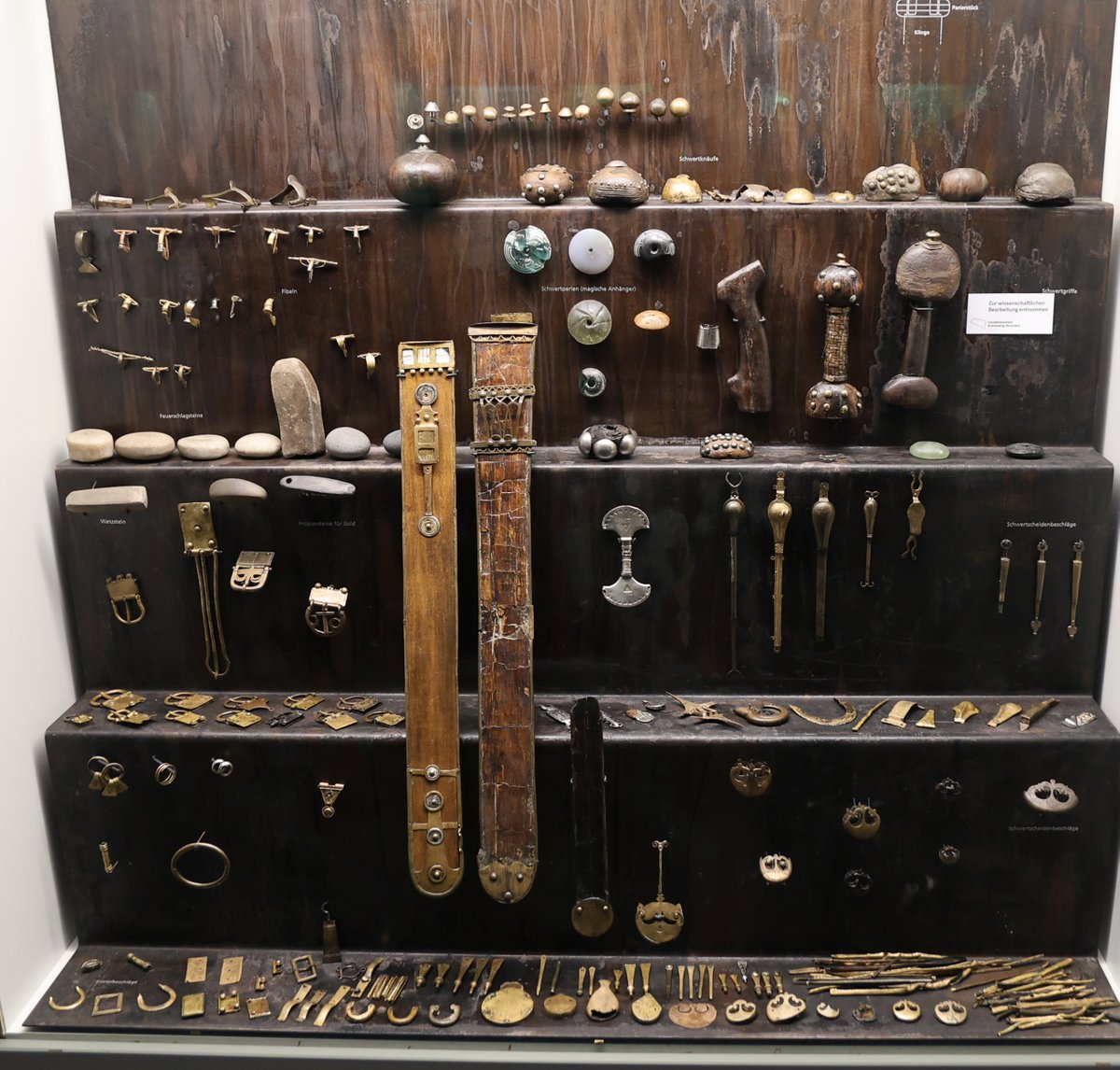
Also pictured are Thorsberg bog finds (shields, byrnie, swords and fittings etc) dated to 200's, at Gottorf Castle in Schleswig - my own photos
1/5
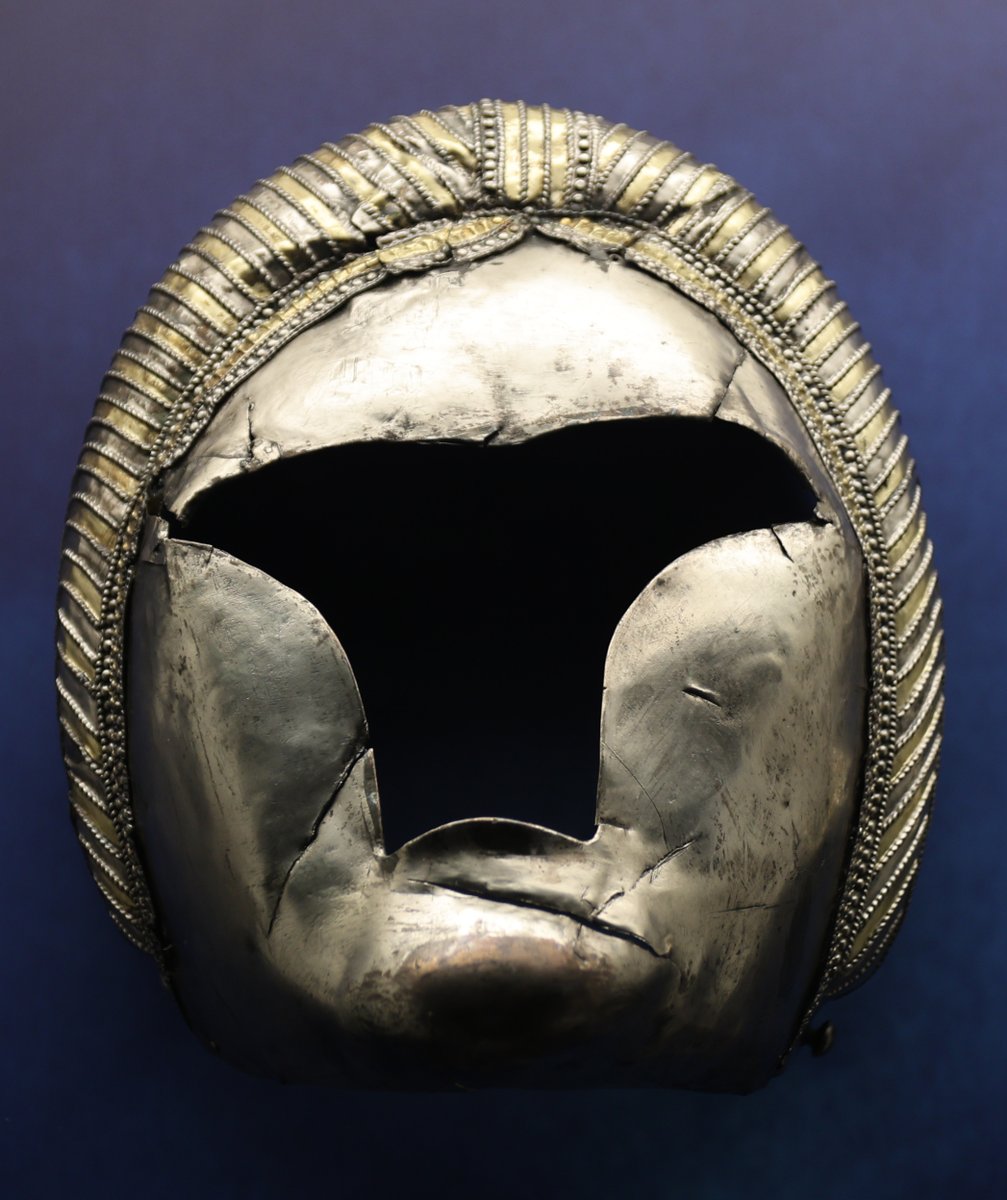
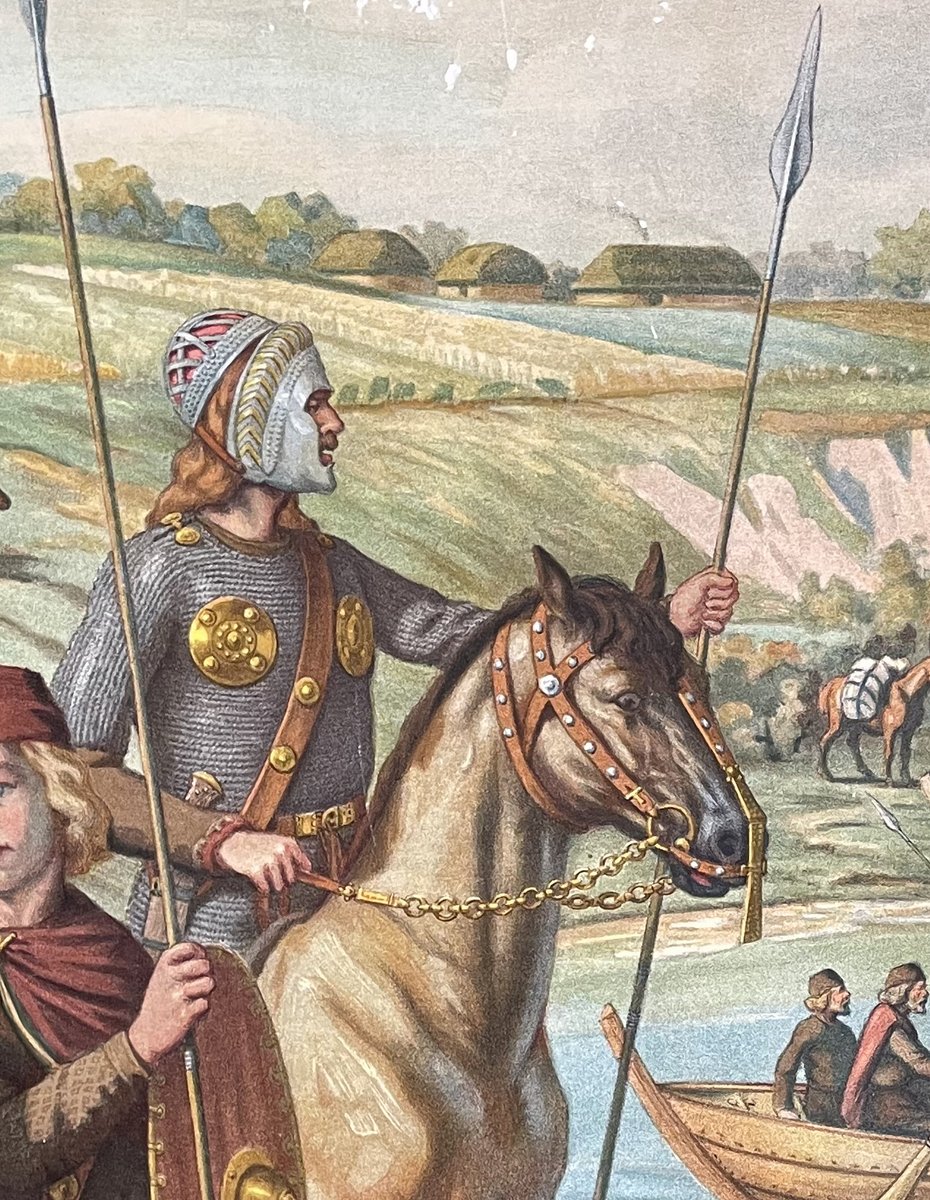
This silver mask from Thorsberg bog was evidently owned by a very high status military leader with clear connections to the Roman army.
However it is uncertain whether it is of Germanic manufacture, influenced by Roman styles, or if it is a Roman cavalry mask which was modified by its German owner - possibly cutting out the face section to increase visibility.
My other photo is of a Roman helmet from the same bog - obviously worn by a Germanic mercenary/auxillary of the Roman army 2/5
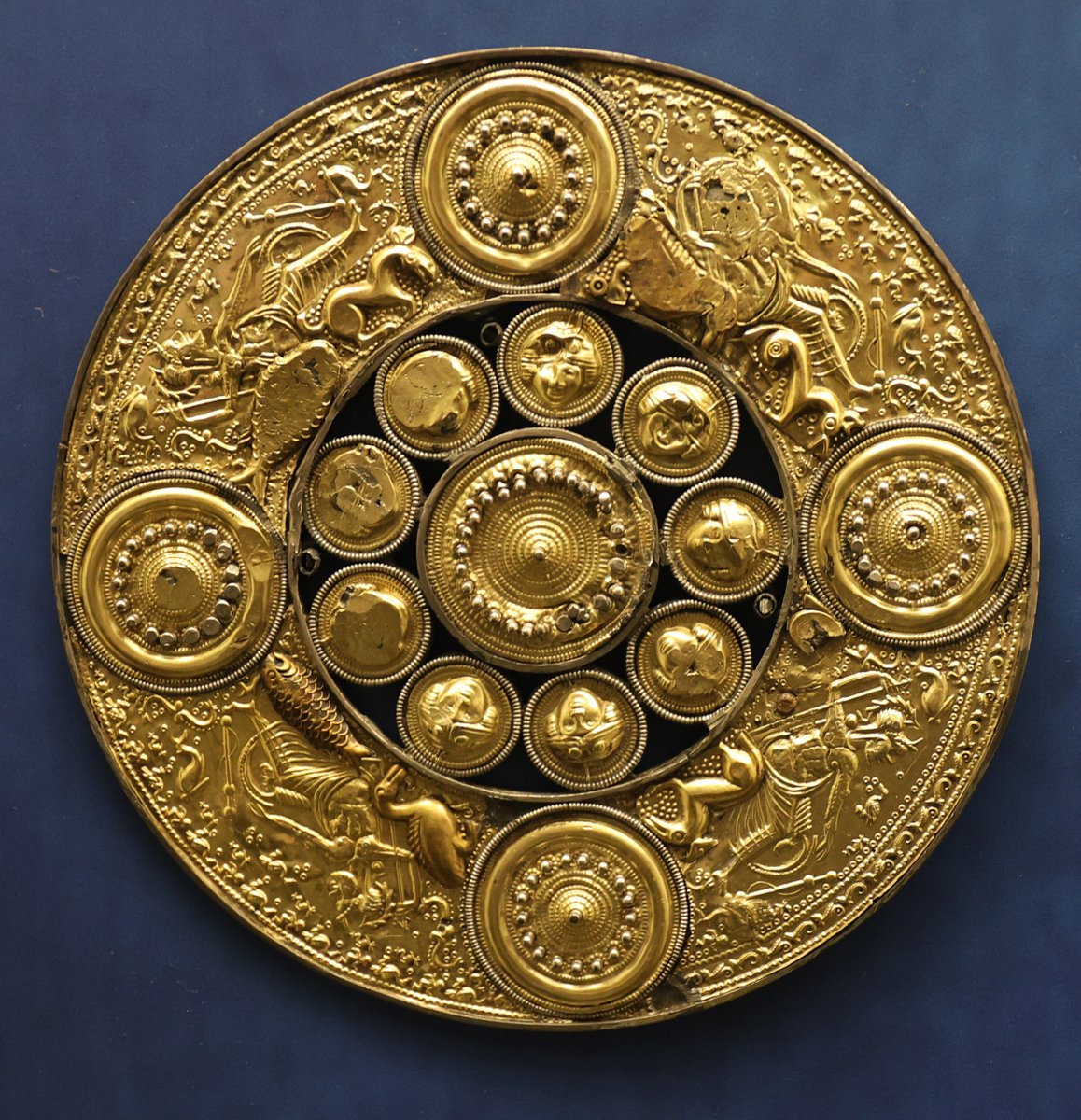
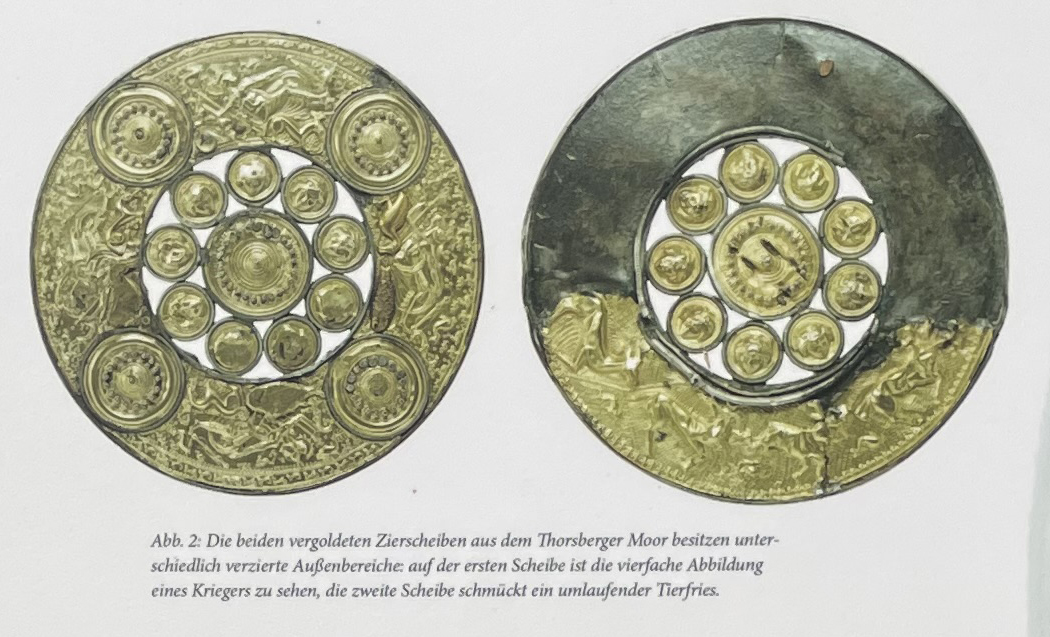
Two Roman-Iron-Age gilt discs from the Thorsberg Moor have differently decorated outer areas: the less well preserved one has animals (deer?) while the other has a complicated combination of Germanic and Roman imagery.
A reclining Romanesque figure bearing a sceptre appears in each of the four sections. Is it a god? It resembles Wodenic kings of later bracteates inspired by Roman solidi images of Emperors.
A combination of the same animals known from the earlier Nordic Bronze age solar drama are also depicted. 1. fish+horse. 2.duck+horse 3. (?)+horse. 4. duck+fish.
Each of the quadrants is separated by a solar disc motif. This shows a unique transitionary stage in Germanic art with NBA elements, Roman elements and the beginning of what would become the Germanic animal style. 3/5
🧵 A Saxon chieftain's burial from Germany at the time of the Anglo-Saxon migration 🧵🏴🇩🇪
In 421 AD, as many Saxons were migrating to Britain, a Saxon chieftain was buried at Fallward near the river Weser, in a boat shaped coffin. 1/6
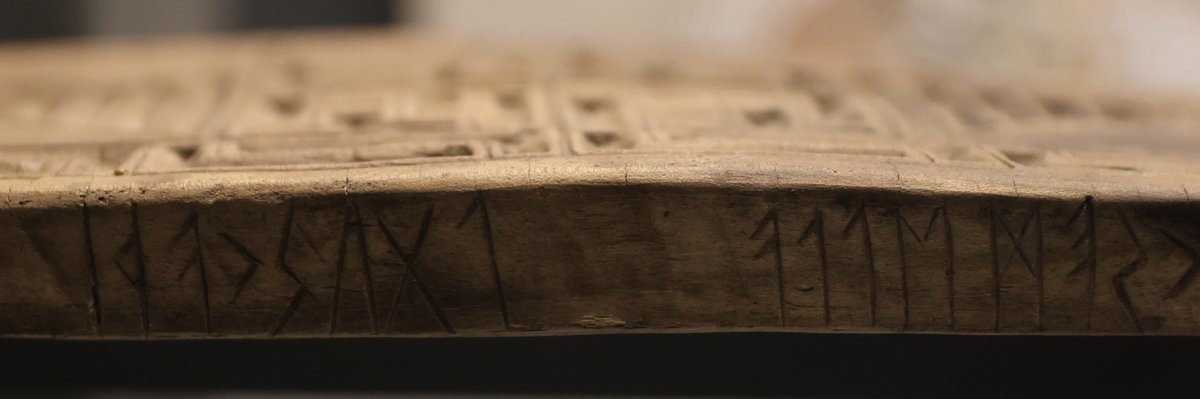
Conditions of the soil allowed for excellent preservation of wooden items including a chair and foot stool (mentioned in my swastika video) with a runic inscription saying what may be the chief's nick name Alguskathi "elk -harmer".
(my pics shows the foot stool) 2/6
He was cremated, like others in the same cemetery, and the urns there are the same as kind the early English used. Elk harmer's people also moved to England shortly after he died. 3/6
What are Zierscheibe? 🧵
On the internet, the word has been used to describe the specific Germanic sun wheel which was used by Himmler to decorate the floor of Wewelsberg castle (used as a school for the SS). In fact Himmler took the so called “sonnenrad” or” black sun” design from a Zierscheibe, but Zierscheibe just means “ornamental disc” and such discs have many different symbols on them. The example here was found in Niederbreisig. 1/5
The decorative discs, cast from bronze, were part of a Germanic woman's belt-fastened sash in the late Merovingian period (6th-7th century). They are particularly common in Germany, and Holland, but are also found in France, England, Scandinavia and Italy.
Today they are associated with allegedly solar motifs. These include sun wheels, black suns and swastikas. You can see why the Nazis liked them. However such geometric designs are no more common than theriomorphic and anthropomorphic-figurative motifs.
Pictured: Alemannic Zierscheibe from Herbrechtingen (6th century), from pfahlheim, a Frankish eg with sunwheel, several german designs 2/5
These variants feature a man on horseback - possibly a god. The left one is Frankish and the right is Alemannic from the NYC Met museum 3/5
🧵 Some British and Australian people WRONGLY dismiss Halloween as a commercial American custom. Others think the origin of pumpkin jack-o'-lanterns is exclusively Irish or at least “Celtic”. In reality these lanterns are as much British as Irish, and the tradition is found in other Germanic nations such as Germany and Sweden too.
pic: Traditional turnip lantern at the Museum of Country Life in Ireland 1/7
Prior to the American pumpkin tradition, people in Ireland, Scotland and England used turnips, swedes and mangelwurzels. The lanterns were associated with the Catholic holiday of All Hallow’s Eve in Ireland, but protestants in Britain sometimes moved the festival, such as in Somerset where it was held on the last Thursday of October and was called “punkie night”. Punkie means ‘jack-o-lantern’ in West Country dialect and these were carried about in a tradition much like trick or treating in America. They didn’t always have faces carved on them, but they were always intended to scare away evil.
The word punkie probably comes from Old English Pūcan or pūclas which were evil spirits in Anglo-Saxon folklore, cognate to Swedish and Norwegian puke “evil spirit”. The Irish word púca”spirit” is probably a loan from Old English as the p sound didn’t exist in primitive Gaelic.
pic: punkie night in Hinton St George, England. 2/7
The earliest attestations of carving such lanterns are from Worcestershire in England in 1840, Hampshire, England in 1838, and Scotland in 1808. So there is no reason to think it originated in Ireland. Various traditions of bonfires and carrying root lanterns or blazing fagots while going door to door for food existed across the British isles but the switch to pumpkins instead of turnips occurred in the USA.
The tradition of using turnip lanterns was still extant as far East as Sussex in 1973 when it was recorded among children there by Jacqueline Simpson in the Folklore of Sussex. Therefore, the introduction of the American pumpkin jack-o-lantern in Britain occurred while the native turnip tradition still existed, so there has never been a time when British people DIDNT make jack-o-lanterns for Halloween.
pic: My wife and I carved these pumpkins last night 3/7