Vik Paruchuri Profile picture
Aug 12 11 tweets 4 min read Read on X
Parsing PDFs has slowly driven me insane over the last year. Here are 8 weird edge cases to show you why PDF parsing isn't an easy problem. 🧵 Image
PDFs have a font map that tells you what actual character is connected to each rendered character, so you can copy/paste. Unfortunately, these maps can lie, so the character you copy is not what you see. If you're unlucky, it's total gibberish. Image
PDFs can have invisible text that only shows up when you try to extract it. "Measurement in your home" is only here once...or is it? Image
Math is a whole can of worms. Remember the font map problem? Well, math is almost always random characters - here we get some strange Tamil/Amharic combo. Image
Math bounding boxes are always fun - see how each formula is broken up into lots of tiny sections? Putting them together is a great time! Image
Once upon a time, someone decided that their favorite letters should be connected together into one character - like ffi or fl. Unfortunately, PDFs are inconsistent with this, and sometimes will totally skip ligatures - very ecient of them. Image
Not all text in a PDF is correct. Some PDFs are digital, and the text was added on creation. But others have had invisible OCR text added, sometimes based on pretty bad text detection. That's when you get this mess: Image
Overlapping text elements can get crazy - see how the watermark overlaps all the other text? Forget about finding good reading order here. Image
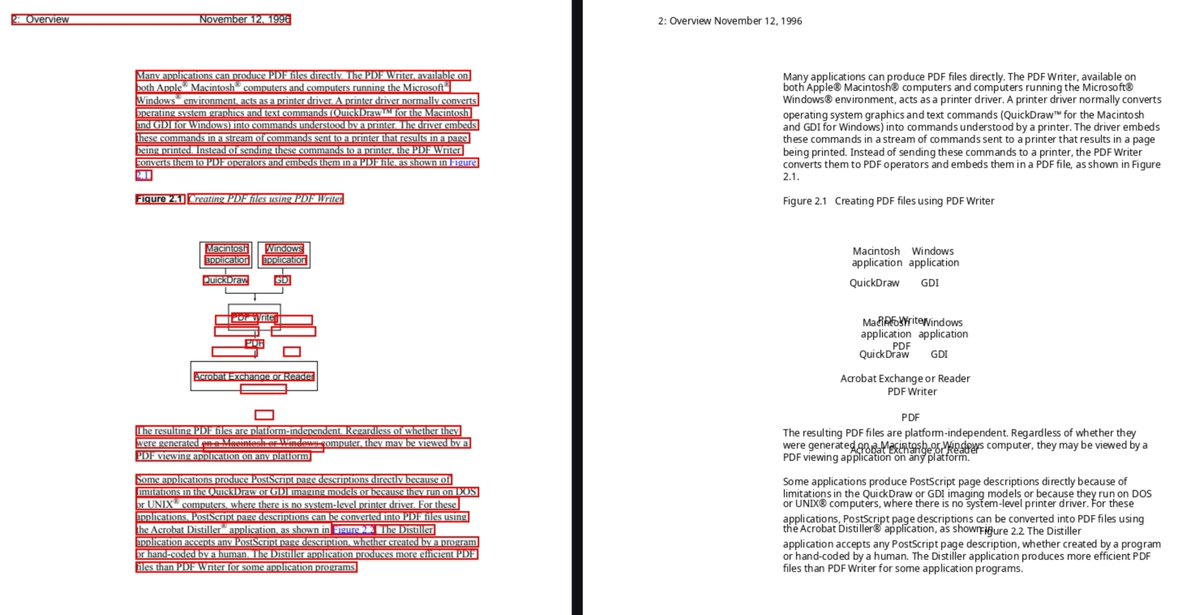
I've been showing you somewhat nice line bounding boxes. But PDFs just have character positions inside - you have to postprocess to join them into lines. In tables, this can get tricky, since it's hard to know when a new cell starts: Image
You might be wondering why you should even bother with the text inside PDFs. The answer is that a lot of PDFs have good text, and it's faster and more accurate to just pull it out.

This is what we do with marker - - we only OCR if the text is bad.github.com/datalab-to/mar…
Anyways, back to fixing more crazy edge cases. Let me know if you've come across any other PDF weirdness.

• • •

Missing some Tweet in this thread? You can try to force a refresh

 

Keep Current with Vik Paruchuri

Vik Paruchuri Profile picture

Stay in touch and get notified when new unrolls are available from this author!

Read all threads

This Thread may be Removed Anytime!

PDF

Twitter may remove this content at anytime! Save it as PDF for later use!

Try unrolling a thread yourself!

how to unroll video
  1. Follow @ThreadReaderApp to mention us!

  2. From a Twitter thread mention us with a keyword "unroll"
@threadreaderapp unroll

Practice here first or read more on our help page!

More from @VikParuchuri

Sep 10
The PDF format is hard to parse - by design.

Let's explore the internals of the PDF format to figure out how Adobe did this to us. Image
I created this amazing sample PDF with reportlab.

We can use `strings sample.pdf | less` to extract/render the ascii text from the PDF binary. Image
This is the whole PDF! The `8 0 obj` lines define different objects (you can see they refer to each other). The xref is a quick way to jump to the byte position of an object.

Let's start with the trailer. Image
Read 16 tweets
Sep 5
High quality math is the secret sauce for reasoning models.

The best math data is in old papers. But OCRing that math is full of insane edge cases.

Let's talk about how to solve this, and how you can get better math data than many frontier labs 🧵 Image
Many papers, including deepseek-math and nvidia nemotron, have concluded that math pretraining is critical for general LLM reasoning: Image
Image
Quality matters! The smollm paper from huggingface found that filtering math tokens from 34B to 10B (keeping the highest quality tokens) and training with fixed steps increased reasoning performance. (finemath4+ vs 3+) Image
Read 13 tweets
Apr 24
We shipped an alpha version of the new Surya OCR model. No hype, just facts:

- 90+ languages (focus on en, romance langs, zh, ar, ja, ko)
- LaTeX and formatting
- Char/word/line bboxes
- ~500M non-embed params
- 10-20 pages/s Image
Image
Image
Image
Get with `pip install --pre -U surya-ocr`. Use with marker: `pip install --pre -U marker-pdf`, then pass the `format_lines` marker option.

More info at github.com/VikParuchuri/s… and github.com/VikParuchuri/m… .
Throughput measured using 1x H100 with Nvidia MPS enabled, 10 workers, and chunking. Finalizing a VLLM config for improved performance. (arch is mostly llama/qwen, but some non-standard stuff).
Read 4 tweets
Feb 19
We've improved marker (PDF -> markdown) a lot in 3 months - accuracy and speed now beat llamaparse, mathpix, and docling.

We shipped:
- llm mode that augments marker with models like gemini flash
- improved math, w/inline math
- links and references
- better tables and forms Image
Image
Find marker at

Benchmarking markdown conversion isn't easy - different services have different formats. We use both a heuristic text matching method, and llm as a judge.

The code for the benchmarks is in the marker repo. github.com/VikParuchuri/m…Image
Image
LLM mode iterates on marker output for certain blocks. You can use gemini, or local models via ollama. More models coming soon.

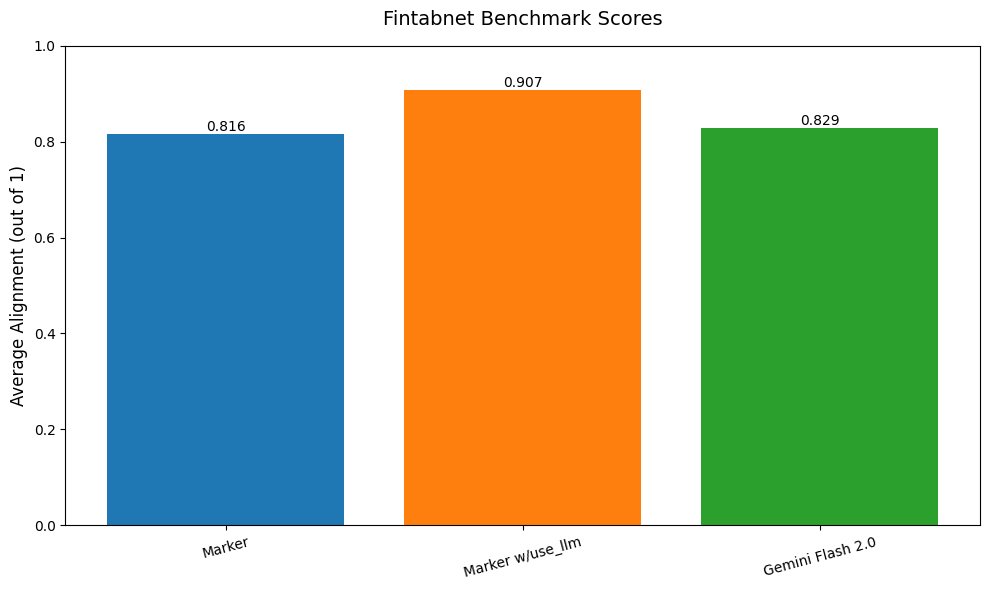
Marker + llms is faster and hallucination-free vs using llms alone. Here marker + gemini flash beats gemini flash alone on a fintabnet benchmark. Image
Read 8 tweets
Nov 27, 2024
Marker v1 is out! This is a complete rewrite - 2x faster, much more accurate, easy to extend, with markdown + JSON chunk output.

Just run `pip install -U marker-pdf`. Image
Image
Image
Find it at .

Marker v1 does layout and order in one step, which turns three model calls into one. The layout model handles more block types, like code and lists, that were tricky before. github.com/VikParuchuri/m…Image
Image
The code is modular, with a consistent internal schema. It's easy to extend with your logic. Data comes in via providers, processors operate on individual blocks, and output is generated through renderers. You can override any part of the system.
Read 8 tweets
Oct 15, 2024
I made a library to detect tables and extract to markdown or csv. It uses a new table recognition model I trained. Image
Image
Image
Table extraction is a task frontier LLMs have trouble with; this is gemini flash extracting the first table. Columns are added, mixed up, and values hallucinated. Image
Read 6 tweets

Did Thread Reader help you today?

Support us! We are indie developers!


This site is made by just two indie developers on a laptop doing marketing, support and development! Read more about the story.

Become a Premium Member ($3/month or $30/year) and get exclusive features!

Become Premium

Don't want to be a Premium member but still want to support us?

Make a small donation by buying us coffee ($5) or help with server cost ($10)

Donate via Paypal

Or Donate anonymously using crypto!

Ethereum

0xfe58350B80634f60Fa6Dc149a72b4DFbc17D341E copy

Bitcoin

3ATGMxNzCUFzxpMCHL5sWSt4DVtS8UqXpi copy

Thank you for your support!

Follow Us!

:(