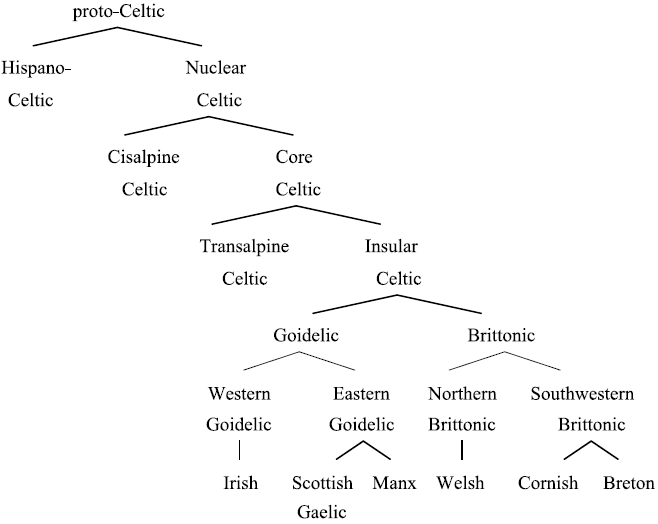
A brief and rough guide to the language groups of Ireland and Britain, specifically what does Bede mean, writing before 731, when he notes the use of five languages in Britain: English, British, Irish, Pictish and Latin (HE I.1)? Let's deal with the so-called Celtic group first:
By British, Bede means what is now called Welsh in English, but this term could be expanded to encompass all the Brythonic/Brittonic languages, known to linguists as the P-Celtic group. Three British languages survive: Welsh, Cornish, and Breton; we have lost Cumbric, and ...
most probably, Pictish, though whether Pictish was a P-Celtic language is still a matter of some debate. We have no written records, but Pictish epigraphy suggests it was P-Celtic, perhaps with an isolated, pre-Celtic element, or even that this element survived simultaneously ...
The Goidelic languages are known to linguists as the Q-Celtic group. Three Irish languages survive: Irish, Scottish Gaelic, and Manx. When Bede refers to Irish as a living language in Britain, in the eighth century, he does not distinguish between Irish and what we now call ...
Scottish Gaelic because no such distinction existed. However, by the fifth century Goidelic was already evolving into a western branch consisting of Irish and an eastern branch consisting of Scottish Gaelic and Manx after the expansion of (Northern) Irish speakers ...
into the Isle of Man and into what we now call Scotland (Land of the Irish). This co-incides with the expansion of the Irish kingdom of Dalriada (Dál Riata) into Britain. We don't actually know when the Brythonic (British) and Goidelic (Irish) language groups split ...
Two principal theories exist as to whether they diverged after arriving in these islands: (1) either in the early Iron age or as part of Bell Beaker Culture (Insular Hypothesis), or (2) if they had already diverged from each other during the Continental period ...
(P-Celtic/Q-Celtic Hypothesis). This hypothesis suggests that proto-Brythonic arrived in Britain from Gaul and that proto-Goidelic arrived in Ireland from Spain, based on the Celtic-Iberian languages of Spain being closer to Goidelic languages, and Gaulish to Old Brittonic.
By contrast, English is a Germanic, as opposed to a so-called Celtic (British or Irish) language. More specifically, and reflective of the regions the Anglo-Saxon peoples originated, it is a West Germanic language.
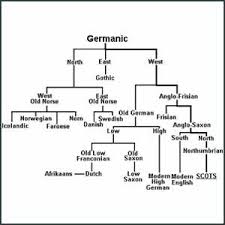
In spite of all the external changes wrought upon it, from Church Latin (via the Irish and Roman missionaries), Old Norse, Anglo-Norman, French, Renaissance Latin, other languages during the expansion of the British empire, more recently Americanisms, English remains Germanic.
• • •
Missing some Tweet in this thread? You can try to
force a refresh

A brief and rough guide to the influence of the Scandinavian (North Germanic) group of languages on English, which has a striking similarity to the Scandinavian effect on Irish ... Here come the Vikings!
The Danes and Norwegian are referred to collectively by several names, including Norsemen or ‘Northmen’. The generic term now used for their language is Old Norse, although this term can refer specifically to Norwegian. When the events were first recorded, the Danes were the ...
dominant group encountered by the English, and as a result, Anglo-Saxon writers use the term ‘Dane’ in a generic sense. A more romantic term is the Vikings, which conjures up the familiar images of raiders intent on looting, pillage and murder. In view of their geographical ...
A certain, quite incidental, post has piqued a surprising amount of interest; thus, I'm reposting some points from previous posts over the years which may be of interest: a very brief and rough guide to the linguistic history of Britain and Ireland in the early middle ages ...
The first English Historian, Bede (Old English: Bēda, c. 672-73 – 26 May 735), notes the use of five languages in Britain: English, British, Irish, Pictish and Latin (HE I. 1). Latin was the language of the Church.
Bede's term for the Irish, Scotti, doesn't distinguish between those in Ireland and those in the Scottish part of Dál Riata. This correlates to his account of Britain in the reign of Oswald, king of Northumbria, who spent 17 years in Dál Riata/rest of Ireland/Pictland ...
Well, this is spectacularly misinformed. This is a map of early Irish monastic settlements in Britain and the continent during the early middle ages: not a period characterized by anti-Judaism (notwithstanding the likes of Agobard of Lyon: a splenetic bigot) and certainly not ...
a feature of Irish monasticism, which put an unusually strong emphasis on the study of Hebrew (yes, really) as part of the three sacred languages (tres linguae sacrae). It's possible that one of the most influential (right down to Finnegans Wake) Hiberno-Latinists was Jewish.
'There has been much scholarly discussion about whether the seventh-century grammarian Virgilius Maro Grammaticus was a Jew and whether he was living in or native to Ireland.His writings (two surviving books – the so-called Epitomae and the Epistolae – and a fragmentary ...
A long thread on Joyce, the Limerick Boycott of 1904, and the shadow of the Kishinev Pogrom of 1903: 'The ostensibly insouciant badinage in Barney Kiernan’s on the subject of Bloom's putative infanticide echoes the charges that underpin the medieval catalogue of alleged ...
ritual murder invoked by Creagh in Limerick that same year: "They slew St Stephen, the First Martyr, and St James the Apostle, and ever since as often as opportunity offered they did not hesitate to shed Christian blood, and that even in the meanest and most cruel manner ...
as in the case of the holy martyr, St Simeone, who though a mere child they took and crucified out of hatred and derision of our Lord Jesus Christ." Here, Creagh refers to Simon Unferdorben of Trent, called ‘sancti Simeonis’ in the Old Roman Martyrology for 24 March ...
Ah, more Truths Universally Acknowledged about Ireland during WWII That Aren't Actually True. There is nothing new about disinformation. Anyone who bases polemical arguments which have little to do with being authentic to historical context, on press clippings should read this:
'It would be quite inconceivable for any other country in the world to send and maintain a Minister who has been doing so much harm to his country as this gentleman. He has never missed an opportunity of showing his anti-Irish spleen and of encouraging anti-Irish elements ...
'This ‘book of condolences’ myth is widespread: it is part of mainstream publicly-available accounts of Irish neutrality. For example, it appears in the first and highest ranked article in a Google search on “Irish neutrality”; it arises in tourist guides’ talks ...
it is cited by secondary school students of history; it is a constant in public and political discourse in Ireland;and it is part of media discourse on Irish neutrality abroad. Its ubiquity is connected to the activities of a significant number of anti-neutrality academics ...
politicians and journalists, such as Salmon, FitzGerald, Roberts, Girvin and Collins, who continue to publicize and promote the story that de Valera went to the German Legation in order to sign a book of condolences and/or to sympathize over the death of Hitler ...