Giovanni Leoni - ULTIMATE Scout Report (Video v Data)
Big, physical, proactive and a real presence inside the box but can he play ball or is he an Italian De Ligt? I was taken aback by what I saw.
Let’s break down what he brings and what he doesn’t - for Liverpool 👇
#LFC
Big, physical, proactive and a real presence inside the box but can he play ball or is he an Italian De Ligt? I was taken aback by what I saw.
Let’s break down what he brings and what he doesn’t - for Liverpool 👇
#LFC
Aerial Ability (Eye Test)
💪 6ft 4 at age 18 allied with an explosive spring, strong shoulders, on paper complete package aerially.
⚡ Quick off the mark, inside the box - can make the first step and get in ahead meeting the ball first
🔍 Reads trajectory EXTREMELY well and adjusts positioning
Summary: Premier league ready in terms of aerial ability. He would relish a battle with a forward who is a brute inside the box... and if Liverpool are defending deep, facing a bombardment of crosses at the death - holding on to a lead... Leoni is an asset.
💪 6ft 4 at age 18 allied with an explosive spring, strong shoulders, on paper complete package aerially.
⚡ Quick off the mark, inside the box - can make the first step and get in ahead meeting the ball first
🔍 Reads trajectory EXTREMELY well and adjusts positioning
Summary: Premier league ready in terms of aerial ability. He would relish a battle with a forward who is a brute inside the box... and if Liverpool are defending deep, facing a bombardment of crosses at the death - holding on to a lead... Leoni is an asset.
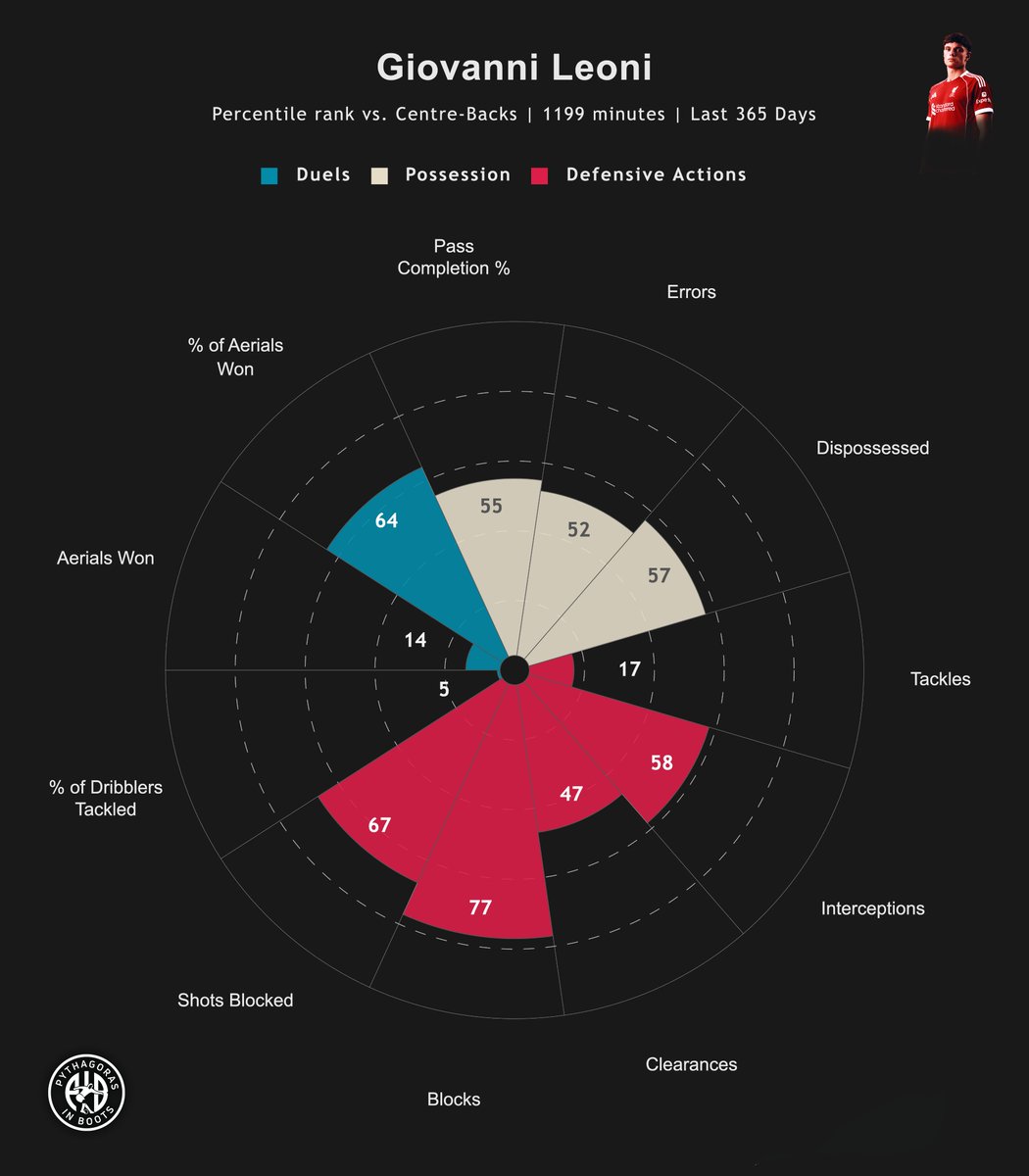
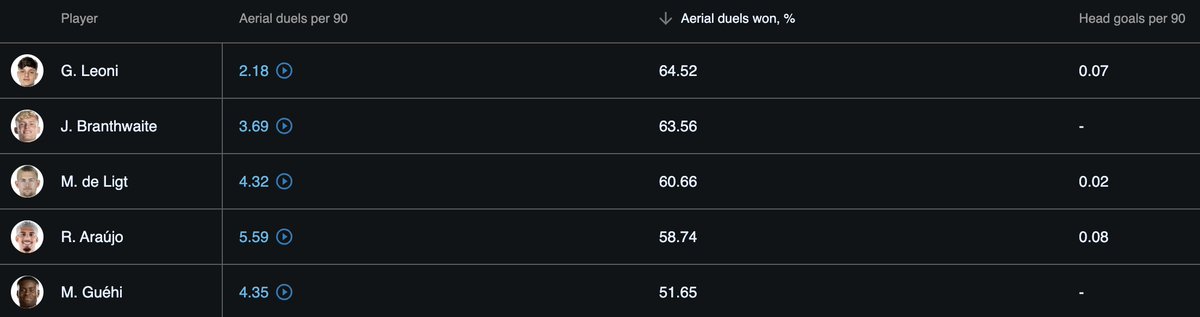
Aerial Ability (Data)
📈 64.5% aerial duels won
🥅 0.07 headed goals per 90
✅ Outperform - Araujo, De Ligt
Summary: High win rate makes him reliable in defensive set-piece scenarios AND adds attacking threat at corners which could prove valuable for Liverpool in tight matches away from home where set-pieces decide games.
📈 64.5% aerial duels won
🥅 0.07 headed goals per 90
✅ Outperform - Araujo, De Ligt
Summary: High win rate makes him reliable in defensive set-piece scenarios AND adds attacking threat at corners which could prove valuable for Liverpool in tight matches away from home where set-pieces decide games.
Anticipation (Eye Test)
⏱ Often first to loose balls in the box
🏃 Proactive positioning; wins duels before attackers react
⚡ Reacts quickly to unexpected situations, showing strong spatial awareness
Summary: Against sturdy big 9s who love to run channels and barge their way against high lines, Leoni could thrive - against smaller wiry forwards less so but we will cover this in marking section.
Inside box he is so adept at sensing where the ball will land. Born to defend the box.
⏱ Often first to loose balls in the box
🏃 Proactive positioning; wins duels before attackers react
⚡ Reacts quickly to unexpected situations, showing strong spatial awareness
Summary: Against sturdy big 9s who love to run channels and barge their way against high lines, Leoni could thrive - against smaller wiry forwards less so but we will cover this in marking section.
Inside box he is so adept at sensing where the ball will land. Born to defend the box.
Anticipation (Stats)
🛡️Interceptions, blocks, errors per 90 → better than Araujo
🎈Intercepts well but his tackling numbers are poor - marking section will explain why. Generally he is better at 'loose' defending i.e. where the ball is being played in to an area vs facing a agile player squaring up to him and taking him on.
Summary: Has the foundations to be reliable in critical moments in the box, giving Liverpool more confidence against shots from distance or crosses into the box.
🛡️Interceptions, blocks, errors per 90 → better than Araujo
🎈Intercepts well but his tackling numbers are poor - marking section will explain why. Generally he is better at 'loose' defending i.e. where the ball is being played in to an area vs facing a agile player squaring up to him and taking him on.
Summary: Has the foundations to be reliable in critical moments in the box, giving Liverpool more confidence against shots from distance or crosses into the box.


👟 Eye Test – Dribbling
👣 Footwork potentially better than 'Current' De Ligt under pressure but is it better than Ajax De Ligt?
❌ Can at times look lumbering due to size, after producing a skill move, can he follow through with a composed pass and do it time and time again?
Summary: Doesn't consistently progress the ball forward. Nothing here looks ground breaking, someone like Yoro has a higher ceiling in terms of ball carrying. In wide areas looks clunky when played at FB, first touch looks hit and miss - at times lifting over players head, other times not receiving it with assurity. Needs developing.
👣 Footwork potentially better than 'Current' De Ligt under pressure but is it better than Ajax De Ligt?
❌ Can at times look lumbering due to size, after producing a skill move, can he follow through with a composed pass and do it time and time again?
Summary: Doesn't consistently progress the ball forward. Nothing here looks ground breaking, someone like Yoro has a higher ceiling in terms of ball carrying. In wide areas looks clunky when played at FB, first touch looks hit and miss - at times lifting over players head, other times not receiving it with assurity. Needs developing.
Dribbling (Data)
⚡ Decent take-on success
📉 Poor carrying distance → limited progressive ball-carrying
🟠 First touch under pressure generally reliable but occasional miscontrols
Summary: Can he consistently advance Liverpool’s possession? possibly needs a more progressive partner to drive the ball forward.
He can beat the press with a dribble, so in tight spaces there could be good potential here... but can he keep his composure to stride forward and take on 1-2 players breaking the lines?
⚡ Decent take-on success
📉 Poor carrying distance → limited progressive ball-carrying
🟠 First touch under pressure generally reliable but occasional miscontrols
Summary: Can he consistently advance Liverpool’s possession? possibly needs a more progressive partner to drive the ball forward.
He can beat the press with a dribble, so in tight spaces there could be good potential here... but can he keep his composure to stride forward and take on 1-2 players breaking the lines?


Build Up / Short Passing (Eye Test)
🔴Over-hits passes under pressure
🔄 Often bails out with long balls rather than playing through midfield lines
❌ Struggles to progress possession in tight spaces
Summary: Not naturally a “ball-playing” CB and under high press, he may be susceptible to turnovers or force less precise passes. Considering Slot is very demanding in this respect, looks a mismatch but could also be ideal place for him to work on weaknesses.
🔴Over-hits passes under pressure
🔄 Often bails out with long balls rather than playing through midfield lines
❌ Struggles to progress possession in tight spaces
Summary: Not naturally a “ball-playing” CB and under high press, he may be susceptible to turnovers or force less precise passes. Considering Slot is very demanding in this respect, looks a mismatch but could also be ideal place for him to work on weaknesses.
Build Up / Short Passing (Data)
⚽ 43 passes per 90, will see more of ball in big side
🎯 88% accuracy - solid for age.
📉 Low forward/progressive passing relative to top PL CBs - concern, can he actively break lines with passes?
Summary: Unlikely to be a primary CB in terms of ball progression based on current numbers. Needs to take more risks with the ball and get on the ball more (which should be a given to be fair if he plays for a bigger side).
⚽ 43 passes per 90, will see more of ball in big side
🎯 88% accuracy - solid for age.
📉 Low forward/progressive passing relative to top PL CBs - concern, can he actively break lines with passes?
Summary: Unlikely to be a primary CB in terms of ball progression based on current numbers. Needs to take more risks with the ball and get on the ball more (which should be a given to be fair if he plays for a bigger side).


Long Passing (Eye Test)
🏹 Decent down-the-line balls to wingers (Near Side)
❌ Prone to over-hit passes under pressure
🎯 At times hits passes into no mans land
Summary: Looks raw in this respect. Didn't see many switches of play, mostly down the line punts, which did reach team mates but some where hard to control. An area of his game which he might have to curtail and minimise if playing for Liverpool and work on it before reintroducing.
🏹 Decent down-the-line balls to wingers (Near Side)
❌ Prone to over-hit passes under pressure
🎯 At times hits passes into no mans land
Summary: Looks raw in this respect. Didn't see many switches of play, mostly down the line punts, which did reach team mates but some where hard to control. An area of his game which he might have to curtail and minimise if playing for Liverpool and work on it before reintroducing.
Long Passing (Data)
⚡ ~40% long pass accuracy
❌ Lower than Branthwaite or Guehi
🥅 Often looks more like clearance than accurate distribution
Summary: Matches the eye test, very raw and prone to 'hoof ball'. Needs to be developed in this area strenously to bring him to the levels requited.
⚡ ~40% long pass accuracy
❌ Lower than Branthwaite or Guehi
🥅 Often looks more like clearance than accurate distribution
Summary: Matches the eye test, very raw and prone to 'hoof ball'. Needs to be developed in this area strenously to bring him to the levels requited.

1 v 1 Marking (Eye Test)
💪 Strong against physical attackers
⚡ Less reliable against nimble forwards
🏃 Can be caught by sudden directional changes
👀 Shows willingness to commit physically, sometimes at risk of fouls
Summary: Works well against big target-men i.e. Lukaku but may struggle vs more nuanced, nimble forwards who drift into wide areas and can take him on but have that wiry strength to just get under the shoulder contact and burst through. Prime Jesus/Aguero types would be an issue for him. Has a reckless challenge in him.
💪 Strong against physical attackers
⚡ Less reliable against nimble forwards
🏃 Can be caught by sudden directional changes
👀 Shows willingness to commit physically, sometimes at risk of fouls
Summary: Works well against big target-men i.e. Lukaku but may struggle vs more nuanced, nimble forwards who drift into wide areas and can take him on but have that wiry strength to just get under the shoulder contact and burst through. Prime Jesus/Aguero types would be an issue for him. Has a reckless challenge in him.
1 v 1 Marking (Data)
⚠️ Higher fouls & card risk than peers
📉 Struggles vs dribblers statistically
Summary: Very concerning numbers from a 1 v 1 point of view. I do think the match ups against physical CFs like Lukaku have skewed perception as to how effective he is defending against talented ball carriers.
⚠️ Higher fouls & card risk than peers
📉 Struggles vs dribblers statistically
Summary: Very concerning numbers from a 1 v 1 point of view. I do think the match ups against physical CFs like Lukaku have skewed perception as to how effective he is defending against talented ball carriers.

CONCLUSION
Pros:
✅ Dominant in the air → set-piece stability
✅ Excellent anticipation & reading the box → intercepts early
✅ Composed under pressure → evades initial pressing
Cons:
❌ Build-up from the back limited → needs a partner for vertical progression
❌ Long pass accuracy low → invites high press
❌ Struggles vs agile attackers → potential high-line vulnerability
In summary a physically imposing, proactive, aggressive CB who reminds me of a De Ligt, has elite capacity for box defending which may prove useful in game states where Liverpool are sat deep but lacks Konate's capacity to mark wide forwards and thus IMO not trustworthy enough to play week in week out in a high line unless vs a big unit type CF.
Ball playing for me is a concern. Dribbling aside, all other metrics were poor and thus needs a lot of development.
I can see why Liverpool wanted Guehi, this kid needs patient development before he can be a more complete package capable of playing in every game. I wouldn't be surprised if they're back in for a more developed CB in January.
Pros:
✅ Dominant in the air → set-piece stability
✅ Excellent anticipation & reading the box → intercepts early
✅ Composed under pressure → evades initial pressing
Cons:
❌ Build-up from the back limited → needs a partner for vertical progression
❌ Long pass accuracy low → invites high press
❌ Struggles vs agile attackers → potential high-line vulnerability
In summary a physically imposing, proactive, aggressive CB who reminds me of a De Ligt, has elite capacity for box defending which may prove useful in game states where Liverpool are sat deep but lacks Konate's capacity to mark wide forwards and thus IMO not trustworthy enough to play week in week out in a high line unless vs a big unit type CF.
Ball playing for me is a concern. Dribbling aside, all other metrics were poor and thus needs a lot of development.
I can see why Liverpool wanted Guehi, this kid needs patient development before he can be a more complete package capable of playing in every game. I wouldn't be surprised if they're back in for a more developed CB in January.

• • •
Missing some Tweet in this thread? You can try to
force a refresh