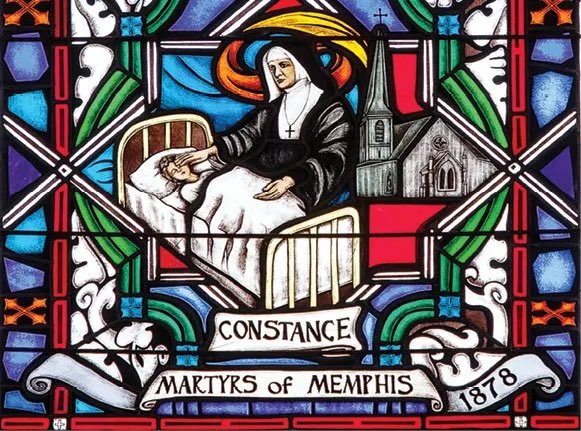
✝️ Today we remember Constance and Her Companions, also known as the Martyrs of Memphis.
They were Episcopal nuns and priests who sacrificed their lives caring for yellow fever victims in Memphis in 1878, exemplifying Christ-like love and service to others in the face of great danger.
They were Episcopal nuns and priests who sacrificed their lives caring for yellow fever victims in Memphis in 1878, exemplifying Christ-like love and service to others in the face of great danger.
2/
"Few know what a wonderful life it was that ended, for this world, when Sister Constance died. It was one long and entire consecration to Christ and the Church; and the strength with which she met the fearful trials of those last days, directing, sustaining, and cheering her devoted companions, and working day and night to spare others, was a supernatural strength."
📖The Sisters of St. Mary at Memphis:
with the Acts and Sufferings of the Priests and Others Who Were There with Them during the Yellow Fever Season of 1878.
New York: Printed, but not Published, 1879; 62pp.
transcribed by Elizabeth Boggs
👉🏻 anglicanhistory.org/usa/csm/memphi…
"Few know what a wonderful life it was that ended, for this world, when Sister Constance died. It was one long and entire consecration to Christ and the Church; and the strength with which she met the fearful trials of those last days, directing, sustaining, and cheering her devoted companions, and working day and night to spare others, was a supernatural strength."
📖The Sisters of St. Mary at Memphis:
with the Acts and Sufferings of the Priests and Others Who Were There with Them during the Yellow Fever Season of 1878.
New York: Printed, but not Published, 1879; 62pp.
transcribed by Elizabeth Boggs
👉🏻 anglicanhistory.org/usa/csm/memphi…

3/
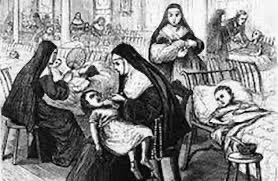
Constance and her companions were Episcopal nuns from the Community of St. Mary who stayed in Memphis during the 1878 yellow fever epidemic to care for the sick and dying.
They operated out of St. Mary's Cathedral, providing medical care, food, and comfort to hundreds of victims daily, regardless of race or economic status.
Constance and her companions were Episcopal nuns from the Community of St. Mary who stayed in Memphis during the 1878 yellow fever epidemic to care for the sick and dying.
They operated out of St. Mary's Cathedral, providing medical care, food, and comfort to hundreds of victims daily, regardless of race or economic status.
4/
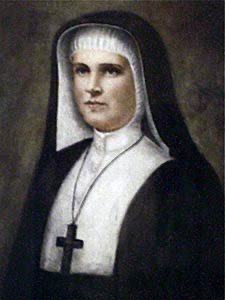
Sister Constance was the first to die on September 9, 1878, followed by Sisters Thecla, Ruth, and Frances, as well as two Episcopal priests assisting them.
Their selfless sacrifice in the face of extreme danger earned them the title "Martyrs of Memphis" in the Episcopal Church.
Sister Constance was the first to die on September 9, 1878, followed by Sisters Thecla, Ruth, and Frances, as well as two Episcopal priests assisting them.
Their selfless sacrifice in the face of extreme danger earned them the title "Martyrs of Memphis" in the Episcopal Church.
5/
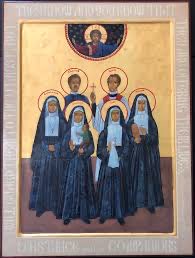
They are commemorated annually on September 9th in the Episcopal Church calendar, inspiring others to sacrificial service.
Their ministry highlights the Christian call to care for the sick and suffering, even at great personal risk.
They are commemorated annually on September 9th in the Episcopal Church calendar, inspiring others to sacrificial service.
Their ministry highlights the Christian call to care for the sick and suffering, even at great personal risk.
🙏🏻
O Almighty God,
who didst give thy servants Constance and her companions boldness to confess the Name of our Savior Jesus Christ before the rulers of this world,
and courage to die for this faith:
Grant that we may always be ready to give a reason for the hope that is in us, and to suffer gladly for the sake of the same our Lord Jesus Christ; who liveth and reigneth with thee, in the unity of the Holy Ghost, ever one God,
world without end.
Amen
O Almighty God,
who didst give thy servants Constance and her companions boldness to confess the Name of our Savior Jesus Christ before the rulers of this world,
and courage to die for this faith:
Grant that we may always be ready to give a reason for the hope that is in us, and to suffer gladly for the sake of the same our Lord Jesus Christ; who liveth and reigneth with thee, in the unity of the Holy Ghost, ever one God,
world without end.
Amen
🧑🧑🧒🧒We’re a church without a building right now.
🙋🏻♂️Can you help us?
⛪️We can do so much more to bring people to Jesus and to serve the community if we had a building of our own.
🥅Please donate or share to reach our goal.
Thank you.
🙏🏻
👉🏻 democracythree.org/saveachurch
🙋🏻♂️Can you help us?
⛪️We can do so much more to bring people to Jesus and to serve the community if we had a building of our own.
🥅Please donate or share to reach our goal.
Thank you.
🙏🏻
👉🏻 democracythree.org/saveachurch
@threadreaderapp unroll
• • •
Missing some Tweet in this thread? You can try to
force a refresh