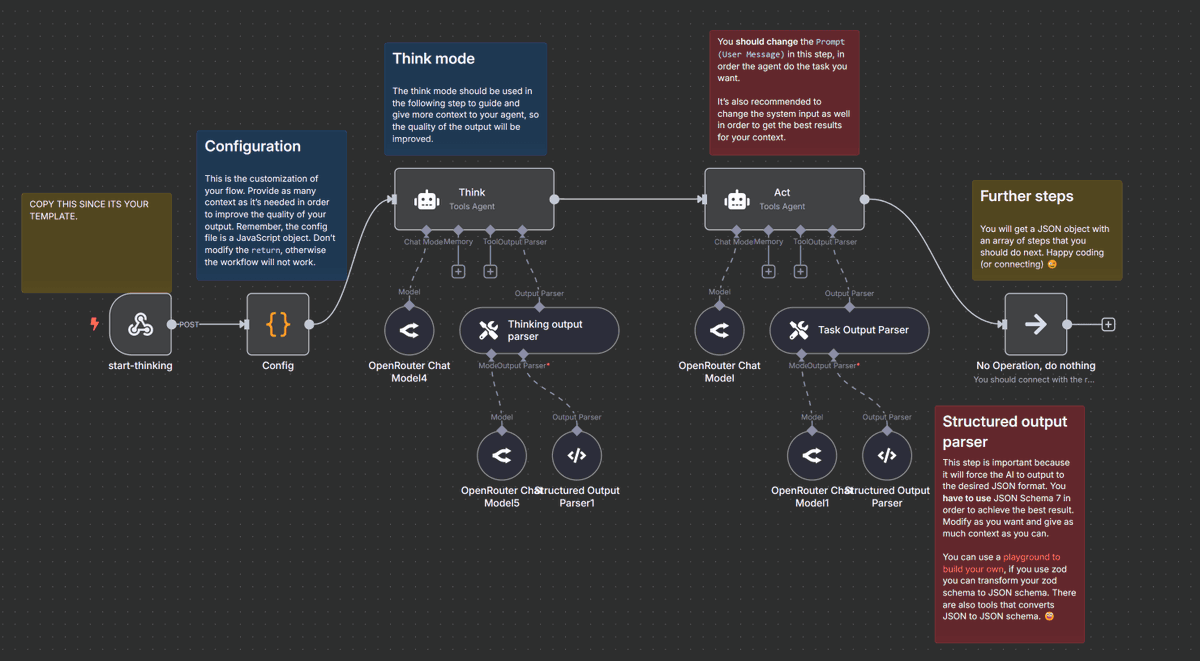
Why would I pay $200/hr for a tutor…
when ChatGPT roasts my wrong answers for free at 2AM?
Here’s the workflow (steal the 10 prompts below):
10/10 would bookmark this:
when ChatGPT roasts my wrong answers for free at 2AM?
Here’s the workflow (steal the 10 prompts below):
10/10 would bookmark this:
Step 1: Get the lay of the land.
Before diving deep, you need the big picture. Otherwise you’ll drown in random details.
Prompt:
“Explain [topic] to me like I’m a complete beginner. Create a 30-day roadmap that goes from basics to advanced, including resources, checkpoints, and goals.”
Before diving deep, you need the big picture. Otherwise you’ll drown in random details.
Prompt:
“Explain [topic] to me like I’m a complete beginner. Create a 30-day roadmap that goes from basics to advanced, including resources, checkpoints, and goals.”
Step 2: Match learning to your style.
Most people fail because they learn in ways that don’t suit them. LLMs can adapt instantly.
Prompt:
“I learn best through [examples/visuals/practice]. Teach me [topic] using this style, and suggest activities I can do daily to reinforce it.”
Most people fail because they learn in ways that don’t suit them. LLMs can adapt instantly.
Prompt:
“I learn best through [examples/visuals/practice]. Teach me [topic] using this style, and suggest activities I can do daily to reinforce it.”
Step 3: Break the subject into chunks.
Your brain doesn’t learn massive topics all at once; you need bite-sized steps.
Prompt:
“Divide [topic] into 10 essential subtopics. For each one, explain what I need to master, the order I should learn them in, and why that order matters.”
Your brain doesn’t learn massive topics all at once; you need bite-sized steps.
Prompt:
“Divide [topic] into 10 essential subtopics. For each one, explain what I need to master, the order I should learn them in, and why that order matters.”
Step 4: Build active recall questions.
Reading ≠ Learning. The real test is whether you can remember and apply it.
Prompt:
“Make me 20 flashcards (question & answer) for the beginner level of [topic]. Also, suggest a spaced repetition schedule for reviewing them.”
Reading ≠ Learning. The real test is whether you can remember and apply it.
Prompt:
“Make me 20 flashcards (question & answer) for the beginner level of [topic]. Also, suggest a spaced repetition schedule for reviewing them.”
Step 5: Get real-world examples.
Your brain locks onto information when it’s tied to reality. No examples = nothing sticks.
Prompt:
“Give me 5 real-world examples of how [topic] shows up in everyday life, work, or history. Explain them in plain English with practical details.”
Your brain locks onto information when it’s tied to reality. No examples = nothing sticks.
Prompt:
“Give me 5 real-world examples of how [topic] shows up in everyday life, work, or history. Explain them in plain English with practical details.”
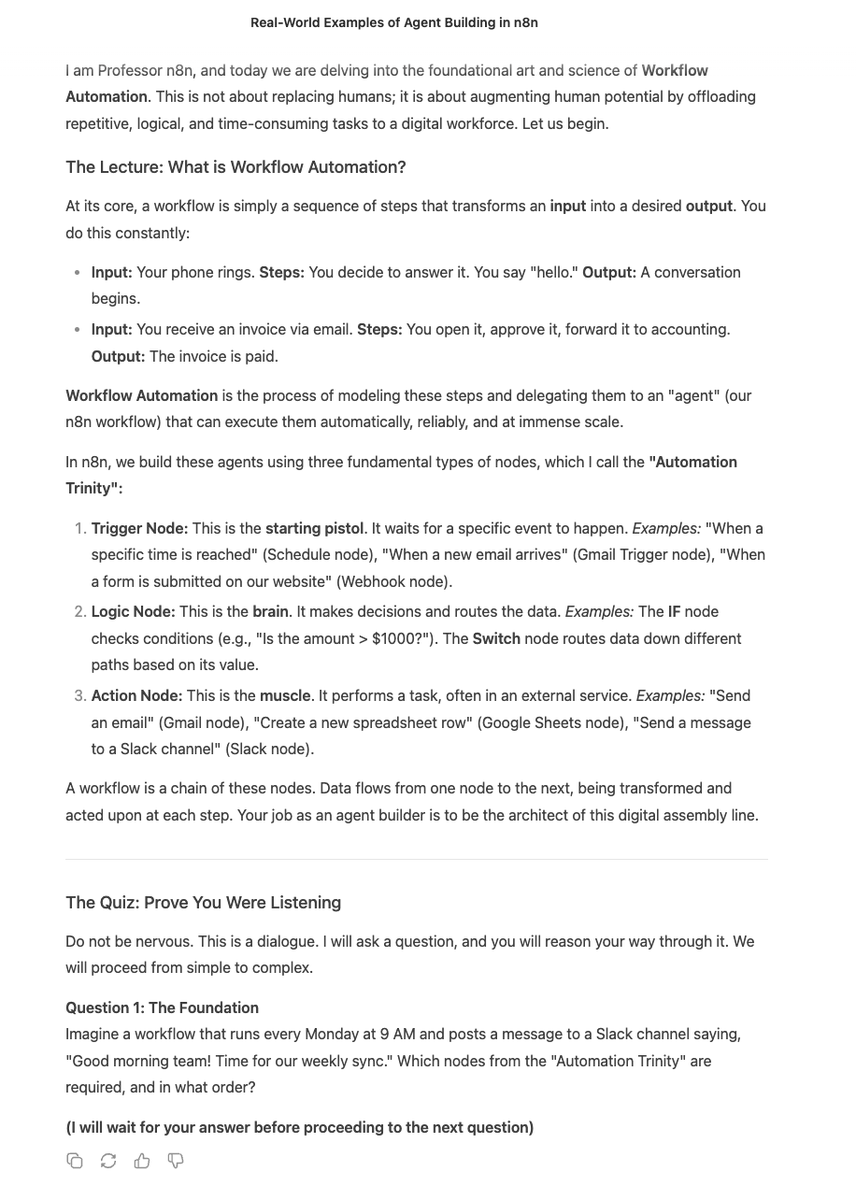
Step 6: Simulate a teacher.
Don’t just passively consume. Let the LLM act like your personal professor who pushes you.
Prompt:
“Act as a professor of [topic]. Explain [concept] clearly. Then quiz me with 5 progressively harder questions until I can explain it back to you.”
Don’t just passively consume. Let the LLM act like your personal professor who pushes you.
Prompt:
“Act as a professor of [topic]. Explain [concept] clearly. Then quiz me with 5 progressively harder questions until I can explain it back to you.”
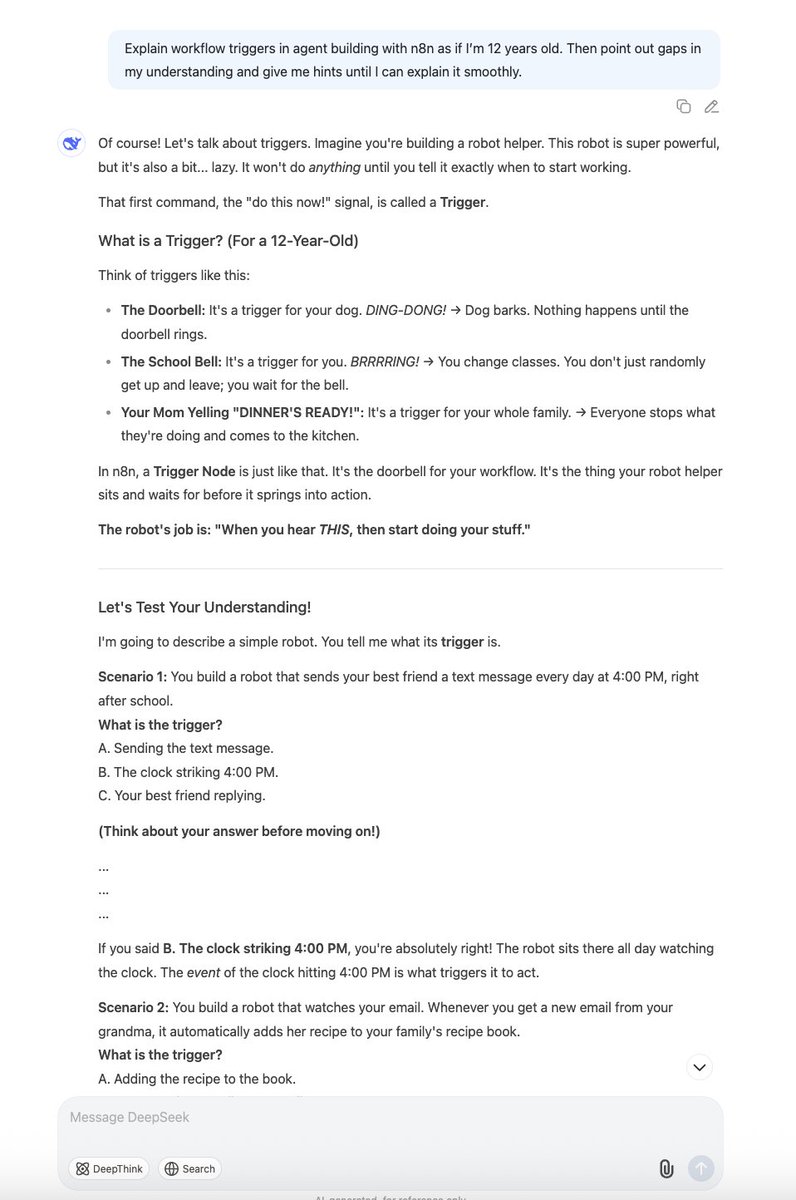
Step 7: Use the Feynman Technique.
If you can’t explain it simply, you don’t understand it. LLMs make this easy to practice.
Prompt:
“Explain [concept] in [topic] as if I’m 12 years old. Then point out gaps in my understanding and give me hints until I can explain it smoothly.”
If you can’t explain it simply, you don’t understand it. LLMs make this easy to practice.
Prompt:
“Explain [concept] in [topic] as if I’m 12 years old. Then point out gaps in my understanding and give me hints until I can explain it smoothly.”
Step 8: Generate practice exercises.
Knowledge without practice fades fast. Exercises turn concepts into skills.
Prompt:
“Give me 10 beginner practice problems in [topic] with step-by-step solutions. After each solution, explain the common mistakes people make.”
Knowledge without practice fades fast. Exercises turn concepts into skills.
Prompt:
“Give me 10 beginner practice problems in [topic] with step-by-step solutions. After each solution, explain the common mistakes people make.”
Step 9: Move into Intermediate Depth.
Once you’ve got the basics, don’t get stuck there. The jump to intermediate is where things click.
Prompt:
“What are the 5 most important intermediate skills in [topic]? For each, give me exercises, case studies, and recommended resources to practice.”
Once you’ve got the basics, don’t get stuck there. The jump to intermediate is where things click.
Prompt:
“What are the 5 most important intermediate skills in [topic]? For each, give me exercises, case studies, and recommended resources to practice.”
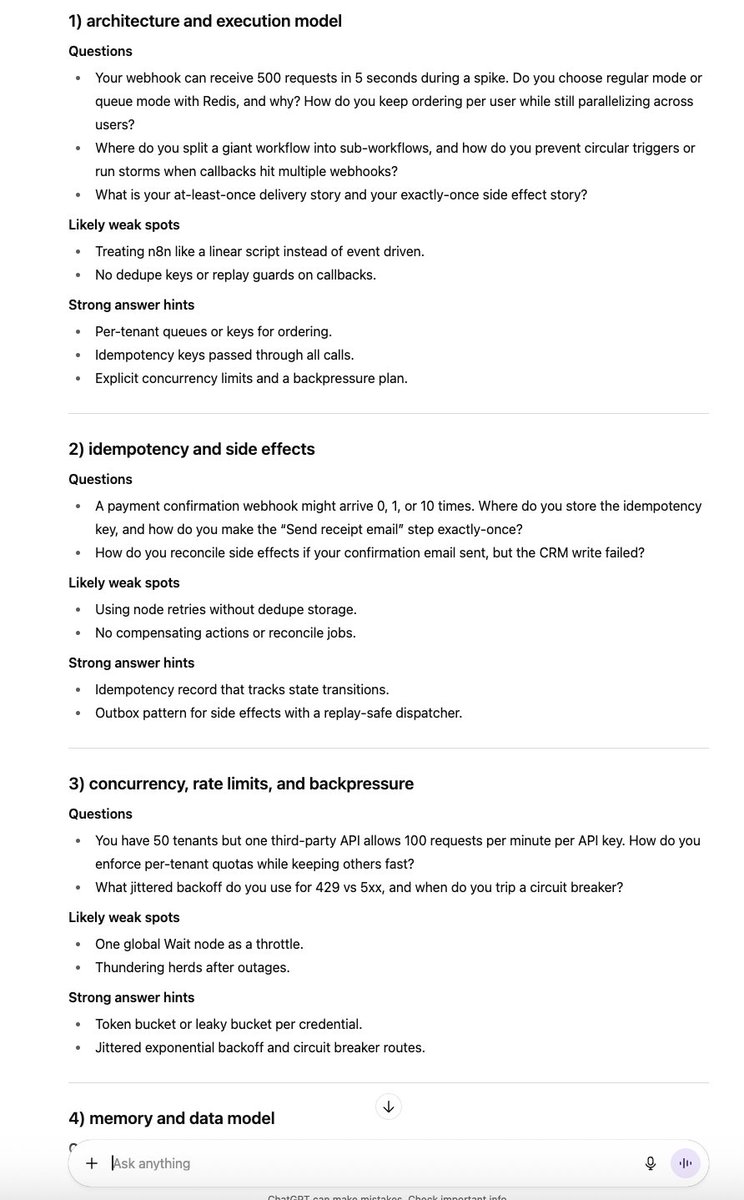
Step 10: Simulate a debate or discussion.
Learning isn’t just knowing facts; it’s being able to defend and argue your perspective.
Prompt:
“Play devil’s advocate. Challenge my understanding of [topic] by asking tough questions and highlighting weak spots in my reasoning.”
Learning isn’t just knowing facts; it’s being able to defend and argue your perspective.
Prompt:
“Play devil’s advocate. Challenge my understanding of [topic] by asking tough questions and highlighting weak spots in my reasoning.”
Bonus step: stay accountable.
The #1 reason people fail to learn something new? They quit. LLMs can keep you on track.
Prompt:
“Create a weekly learning plan for [topic]. Include clear goals, checkpoints, self-assessment tasks, and motivational reminders to keep me consistent.”
The #1 reason people fail to learn something new? They quit. LLMs can keep you on track.
Prompt:
“Create a weekly learning plan for [topic]. Include clear goals, checkpoints, self-assessment tasks, and motivational reminders to keep me consistent.”
I hope you've found this thread helpful.
Follow me @aivanlogic for more.
Like/Repost the quote below if you can:
Follow me @aivanlogic for more.
Like/Repost the quote below if you can:
https://twitter.com/1658529904571424768/status/1966464516902044034
• • •
Missing some Tweet in this thread? You can try to
force a refresh