Before his murder, Charlie Kirk was two things: a power broker in the Trump coalition and a symbol of a specific vision for that coalition.
You will not understand why his murder feels so cataclysmic to so many if you do not first understand what Kirk symbolized.
You will not understand why his murder feels so cataclysmic to so many if you do not first understand what Kirk symbolized.

I have been thinking about Kirk and his appeal for several weeks now, actually. A producer from his show invited me to come on and talk to Kirk about China and Taiwan.
After I accepted this offer I began to binge his past shows, trying to prepare for the episode.
After I accepted this offer I began to binge his past shows, trying to prepare for the episode.
I also talked with several fans, asking them what shows they thought were best and what they liked most about Charlie Kirk.
This episode will obviously never happen now. But I can share with you what I learned about what Kirk means to the right--especially the young right.
This episode will obviously never happen now. But I can share with you what I learned about what Kirk means to the right--especially the young right.
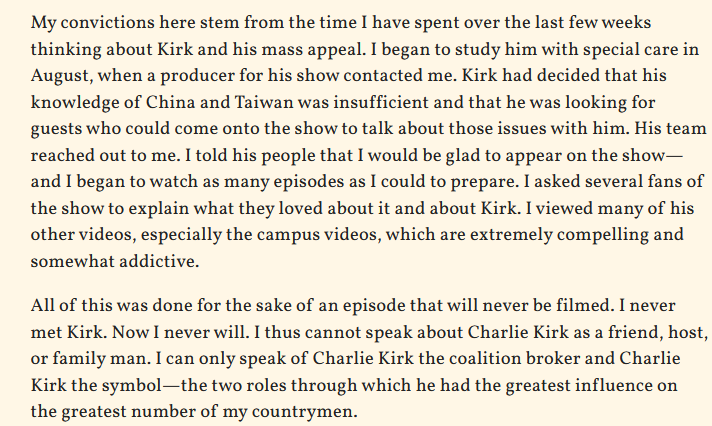
This is important to do because those not involved in the new right's internal politics and controversies don't understand really what Kirk was about or what he accomplished. Most non-politicos tend to think of Kirk mostly as an internet provocateur chasing clout.
This is not accurate. It does not describe Kirk's actual role as a coalition-broker in the Republican Party nor what Kirk represented to the millions who followed him.
In this short memorial essay I try to explain both of those things: scholars-stage.org/bullets-and-ba…
In this short memorial essay I try to explain both of those things: scholars-stage.org/bullets-and-ba…
On that first part: No man save Trump himself did more to pioneer the electorally viable conservative populism that now defines the GOP—not just in terms of its ideas and aesthetic style, but also in terms of its institutions, leadership, money flows, and personnel networks.
Kirk had four sources of influence: his massive megaphone; his vote-mobilization machine; his personal network of activists, donors, politicians, and media personalities; and the trust of the president.


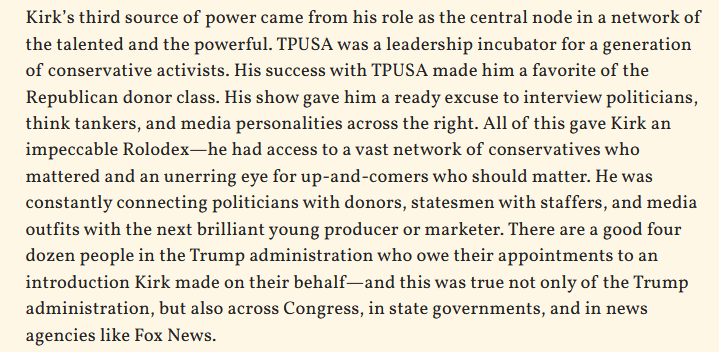

If all you have seen of Kirk are some of his more viral clips you do not understand how important he was to the MAGA movement. Constantly he brokered peace between hostile factions, connected donors with politicians and statesmen with staffers, acted as a conduit for
advice, money, and ideas; got bodies at rallies and voters in booths; training a new generation of leaders while securing favors for the old. He was the indispensable man on the populist right, the man holding the movement together.
His assassination was not, therefore, just an attack on a set of ideas: it was an attack on pillar of power.
The anger you see across the right reflects this. These people did not just know Charlie Kirk--they depended on him, &were grateful for what he did for them personally.
The anger you see across the right reflects this. These people did not just know Charlie Kirk--they depended on him, &were grateful for what he did for them personally.
But Kirk was more than just a node in a structure of power--he stood for things. He stood for a particular way of doing things, a specific path for conservative victory. He was an especially powerful symbol to the conservative activists who hit college during the Great Awokening.
To understand what Kirk and TPUSA meant to those young Republicans you must understand what the young Republican on campus was feeling at the height of the Great Awokening.
He was feeling fear.
He was feeling fear.
What was he afraid of?
Many things.
Many things.

This is the context for Kirk's college appearances. Liberals lampooned him for debating 19 year olds.
They missed the point of what he was doing.
What was the point? I explain:
They missed the point of what he was doing.
What was the point? I explain:
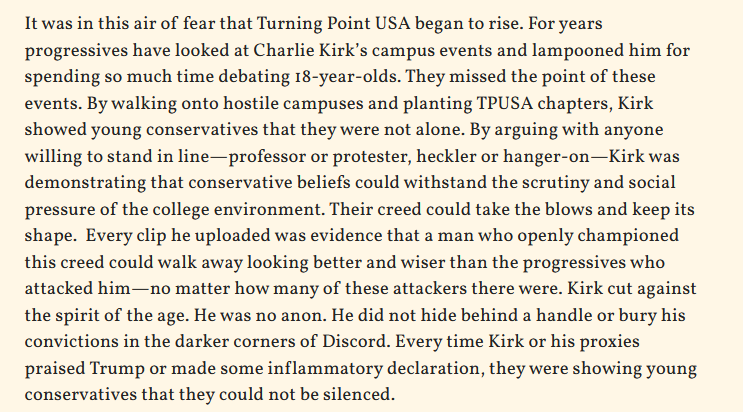
The overarching message of his activities was simple: You do not need to be afraid.

That was the central message of the man who was murdered this week.
There was an obvious corollary to this message, which Kirk often affirmed: if we show up, then we WILL win.
Not everybody on the right believed this. Many were ready to write off small-d democracy.
Not Kirk.
Not everybody on the right believed this. Many were ready to write off small-d democracy.
Not Kirk.

Kirk believed that the traditional arts of the American populist tradition--taking their arguments to the public sphere, and building vast machines to mobilize the apathetic, the unsure, or the afraid--could bring conservative populists a national majority.
Not everyone on the right, especially the young right, shared Kirk’s faith in constitutional liberties, popular mandates, and retail politics. Many of these young men were animated by a hatred for modernity that Kirk believed was spiritually destructive.
Kirk was convinced that one of his missions was to steer these young men to straighter paths. Here is how he described that mission in the last interview he ever gave:

Such was the mission of the man who was murdered this week.
Read my full essay here: scholars-stage.org/bullets-and-ba…
(Also available on S*stack under "Scholar's Stage")
• • •
Missing some Tweet in this thread? You can try to
force a refresh