1. Man is allowed to join a women's volleyball team, the Jaguars, for a tournament in Mexico.
2. The Jaguars are crowned champions of the tournament.
I never would have seen that coming, especially considering the fact that this was an open tournament where this grown man ended up playing teams of young teen girls.
Mexico seems to be on the trans train as of late.
Along with the news on "Angie" Lara Gamboa, another group of 12 men who play women's volleyball recently sued the Mexican Volleyball Federation for "discrimination" (it appears one of the men was removed from a women's game) and won their case earlier this year.
Among them are two brothers, "Nancy" and "Jessica" Hernandez, both men pretending to be "sisters," who have played (and won) national masters tournaments.
"Jessica" says that he began "self-medicating" with hormones as a teen and began getting plastic surgery at 18.

I don't speak Spanish, so could anyone translate the gist of what these guys are saying here?
🧵Richard Raskin aka "Renee Richards" is often touted as the one and only historical example of men participating in women's sport prior to the year 2000.
Richards, a lackluster professional male tennis athlete, was able to prolong his career into his 40s and 50s, playing professional female athletes 20 to 30 years younger than himself.
Despite a somewhat common narrative that women were perfectly fine with these men prior to Riley Gaines, Richards had to threaten legal action to get on the women's tour, and while on the tour, female athletes were overwhelmingly against his presence, with multiple women being fined after simply walking off the court rather than face him as an opponent.
Richards is far from the only man who was participating in women's sport during those years, however. Many other men seem to have simply been forgotten, but it's important that we are aware of these cases because "those who cannot remember the past are condemned to repeat it."
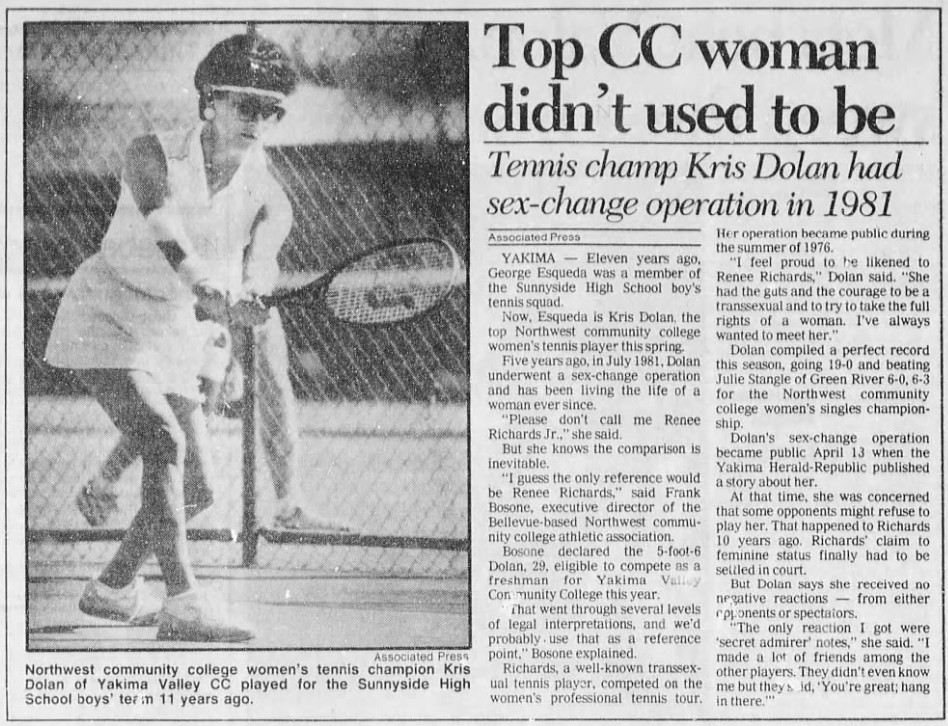
2/ In 1986, a 29-year-old man named George Esqueda joined the "women's" tennis team at Yakima Community College after being declared 'eligible.'
Now going by the name "Kris Dolan," George proceeded to win the NWAACC State Championship singles title with a perfect 19-0 record for the season as the "top Northwest community college 'women's'" tennis player.
He also placed 2nd in "women's" doubles with his partner. In 1987, Dolan won the NWAACC State Championship "women's" title in both singles and doubles.
Dolan was hopeful that he would get a scholarship to play tennis for the University of Washington, but it does not appear that ever occurred.
He claimed there was no pushback to his participation and that he actually received notes from "secret admirers."
3/ Steve Walquist changed his name to "Elaine" in the late '70s and began playing in "women's" table tennis tournaments in the '80s, winning multiple Michigan Table Tennis State Championship titles.
He was reportedly a nationally ranked "women's" player but did not seem to have had the same level of success when he previously played against men.
Walquist says he spent most of his life "living stealth" as a high school teacher, and has advocated in the past against bills restricting teenagers from having irreversible surgeries and procedures done before they have finished first developing their healthy bodies, using himself, a man who was perfectly fine waiting until he was 28 to begin pretending to be a woman, as an example.
Here's a great example of the nonsense behind the "no advantage" myth.
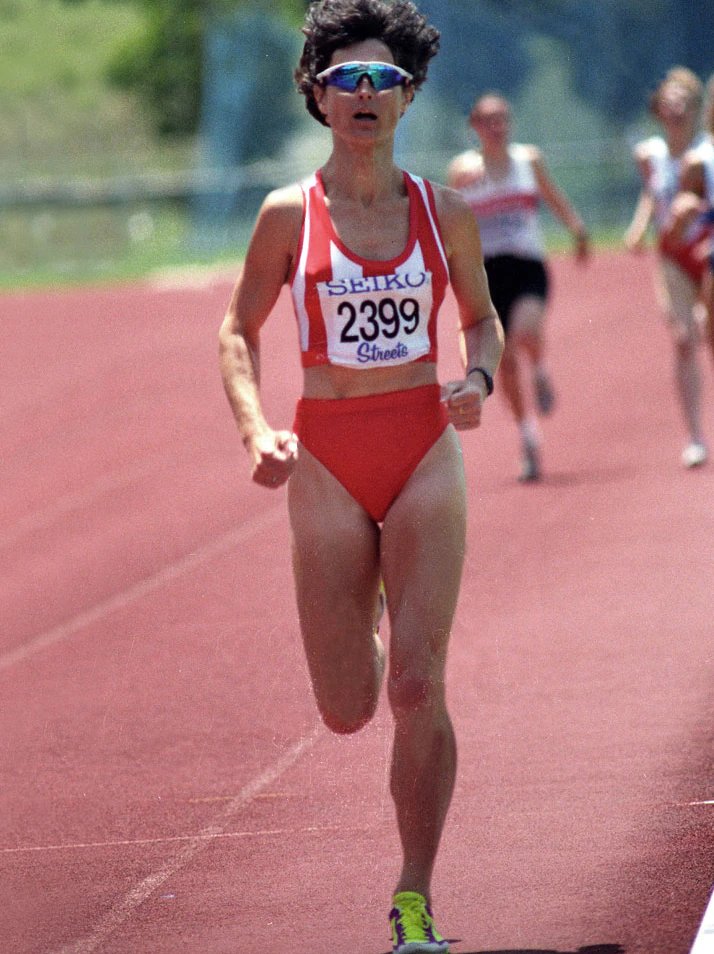
In the late 80s and early 90s, a man named Rick Carne began running, and winning, women's races in Australia under the name "Rickie." (He now goes by Rickie Coughlin.)
Carne quickly drew criticism and women threatened to protest his participation, yet he was allowed to continue competing.
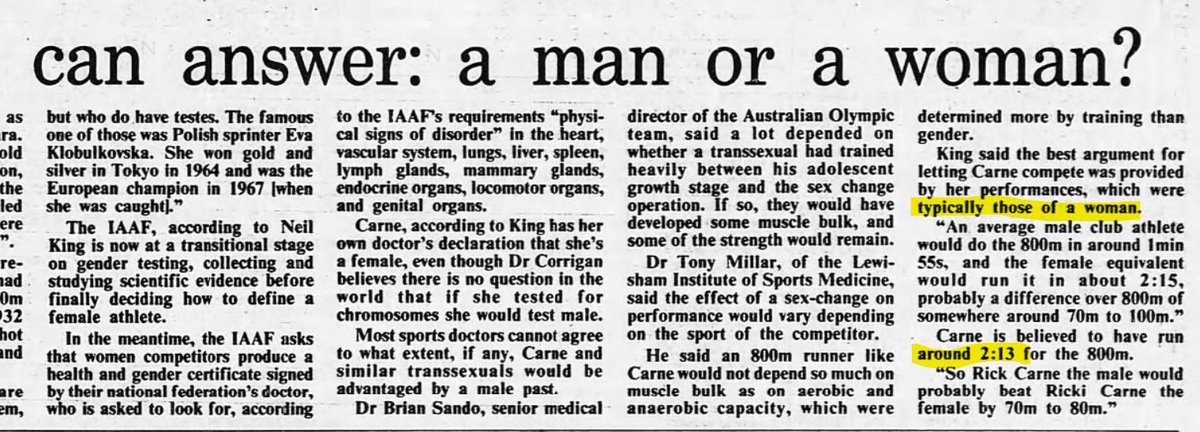
Australia Athletics' general manager, Neil King said, "There is no true definition of what is a woman."
He also claimed that Carne's performances were the best evidence for why they should continue allowing him to compete in the women's category.
He said this: "An average male club athlete would do the 800m in around 1m 55s, and the female equivalent would run it in about 2:15...So Rick Carne the male would probably beat Rickie Carne the female by 70m to 80m." At the time, Carne was running around 2:13 in the 800m.
First off, "Rickie" was not female. What he should be saying is Rick Carne on drugs would be slower than Rick Carne not on drugs.
And looking at actual 800 times, per athletic.net, out of the 83,609 girls who ran the 800 in 2025, there were less than 500 high school girls in the country running under 2:14.
2:13 is NOT average. It's in the top 0.6% of high school runners.
Carne/Coughlin was also not a collegiate runner or undergoing elite training. He was a club runner in his 30s.
🧵In 1972, the United States passed a federal law that prohibited sex-based discrimination in educational programs. This law, called Title IX, revolutionized sport for women and girls.
Prior to the passage of Title IX, schools were not required to offer any sort of programs for girls, including girls' sports teams, so naturally, they didn't. Most schools did not even have a team for girls, and when they did, they did not offer funding for uniforms, locker rooms, or other expenses.
In 1971, only 310,000 women and girls participated in high school or collegiate sports compared to 3.6 million men and boys. The NCAA did not even offer women's teams, and their first women's championship did not occur until 1982.
While the language of Title IX broadly addresses sex-based discrimination, the only athletes who had ever been discriminated against in sport were female, and it's understood that Title IX was created largely for the benefit of female athletes and students.
It did not even last 5 years before coaches abused this legislation to benefit male athletes at the expense of female instead...
2/ In 1972, after the new Title IX implementation, the Indiana Supreme Court immediately ruled that boys had a "right" to try out for girls' teams if no boys' teams were offered at a school (as a counter to the fact that they allowed girls to do the same on boys' teams).
When IHSAA commissioner Phil Eskew tried to appeal the decision, telling the court this could damage girls' athletics, he was ignored. "They said no red-blooded American boy would try out for a girls' team," Eskew said.
Eskew would ultimately be proven right and the courts very, very wrong.
3/ The South Bend Clay High School girls' volleyball team, in South Bend Indiana, was 3-14 in the 1984 volleyball season.
That all changed the next year when high school junior Brian Goralski, with the encouragement of his father Mel, who was nicknamed the "godfather" of men's volleyball in the area, decided to join the team.
Goralski's stated reason for playing was so that he could get visibility to get a scholarship for a men's team, and because of the Indiana court ruling in 1972, he was more than welcome to do so.
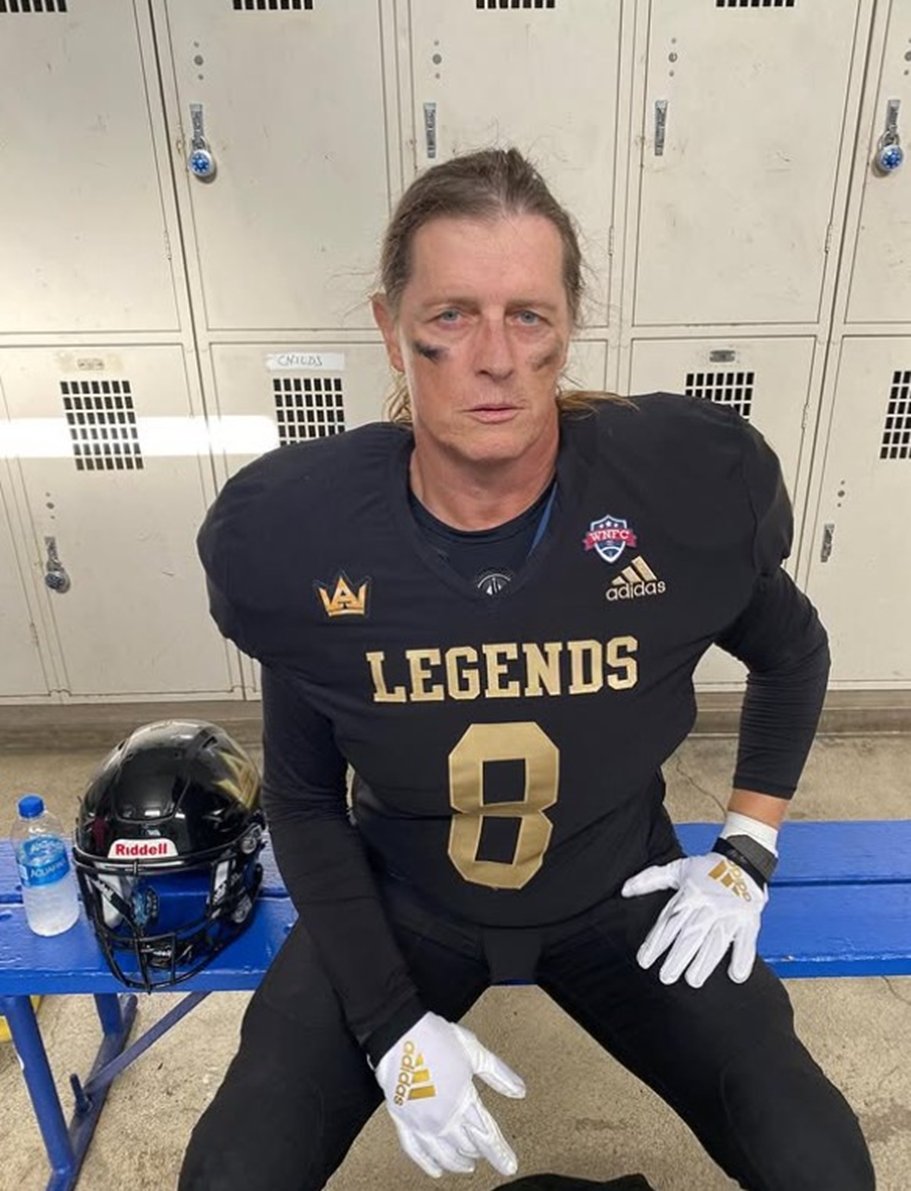
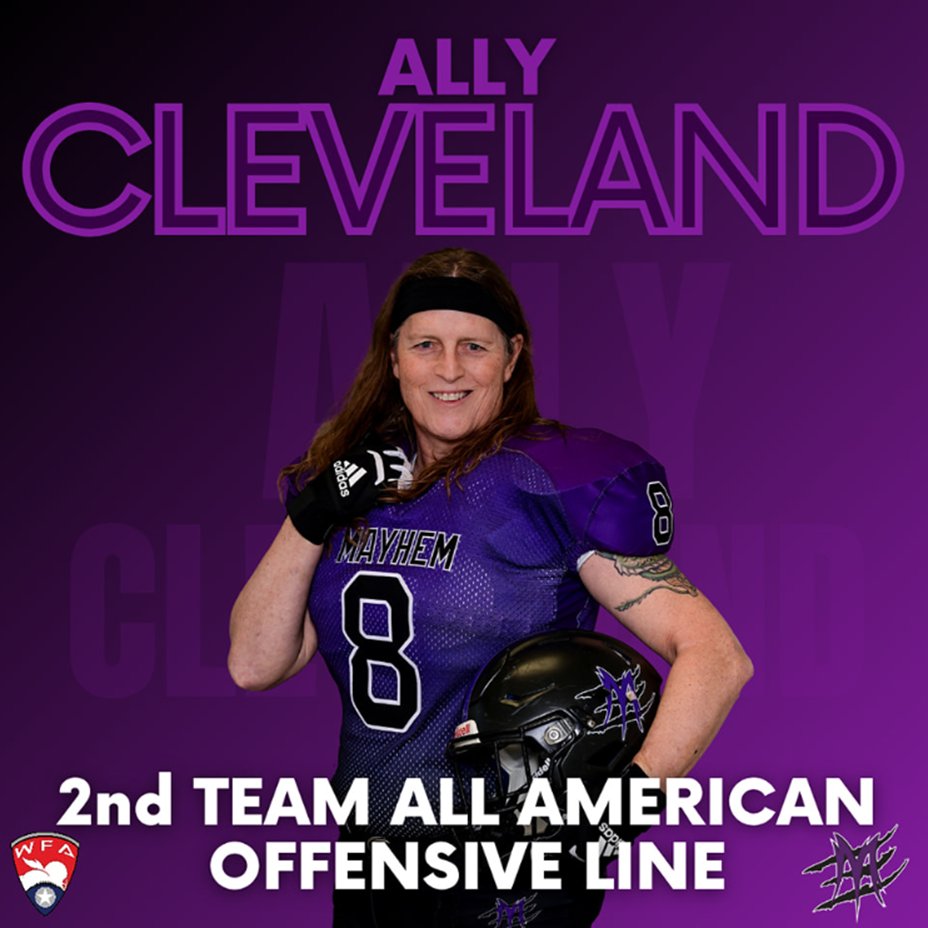
🧵Meet Ally Cleveland. Cleveland is currently 61 years old and plays women's "professional" tackle football.
(Although there is no actual paid women's professional league, athletes at the highest level in the WFA and the WNFC are considered "pros" by both the leagues and the athletes themselves)
Cleveland grew up with football, and that, coupled with the fact that a 61-year-old is still playing at the highest level of the game for women seems quite remarkable.
That is, until you learn that "Ally Cleveland" is actually a man formerly named Bill Getty.
Most who are familiar with sport are aware of the phenomenon of fathers who were high school football stars who then go on to try and relive their "glory days" through their sons, but when men are allowed into women's sports, those men can relive the "glory days" themselves.
Women and girls have very, very few opportunities to participate in tackle football in their youth, which is why it is even more egregious when men and boys who have played throughout their lives then steal those precious few positions from women on adult teams, women who have perhaps been waiting their entire lives for a chance to try out the sport.
Cleveland has played in the WFA and WNFC for years on teams including the Los Angeles Legends, the Los Angeles Bobcats, the Utah Falconz, and most recently, on the Maine Mayhem.
This past season, Cleveland was named a WFA Second-Team All-American. Maine Mayhem said this of their captain: "Ally’s versatility is unmatched—whether offense, defense, or special teams, [he] stepped up wherever needed. Wearing #8, [he] played with heart, grit, and an elite level of skill every snap."
In 2024, Cleveland was named to the 2024 WNFC All-Pro 1st Team, leading the Utah Falconz team in tackles despite being the oldest person on the team at 60 years of age.
I'm not sure if there are any 60-year-old women playing at the highest level of men's tackle football, but Cleveland certainly isn't the only man on a women's team.
1/ A couple weeks ago, I posted about an American man who had moved to Korea, changed his name to a Korean women's name, Yong-Ja Hong (or Hong Young-Ja 홍영자 in Korean) and had been stealing basketball prizes and awards from Korean women.
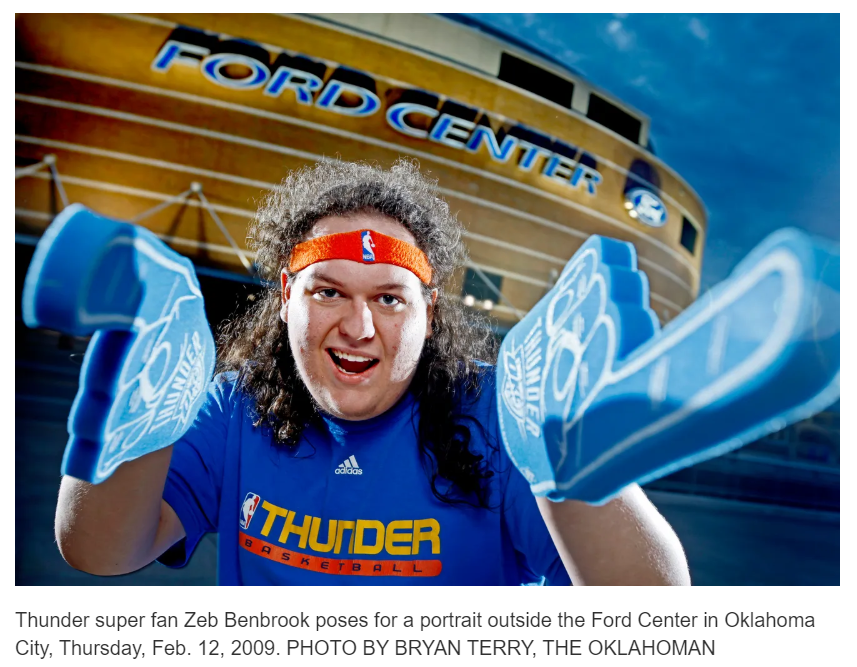
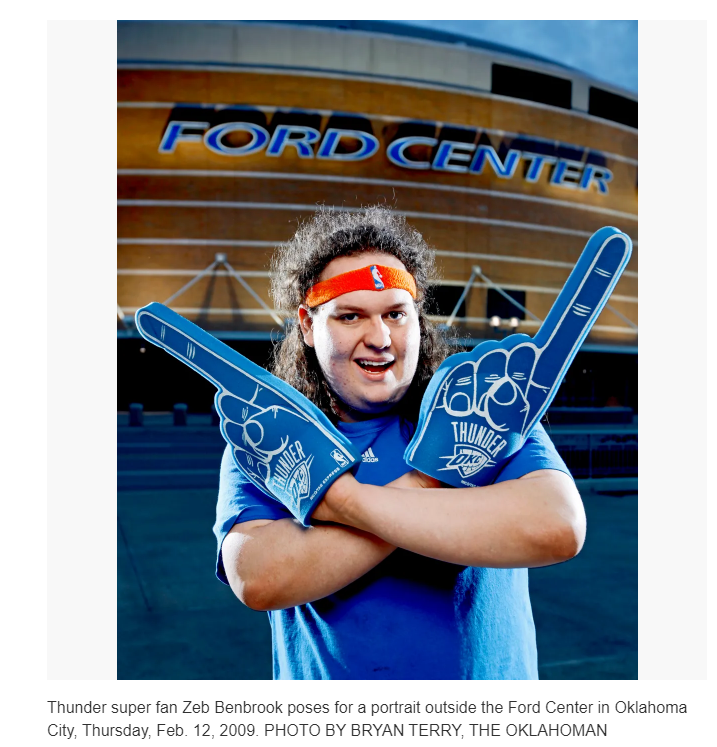
Some new information has come to light, and it turns out that "Yong-Ja" is none other than Zebulon (Zeb) "Zorgon" Benbrook, author of the "Welcome to Loud City" blog and Oklahoma Thunder "superfan".
2/ It appears that Benbrook first began identifying as a "woman" at 24 after he was "diagnosed" with "gender dysphoria."
Under the name "Marina Mangiaracina" Benbrook ran for a spot on the Oklahoma City Council in 2017 (in order to "protect trans rights"), but was ultimately defeated.
3/ Benbrook also wrote an article on himself for Outsports, describing how hard it was for him to be a 6'5" man trying to play basketball "as a woman" in Oklahoma.
Perhaps that's why he decided to move to South Korea, change his name again, and join a women's basketball team.
🧵1/ A little bit more background on the stars of the BPJ and Hecox cases, because as we know, details that actually might be important always seem to be conspicuously left out and are never mentioned.
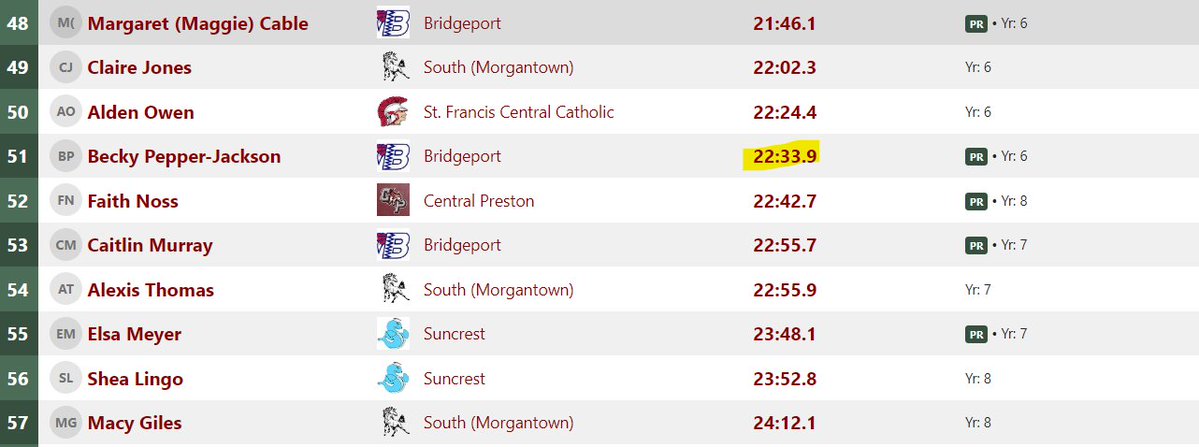
When Heather Jackson demanded that her son should be allowed on the girls' cross country team in middle school instead of the boys,' Pepper-Jackson's presence on the team was repeatedly defended with the excuse that because he wasn't winning and because he wasn't very good, it was then fair and 'harming no one.'
The claim had also been made that because he was blocking his puberty, he would never develop the advantages that other males had over female athletes.
2/ Heather Jackson never mentioned that before he became "Becky," her son Stratton Pepper-Jackson had survived a heart-related issue, as described in a local news outlet.
The specific condition was not mentioned, but we can assume that if it were related to his heart, then that might affect his aerobic abilities.
Should all boys with heart conditions be allowed to run against girls?
3/ Looking at Pepper-Jackson's middle school results, he wasn't the slowest boy in the races. In his 6th grade Mountain Hollar Middle School Invitational, Pepper-Jackson would have beaten 10 boys, several of them older than himself in 7th and 8th grade.
Why was it being argued that Pepper-Jackson had no advantage but these boys did? If we're judging 'advantage' based entirely on how an individual compares to girls, shouldn't all of these boys be allowed into the girls' race as well?
Children develop at different rates. Some boys enter puberty earlier than others. If we base male advantage solely on puberty, wouldn't it be unfair to allow the boys who had entered puberty earlier to compete against boys who hadn't?