SEGM Profile picture
Oct 25 11 tweets 5 min read Read on X
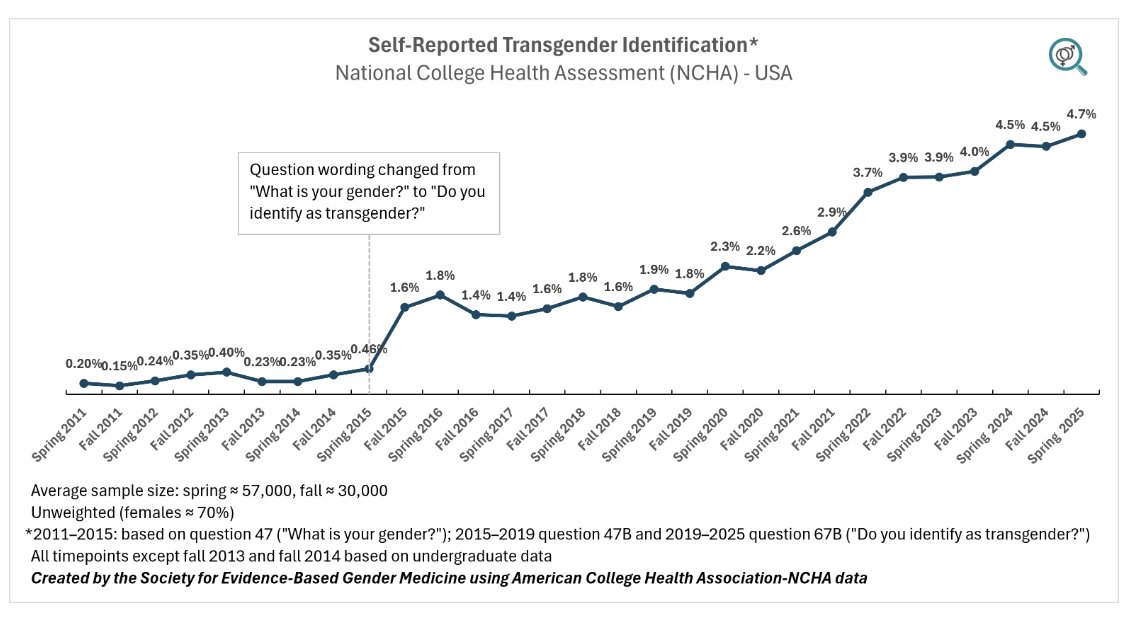
Recent claims of a “free fall” in youth trans identities may have been greatly exaggerated. A sample of 45K+ students shows trans & nonbinary identities at an all-time high. The claimed drop may stem from flawed weighting and poorly designed survey questions. SEGM's analysis⬇/1 Image
Per the NCHA data, in 2025, 8% of women & nearly 5% of men attending U.S colleges had a non-"cisgender" identity. While there is no evidence of a drop in transgender/nonbinary identities, the data suggest that we may be approaching a plateau. /2

segm.org/transgender-id…Image
Youth with "nonbinary"- type identities far outnumber those who identify as "trans men" or "trans women." Since 2022, the nonbinary numbers have leveled off, leading to an overall "trans identification" plateau— just as the cross-sex identity, esp. FtM, is still increasing./3 Image
The data, which come from the National College Health Assessment in the U.S., provide three different ways to estimate "transgender" ("non-cisgender") identification. It yields a range of possible estimates and suggests that at least 1 in 20 do not identify with their sex. /4 Image
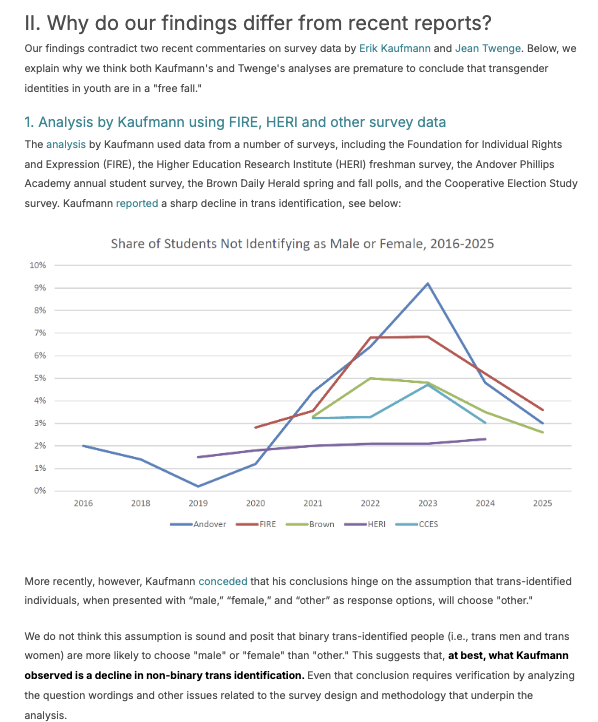
Our conclusions using the American College Health Association's National College Health Assessment data contradict two recent analyses that concluded that trans identity in youth is in a "free fall." We examine the reasons for our discordant conclusions. /5 Image
First, we look at the analysis by Kaufmann. We conclude that, at best, what Kaufmann observed is a decline in nonbinary trans identification, but even that finding needs to be rigorously examined. /6 Image
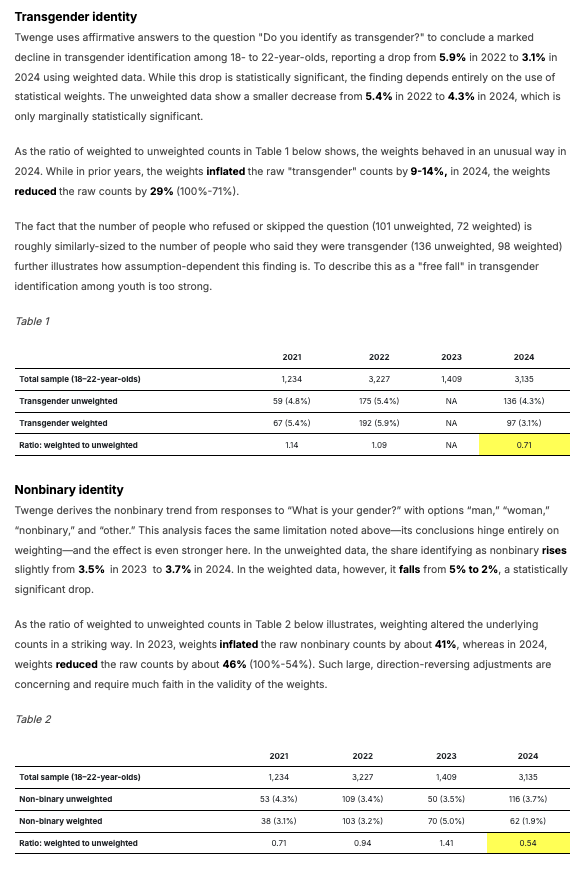
Next, we look at the analysis by Twenge. We observe that her conclusion of a "free fall" in trans and nonbinary identities hinges entirely on the application of statistical weights. Raw data has either only marginally significant findings or suggest an increase, not a fall. /7 Image
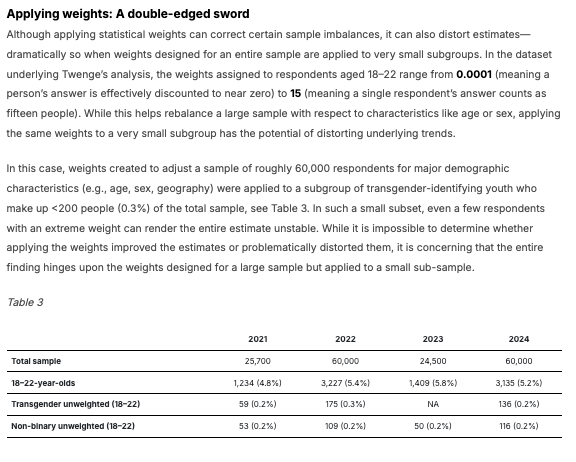
It is impossible to know whether the weights improved or distorted the estimates. However, it is concerning when the entire finding is dependent on a weight designed for a population of 60K, but applied to a very small group (trans-identified youth are <0.2% of the sample). In 2024, the weights, when applied to this subgroup, had a particularly unusual effect, sharply deflating raw numbers./8Image
More generally, applying weights is a double-edged sword. It can help rebalance non-representative samples, but it can also potentially distorting findings, especially when weights are applied to very small sub-samples. The weights in Twenge’s analysis range from 0.0001 (discounting a response to near zero) to 15 (i.e., 1 response counts for 15). With fewer than 200 trans-identified individuals in the sample, even a few responses with extreme weights can render the entire estimate unstable or invalid. /9Image
While we believe the data source we used (ACHA-NCHA) is more robust than those relied on by Kaufmann and Twenge, our analysis has numerous limitations. Further, it only looks at U.S. college students. Trends among non-college youth may differ. These questions merit careful analysis using reliable data sources and sound methodologies. /10
Social media platforms have largely displaced peer-reviewed journals as de facto forums for debate in gender medicine. We thank @epkaufm and @jean_twenge for initiating this important discussion and debate.

Although we conducted extensive internal review, we are not immune to error and welcome questions, discussions, and rigorous debate! /end

segm.org/transgender-id…

• • •

Missing some Tweet in this thread? You can try to force a refresh

 

Keep Current with SEGM

SEGM Profile picture

Stay in touch and get notified when new unrolls are available from this author!

Read all threads

This Thread may be Removed Anytime!

PDF

Twitter may remove this content at anytime! Save it as PDF for later use!

Try unrolling a thread yourself!

how to unroll video
  1. Follow @ThreadReaderApp to mention us!

  2. From a Twitter thread mention us with a keyword "unroll"
@threadreaderapp unroll

Practice here first or read more on our help page!

More from @segm_ebm

Jun 18
The new study from the early Dutch cohort of puberty suppressed youth will require substantial analysis, but several important preliminary points can be made. /1
👉To cut to the chase, the study cannot answer the key question of whether early pubertal blockade (at Tanner stage 2) leads to worse adult sexual outcomes, because there were only 5 cases of early puberty blockade.

To increase the sample, the authors lumped early puberty (Tanner 2) with mid puberty (Tanner 3). The resulting sample (n=17) was still too small, and it was not possible to perform statistical analysis comparing sexual function outcomes of early/mid puberty suppression with later pubertal suppression (Tanner 4/5).

Therefore, no conclusions can be made about the effects of earlier vs. later pubertal suppression on future sexual function, and it is unclear how the authors concluded that early PB has no adverse effects on sexual function. /2
👉The only conclusion that can be made with some degree of confidence is that puberty-suppressed individuals have high rates of sexual dysfunction in adulthood (at average age 29). About 30% have not been sexually active in a year. In addition, 50% of males (MtF) and 58% of females (FtM) reported having one or more sexual dysfunction.

Not all typical domains of sexual dysfunction are accounted for in the study. There is no reporting on pain during sexual activity - previous studies have shown this is a frequent problem identified in transgender people after gender affirming medical treatment. Thus, this study may seriously underestimate sexual dysfunction.

Still, assuming the respondents' answers focused on recent sexual experiences as adults, the reported rate of sexual dysfunction (50-58%) compares unfavorably to the general Dutch population, where only 7%–17% report sexual dysfunction in the last 12 months (see table below).

However, even that cannot be assumed, since the respondents were asked if they had *ever had sexual difficulties, which means such difficulties may have occurred at any stage in their life: during puberty blockade; while on cross-sex hormones pre-surgery, immediately post-surgery, or well after the surgery.

Failure to differentiate between the stages when the sexual difficulties occurred is a major methodological limitation which makes the data shared by the authors extremely challenging to interpret. /3
rutgers.nl/wp-content/upl…Image
Read 8 tweets
Jun 13
Given the skewed sex ratios among gender-dysphoric youth, most attention has focused on females. But the number of males has sharply risen as well—and the effects of androgen blockers & estrogen on males remain under-discussed. A new peer-reviewed paper addresses this gap. /1 ⬇️ Image
While systematic reviews provide only low-certainty evidence of harms of estrogen and testosterone blockers in males, in reality the harms are likely, as explained by the authors of the paper. Lack of evidence of harm ≠ evidence of lack of harm. /2
link.springer.com/article/10.100…
The authors highlight a broad range of risks from estrogen use in males: sterility, stroke, brain volume loss, cognitive impairment, dementia risk, autoimmune disease, metabolic dysfunction, pancreatitis, and elevated rates of breast, thyroid, and testicular cancer and brain tumors, and early mortality. Many of these risks remain under-discussed in clinical settings. /3
Read 10 tweets
Jun 7
📢 The volume of research in youth gender medicine has exploded in recent years. To meet the growing need for rigorous analysis, we’re launching SEGM Digest: concise, scientifically grounded reviews of influential publications. Issue 1 covers 7 major papers from Apr–May 2025. /1Image
📄 HHS Review (2025):
Issue 1 of SEGM Digest opens with an overview of the landmark 2025 HHS Review of pediatric gender dysphoria treatments. The Review's evidence and ethics analysis do not support the provision of hormones and surgery as the standard of care for GD youth. /2
segm.org/SEGM-Digest-Is…Image
📄 Utah Report (2024):
Utah’s Department of Health commissioned an assessment of safety and efficacy of hormones in GD minors. Puzzlingly, the report omits an evidence synthesis—the primary aspect of any credible evidence review, limiting its utility. /3
segm.org/SEGM-Digest-Is…Image
Read 9 tweets
May 10
New peer-reviewed study finds that the evidence base for pediatric gender medicine is weak: individual studies are inconsistent, and systematic reviews show no clear benefits. Guidelines that state or imply that medical transition is the standard of care aren't evidence-based. /1 Image
The study is not a systematic review (a limitation that the authors note), but it provides a comprehensive overview about what's known about the evidence base underpinning youth gender medicine. /2
link.springer.com/article/10.100…
Studies originating from gender clinics tend to focus on measuring the magnitude of the hypothesized psychological benefits. There is less focus on studying the risks and harms. This new publication provides a succinct summary of expected harms, along with the rationale. /3 Image
Read 9 tweets
Mar 28
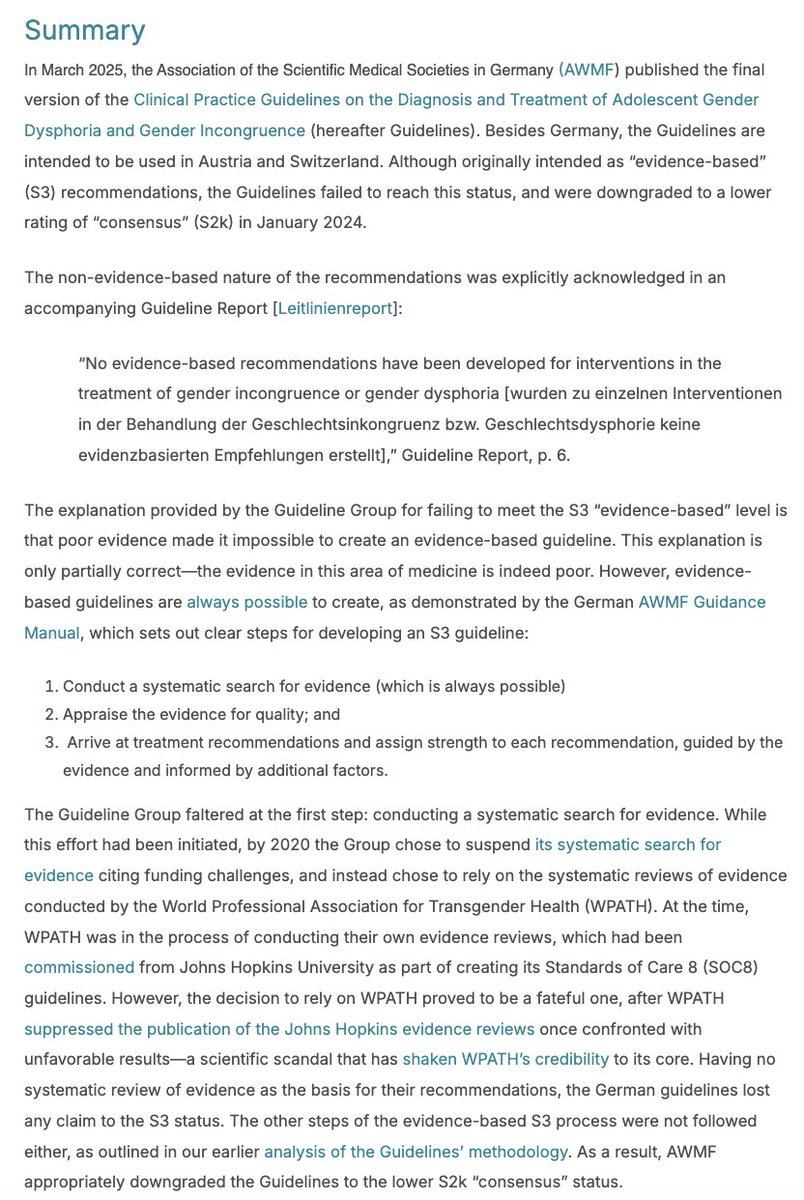
🧵Germany’s new GD guidelines represent a shift toward caution, by acknowledging that most youth with gender distress have temporary "gender non-contentedness" and should not be medically transitioned. Still, significant problems remain, as we explain in our Spotlight. Link⬇️ /1Image
The final Guidelines are the result of a year-long debate and revisions following the release of the earlier draft. The final recommendations are now more cautious, but core issues remain.

Chief among them: the guidelines are not evidence-based. /2

segm.org/German-guideli…
Originally, the Guidelines were intended to be “evidence-based.” However, the team abandoned its systematic reviews in 2020, and chose to rely on WPATH's. When WPATH suppressed its own systematic reviews, the guidelines lost the ability to claim the evidence-based "S3" status. /3 Image
Read 13 tweets
Feb 4
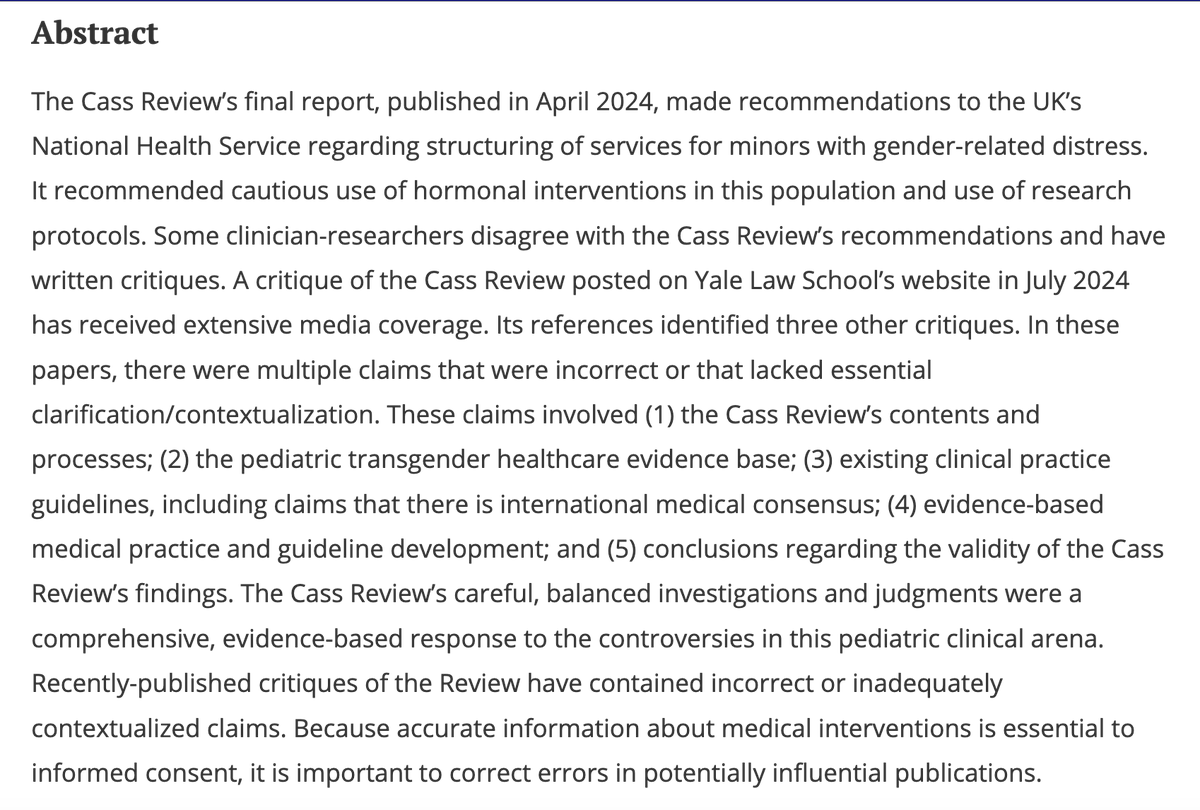
A new peer-reviewed article examining the criticisms of the Cass Review, just published. The authors found that the primary source of the criticism, a non-peer-reviewed paper published on the Yale Law School website, contains numerous inaccurate and misleading claims.
Link👇/1Image
The link to the article is below:

/2tandfonline.com/doi/full/10.10…
The authors of the new publication conclude:
"The Cass Review’s careful, balanced investigations and judgments were a comprehensive, evidence-based response to the controversies in this pediatric clinical arena. Recently-published critiques of the Review have contained incorrect or inadequately contextualized claims. Because accurate information about medical interventions is essential to informed consent, it is important to correct errors in potentially influential publications." /3Image
Read 7 tweets

Did Thread Reader help you today?

Support us! We are indie developers!


This site is made by just two indie developers on a laptop doing marketing, support and development! Read more about the story.

Become a Premium Member ($3/month or $30/year) and get exclusive features!

Become Premium

Don't want to be a Premium member but still want to support us?

Make a small donation by buying us coffee ($5) or help with server cost ($10)

Donate via Paypal

Or Donate anonymously using crypto!

Ethereum

0xfe58350B80634f60Fa6Dc149a72b4DFbc17D341E copy

Bitcoin

3ATGMxNzCUFzxpMCHL5sWSt4DVtS8UqXpi copy

Thank you for your support!

Follow Us!

:(