LiorLefineder Profile picture
Nov 2 2 tweets 1 min read Read on X
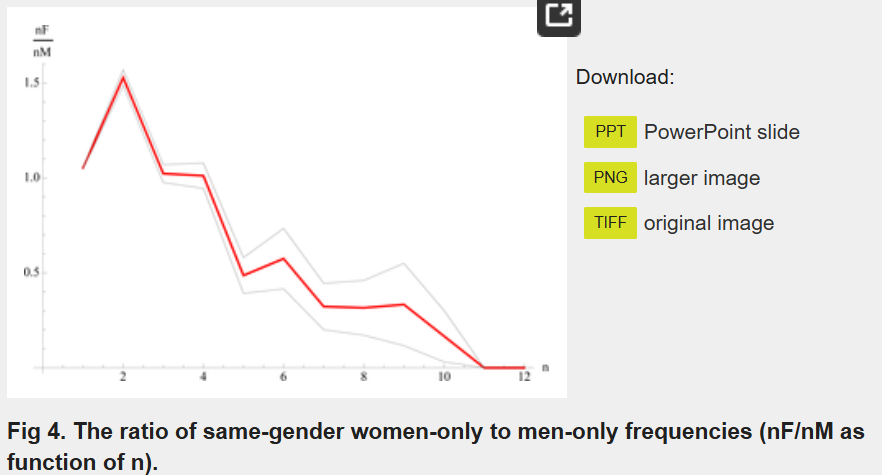
Looking at "112,000 profile pictures from nine world regions," Women like to hang out in pairs. There were 50.8% more pictures with two female peers than pictures with two male peers. Men like to hang out in groups, pictures with more people are more likely to be all Men. Image
"Women Favour Dyadic Relationships, but Men Prefer Clubs: Cross-Cultural Evidence from Social Networking"
journals.plos.org/plosone/articl…

• • •

Missing some Tweet in this thread? You can try to force a refresh

 

Keep Current with LiorLefineder

LiorLefineder Profile picture

Stay in touch and get notified when new unrolls are available from this author!

Read all threads

This Thread may be Removed Anytime!

PDF

Twitter may remove this content at anytime! Save it as PDF for later use!

Try unrolling a thread yourself!

how to unroll video
  1. Follow @ThreadReaderApp to mention us!

  2. From a Twitter thread mention us with a keyword "unroll"
@threadreaderapp unroll

Practice here first or read more on our help page!

More from @lefineder

Oct 13
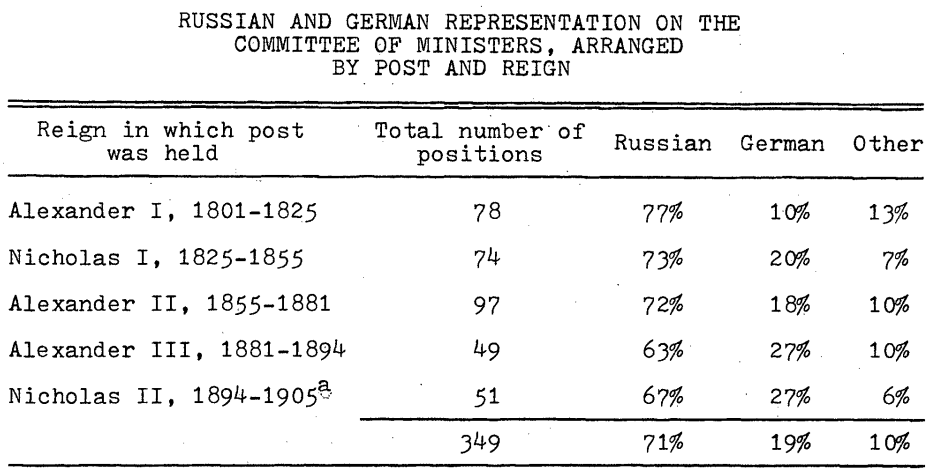
Germans accounted for 19% of the ministers in the Russian Empire, despite being around 1% of the empire's population.

Most of these Germans were 'Baltic Germans' incorporated into the empire during the conquests of the Great Northern War (1720). Only 80 years later, we already see that Germans have risen into positions of high prominence in the Committee of Ministers of Alexander I.Image
Detailed origin of ministers.
The other non-foreign non-Baltic German ministers are probably Volga Germans brought in by Catherine the Great.
"The six ministers of German descent were either two or three generations removed from their families' immigration to the Russian Empire." Image
"If Russian nationalists impugned the loyalty of the German bureaucrats, the tsars themselves never did so, always stressing the faithfulness of their high German servants. 'The Russian Nobles serve the State, the German ones serve us,' declared Nicholas I." Image
Read 5 tweets
Oct 7
Linear B tablets mention Women taken as war captives from Anatolia, showing Mycenaean Greeks were raiding the region of Troy.
"These descriptions often use the word lawiaiai, ‘captives’, which is the same word used by Homer to describe women seized by Achilles."

Note that the Iliad begins with Achilles' rage about Agamemnon not handing him a captive woman (Briseis).Image
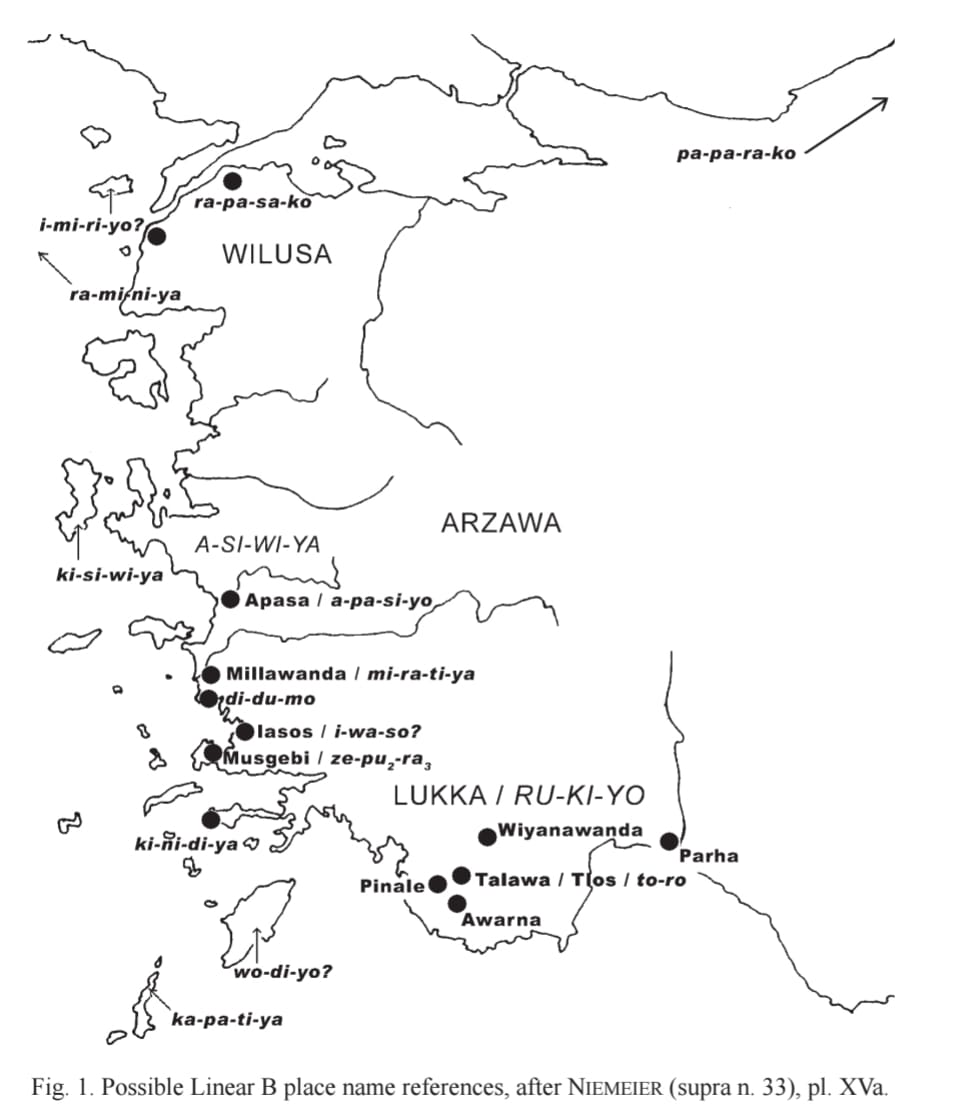
The Mycenaeans were very familiar with the coasts of West Asia, and many places there are referenced in Linear B tablets. Image
Text in the top tweet from: Image
Read 4 tweets
Oct 1
Greco-Roman writers were the first to use coordinates of latitude and longitude to map places, and the first to lay down geometrical treaties specifying how to project regions onto maps.
This transformed Geography from a mere itinerary, schematically displaying places, into a real science based on mathematical principles.

Ptolemy's Geography, written around 150 AD, gives the coordinates of 8,000 different places, on top of being a monumental achievement in pre-modern mapping, when these coordinates are compared to modern Greenwich coordinates, a tight correlation is seen (0.98) between the numbers, indicating a remarkable degree of accuracy.Image
Image
Comparison of Ptolemy’s longitudes and latitudes with real values.
ancientportsantiques.com/ancientmaps/cl…Image
This map displays the degree of deviation between Ptolemy's coordinates to the actual position of locations.
We can see that the furthest places from the centers of the Roman world are mapped less accurately. Image
Read 10 tweets
Sep 23
Jokes from the "Philogelos", the oldest surviving joke book (dated 4th century AD).🧵 Image
Image
208. Someone asks a cowardly boxer, ‘Whom do you have a fight with today?’ With a polite gesture in the direction of his opponent, he answers, ‘With that dear sweet gentleman over there.’
203. A fellow approaches a stupid prophet and asks if his enemy will come to town. The prophet responds that he’s not coming. But when the fellow learns a few days later that his enemy is actually in town now, the prophet remarks, ‘Yeah, the guy’s outrageous, isn’t he?’
Read 28 tweets
Sep 13
A Frankish Odyssey.
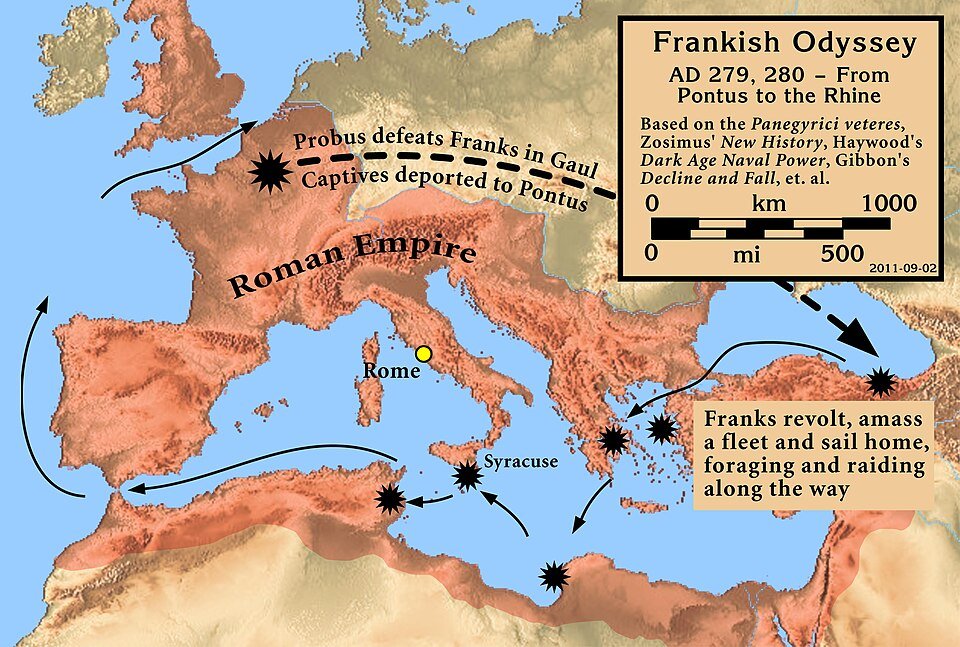
Around 279, Emperor Probus defeated the Germanic people in a series of wars. As part of the peace agreement, Germanic groups were resettled throughout the empire. This included a group of Franks who were resettled in the region of Pontus on the coast of the black sea, but almost as soon as they were settled, the Franks rebelled.

Taking control of a fleet stationed in an Euxine harbor, they sailed out of the black sea into the Mediterranean, pillaging their way through Anatolia, Greece, and North Africa. They ravaged the famous city of Syracuse in Sicily and tried to take Carthage, but were repulsed. Eventually, they reached and passed the Pillars of Heracles into the Atlantic Ocean.
From there, they coasted from Hispania to Gaul, passing the British Channel until they returned to the shores of their home.Image
Here's Edward Gibbon's description of the odyssey from his history:
"Of all the barbarians who abandoned their new settlements, and disturbed the public tranquillity, a very small number returned to their own country....The successful rashness of a party of Franks was attended, however, with such memorable consequences"Image
The historian Zosimus mentions that the Franks "returned home without any great loss." Image
Read 4 tweets
Sep 3
The share of rulers whose birth year is known can be used as a measure of the quality of recordkeeping in a given society at a particular time.
When the elite bureaucracy that produces and maintains historical records is poor, we get the names of rulers but not accurate numerical information, such as the year of their birth.

Statistical evidence for the previous statement can be seen in the fact that medieval European regions with a greater share of rulers with a known birth year have a higher per capita production of manuscripts and higher rates of numeracy among the elite( by looking at the degree of age heaping in their recorded ages).

Now, keeping all this in mind, let us look at the quality of recordkeeping since the start of the Roman Republic. 🧵Image
Image
Rulers in the time of the Roman Republic were the consuls. Due to various historical reasons, we have data on all Roman consuls, 737 people, serving between 509 BC - 31 BC.
The % of whose birth year is known by century can be extracted from the digital prospography of Rome. Image
We can see that record-keeping before 300 BC in the Roman Republic was extremely poor. This is something that is often attributed to the Celtic siege of Rome, 380 BC, but probably has more to do with low rates of literacy in Italic languages at the time.
Read 7 tweets

Did Thread Reader help you today?

Support us! We are indie developers!


This site is made by just two indie developers on a laptop doing marketing, support and development! Read more about the story.

Become a Premium Member ($3/month or $30/year) and get exclusive features!

Become Premium

Don't want to be a Premium member but still want to support us?

Make a small donation by buying us coffee ($5) or help with server cost ($10)

Donate via Paypal

Or Donate anonymously using crypto!

Ethereum

0xfe58350B80634f60Fa6Dc149a72b4DFbc17D341E copy

Bitcoin

3ATGMxNzCUFzxpMCHL5sWSt4DVtS8UqXpi copy

Thank you for your support!

Follow Us!

:(