People get confused by these terms, so let’s clear it up.
I’m a big proponent of Dr. Alice’s (@calirunnerdoc) framing that COVID damages the entire vasculature .. the body’s vast network of blood vessels.. and that this damage is in part or fully mediated long-term by immune dysfunction.
Another way to say that: COVID causes vasculopathy.
Vasculopathy is a broad term.. it means any disease or dysfunction of blood vessels. That includes:
🩸 Endothelial dysfunction – when the vessel lining loses its ability to regulate blood flow, clotting, and permeability.
🧱 Atherosclerosis – plaque buildup that narrows arteries.
🌫️ Microangiopathy – small-vessel damage that limits oxygen delivery.
🧩 Thrombotic vasculopathy – microclots and hypercoagulability driven by immune or endothelial injury.
All of these fall under vasculopathy.
Some people call the vascular damage from COVID vasculitis, but that’s a narrow subset of vascular disease.
🧠 Vasculitis = inflammation in the vessel wall, often autoimmune.
🧠 Vasculopathy = any structural or functional vessel damage — inflammatory or not.
COVID can trigger vasculitis, yes, but the broader story is vasculopathy. It’s not just that the virus travels through the bloodstream…it damages the bloodstream’s infrastructure itself.
When the endothelium is injured, oxygen delivery, nutrient exchange, and waste clearance are all disrupted … everywhere blood flows.
That’s why COVID-related vascular injury can affect every organ system, from the brain and heart to kidneys, lungs, and skin.
COVID causes vasculopathy .. and the vasculature touches everything.
• • •
Missing some Tweet in this thread? You can try to
force a refresh

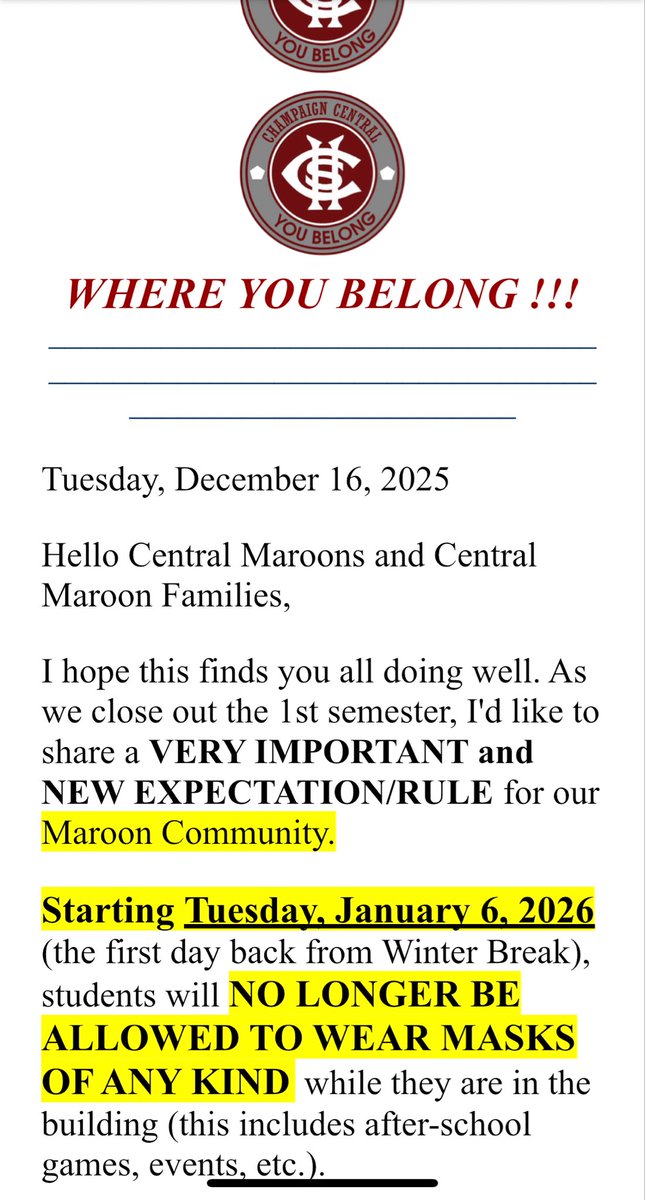
After years of advocating for clean air and protecting kids during an ONGOING PANDEMIC, my daughter’s high school is trying to ban masks.
My kid is a freshman.
Illinois Section 2A tennis champion and state qualifier.
Healthy. Driven. Focused.
All As.
And her school wants to take away her right to protect herself from a virus known to cause brain damage, vascular injury, immune dysfunction, and Long Covid.
Let that sink in.
On January 26, @Unit4Schools plans to enforce a #MaskBan.
This is not about politics.
This is about bodily autonomy.
This is about disability discrimination.
This is about children’s rights.
If you think this ends quietly, you are mistaken.
@ACLU
@Liesl4CleanAir
@luckytran
📄 Receipts + documentation:
👇
Share this. Screenshot it. Tag people.
Because kids deserve clean air in school.
No student should need a doctor’s note or a diagnosis to protect their lungs, brain, and immune system during an ongoing airborne pandemic.
Wearing a respirator is not a “special accommodation.”
It is a basic human right.
Clean air is not a privilege.
Protection is not a medical exemption.
And prevention should never require permission.
Making masking “medical only” has serious implications.
FERPA places strict limits on who may access medical or disability-related information—and for what purpose.
Policies that require students to justify protective behavior with medical documentation risk coerced disclosure of private health information, especially if enforcement involves non-medical staff or law enforcement.
That is not neutral policy.
That is a privacy and civil rights problem.
This was the beginning of the doc that no longer seems to be available. If you want to write & inform them of the science & consequences of airborne pathogens, impact on children, efficacy of respirators & the importance of clean air as a human right, contact: gardnemo@u4sd.org
🧵 Another Year in Review: What Still Hasn’t Happened for Long COVID
Another year has passed.
Not a breakthrough year.
Not a reckoning year.
A stalling year.
Another year where Long COVID exists everywhere in lived reality and almost nowhere in systems that matter.
We’ve had a flood of papers on biomarkers.
Promising headlines.
Colorful heat maps.
Elegant omics.
And yet, most of these studies are not predictive.
They are descriptive.
They characterize who showed up to a study, often late, often filtered, often already narrowed by survival, access, and persistence.
Correlation dressed up as foresight.
Classification mistaken for causation.
A thousand papers telling us what Long COVID looks like and almost none telling us what to do about it.
We are still confusing signal detection with clinical utility.
We are still publishing “may suggest,” “could indicate,” “associated with,” while patients are deciding whether to shower or eat on any given day.
Drug trials are happening. Slowly.
Painfully slowly.
And many of them quietly exclude the people who have been sick the longest.
First-wavers.
Those infected before vaccines, before variants were named and sequenced.
The people whose biology has been marinating in viral persistence, immune dysregulation, endothelial damage, autonomic chaos for years.
They are “too complex.”
“Too heterogeneous.”
“Too confounded.”
In other words: inconvenient.
So trials skew toward those with shorter duration illness, cleaner timelines, fewer comorbidities, better documentation.
Which makes the results easier to publish.
And less representative of reality.
We’ve seen the dog-and-pony shows.
High-profile initiatives.
Big announcements.
Task forces.
Centers.
Logos.
Dust kicked up.
Cameras rolling.
Then silence.
Websites that stop updating.
Emails that stop getting answered.
Clinics quietly closing or narrowing scope.
Patients being told, again, that there’s “nothing more we can do.”
1/5 🧵
🎙️ Just delivered “Herd Immunity to BS: Building Resilience to Misinformation in the AI Age.”
Small crowd.
Big topic.
Essential conversation.
Finally got a photo with Dr. Rachel Hoopsick — one of the sharpest voices in our field.
My talk covered:
• How exercise really affects immunity
• Why misinformation spreads faster than pathogens
• What Long COVID + chronic disease data actually show
• Why clean air > hand sanitizer
• And how to build your “immune system” for nonsense in the age of AI
Dropping the full script below — and I’ll be sharing my Living Library next: a public archive of all the receipts, references, and evidence showing how we got here.
If you’re tired of spin, vibes, and post-pandemic amnesia… Stay tuned.
👇 Script:
2/5
🎙️ “Herd Immunity to BS”
Full Presentation Script (≈45–50 min talk + Q&A)
🎬 ACT 1 – Framing & Exercise + Immunity (≈15 min)
[TITLE SCREEN]
Before we begin, I want to prepare you for something. Some of what I’m about to say may sound provocative — maybe even shocking.
My goal isn’t to alarm you, but to wake something up in you: your curiosity, your skepticism, your desire for truth, and your instinct to protect yourself and others with knowledge.
I hope that’s why you’re here — in this graduate program, in the College of Applied Health Sciences, in the Department of Health and Kinesiology.
We live in an era of herd immunity to facts.
Emotionally charged claims in algorithmic feeds often travel farther and faster than sober updates and corrections. Every one of us has been exposed.
So if at any point today you feel that internal tuning-fork buzz of disbelief — good. That’s your critical-thinking reflex firing.
I’ll be talking about exercise, immunity, chronic disease, misinformation — and yes, about COVID — the Voldemort of this era.
The pandemic isn’t over. By definition it remains global, unpredictable, and ongoing until transmission stops — not when our attention span does.
Emergency declarations ended. Attention spans ended. But the pandemic never did.
The result? A Stranger Things-style rip in the world. We live in the Upside Down.
Today, I’m going to try to flip your world upright.
(Click “Begin Interactive Presentation.”)
[FOUNDATION → Definitions / About / Lab Intro]
Many of you know me for behavior-change and digital-health research.
Since 2020, I’ve also become an unwilling science translator — summarizing hundreds of studies on COVID’s long-term effects because I couldn’t stand the gap between what we know and what people are told.
I’ve used AI not as a gimmick but as a public-health amplifier — turning complexity into clarity.
And what I’ve learned is that the biggest health crisis we face isn’t just viral. It’s informational.
[FOUNDATION → Understanding Information Disorders]
The Council of Europe calls these information disorders — systemic disturbances in the information ecosystem.
Wardle & Derakhshan (2017) describe three types:
Misinformation: false but not meant to harm
Disinformation: false and intended to deceive
Malinformation: true facts used to harm
Think of it as a public-cognitive imbalance, not a clinical disorder.
Across 57 studies, prevalence of health misinformation ranged from <1 % to ~87 %, depending on platform and topic (Wang 2019; Suárez-Lledó 2021).
Reviews of YouTube content show 20–30 % of videos about emerging infectious diseases contain misleading information.
And in the classic Science paper by Vosoughi et al. (2018) — using political data, not health — falsehoods were 70 % more likely to be retweeted, and truth took six times longer to reach the same number of people.
Platform analyses since then show ≈ 89 % of engagement concentrated in the top 1 % of false-post activity (Pierri 2023; Ceylan 2023).
⚠️ Real-World Consequences
• Roughly 40–44 million Americans have experienced Long COVID (CDC Pulse 2024; Heun-Johnson 2025).
• Preventable deaths and chronic illness burdens followed delayed treatment and policy minimization.
• Healthcare systems remain strained by preventable illness and burnout.
[FOUNDATION → Health Misinformation / PA Misinfo (JMIR Findings)]
Our lab’s JMIR Infodemiology study analyzed physical-activity misinformation online.
Even in a field built on evidence, we recycle myths like folklore — and sometimes we teach them.
3/5
Take the phrase: “Exercise boosts the immune system.”
It sounds right, it feels right, it’s in textbooks — but it’s wrong, or dangerously oversimplified.
Exercise doesn’t boost immunity; it tunes it.
Too little, and it’s off-key. Too much, and the string snaps.
The right dose keeps the immune response balanced and resilient — but it doesn’t prevent infection.
That’s why even elite athletes have been sidelined by SARS-CoV-2: myocarditis, brain fog, dysautonomia.
[FOUNDATION → Reality Check / PA Guidelines]
Here’s a reality check: less than half of kinesiology majors can correctly state the adult PA guidelines.
Even experts in our field don’t always practice what they preach.
We say we’re interdisciplinary, but we live in silos.
We can’t fix public health if we ignore the physics of airborne spread or the psychology of misinformation.
[FOUNDATION → Disunderstanding / Herd Immunity Concept]
“Disunderstanding” means the confident misunderstanding that spreads faster than facts.
Our field is full of it. We tell people to wash their hands for an airborne virus and pretend clean air is optional.
Ignaz Semmelweis was ostracized for telling doctors to wash hands between patients.
Today we ostracize scientists who remind us pathogens move through air.
History doesn’t repeat — it rhymes, and the rhyme scheme is ignorance.
Before we talk about behavior change or digital health, we have to repair our relationship with truth.
We’ve trained our bodies better than our bullshit detectors. But we can retrain them.
That’s what today is about — rebuilding immunity to misinformation in the AI age.
🧵 In science and medicine, honesty about one’s credentials isn’t just good ethics — it’s essential to public trust.
The line between “student,” “medical doctor,” and “researcher” exists for a reason: people rely on these labels to decide whose advice could affect their health.
Imagine someone trained as a veterinarian speaking about human cardiology and letting others call them “doctor.”
They are a doctor — but of animals. The training, licensure, and legal responsibilities are completely different. Titles mean something because lives depend on them.
For instance, in Ireland’s Royal College of Surgeons (RCSI), there are two main paths to becoming a physician:
•Undergraduate entry: a 5–6 year program starting right after secondary school.
•Graduate Entry Programme (GEP): a 4-year fast-track route, but only for people who already hold a bachelor’s degree.
So if someone graduated high school in, say, 2008, they couldn’t possibly have “finished” the medical program by 2010 unless time travel was part of the curriculum. You probably shouldn’t call yourself a “Jr Doctor” either eh?
“Calling SARS-CoV-2 ‘Airborne AIDS’ is biologically imprecise but epidemiologically instructive — it conveys that repeated infections can progressively undermine immune competence across large populations.”
“Multiple studies now demonstrate persistent T-cell dysregulation, exhaustion, and reduced proliferative capacity months after infection — changes that mirror key features of chronic HIV infection.”
🧠 COVID Truth Defense Playbook
A Strategy Guide for Responding to Anti-Science Doctors and Bad-Faith Medical Professionals (on social media… something I’m still working on)
Disclaimer: This is NOT MEDICAL ADVICE.
🔑 Core Principles 1/ Don’t debate science deniers—define them.
Never waste time arguing the basics with someone who’s already shown contempt for the scientific process. 2/ Flip the burden of proof back on them.
“If you’re not disturbed by these findings, show us the evidence that disproves them.”
Every study has limitations. Don’t get dragged into “journal club” mode with denialists. It’s a trap designed to waste your time and obscure the big picture. 3/ Establish linguistic symmetry.
Just as “climate denier” became a recognizable label through repeated use of truth, so too should terms like COVID minimizer, airborne denier, and immune damage denier. 4/ Never fight on their turf. Shift the frame.
If they demand RCTs for every mechanism, call out the impossibility and the double standard. We don’t require RCTs to prove smoking causes cancer or that parachutes prevent death.
🎯 Target Categories & Labels
Use these sparingly, strategically, and with citations or quotes when possible. Think of them like rhetorical scalpel tools—not sledgehammers.
1. AIDS Denier
🧬 Definition: Any healthcare professional who denies or dismisses the growing convergent evidence that SARS-CoV-2 causes long-term immune system damage via T cell depletion, immune exhaustion, and persistent viral reservoirs—especially when they insist on RCTs to “prove” causality.
📌 “We didn’t demand RCTs to prove HIV causes AIDS. We looked at converging evidence: immunological damage, depletion of T cells, chronic infections, and organ pathology. SARS-CoV-2 shows similar patterns. If you deny that, you’re not a skeptic. You’re an AIDS denier.”
Note: SARS-CoV-2 doesn’t cause AIDS in the traditional sense—and it deserves its own classification, just as Long Covid is not the same as ME/CFS. But the virus can induce an AIDS-like acquired immune dysfunction. To deny this is to deny the very framework we used to understand the original AIDS epidemic. So ask them: What’s your evidentiary threshold for recognizing an airborne virus that causes chronic immune damage?
Put the burden back on them. You don’t owe them a full literature review. If they attack your position, it’s their job to support theirs—with citations.
2. Airborne Biohazard ☣️ Denier
🌬️ Definition: Any doctor who minimizes or denies the airborne transmission of SARS-CoV-2 and refuses to mask or take precautions, despite overwhelming evidence from fluid dynamics, outbreak investigations, and expert consensus.
📌 “We no longer debate whether COVID is airborne. The science is settled. If you still treat this like a droplet disease that magically went away and returned as ‘just a cold’ in 2025, you’re not just outdated—you’re an airborne biohazard denialist clinging to the myth that betacoronaviruses naturally evolve to become mild. There’s no evidence for that—and plenty against it.”
3. Science Denier
📚 Definition: Any professional who handwaves away peer-reviewed studies, systematic reviews, or expert consensus published in top-tier journals, demanding only RCTs—especially when ethical or logistical constraints prevent them.
📌 “RCTs aren’t the only valid method. Epidemiology, immunology, and pathology also count. Public data from schools, transit systems, and health departments may all be relevant—because methods should follow the research question, not ideology. If you ignore converging evidence in favor of fantasy RCTs, you're not practicing evidence-based medicine—you’re performing denial in a lab coat.”