1/Thrilled to share @fsuigc’s latest report, based on a national survey of 1,447 U.S. adults we conducted in late September—one week after the assassination of Charlie Kirk.
We examine how Americans think about harmful speech and whether physical violence can ever be justified to stop its public expression.
Link to report: igc.fsu.edu/research-data/…
What follows is a summary of key findings.
We examine how Americans think about harmful speech and whether physical violence can ever be justified to stop its public expression.
Link to report: igc.fsu.edu/research-data/…
What follows is a summary of key findings.
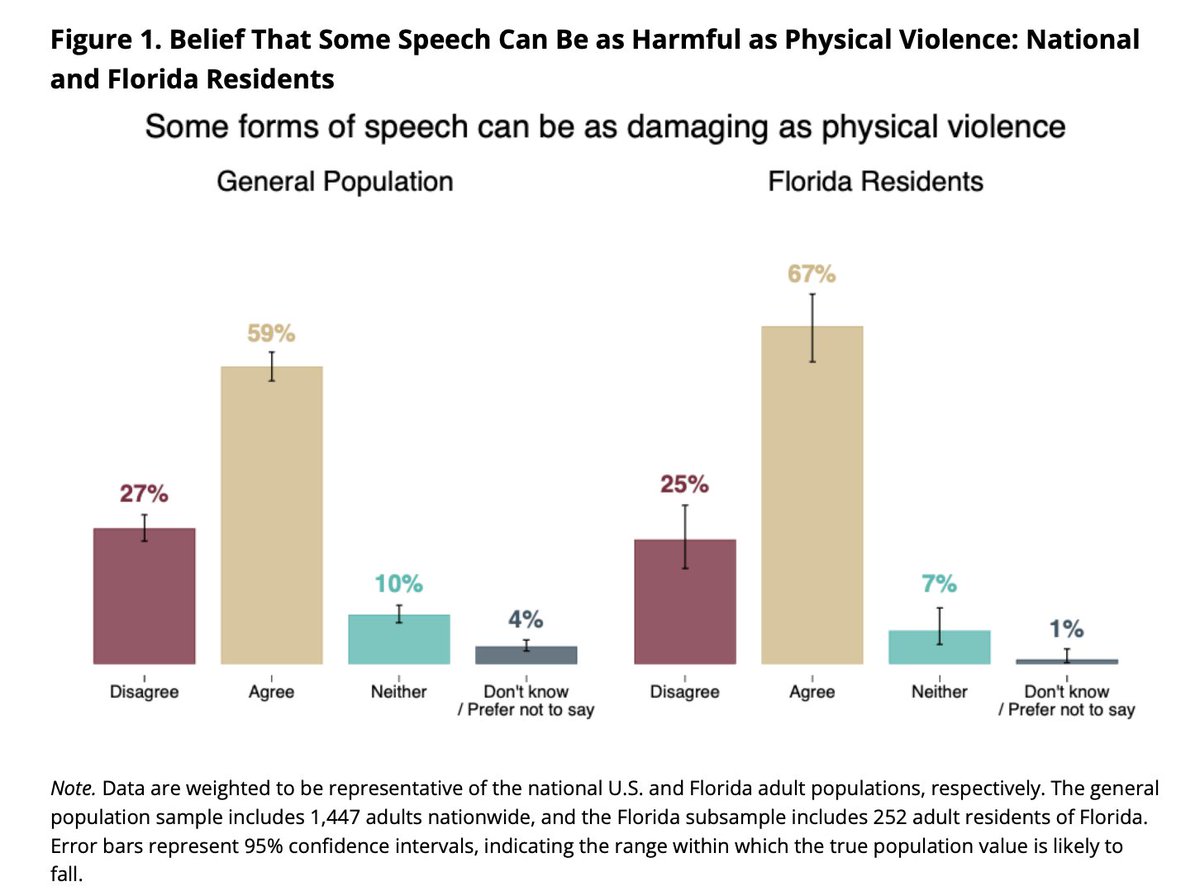
2/ First: nearly 60% Americans at least somewhat agree that “certain forms of speech can be as damaging as physical violence” 
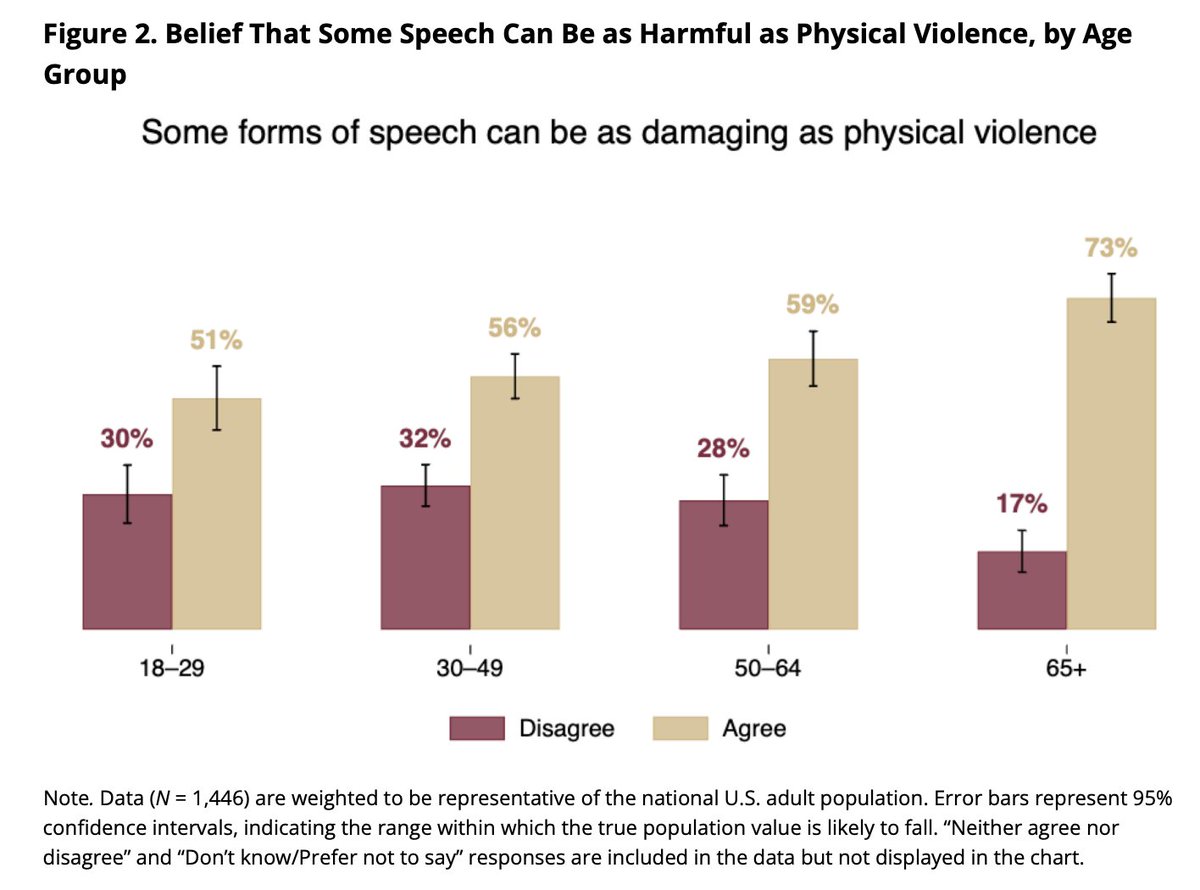
3/ But contrary to popular narratives, it’s older Americans—not Gen Z—who are most likely to agree.
-73% of seniors agree, 17% disagree
-51% of adults under 30 agree, 30% disagree
Note: Young adults are the most likely to choose a neutral position.
-73% of seniors agree, 17% disagree
-51% of adults under 30 agree, 30% disagree
Note: Young adults are the most likely to choose a neutral position.
4/ Why this matters: prior surveys (e.g. Knight Foundation) asking similar questions mostly sampled students or young adults. We had no baseline for older age groups.
So this age pattern may have long existed—but we couldn’t see it until now.
But as will be shown further below, equating speech with violence has almost no impact on older adults’ views about using violence to stop harmful speech, while it has an important impact among younger adults.
So this age pattern may have long existed—but we couldn’t see it until now.
But as will be shown further below, equating speech with violence has almost no impact on older adults’ views about using violence to stop harmful speech, while it has an important impact among younger adults.
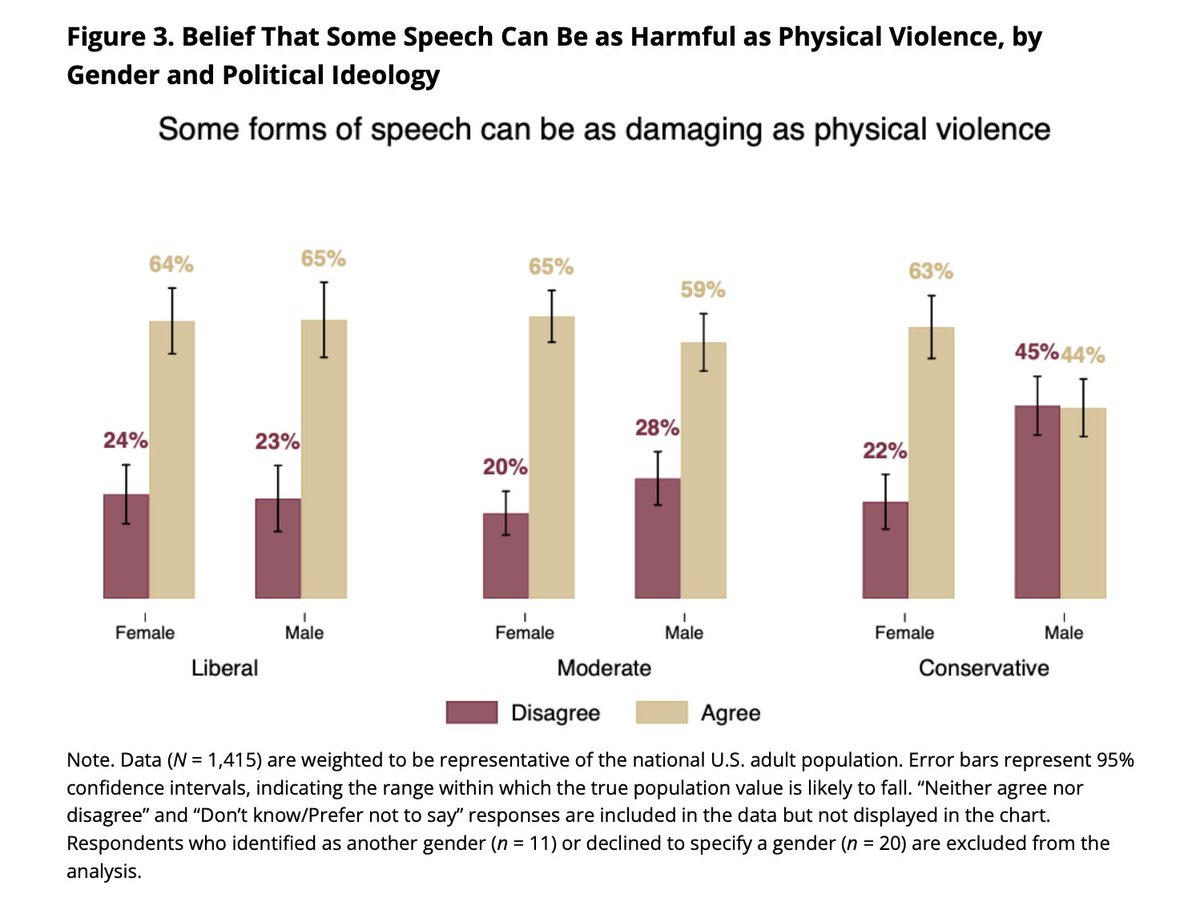
5/ We also observe ideological differences, though they're smaller than many might expect:
-Liberals: 63% agree
-Moderates: 62% agree
-Conservatives: 52% agree
But most of this gap is driven by conservative men:
-Conservative men have the lowest agreement (44%) and the highest disagreement (45%).
-Conservative women look more like liberals.
-Liberals: 63% agree
-Moderates: 62% agree
-Conservatives: 52% agree
But most of this gap is driven by conservative men:
-Conservative men have the lowest agreement (44%) and the highest disagreement (45%).
-Conservative women look more like liberals.
6/ We next asked respondents whether they agree that using physical violence “is sometimes justified to stop a person from engaging in harmful publish speech”. We included a “don’t know / prefer not to say” option to avoid inflating agreement.
Overall, just 11% of Americans agree that using physical violence can be justified, with 76% disagreeing.
Overall, just 11% of Americans agree that using physical violence can be justified, with 76% disagreeing.

7/ But here, age matters a lot:
-19% of adults under 30 agree, 62% disagree
-5% of adults 65+ agree, 89% disagree.
-19% of adults under 30 agree, 62% disagree
-5% of adults 65+ agree, 89% disagree.

8/ Broken down by ideology, the sharpest differences appear among liberals:
-31% of liberals under 30 agree violence can be justified, 55% disagree
-1% of liberals 65+ agree, 92% disagree.
Among conservatives, younger adults aren’t more likely to agree––but they are less likely to disagree.
-31% of liberals under 30 agree violence can be justified, 55% disagree
-1% of liberals 65+ agree, 92% disagree.
Among conservatives, younger adults aren’t more likely to agree––but they are less likely to disagree.

9/ Now the key interaction I noted earlier:
Believing “speech = violence” matters significantly for younger adults’ attitudes toward using violence… but almost not at all for older adults.
For adults 50+:
-9% agree violence is justified, whether or not they equate speech & violence.
But for adults < 50:
-18% who equate speech/violence agree
-7% who don’t equate the two agree
Believing “speech = violence” matters significantly for younger adults’ attitudes toward using violence… but almost not at all for older adults.
For adults 50+:
-9% agree violence is justified, whether or not they equate speech & violence.
But for adults < 50:
-18% who equate speech/violence agree
-7% who don’t equate the two agree

10/ While not shown above, among liberals under 50, this belief doubles support for violence (15% → 30%). Same directional pattern for conservatives (though they start from lower baseline rates).
11/ Finally, we also asked whether "freedom of expression should sometimes be restricted" when it conflicts with promoting social harmony and inclusion.
Results:
-43% disagree
-37% agree
-20% unsure
Results:
-43% disagree
-37% agree
-20% unsure

12/ By age, seniors stand out again, with 53% disagreeing with restricting expression.
Younger adults, meanwhile, have the lowest disagreement and the highest neutrality—suggesting more uncertainty about the expression-harmony tradeoff.
Younger adults, meanwhile, have the lowest disagreement and the highest neutrality—suggesting more uncertainty about the expression-harmony tradeoff.

13/ One of the strongest predictors of supporting restrictions on expression is beliefs about speech and harm:
Among those who reject the idea that certain speech can be akin to physical violence:
-26% support limits
-56% oppose them
Among those who endorse the comparison:
-42% support limits
-38% oppose them
Believing violence can be justified to stop speech has an even stronger effect (right panel)—though this group is a much smaller share of the sample.
Among those who reject the idea that certain speech can be akin to physical violence:
-26% support limits
-56% oppose them
Among those who endorse the comparison:
-42% support limits
-38% oppose them
Believing violence can be justified to stop speech has an even stronger effect (right panel)—though this group is a much smaller share of the sample.

14/ As debates over extremism, campus speech, and public safety intensify, understanding how Americans think about harm and expression has never been more important.
We hope this report helps ground that debate in data, not assumptions.
Stay tuned for our next report, which examines how Americans interpret Israel's actions in Gaza.
We hope this report helps ground that debate in data, not assumptions.
Stay tuned for our next report, which examines how Americans interpret Israel's actions in Gaza.
• • •
Missing some Tweet in this thread? You can try to
force a refresh