
I want to address the most common right-wing critique of capitalism. A lot of people say capitalism destroys morality, hollows out our human connections, and pits prosperity against culture. They argue that you can either have a rich society or a virtuous one, but not both.
🧵
🧵
https://twitter.com/Nalin_Haley/status/1988297448255877223
This is the deterioration hypothesis: Markets may make us richer, but they also make up morally colder. They ruin relationships and social cohesion overall.
Lauren Southern said: “Capitalism is indifferent to morality… if you are a nation that has lost God, capitalism becomes the devil’s playground.”
Sarah Stock said globalization strips us from meaningful work: “You used to buy your chair from the guy down the street… there’s a lot more meaning in that connection.”
Sarah Stock said globalization strips us from meaningful work: “You used to buy your chair from the guy down the street… there’s a lot more meaning in that connection.”
Josh Hawley claims family and tradition “get in the way of uninhibited free choice.”
Tucker Carlson warns: “Any economic system that weakens and destroys families is not worth having.”
Tucker Carlson warns: “Any economic system that weakens and destroys families is not worth having.”
This critique is ancient. Rousseau, Marx, Sandel, and Anderson all argued that markets crowd out virtue, corrode community, or train us to treat people as commodities.
This is a falsifiable claim. Let’s look at the actual data.
This is a falsifiable claim. Let’s look at the actual data.
First empirical fact: Market societies show higher trust, greater aversion to unethical behavior, and no evidence of moral decline, even when they become more market-oriented over time.
Callais, Harris, and Borchard directly tested the “moral deterioration hypothesis.” Their conclusion is straightforward:
“Market-oriented societies have a greater aversion to unethical behavior, higher levels of trust, and are not associated with lower levels of morality.”
“Market-oriented societies have a greater aversion to unethical behavior, higher levels of trust, and are not associated with lower levels of morality.”

Second fact: Interacting in markets humanizes people rather than dehumanizing them.
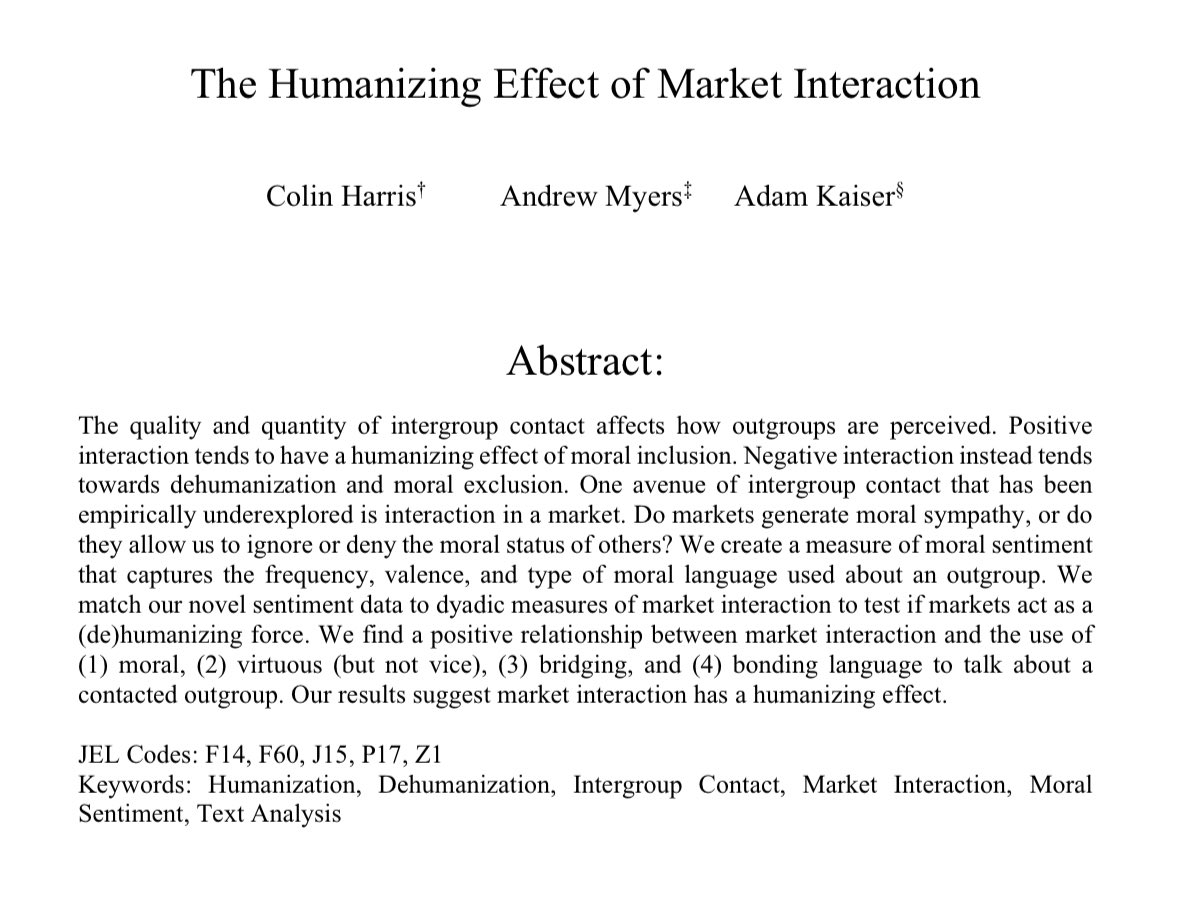
A 2022 study in the Journal of Economic Behavior & Organization finds that market interaction increases moral sentiment toward outgroups, increases bridging moral language, and increases the use of virtuous language. The authors conclude:
“Market interaction has a humanizing effect.”
“Market interaction has a humanizing effect.”
Third fact: If your fear is about the decline of community and civil society, the evidence gets even more decisive.
Two studies using a massive dataset stretching back to 1789 show that state ownership, not capitalism, destroys civil society.
The authors find:
“Increased state ownership is associated with the repression, decline, and reduced participation in civil society and religious organizations.”
The authors find:
“Increased state ownership is associated with the repression, decline, and reduced participation in civil society and religious organizations.”


Capitalism correlates positively and significantly with social capital. Social trust, dense networks, and democratic participation all rise with more economic freedom and fall with more government control.
Fourth fact: Market societies are less materialistic, not more.
A 2020 Constitutional Political Economy study shows countries with higher economic freedom are less driven by materialistic values.
The authors summarize:
“Countries with more economic freedom are less materialistic.”
The authors summarize:
“Countries with more economic freedom are less materialistic.”

Fifth fact: Markets actually cultivate virtue.
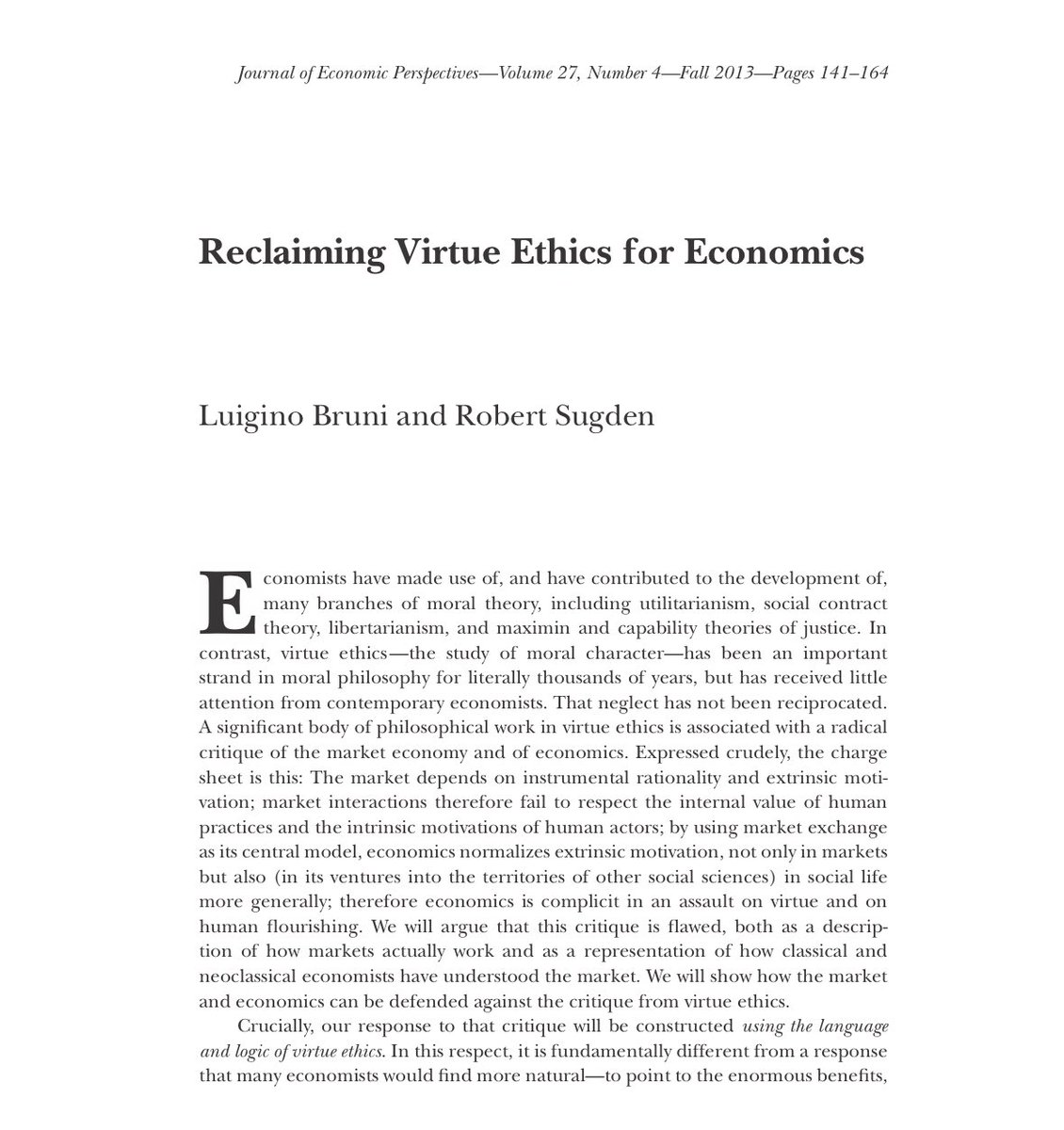
People misunderstand how markets operate: markets do not rely on “greed,” they require reciprocal service, reliability, trustworthiness, and long-term reputation. They show that markets can be defended on virtue-ethical grounds. Markets reward prudence, honesty, and cooperation.
And of course, the book Do Markets Corrupt Our Morals? compiles the largest evidence base in the field and comes to the blunt conclusion: Markets are moral spaces and moral training grounds.

The authors found that market societies have:
• higher charity rates
• lower corruption
• less prejudice
• greater trust
• less acceptance of violence
• higher social capital
• more humane moral norms
• higher charity rates
• lower corruption
• less prejudice
• greater trust
• less acceptance of violence
• higher social capital
• more humane moral norms
The conservative critics of capitalism are diagnosing a real problem: loneliness, atomization, cultural decline… but they’re assigning blame to the wrong mechanism.
Atomization is overwhelmingly driven by:
• state expansion into family and community domains
• crowding out of private associations
• zoning and housing policy
• mass schooling
• centralized welfare systems
• media monoculture
• political polarization
• technology shocks
• state expansion into family and community domains
• crowding out of private associations
• zoning and housing policy
• mass schooling
• centralized welfare systems
• media monoculture
• political polarization
• technology shocks
In reality, capitalism is the only system that allows families, churches, clubs, associations, and communities to flourish outside the state. Markets decentralize power and give people the resources and autonomy to build real community.
If you want stronger families, stronger churches, and stronger communities, the empirical literature points in only one direction: More economic freedom.
• • •
Missing some Tweet in this thread? You can try to
force a refresh





