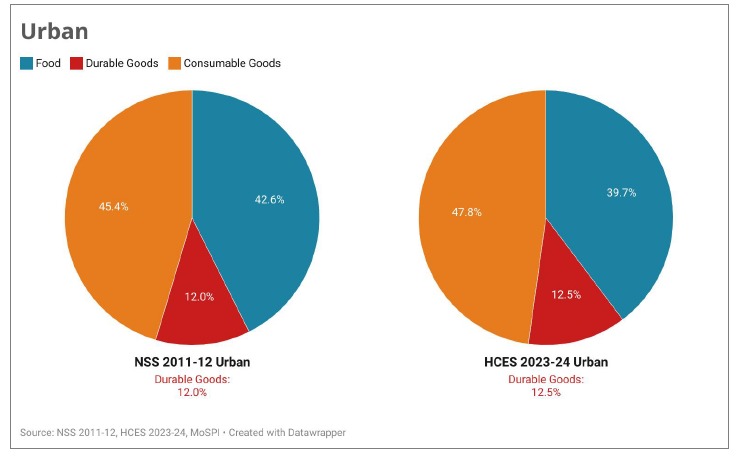
Long-term consumption pattern of Indian households have changed significantly from 2011-12 to 2023-24. Particularly, expenditure on Durable Goods is increasing and ownership of key durable assets has become more widespread. Latest paper by @ShamikaRavi & Sindhuja Penumarty 1/9
Across the 3 components- Food Items, Consumable Goods and Services, and Durable Goods, the share of food has fallen to less than 50% in both urban & rural. Today, households allocate a greater share of their expenditure to non-food spending on consumables, and durable goods. 3/9
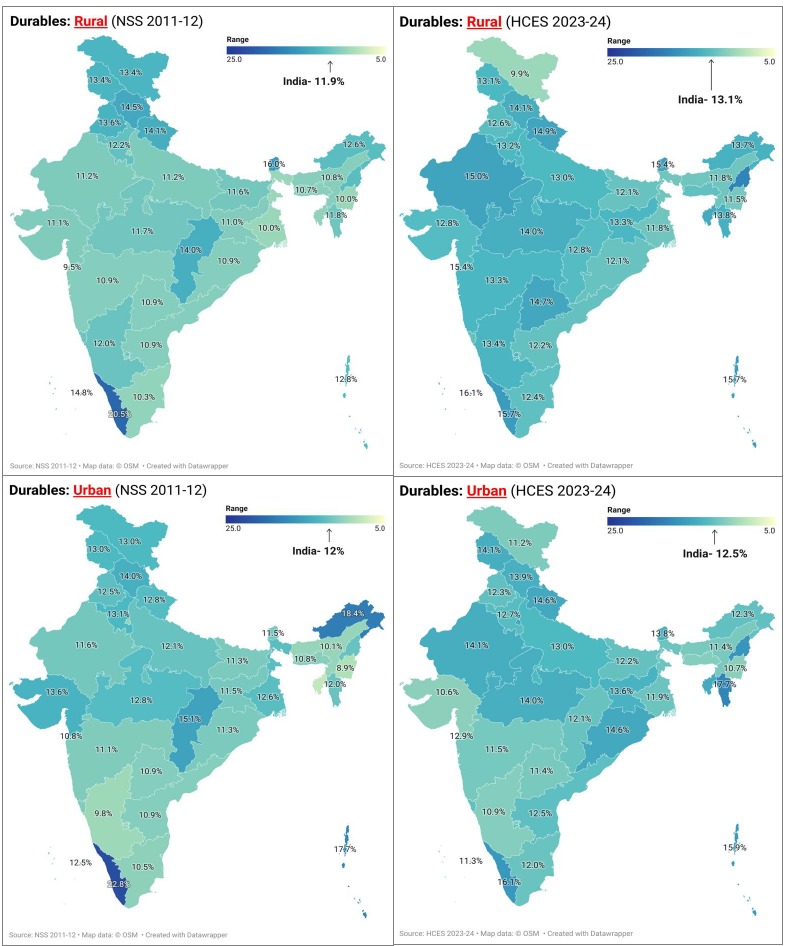
Share of MPCE (%) spent on Durable Goods has risen in both sectors, with the rural share slightly surpassing that of urban households in many states. In rupee values, spending has increased across all states and sectors, with higher absolute expenditure in urban households. 4/9
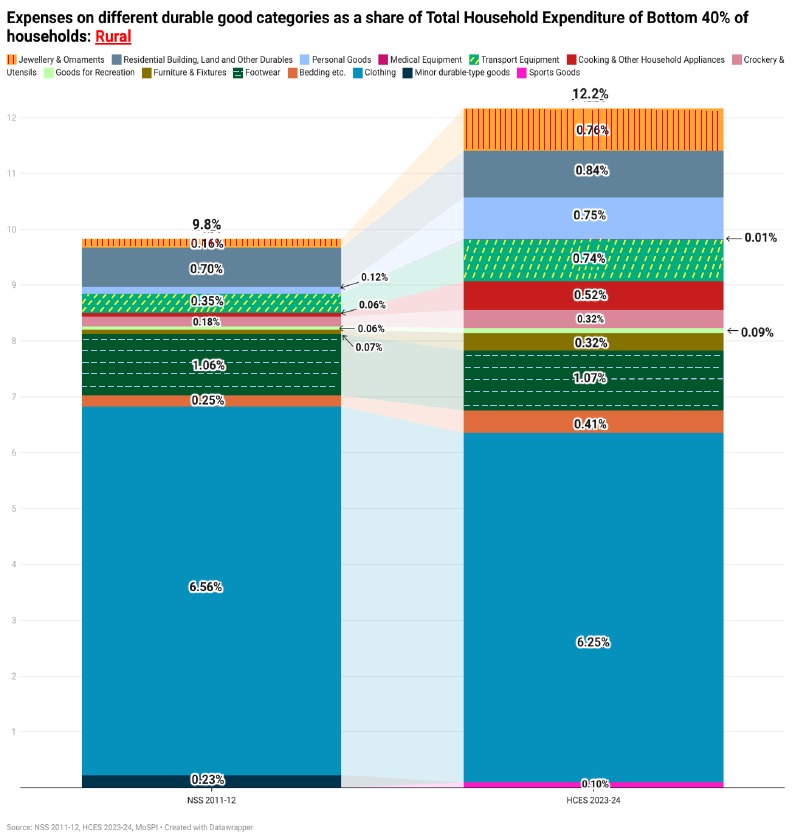
What are households spending on?
Within the Durable Goods category spending is shifting away from basic items like Clothing & Footwear towards asset-building expenditure on Personal Goods,and Cooking & Household Appliances. This is unfolding even in the bottom 40% households 5/9
Which Durable Goods do households own?
There is significant improvement in household asset ownership across states and sectors relative to the 2011-12 levels, most notably for four key durables- Motor Vehicles, Mobile Handsets, Televisions and Refrigerators. 6/9
A story of convergence: Across the four key assets, ownership gaps have narrowed significantly between the highest (Top 20% Households) and lowest (Bottom 40% Households) consumption classes. Convergence is stronger in urban areas with gaps narrowing more rapidly. 7/9
These findings show significant improvements in asset ownership throughout the country, including among the poorest or the bottom 40% of households across urban and rural areas. 8/9
Crucial policy implications- financial access & affordable credit expansion; public service delivery like roads, public transport, reliable electricity & piped water; adjustments to the estimation of inflation; and decisions on R&D, innovation and production goods & services. 9/9
Widening breadth of asset ownership across consumption classes: A greater proportion of households now own multi-asset categories in both sectors. Share of households not owning assets in any asset category is 5% or lower, signalling a reduction in asset poverty.
• • •
Missing some Tweet in this thread? You can try to
force a refresh

India's pharmaceutical success mirrors Janus, the Roman god with two faces. The sector boasts the highest number of US FDA-approved plants outside the US, showing a forward-looking commitment to quality and global standards. Dr @bibekdebroy writes. (1/5)
Contrasting this success is a concerning past: over 2,500 of 88,844 drug samples tested were sub-standard and 379 spurious. Stringent checks by CDSCO highlight the ongoing battle against subpar pharmaceuticals. 2/5 newindianexpress.com/opinions/2023/…
The Mashelkar Committee's 2003 concerns on India's drug regulation remain unresolved. Recent incidents of hazardous cough syrups and DEG poisoning cases highlight a failure to ensure safe pharmaceuticals.3/5
C-sections, essential for mother-baby safety in some cases, are on the rise. The choice between medically advised, elective, & financially motivated C-sections can be complex. India's rate jumped from 17.2% to 21.5%, raising concerns. @adityasinha004 & @saini_ak08 write. 1/4
The disparity in C-section rates across Indian states is alarming. Telangana records a high of 60.7%, while Nagaland has only 5.2%. Such variations suggest non-medical factors at play, potentially compromising women's autonomy. 2/4 livemint.com/opinion/online…
Beyond the immediate need, C-sections carry risks. Studies show potential complications and health impacts for mothers and children. This costly procedure also adds an estimated ₹5,000 crore annually to India's healthcare expenses. 3/4
Contrary to global trends showing a decline in democracy, India sees a strengthening in democratic traditions & institutions, with a notable surge in women’s political participation. Women have become predominant agents of change in Indian democracy. Dr @ShamikaRavi writes. 1/5
Remarkable progress has been noted in women's roles as voters & candidates in India. The increase in women contesting elections across assembly constituencies is 7-fold over the last 4 decades. A robust indicator of reducing gender disparities. 2/5 timesofindia.indiatimes.com/blogs/shamika-…
The Nari Shakti Vandana Adhiniyam is a pivotal stride in promoting women into leadership positions nationally. It's crucial to build societal support and create a conducive environment for systemic shifts, promoting women leaders at every level. 3/5
India's Consumer Price Index tracking is akin to an antique store filled with obsolete items like CDs, DVDs, torches & trunks. These items represent dated consumption patterns & a nostalgic clinging to the past. Dr @bibekdebroy & @adityasinha004 write. (1/5)
The CPI basket should reflect the fluidity of societal needs, preferences, & economic conditions. Yet, current weights point to an over-reliance on food inflation & don't reflect Engel's Law or the modern Indian's consumption habits. 2/5 thehindu.com/opinion/op-ed/…
As incomes rise, consumer spending diversifies to non-food items like housing, education, & digital services, reflecting improving living standards. The high weight assigned to cereals overlooks this shift and the impact of initiatives like Pradhan Mantri Garib Kalyan Yojana. 3/5
Land records and property rights underpin economic stability and social equity. Clear property rights are key to capital generation, investment, & prosperity, & address inequality by protecting individuals' assets. Dr @bibekdebroy, Dr @BjornLomborg & @adityasinha004 write. 1/10
Formalization of property rights in developing countries, where informal/customary ownership is prevalent, can unlock vast economic potential. However, globally, 70% of people cannot access formal land registration systems; 1 in 5 face a risk of eviction within five years. 2/10
GoI is actively encouraging the modernization of land records through the Digital India Land Records Modernization Programme. The Bhu-Aadhaar project aims for comprehensive completion by March 2024, incorporating geo-coordinates of all land parcels for precise tracking. 3/10
The debate on 'freebies' highlights the risk of wasteful expenditure, threatening fiscal balance & economic growth. Can the antidote to freebies be an Expenditure Council? Dr @bibekdebroy & @adityasinha004 explore. 1/4
An Expenditure Council (EC), akin to the GST Council, could guide India towards sustainable development and fiscal health. By guiding resource allocation, it can focus on long-term prosperity rather than short-term gains. 2/4
While bodies like Niti Aayog and the Finance Commission play crucial roles, they lack the platform for central-state collaborative strategizing on resource use. An Expenditure Council could fill this gap, fostering consensus among states. 3/4