Daniel Wallach Profile picture
Nov 27 26 tweets 10 min read Read on X
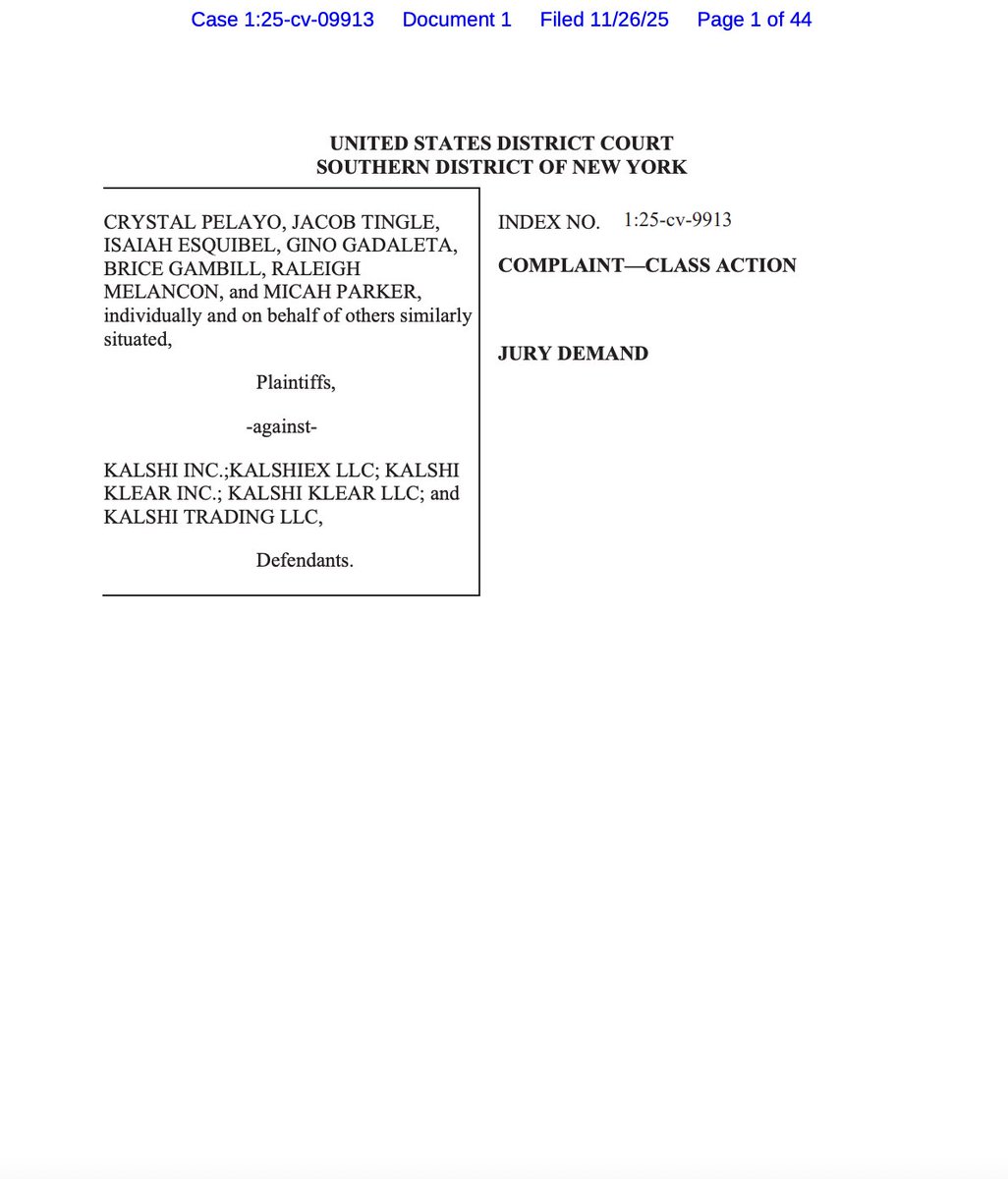
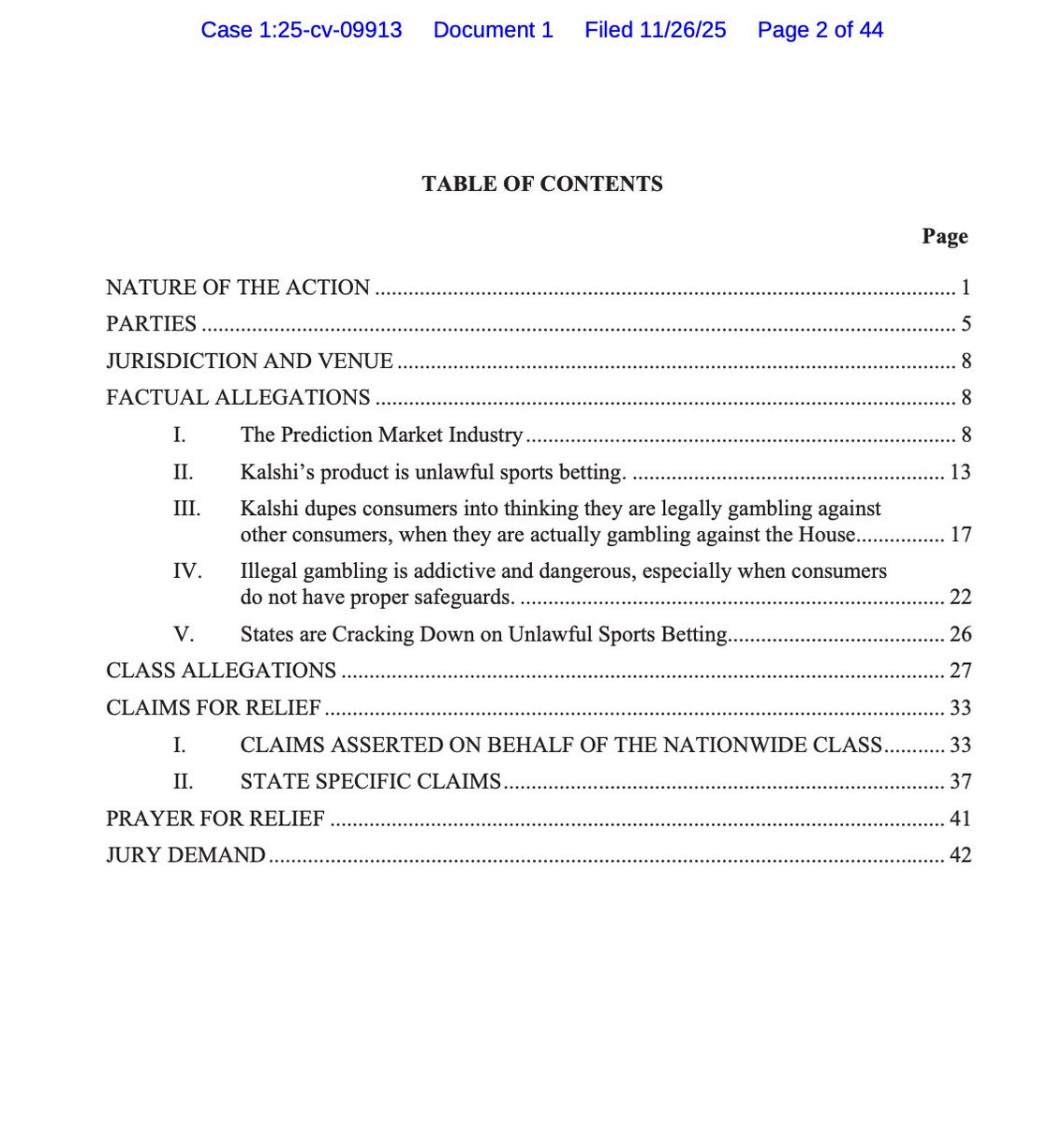
NEW: Kalshi has been hit with a nationwide class action lawsuit in the SDNY for operating an illegal online sports betting platform and for "duping" customers into believing that they are legally gambling against other consumers when they are actually gambling against the house. Image
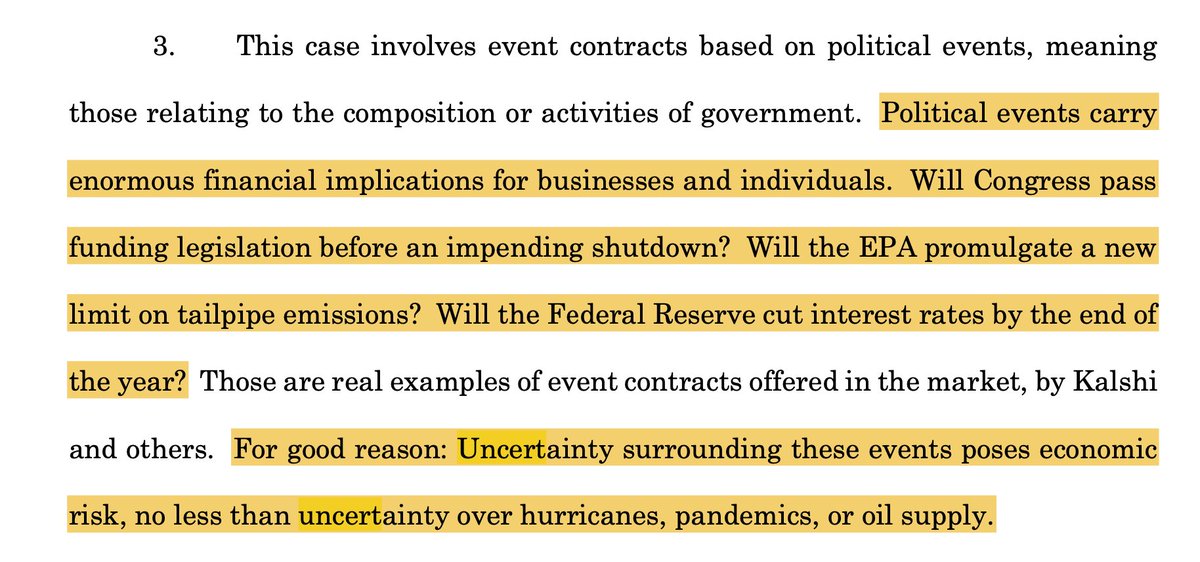
Image
"Consumers on Kalshi do not only bet against each other—they also bet against the House. Kalshi operates institutional market makers, which also gamble against the consumer." Image
"A Kalshi representative called Kalshi Trading 'one of many ‘peers’ in the peer-to-peer ecosystem. Kalshi Trading is not a peer; it is the House." Image

Image
"Kalshi also partners with hedge funds, such as Susquehanna International Group, to provide a sophisticated 'market making' service for Kalshi by being on the other side of consumers’ bets." Image

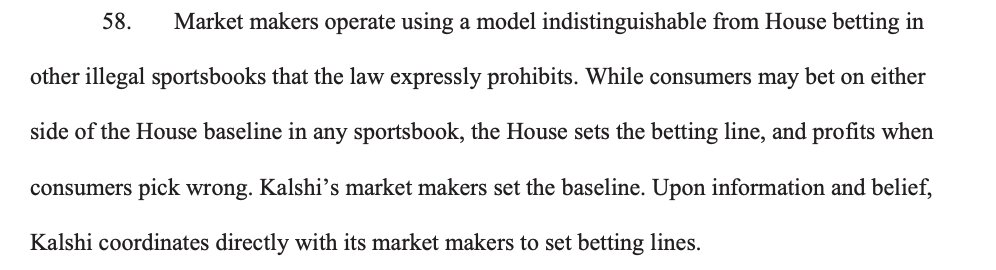
"Market makers operate using a model indistinguishable from House betting in other illegal sportsbooks that the law prohibits. While consumers may bet on either side of the House baseline in any sportsbook, the House sets the betting line, and profits when consumers pick wrong." Image
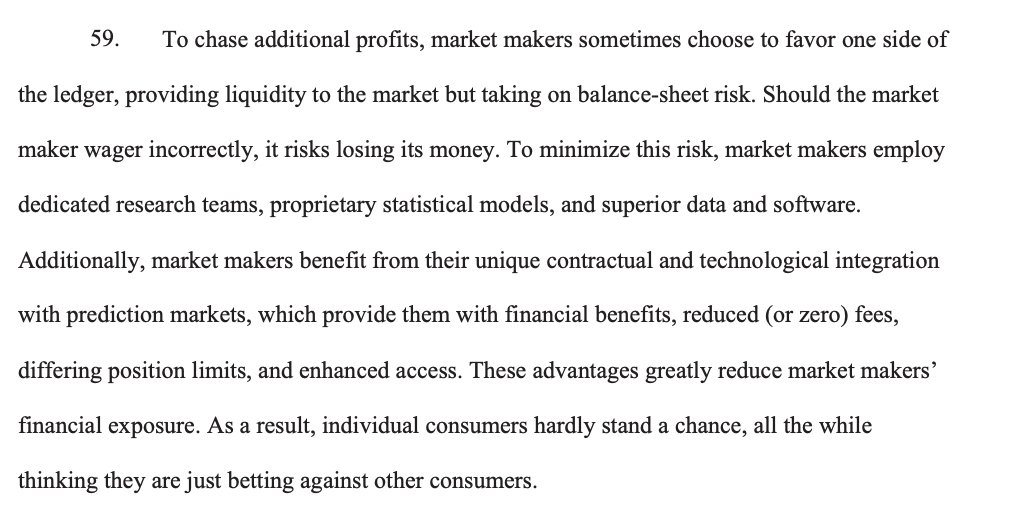
"Market makers benefit from their unique contractual and technological integration with prediction markets, which provide them with financial benefits, reduced (or zero) fees, differing position limits & enhanced access. These advantages greatly reduce their financial exposure." Image
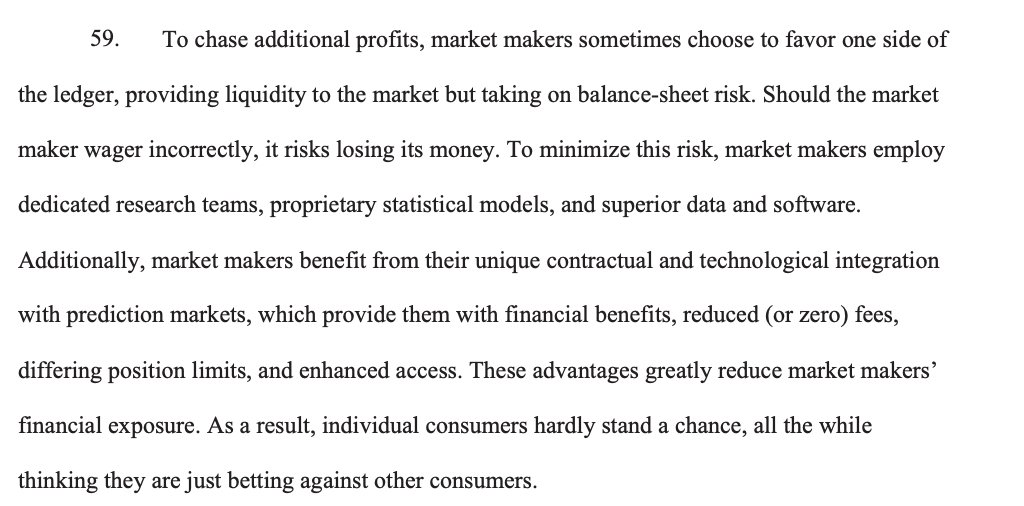
"As a result, individual consumers hardly stand a chance, all the while thinking they are just betting against other consumers." Image
"Because Kalshi serves as a counterparty, shouldering the credit risk of all bets, and serving as its own market maker (facing off against consumers in the process), Kalshi and its partners are gambling 'winners' at the expense of the consumer." Image

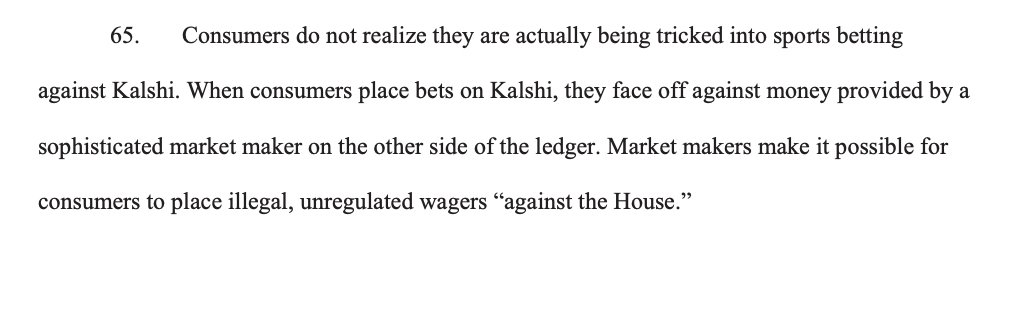
"When consumers place bets on Kalshi, they face off against money provided by a sophisticated market maker on the other side of the ledger. Market makers make it possible for consumers to place illegal, unregulated wagers 'against the House.'" Image
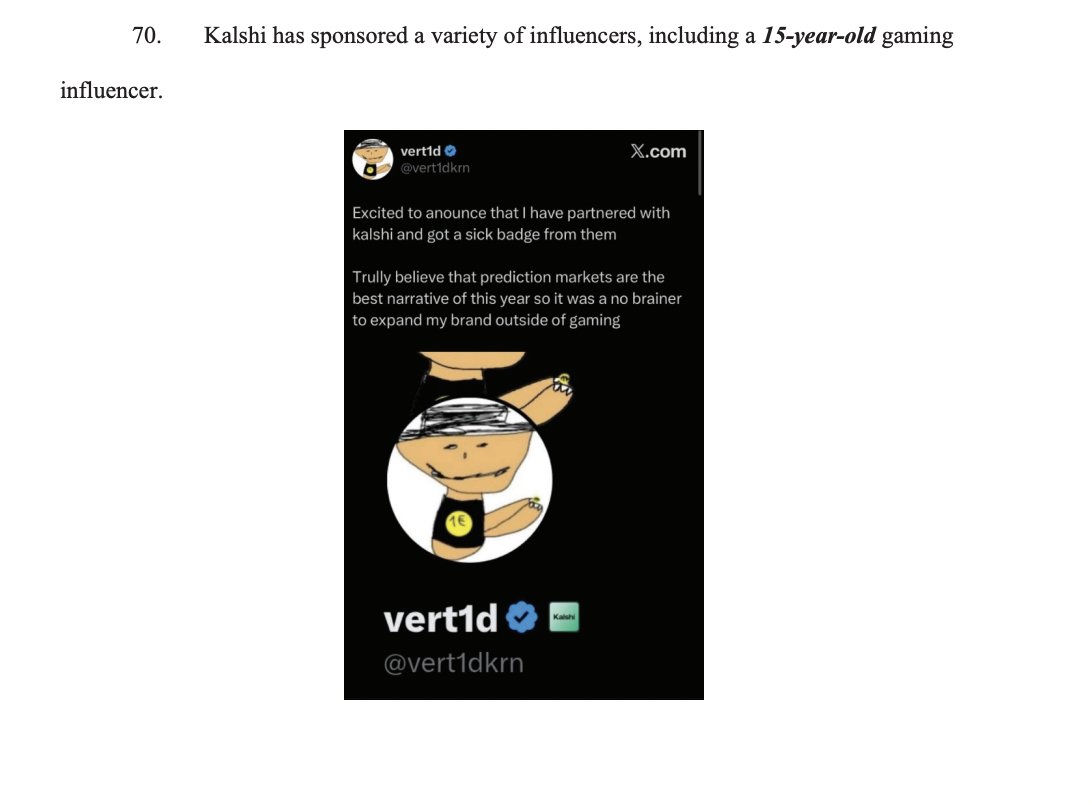
"Kalshi enables addictive gambling behavior by underage adults, problem gamblers, and others by enticing them to gamble with 'free' money while ensuring them that they are legally gambling against peers. For example, Kalshi runs advertisements through sponsored influencers." Image
"Kalshi has sponsored a variety of influencers, including a 15-year-old gaming influencer." Image
"On September 19, 2025, Kalshi also announced that it was targeting college campuses. Kalshi publicly announced that it was partnering with college clubs as part of 'KalshiU' to bring in 'the next 100M users.'" Image
"Kalshi makes unlawful gambling widely available to the public through its online and mobile platforms, presenting broader swaths of the population with the attendant risks of gambling without any of the safeguards." Image
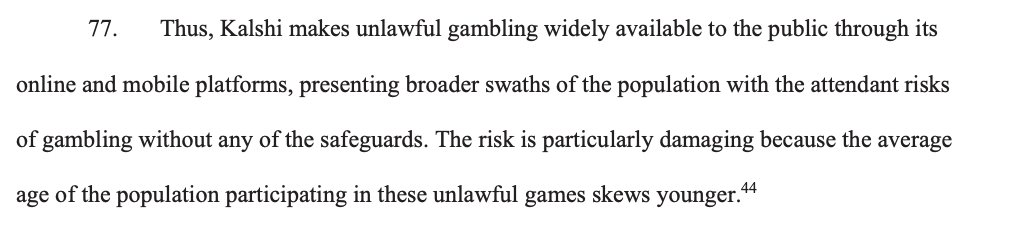
"The risk is particularly damaging because the average age of the population participating in these unlawful games skews younger." Image
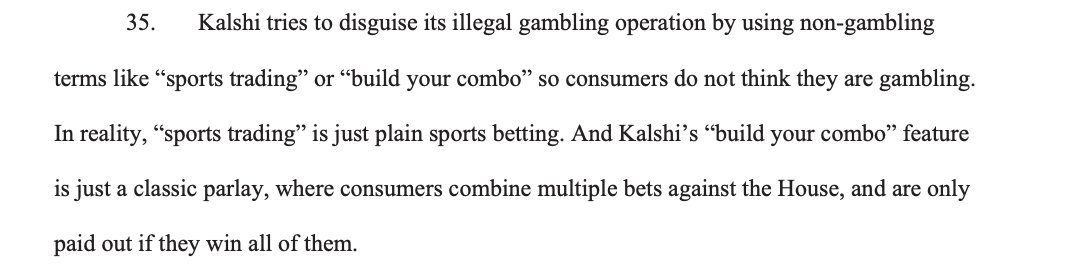
"Kalshi tries to disguise its illegal gambling operation by using non-gambling terms like 'sports trading' or 'build your combo' so consumers do not think they are gambling. In reality, “sports trading” is just plain sports betting." Image
"And Kalshi’s 'build your combo' feature is just a classic parlay, where consumers combine multiple bets against the House, and are only paid out if they win all of them." Image
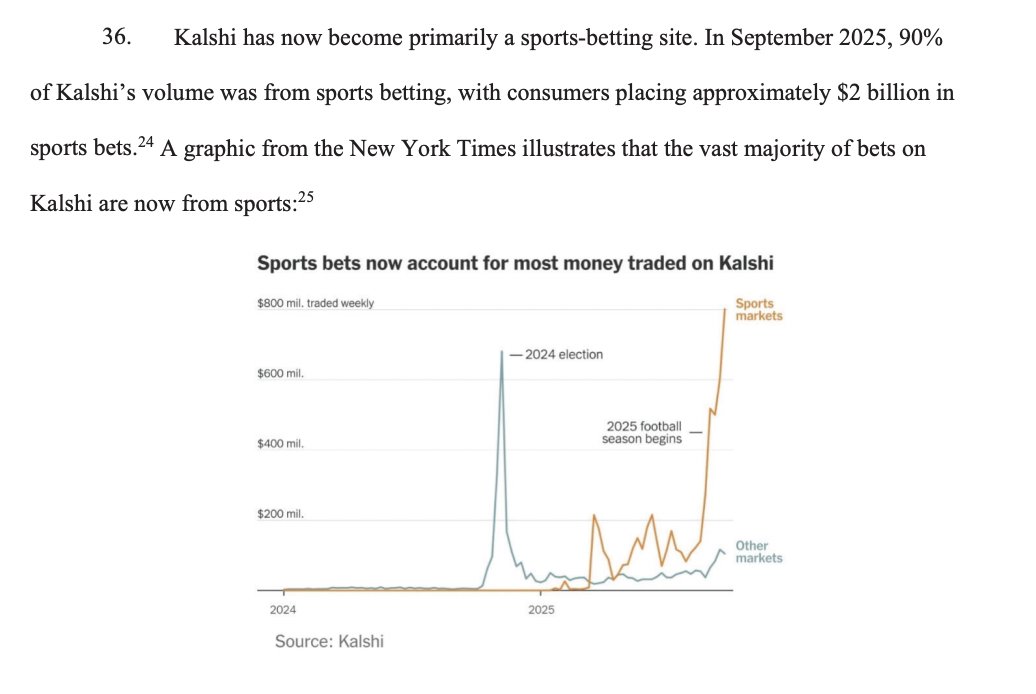
"Kalshi has now become primarily a sports-betting site. In September 2025, 90% of Kalshi’s volume was from sports betting, with consumers placing approximately $2 billion in sports bets." Image
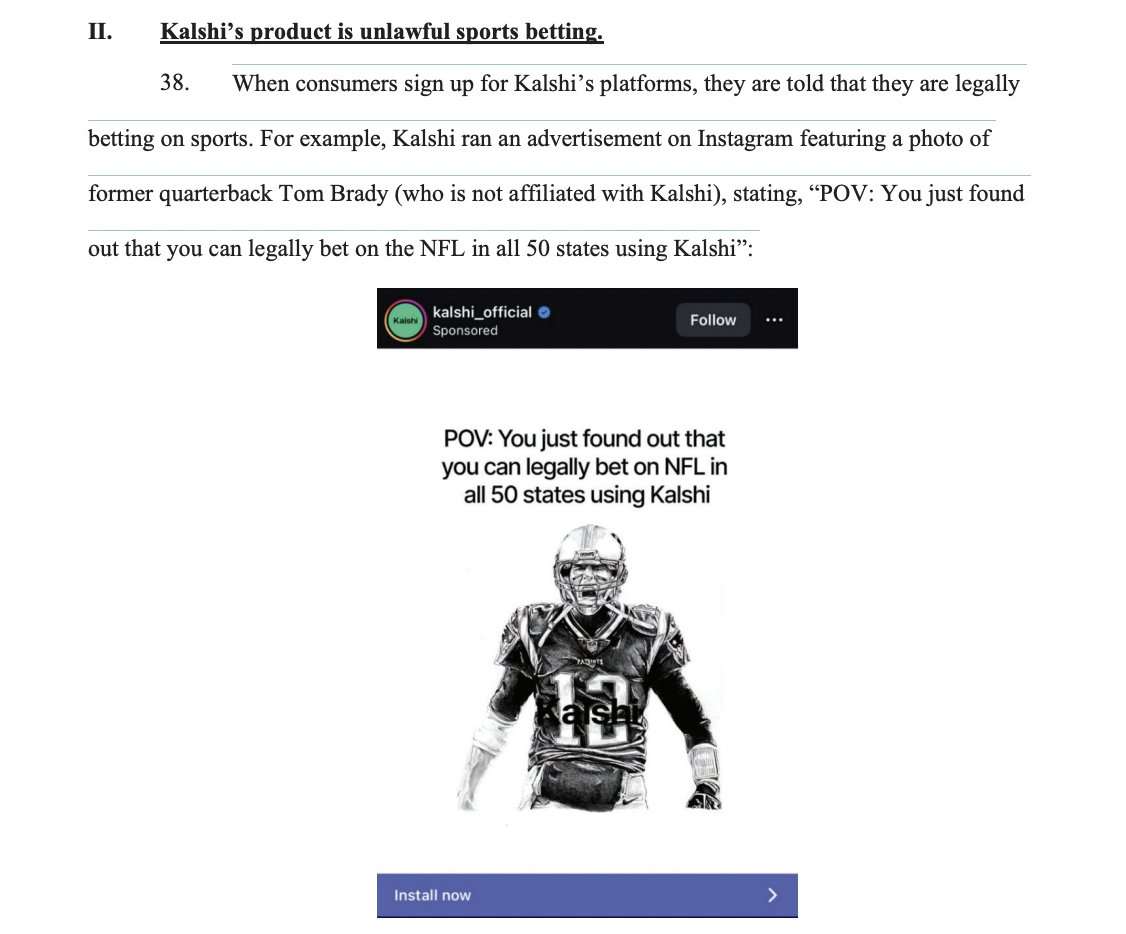
"Kalshi at times drops the mask and admits that it is a betting site, falsely marketing its platform as 'legal sports betting.' But Kalshi’s betting platform is in no way legal. Consumers are tricked into betting against the House." Image
"For example, Kalshi ran an advertisement on Instagram featuring a photo of former quarterback Tom Brady (who is not affiliated with Kalshi), stating, “POV: You just found out that you can legally bet on the NFL in all 50 states using Kalshi'." Image
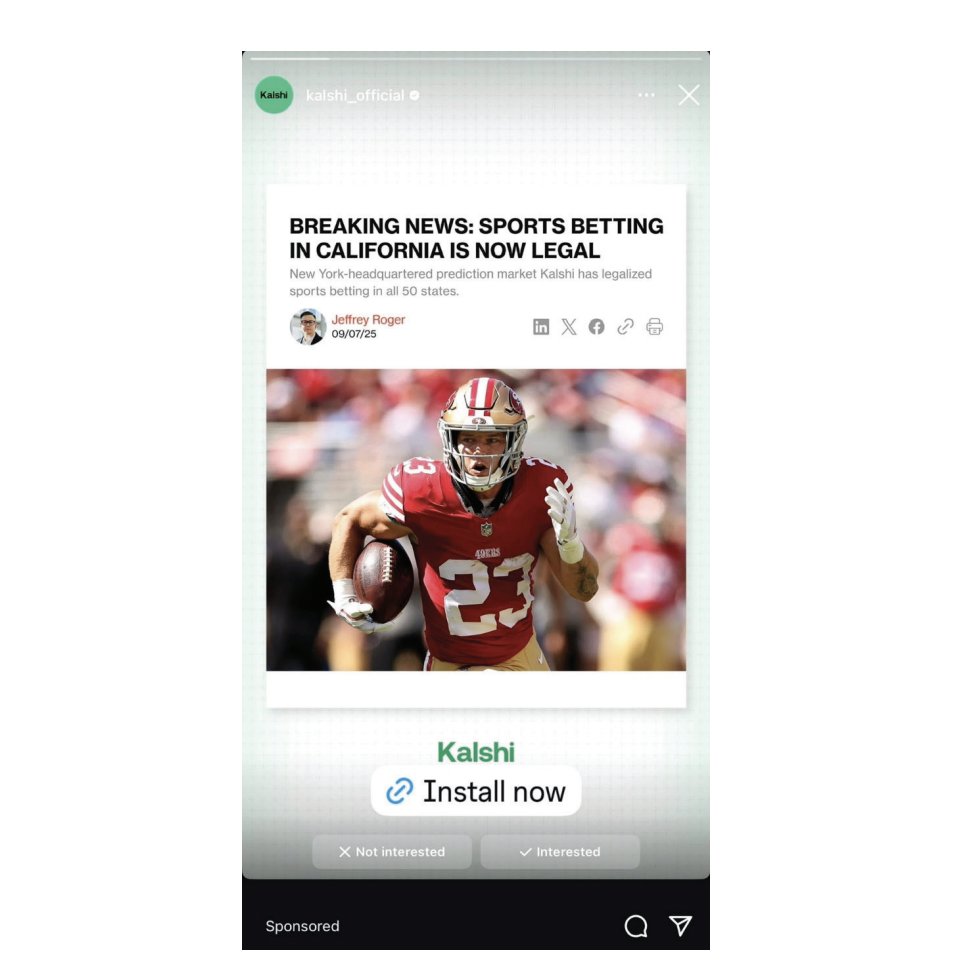
"It similarly ran ads pretending to be news articles. One such ad stated, 'Breaking News: Sports Betting in California is Now Legal: New York-headquartered prediction market Kalshi has legalized sports betting in all 50 states.'" Image
"But Kalshi does not offer legal sports betting—it offers illegal sports betting. New York State bans all forms of gambling under the state constitution, except for specifically named exceptions." Image

The complaint seeks to create a nationwide class consisting of "All persons in the United States who spent money by wagering on Kalshi’s mobile or web platforms." Image
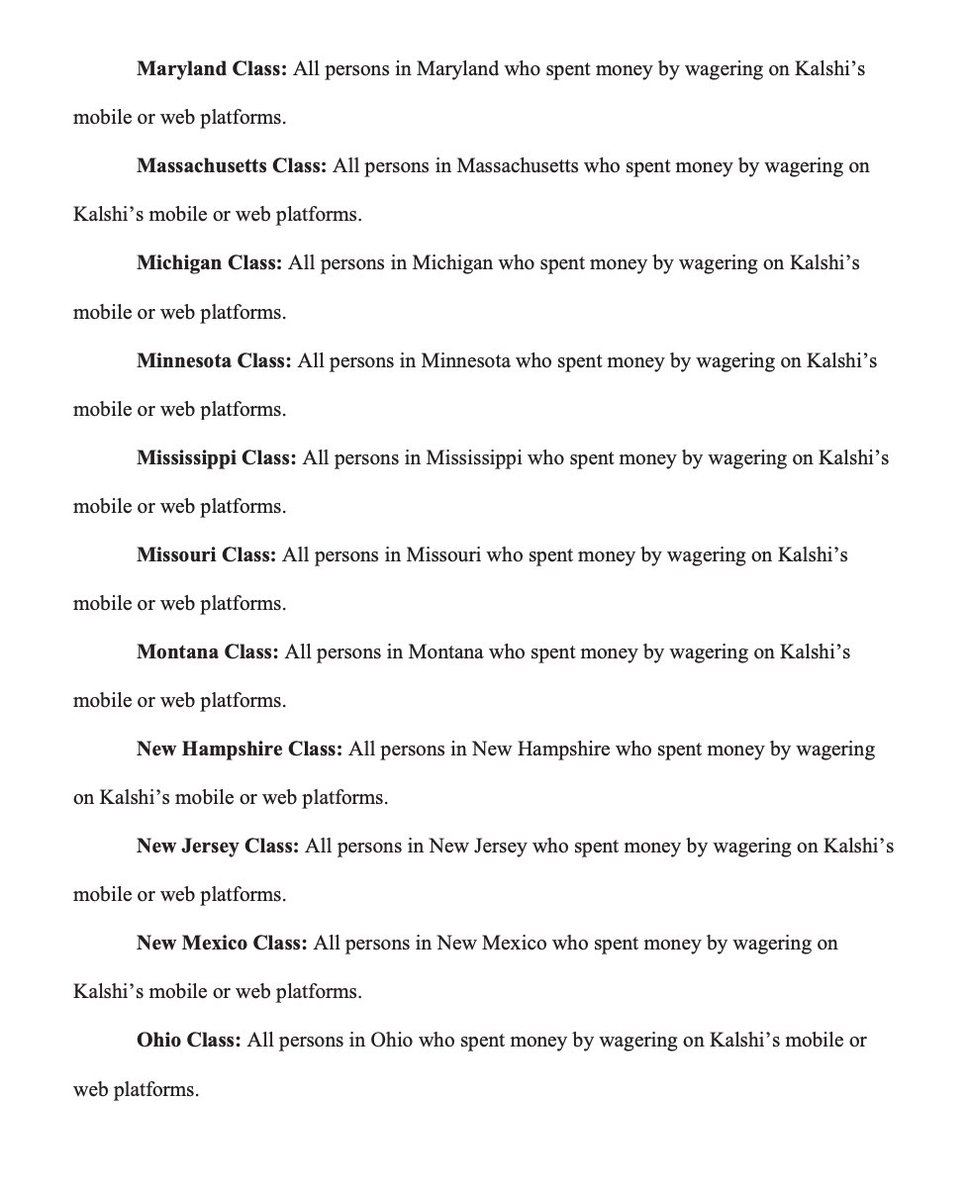
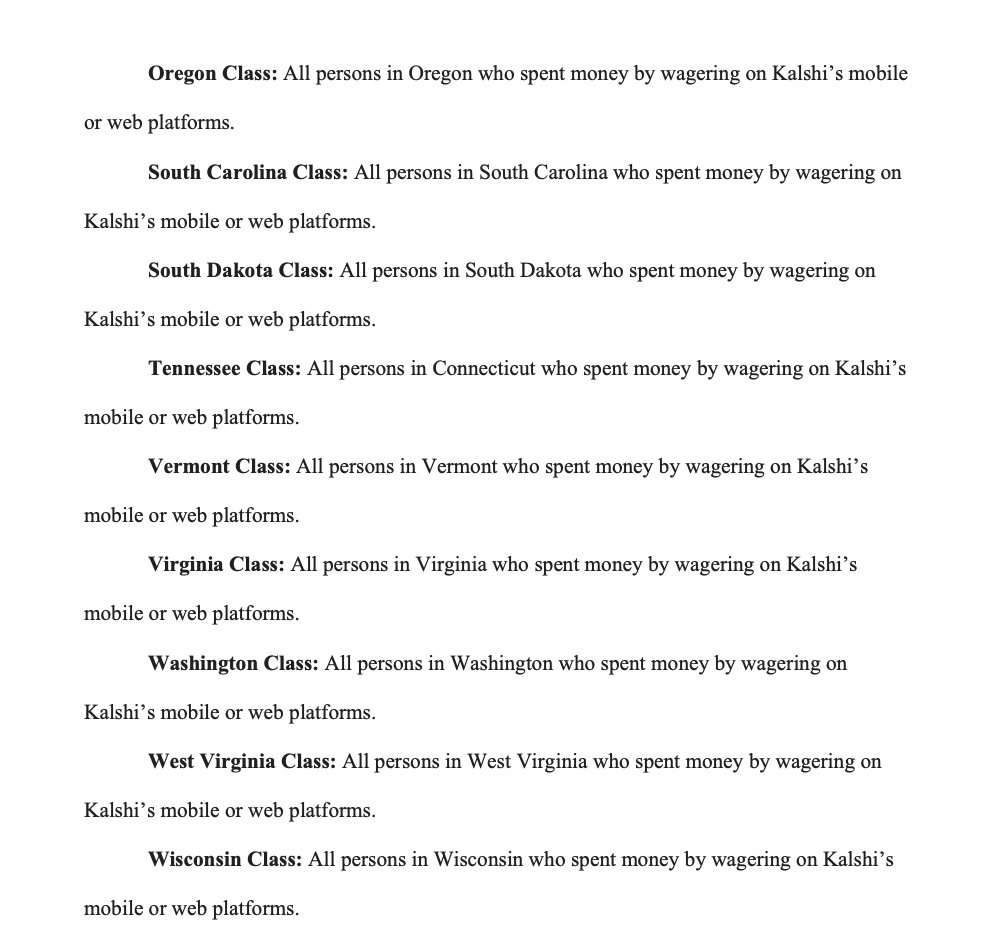
In addition to a nationwide class, Plaintiffs seek to create State sub-classes consisting of consumers from the following 30 states: Image
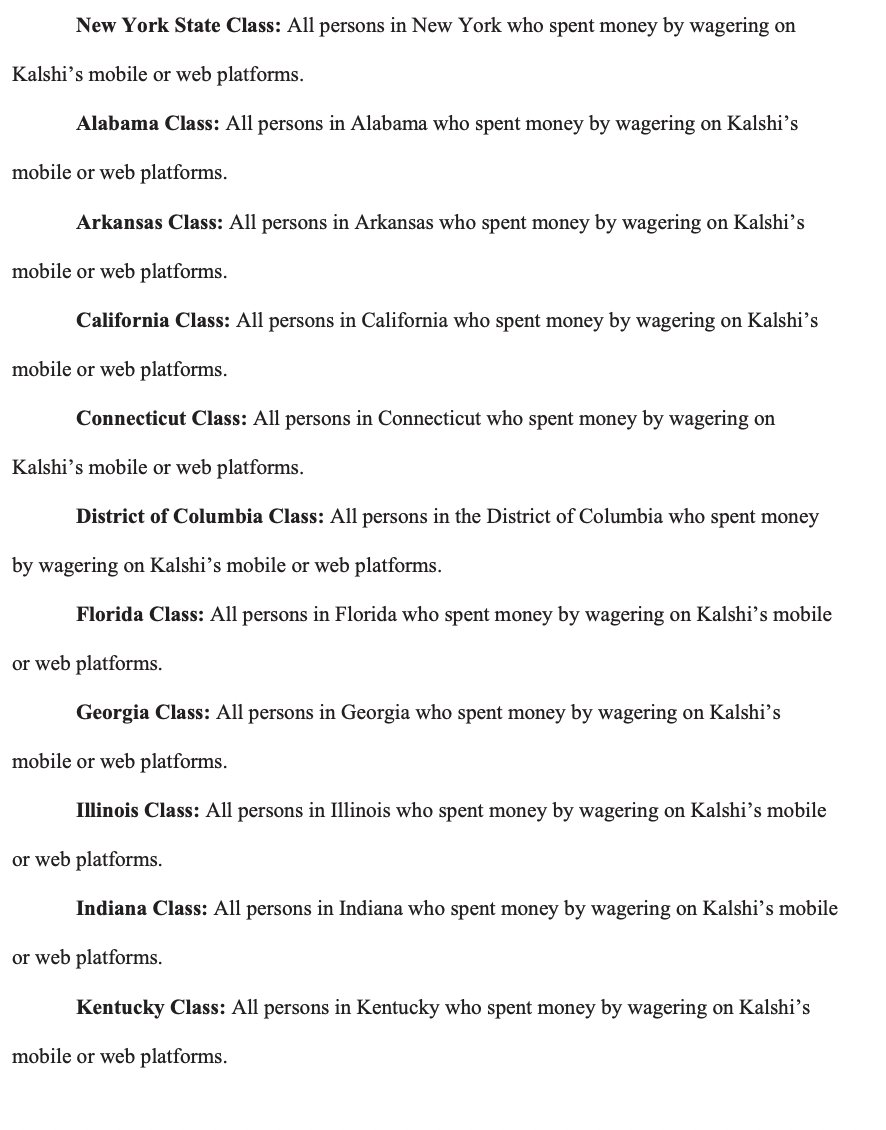
Image
Image
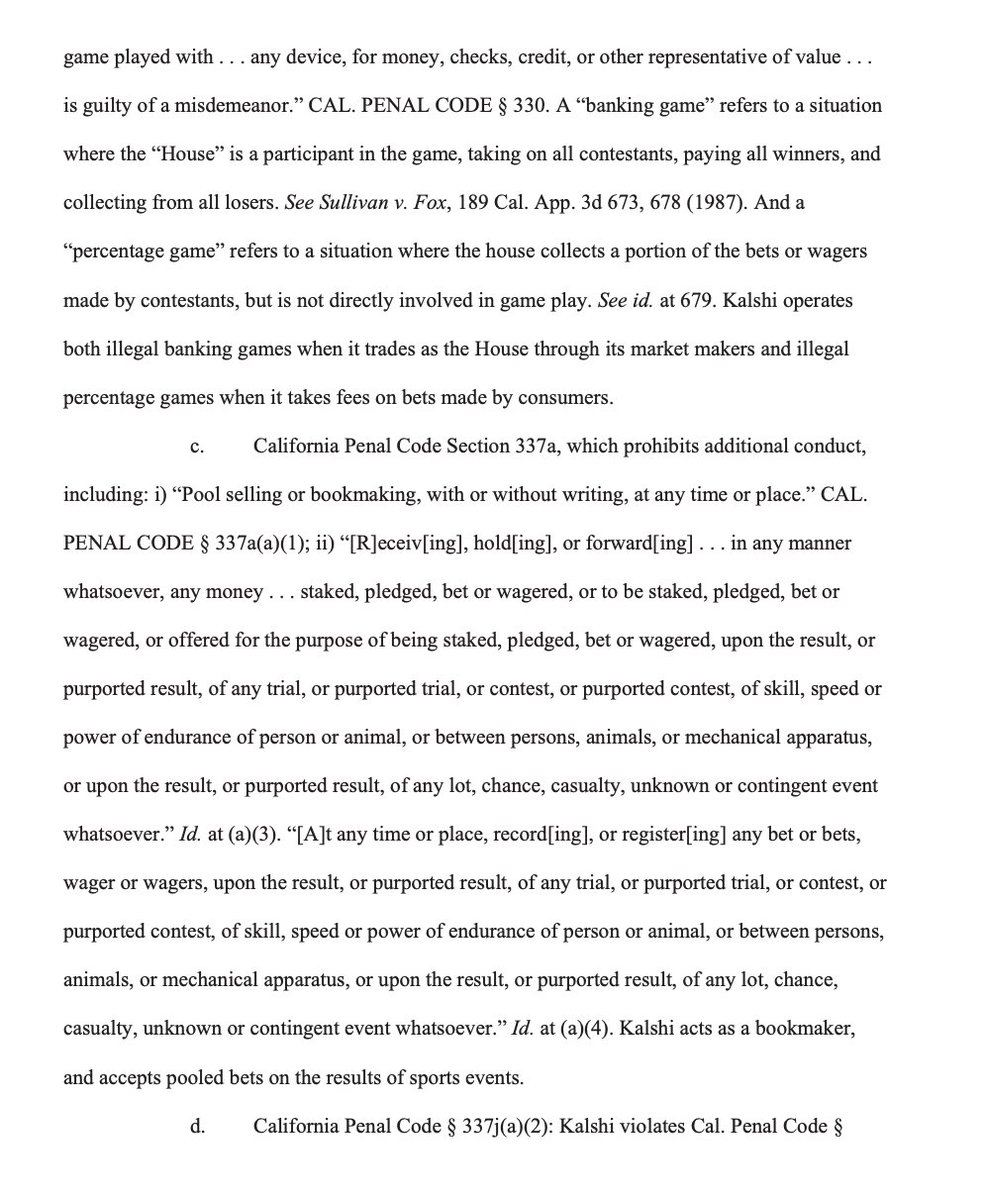
The complaint also highlights Kalshi's numerous alleged violations of California law, including Penal Code section 337a's ban against pool selling and bookmaking -- which featured prominently in @AGRobBonta's recent opinion on daily fantasy sports. Image
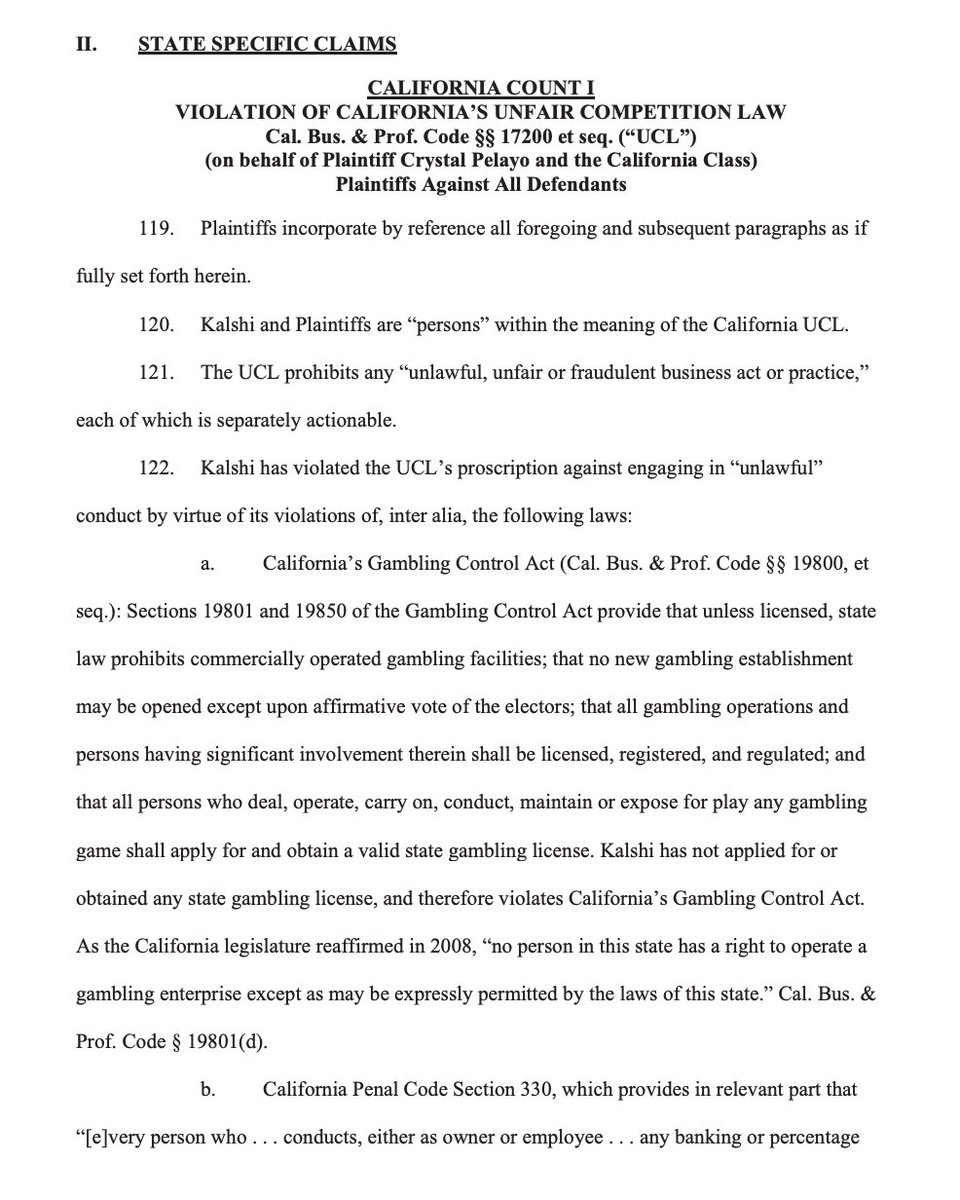
Image
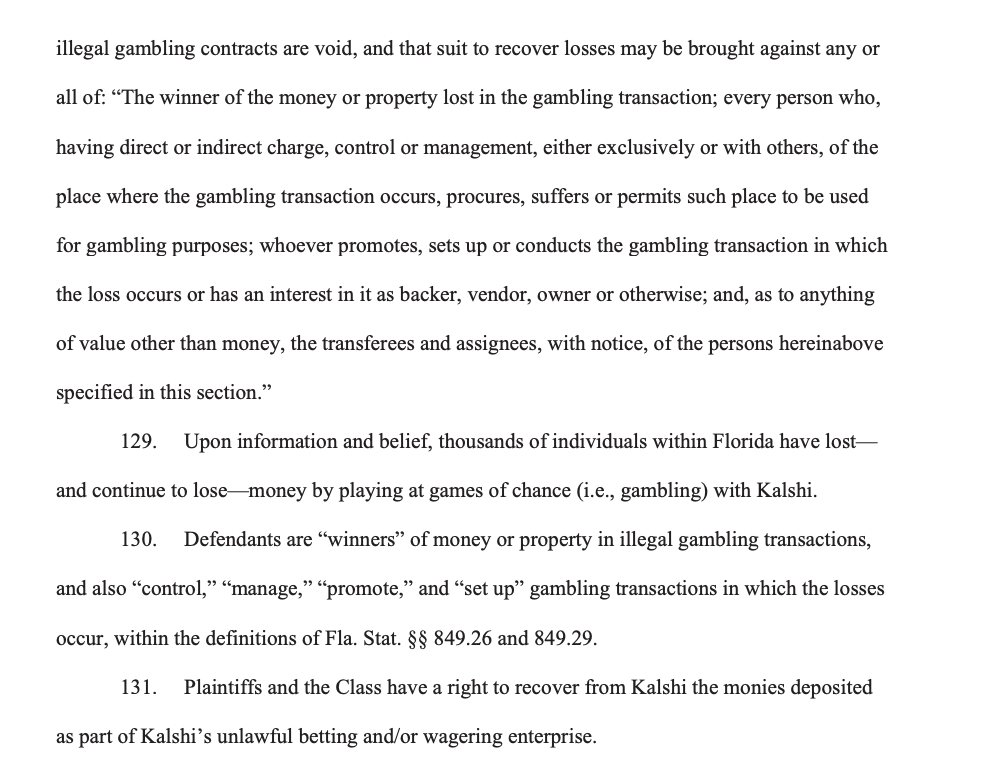
@AGRobBonta There is also a separate stand-alone count for Kalshi's numerous alleged violations of Florida law. "Upon information and belief, thousands of individuals within Florida have lost— and continue to lose—money by playing at games of chance (i.e., gambling) with Kalshi." Image
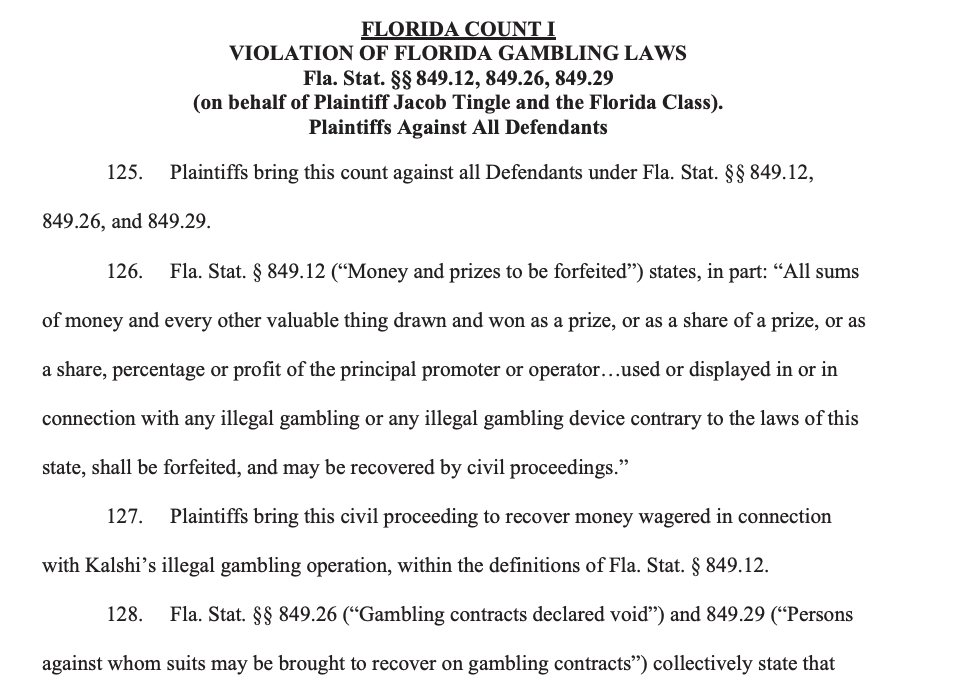
Image
@AGRobBonta The relief sought by plaintiffs includes treble damages, restitution, disgorgement, injunctive relief, and attorneys' fees and expenses. Image
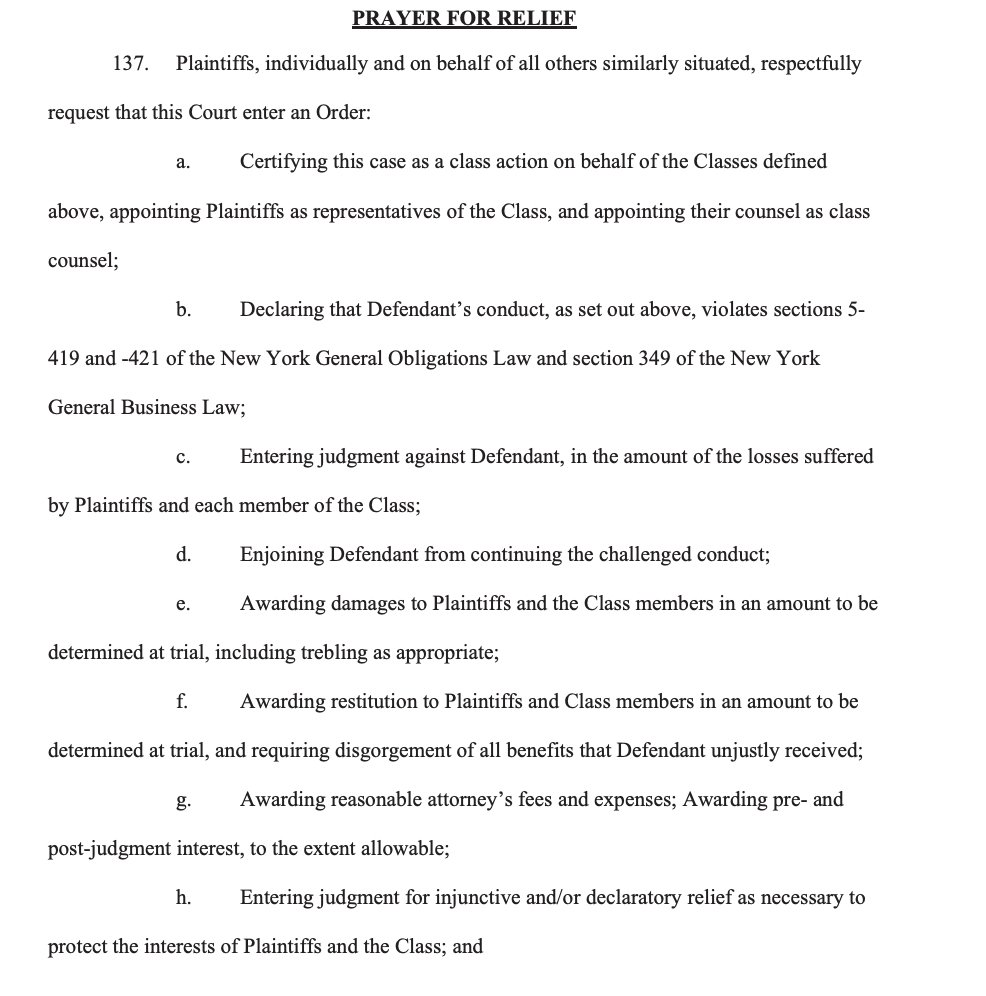
• • •

Missing some Tweet in this thread? You can try to force a refresh

 

Keep Current with Daniel Wallach

Daniel Wallach Profile picture

Stay in touch and get notified when new unrolls are available from this author!

Read all threads

This Thread may be Removed Anytime!

PDF

Twitter may remove this content at anytime! Save it as PDF for later use!

Try unrolling a thread yourself!

how to unroll video
  1. Follow @ThreadReaderApp to mention us!

  2. From a Twitter thread mention us with a keyword "unroll"
@threadreaderapp unroll

Practice here first or read more on our help page!

More from @WALLACHLEGAL

Oct 27
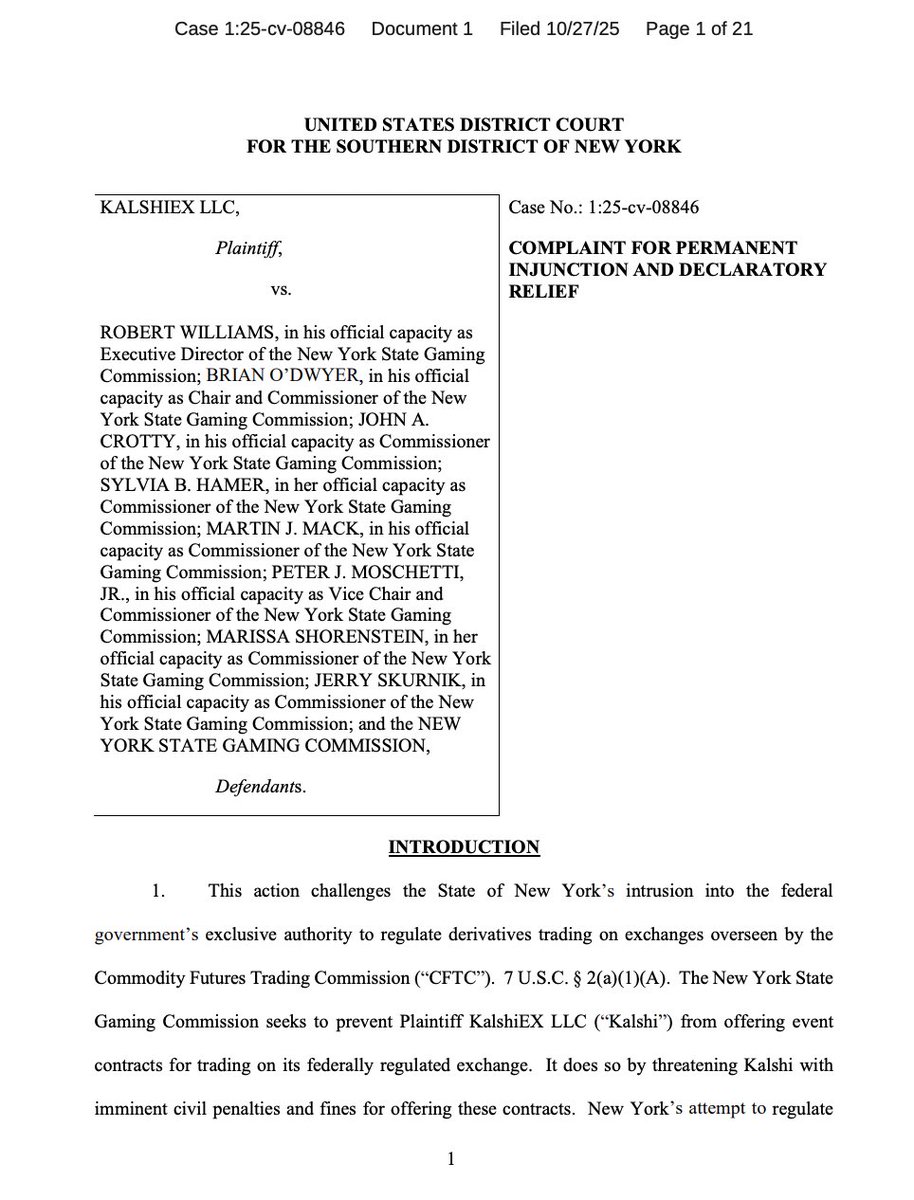
News: Kalshi files federal lawsuit against New York State after receiving cease-and-desist letter from @NYSGamingComm on Friday evening and will soon be filing a motion for preliminary injunction to prevent NYS from from enforcing its gambling laws vs. Kalshi. (h/t @akhoya87) Image
"Earlier this year, federal courts in Nevada and New Jersey granted Kalshi preliminary injunctions to prevent similar state overreach."

No mention of the Crypto dot com ruling or Nevada's motion to dissolve Kalshi's preliminary injunction (set for hearing on Nov. 14th). Image
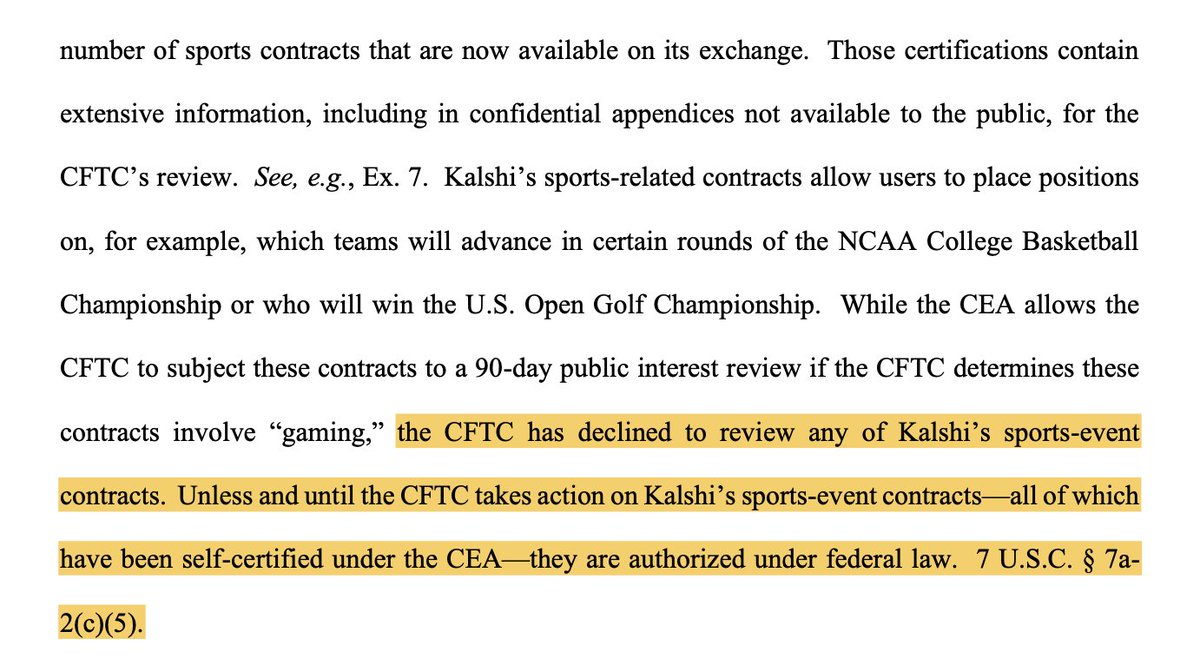
Kalshi: "Unless and until the CFTC takes action on Kalshi’s sports-event contracts—all of which have been self-certified under the CEA—they are authorized under federal law."

Not true.

See Rule 40.11(a)'s blanket ban on gaming contracts and CFTC's 9/30/25 staff advisory. Image
Read 6 tweets
Apr 26
There is another fundamental flaw in Kalshi's legal argument.

Kalshi's 'sports-outcome' event contracts may not qualify as an "excluded commodity" for purposes of triggering the CFTC's exclusive jurisdiction.

Here's why:

1) Under the Commodity Exchange Act (the CEA), "event contracts" are defined as "agreements contracts, transactions, or swaps in excluded commodities."

2) In other words, "event contracts" are subject to regulation under the CEA as an "excluded commodity."

3) What is an "excluded commodity"?

4) The CEA defines "excluded commodity" as an "occurrence, extent of an occurrence, or contingency" that is “beyond the control of the parties to the relevant contract" and "associated with a financial, economic, or commercial consequence."

5) The key words are "associated with a financial, economic, or commercial consequence."

6) So, are the outcomes of sporting events "associated with a financial, economic, or commercial consequence"?

7) Kalshi previously took the position that they are not.

8) In a brief filed on November 15, 2024 with the D.C. Circuit, Kalshi explained that "contracts relating to games—again, activities conducted for diversion or amusement—are unlikely to serve any ‘commercial or hedging interest.’” (📸)

9) During the May 30, 2024 oral argument in its lawsuit with the CFTC, Kalshi asserted that contracts relating to "games" such as "football, horseracing and golf" have "no economic significance," adding that "it's probably not the type of contracts that we want to be listed on an exchange, because they don't have any real economic value."

10) Kalshi has since reversed field.

11) In a Reply Brief filed earlier this week, Kalshi argued that the "sporting events" for which if offers event contracts "have obvious financial implications," pointing to Rory Mcllroy's sudden-death playoff win in the 2025 Masters which resulted in increased television viewership—reportedly a 33% increase over the prior year—"with enormous financial consequence for CBS and its advertisers."

12) But it's not the sporting event itself which is the measuring stick. The fact that broadcast rights associated with major sporting events are financially consequential does not, a fortiori, mean that the “outcome” of the sporting event is “associated with” a financial, economic, or commercial consequence.

13) Otherwise, as incoming CFTC Chairman Brian Quintenz has opined, “since practically any event has at least a minimal financial, commercial, or economic consequence, ALL events are commodities."

14) The more salient question —and the one actually raised by the definition of "excluded commodity"— is whether the "OUTCOME" of the event is "ASSOCIATED WITH" a "financial, economic, or commercial consequence"?

15) In other words, the relevant inquiry is whether Rory Mcllroy winning the Masters is "associated with" (i.e., connected to) financial consequences, not whether CBS makes money from streaming the event, as the Casino Association of New Jersey explained in an amicus brief filed last week.

16) The answer to that question would appear to be "no" — that is, other than to the competitors themselves (such as Mr. Mcllroy, who earned $4.2 million for winning the Masters).

17) So an “excluded commodity” could be yes/no for Las Vegas to host the 2029 Super Bowl, but not the outcome of the game.

18) It is ironic that Kalshi urged a narrow definition of “gaming” in its lawsuit against the CFTC, but is now urging a broad definition of “economic consequence.”Image
19) Now contrast that with the “examples” of “events” that the CFTC lists on its website as illustrative of an “event contract”:

“Macroeconomic indicators, corporate earnings, level of snowfall, or dollar value of damages caused by a hurricane.”

Key distinction = macroeconomic
20) Even the examples of "events” or "occurrences" that Kalshi offers up in its court filings as illustrative examples of "event contracts" are those having a macroeconomic (rather than a purely individualized or microeconomic) impact: Image
Read 9 tweets

Did Thread Reader help you today?

Support us! We are indie developers!


This site is made by just two indie developers on a laptop doing marketing, support and development! Read more about the story.

Become a Premium Member ($3/month or $30/year) and get exclusive features!

Become Premium

Don't want to be a Premium member but still want to support us?

Make a small donation by buying us coffee ($5) or help with server cost ($10)

Donate via Paypal

Or Donate anonymously using crypto!

Ethereum

0xfe58350B80634f60Fa6Dc149a72b4DFbc17D341E copy

Bitcoin

3ATGMxNzCUFzxpMCHL5sWSt4DVtS8UqXpi copy

Thank you for your support!

Follow Us!

:(