Good news in @ethereum land.
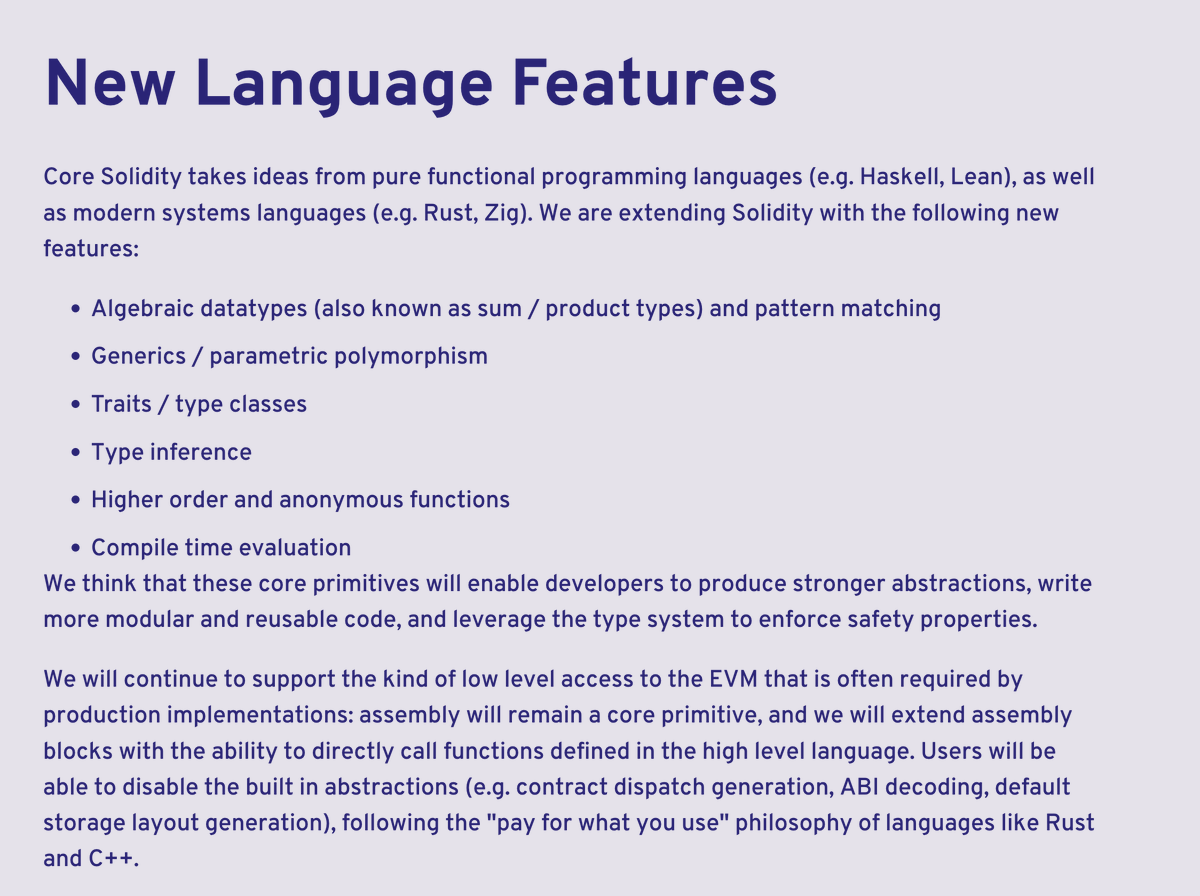
Solidity is finally growing up. ADTs, generics, traits, type inference, first-order functions. Inheritance getting phased out. Linear types and even theorem proving on the table.
I’ve been very critical of Solidity because it always felt like a strange mix of Java and JavaScript, with the permanent ability to shoot yourself like assembly. This upgrade is long overdue.
Congrats to the people pushing this forward. I’m already reviewing the code on GitHub.
@rodrigogeraldo, one of the main committers, clearly knows what he is doing. Deep compiler expertise, real programming-language design sense. Great to see a LATAM brother leading a project this important.
If Ethereum manages to:
- raise the gas limit considerably
- add privacy as a core L1 feature
- become post-quantum resistant with @leanEthereum
- fully leverage ZK
- improve interoperability with intents and standards that unify the L1/L2 experience
- develop native and based rollups
- and bring Solidity to modern language standards
there is no way competitors catch up.
We just need to prioritize features correctly and act with a proper roadmap. Ethereum must think more like a real business. We can't have engineers deciding the roadmap. We need to think in terms of users and product. We will be writing about this in our blog.
Lambda @class_lambda will try to help on every front. @ethrex_client, our minimalist and performant Rust production ready execution client, is just the first step towards this.
Let’s build.
Solidity is finally growing up. ADTs, generics, traits, type inference, first-order functions. Inheritance getting phased out. Linear types and even theorem proving on the table.
I’ve been very critical of Solidity because it always felt like a strange mix of Java and JavaScript, with the permanent ability to shoot yourself like assembly. This upgrade is long overdue.
Congrats to the people pushing this forward. I’m already reviewing the code on GitHub.
@rodrigogeraldo, one of the main committers, clearly knows what he is doing. Deep compiler expertise, real programming-language design sense. Great to see a LATAM brother leading a project this important.
If Ethereum manages to:
- raise the gas limit considerably
- add privacy as a core L1 feature
- become post-quantum resistant with @leanEthereum
- fully leverage ZK
- improve interoperability with intents and standards that unify the L1/L2 experience
- develop native and based rollups
- and bring Solidity to modern language standards
there is no way competitors catch up.
We just need to prioritize features correctly and act with a proper roadmap. Ethereum must think more like a real business. We can't have engineers deciding the roadmap. We need to think in terms of users and product. We will be writing about this in our blog.
Lambda @class_lambda will try to help on every front. @ethrex_client, our minimalist and performant Rust production ready execution client, is just the first step towards this.
Let’s build.
github: github.com/argotorg/solco…
• • •
Missing some Tweet in this thread? You can try to
force a refresh