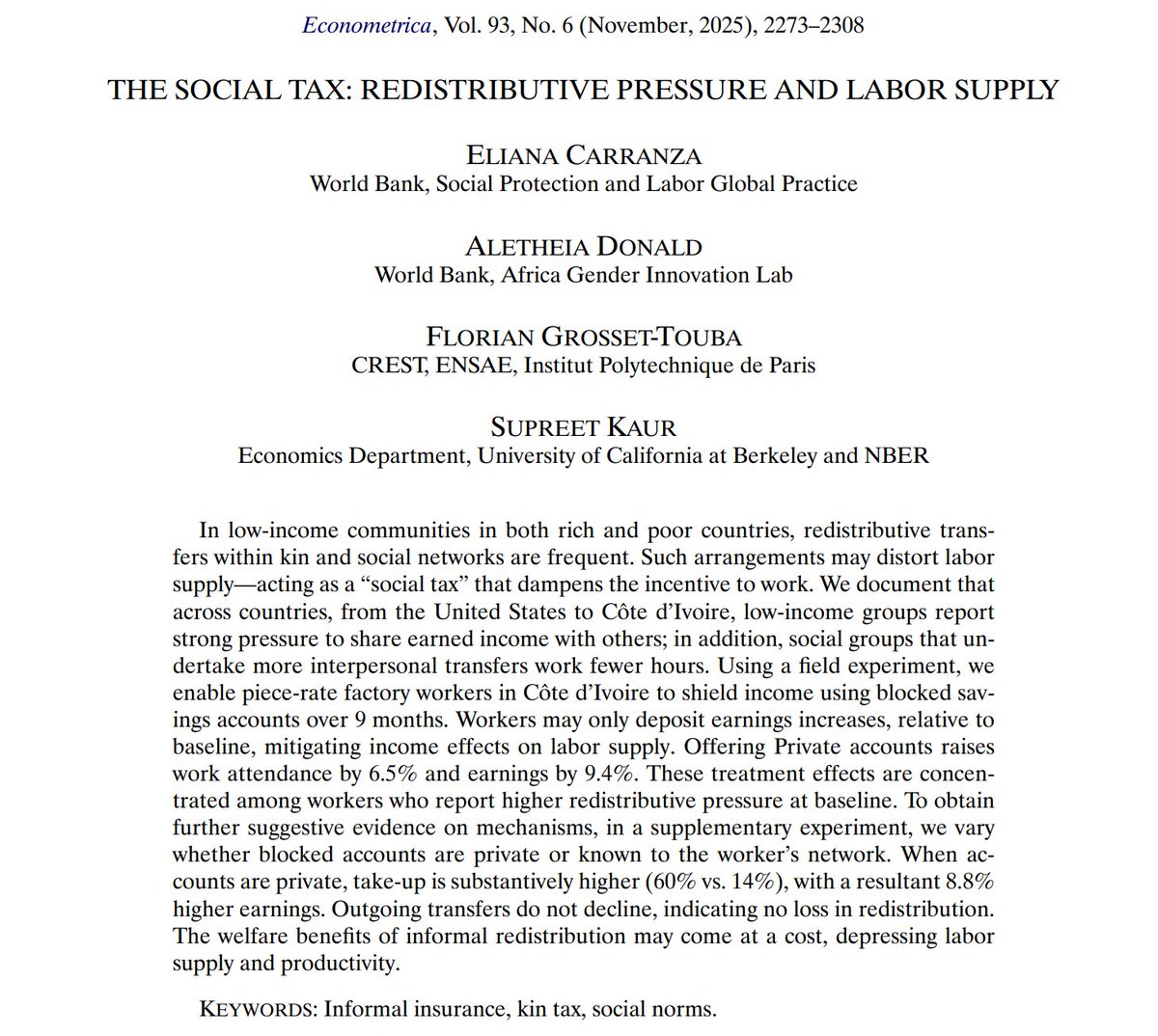
A serious problem in the developing world is that the moment anyone makes anything, their family and relations show up demanding a claim. The "social tax" is so large that 60% of workers take a bank account they can't use for months, just to keep others from knowing! 1/
The experiment is at a cashew processing plant, where workers scrape the plant husk off the nut. The compensation scheme is a pure piece-rate system -- workers are paid by the kilogram. These are almost entirely women.
The experimenters offered a savings account which paid no interest, and prevented you from accessing it for some number of months. This account would only be for income above expected. Unlike wages, which are paid publicly, no one would know how much got deposited.
Remarkably, this was extremely popular. 60% of offered workers took up the account, despite the fact that (with discount rates) they are essentially choosing to lose money.
This makes more sense when one realizes how ubiquitous demands for money are. They can only be refused when you can credibly claim to have nothing to give.
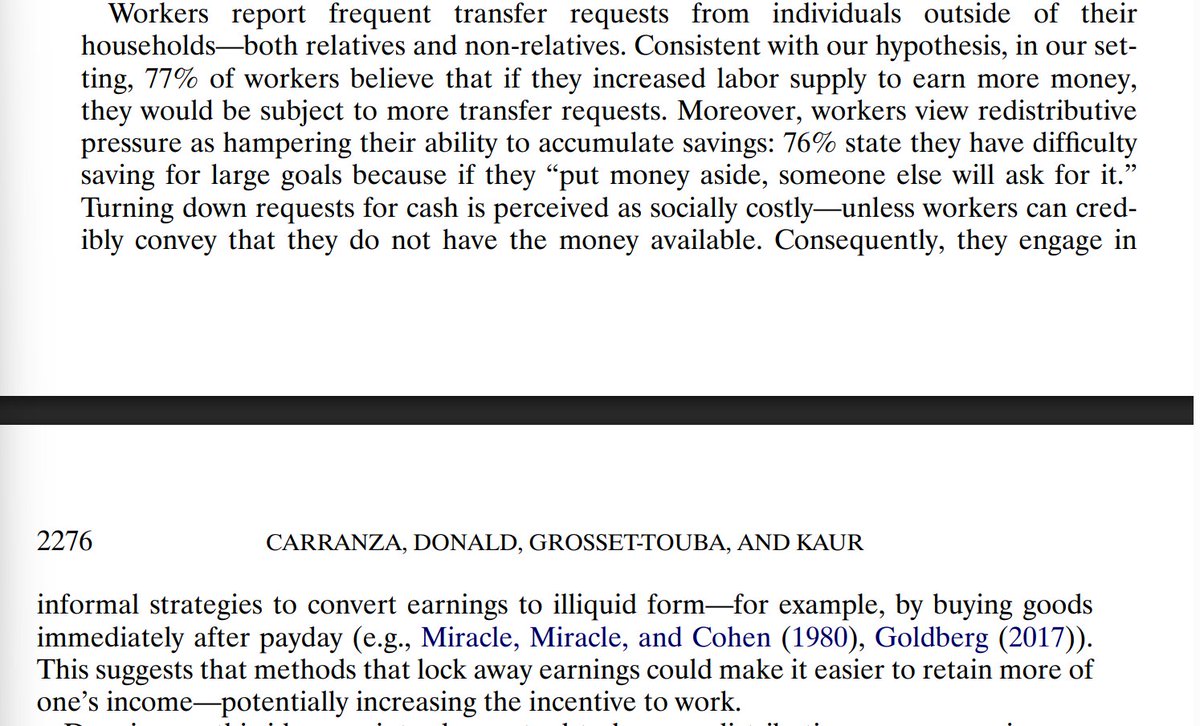
Being offered a private account causes worker earnings to go up by 9.4%.
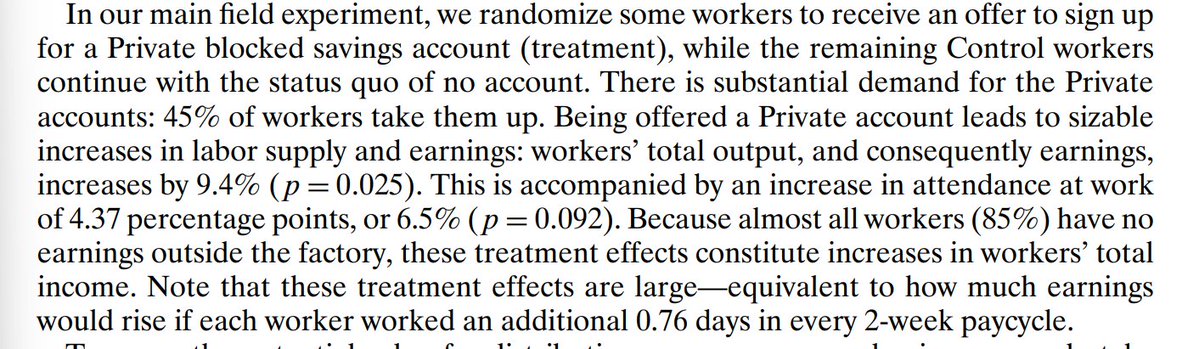
To put this in perspective, we can calculate how large the implicit social tax on earnings is. Obviously, we don't know the exact labor supply elasticity, but we can estimate a range of somewhere between a 20 and 65 percent tax on earnings. This is astonishingly large!
The range is coming due to uncertainty over what the right estimate is for how much people respond to a tax. Either way, it's harmful -- either the tax is small, but especially distortionary, or it's large if not especially distortionary.
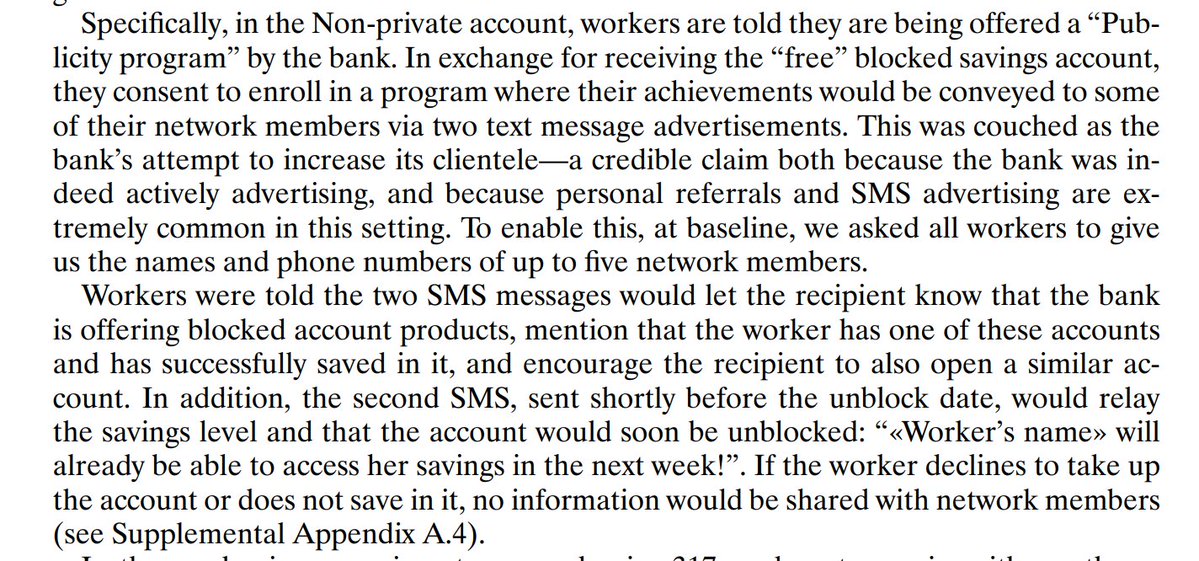
They establish that it's the privacy, not self-control benefits, which are responsible for the results by offering a "public" account, which alerts their family. (They claim that this is for promotional purposes). Wayyyyy fewer people take this up.
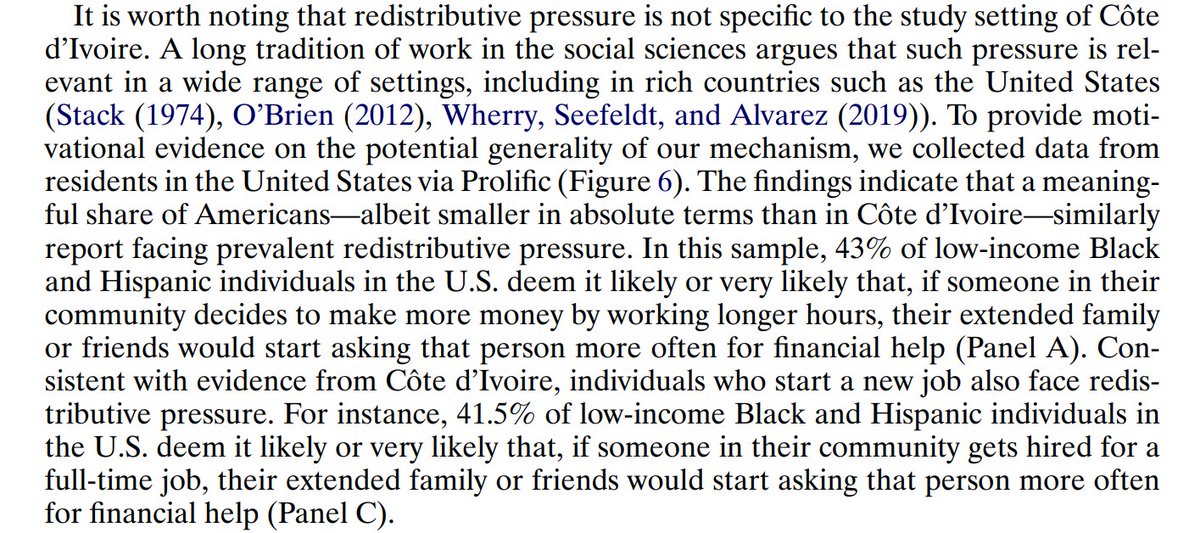
These basic results apply to the Black community in America too. There, too, is considerable pressure to redistribute good times to others.
One more thing. It's possible for transfers to be welfare enhancing in the presence of credit constraints and a lack of insurance. But the private accounts didn't change transfers at all! So this *must* be welfare improving.
Really big fan of this study. We have not considered enough the possibility of a culture of generosity holding back development. So be stingier!
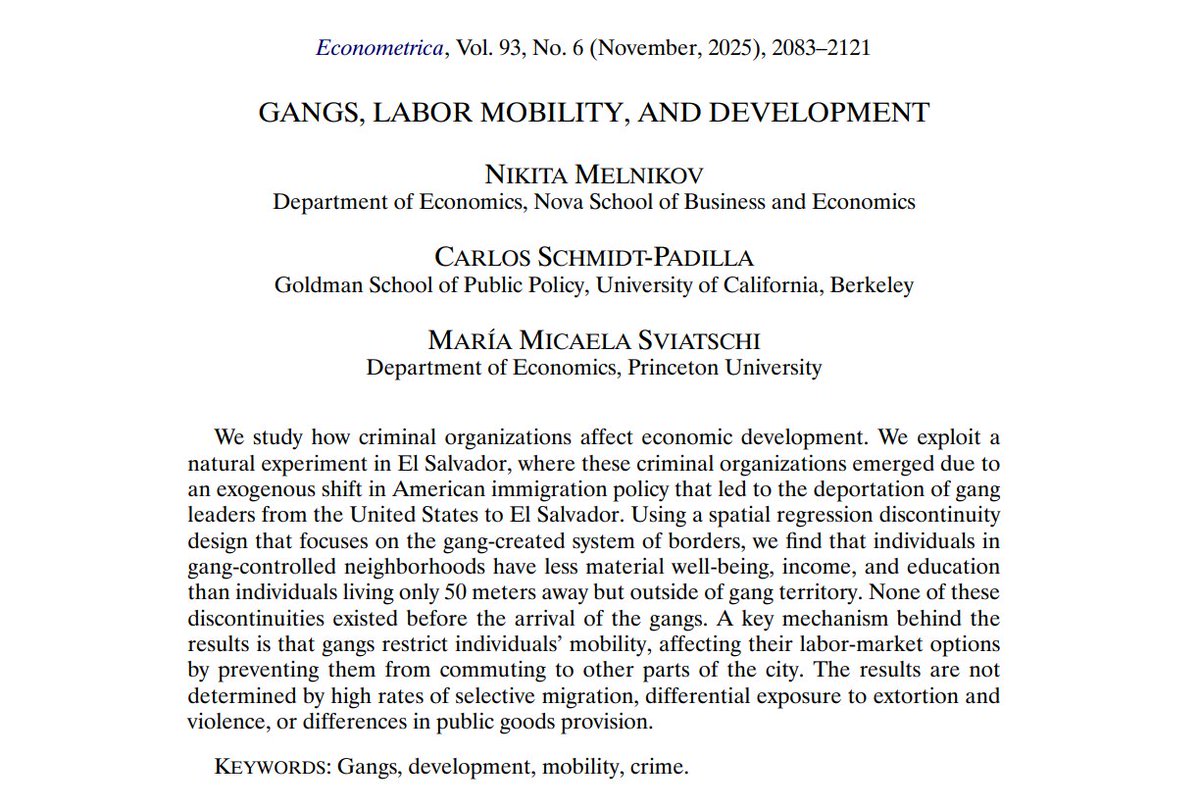
There's a reason Bukele is so celebrated in El Salvador -- the gangs, MS-13 and Barrio-18, were so awful that they reduced the wages of the people who lived in their zone by more than 50%! People were too afraid of being shot to leave their zone for better jobs. 1/
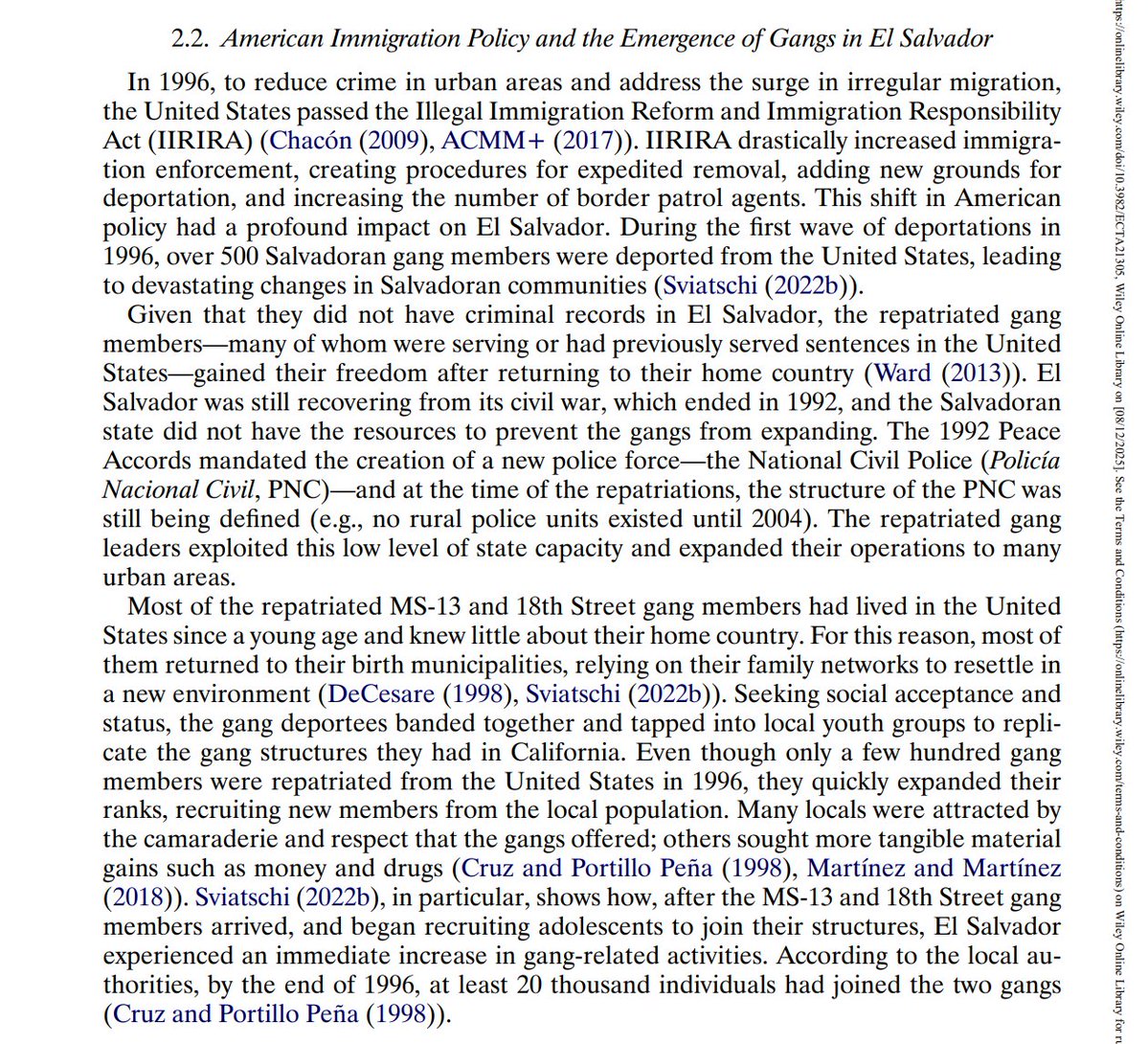
The El Salvadorean gang situation was an accidental creation of the United States -- when we dumped hundreds of gang members hardened by the streets of 90s Los Angeles, El Salvador could not keep up.
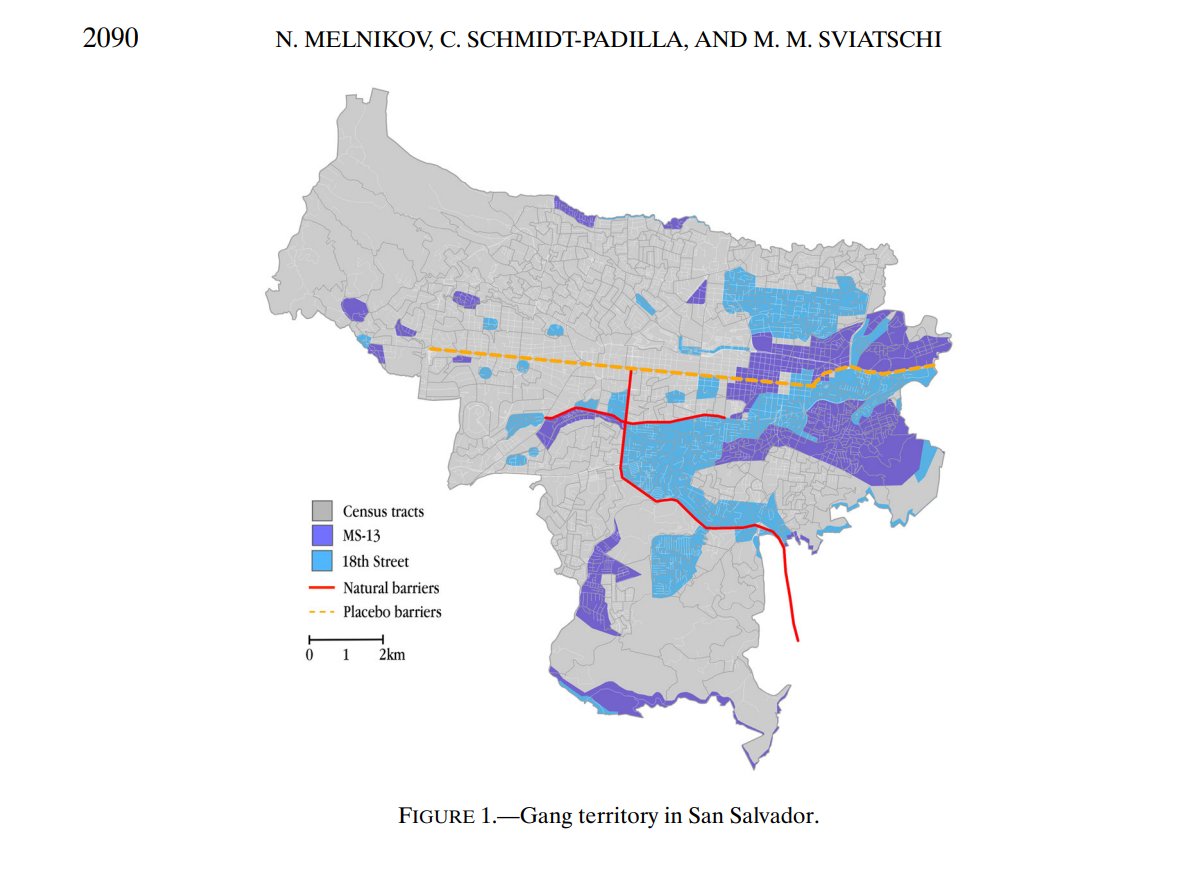
A plausible consequence of the American upbringing is that they kept a very tight control of territory, demarcated by natural boundaries of streets and avenues. These boundaries were quite stable over time (they confirm this with retrospective surveys).
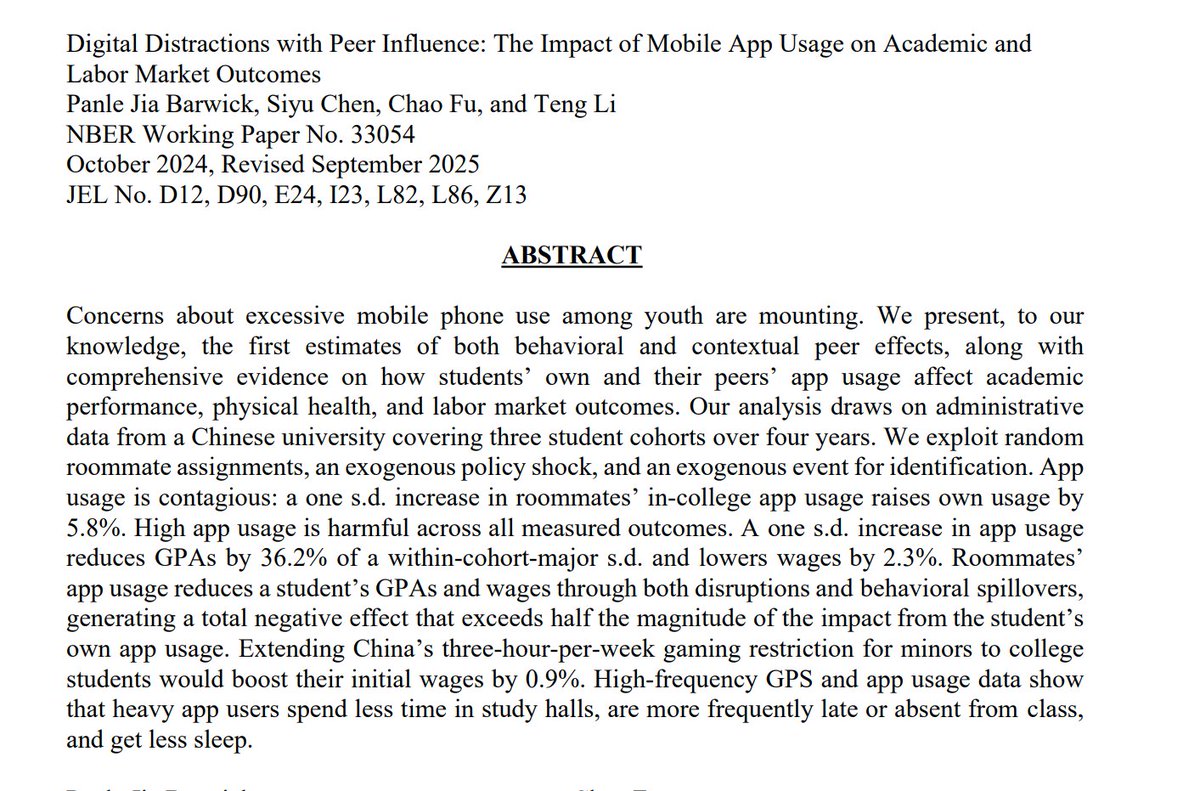
This is *the best* study we have on the effect of phones on academic performance, and an absolute must read. It's really bad for you! It reduces grades and lowers wages coming out of school, with doubling app usage reducing wages by 1.5%, or $135 a year. 1/
It's historically been difficult to measure the effect of videogame usage because it's endogenous. Someone who is already less attentive might play videogames in class -- but who is to say whether it is the videogames causing it, or the inattention which caused both?
To do so, we need exogenous variation, and we have three sources of such. The first are roommates. At this university (which I believe to be Jinan University, but officially it's anonymous), roommates are randomly assigned. If your roommate plays, they share the game with you.
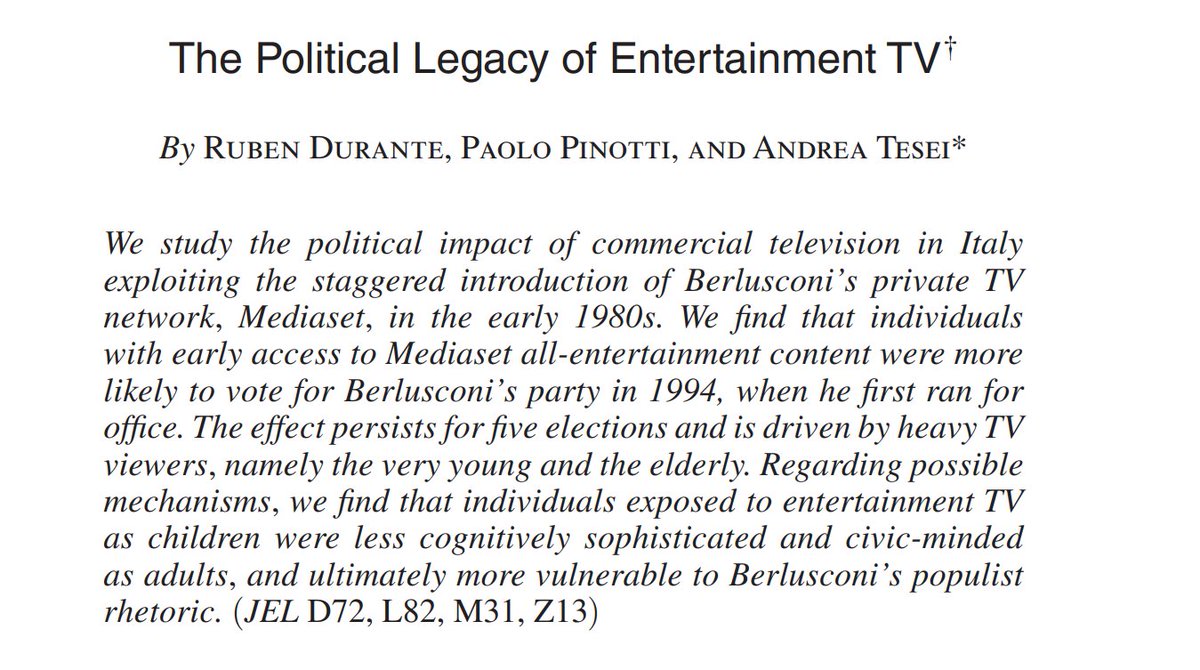
The basis of Silvio Berlusconi's political power was his TV network Mediaset. Using the staggered roll-out of the network, the authors find that watching television made young people stupider -- and thus, more likely to vote for Berlusconi. 1/
The fundamental argument behind the paper is that the places where transmitters were placed, conditional upon controls like population and income, were unrelated to future propensity to vote for him.
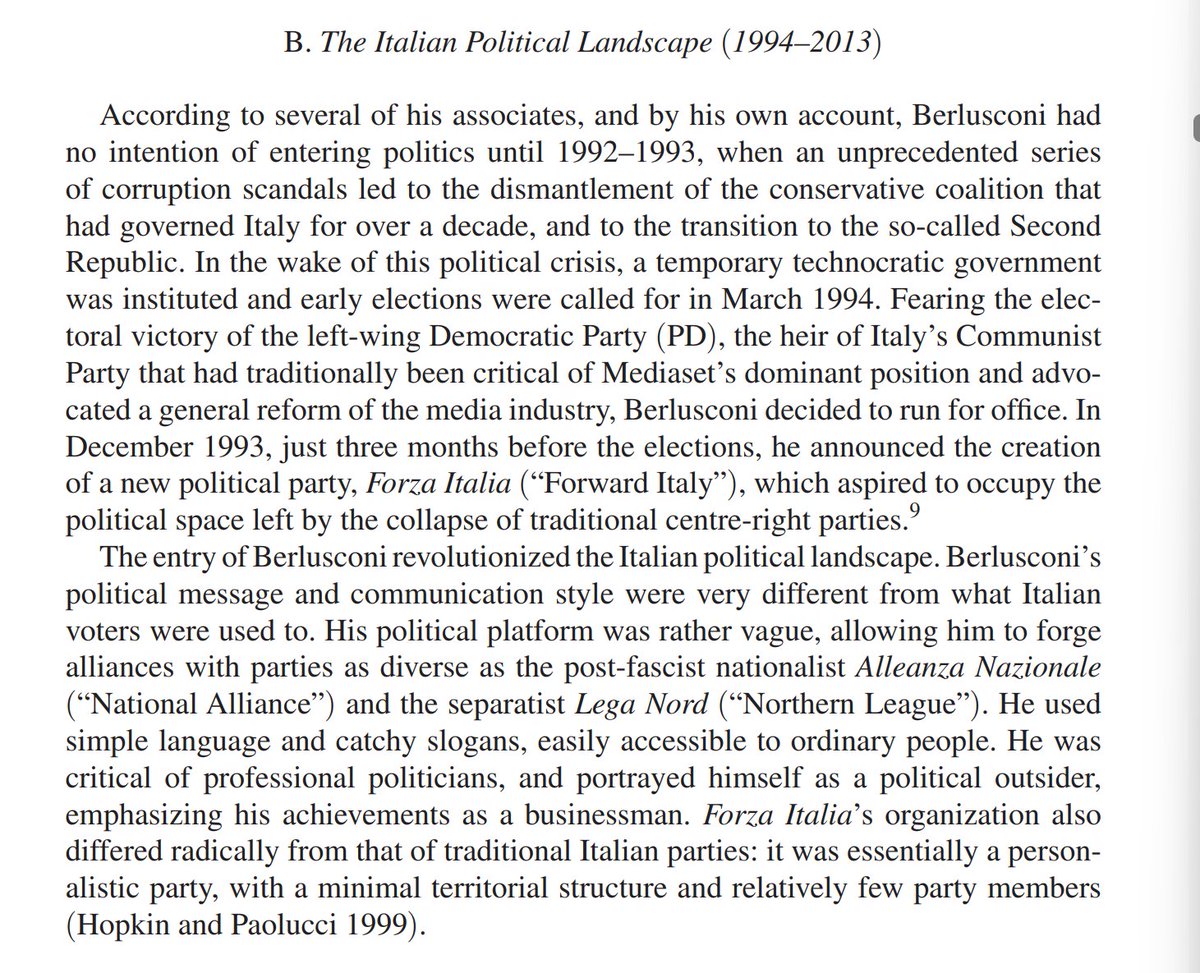
There is support for no intentional selection -- by general agreement, Berlusconi didn't intend to enter politics until the political cataclysm that was Mani Pulite.
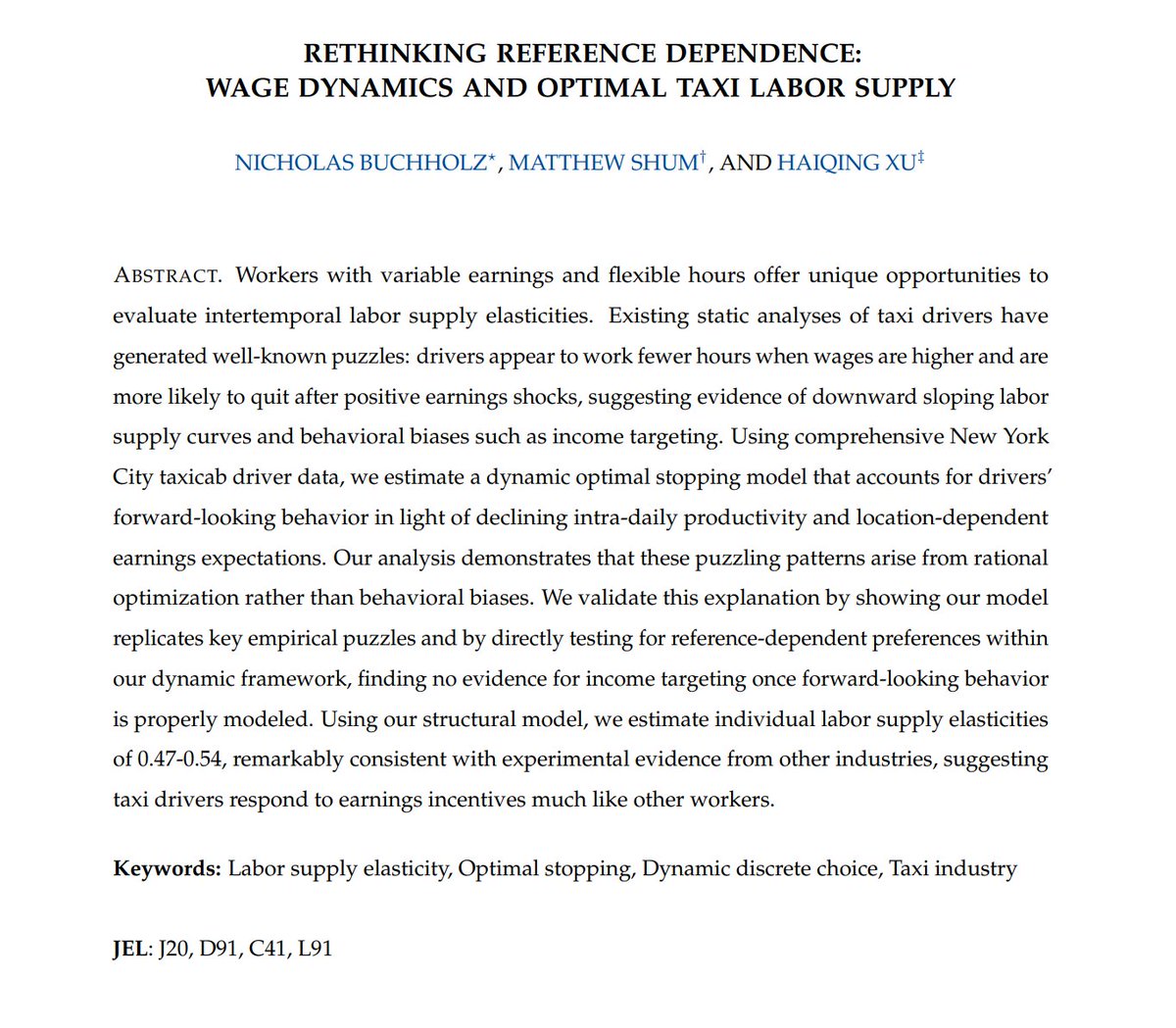
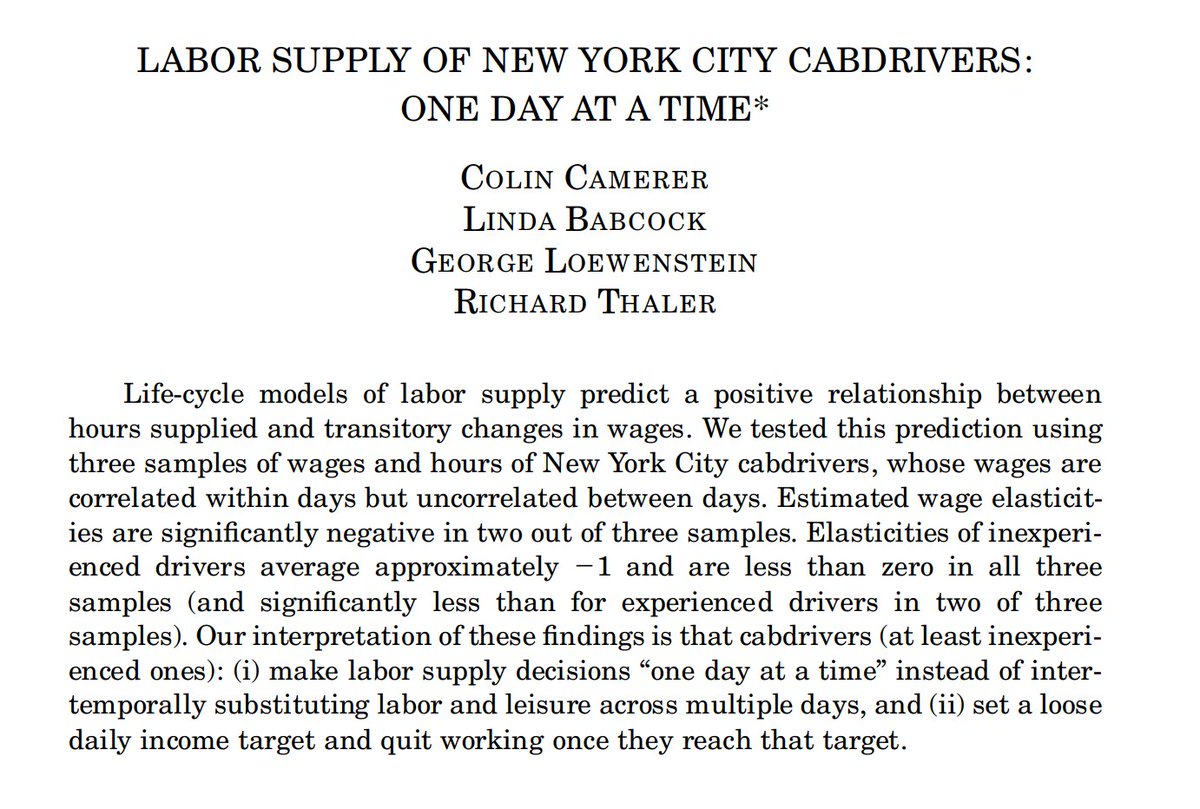
Contrary to some earlier work, taxi drivers behave like any other worker. They do not engage in "income targeting", where they choose an amount they want to make in a day and work till that is reached, which would imply a negative response of hours worked to income shocks. 1/
Back in 1997, a group of leading behavioral economists thought they had found that the elasticity of labor supply was negative, which would track best with workers choosing a target. If wages are unexpectedly high, then they will work less.
Rather than the small, hand collected sample of the original paper, they have 27 million trips between July and September, 2012. They're able to show what's going on is simple -- productivity declines over time.
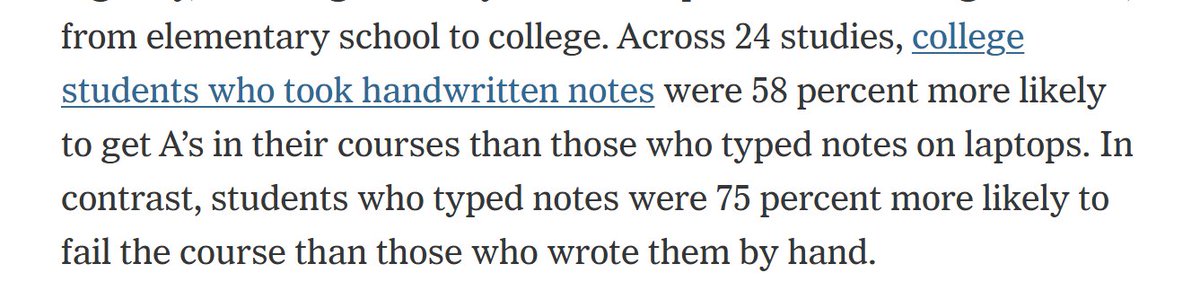
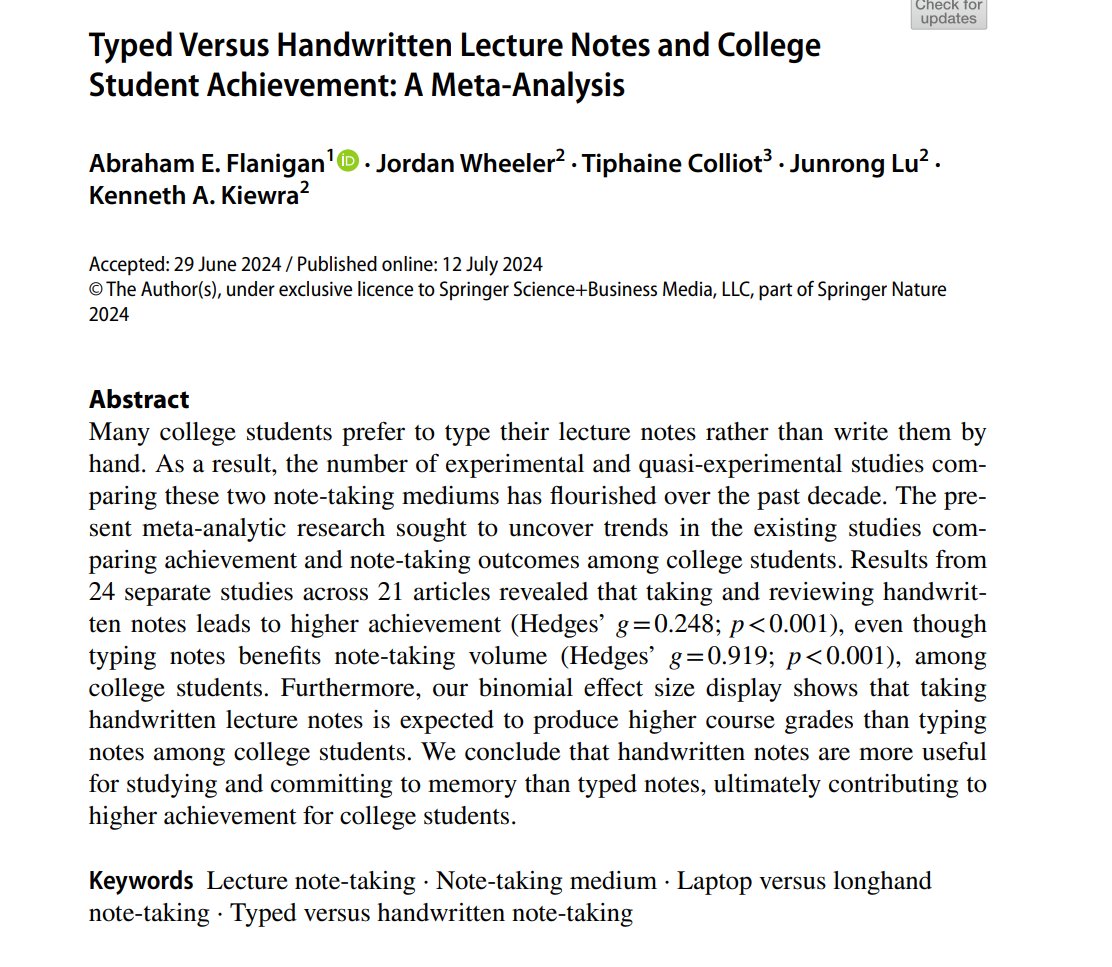
In a recent op-ed, Prof. Jean Twenge claims that college students who took notes by hand had way better academic results. This would be incredible -- if it weren't for the fact that that's not what the study shows! This is a serious act of misrepresentation. 1/
The meta-analysis she cites is quite annoyingly paywalled, but I did eventually get to read it. The studies they are analyzing are standard lab experiments on undergrads for notetaking. They have two groups, and have them answer a quiz after watching a 15 minute talk.
They then give, as an exercise, what the effect on course grades would be with these assumptions: grades are normally distributed, there is no selection into mode of note-taking, and the effect from the experiment is the same everywhere and just shifts your underlying ability.
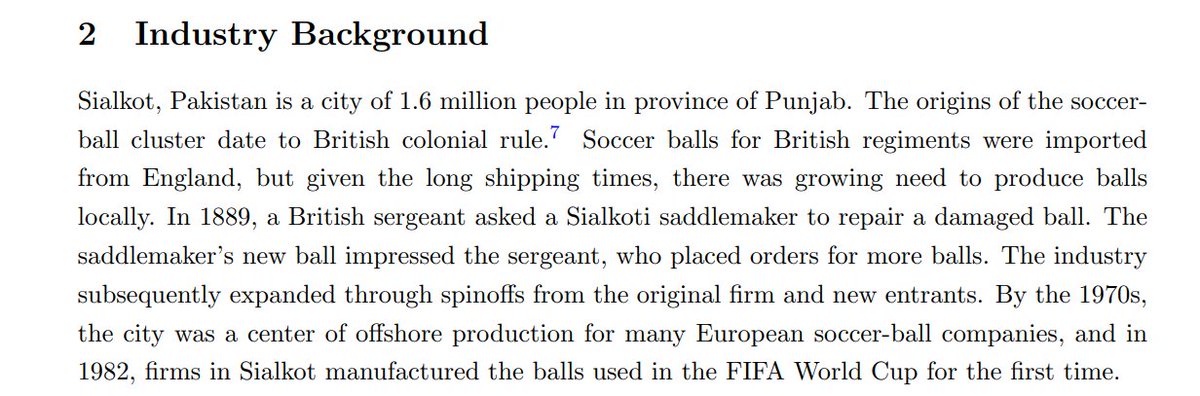
Especially in the developing world, technological advancements are not used for puzzling reasons. When a group of Ivy League economists invented a better way to manufacture soccer balls, they couldn't get anyone to take it.
Sialkot, Pakistan, is one of the foremost centers of soccer ball production in the world, and it all started with a chance encounter between a British soldier and a saddlemaker. By 2012, 135 firms employed around 36,000 people to produce 20% of the world's soccer balls.
Sialkot primarily makes higher quality, hand-stitched balls. One sews together 20 hexagons and 12 pentagons, made of an artificial leather called "rexine" glued to cloth. These materials account for much of the cost of the ball -- 46%, in fact.