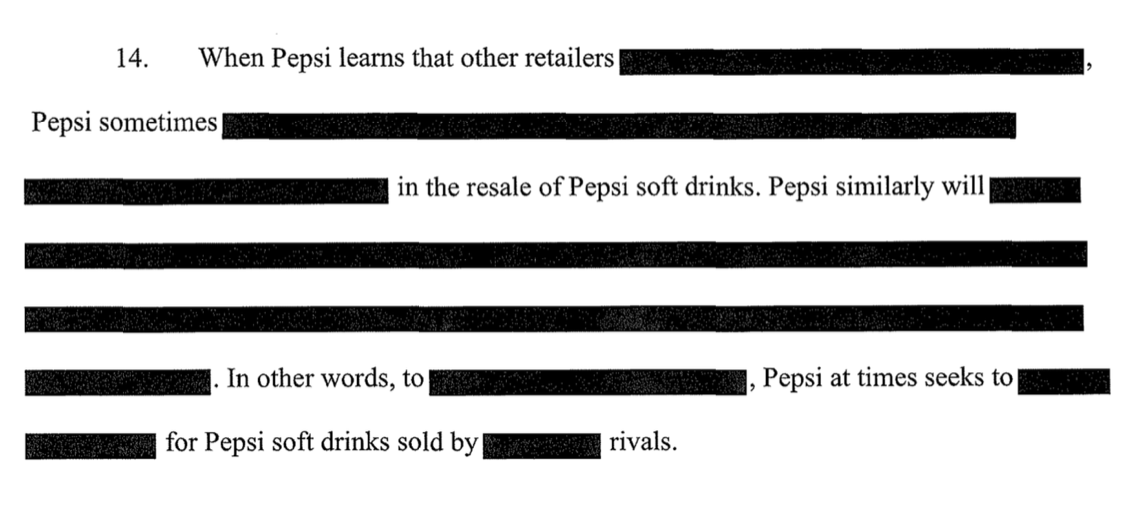
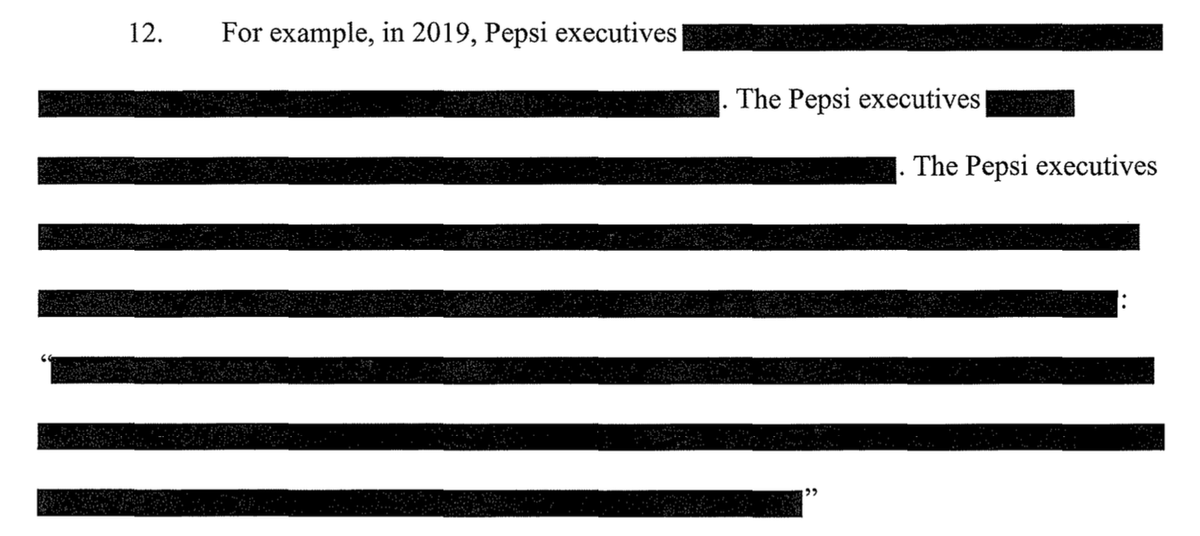
1. For at least 10 years, Pepsi has conspired with Walmart to force up grocery prices. That’s the shocking evidence made public today in an unsealed FTC lawsuit. The suit was dropped in May by @AFergusonFTC just before it was to be un-redacted. We went to court to get it unsealed & won.
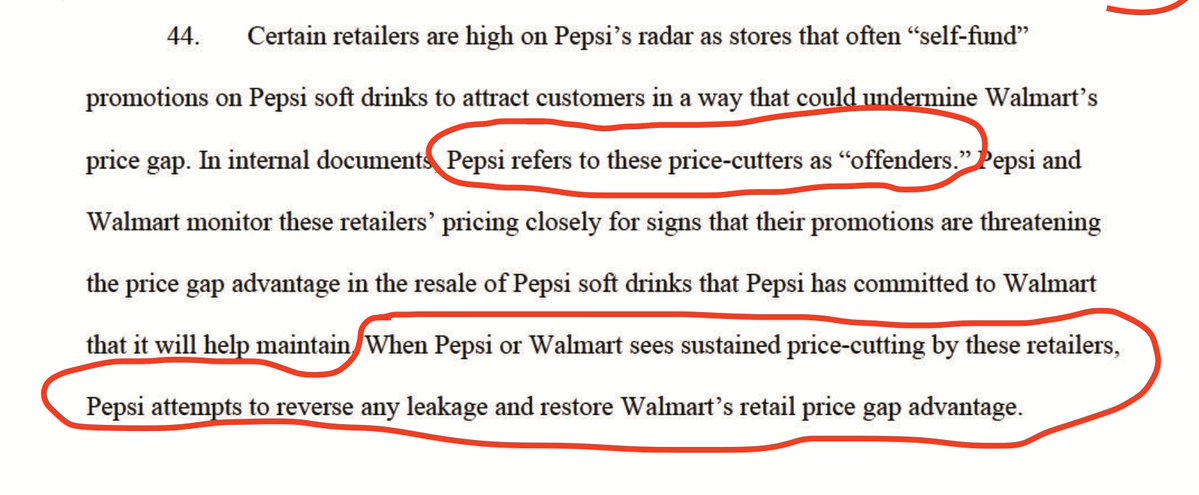
2. The evidence we can now see demolishes the core argument made by opponents of the Robinson-Patman Act. They claim not enforcing the law has led to lower prices. But this new material shows the opposite: Pepsi forced all grocers besides Walmart to raise their prices.
3. Pepsi monitors prices at Walmart's competitors. If they see other grocery stores starting to match or beat Walmart on price, an alarm goes off in Pepsi and a team swings into action.
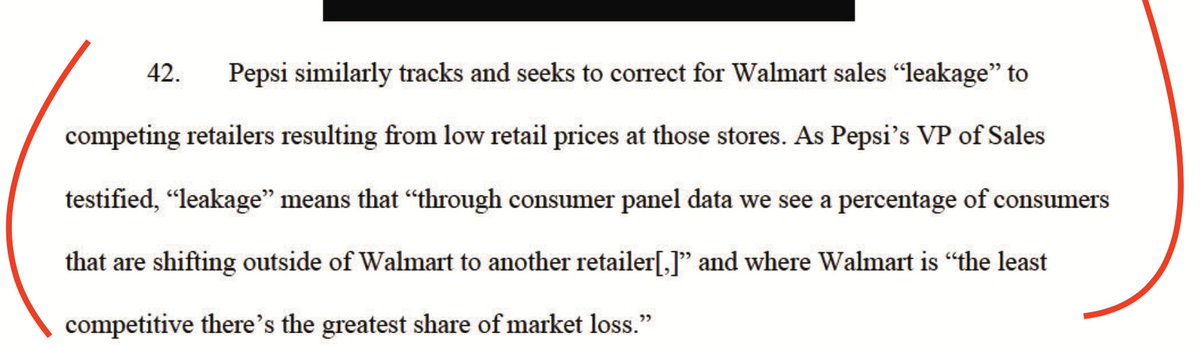
4. The examples are stunning. Here's one: Pepsi executives notice that Walmart's price gap is shrinking in its South Division. Pepsi's "Pricing Council" creates extensive plan to ensure other retailers are no longer selling Pepsi products for less than Walmart.
5. Another example involves Food Lion. Pepsi sees Food Lion as the "worst offender," because it prices Pepsi products below Walmart. So Pepsi creates a multi-year roadmap to force Food Lion to raise its prices.
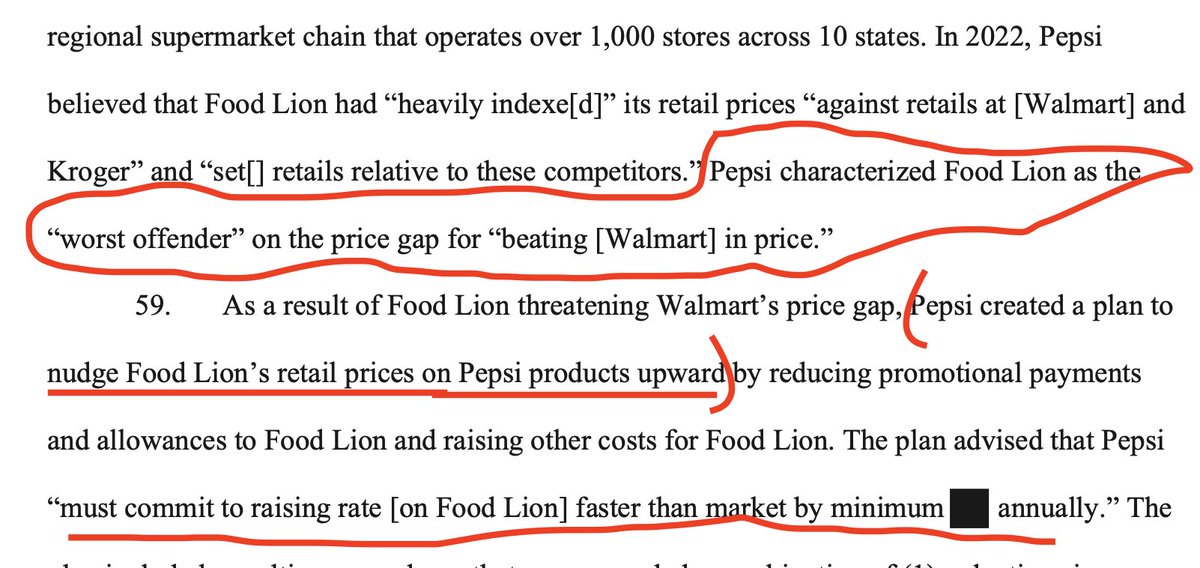
6. Why does Pepsi do this? Walmart’s promise is: Keep us the king of our domain and we’ll make you the king of yours. Walmart helps Pepsi dominate the drink market in exchange for Pepsi ensuring that Walmart dominates groceries.
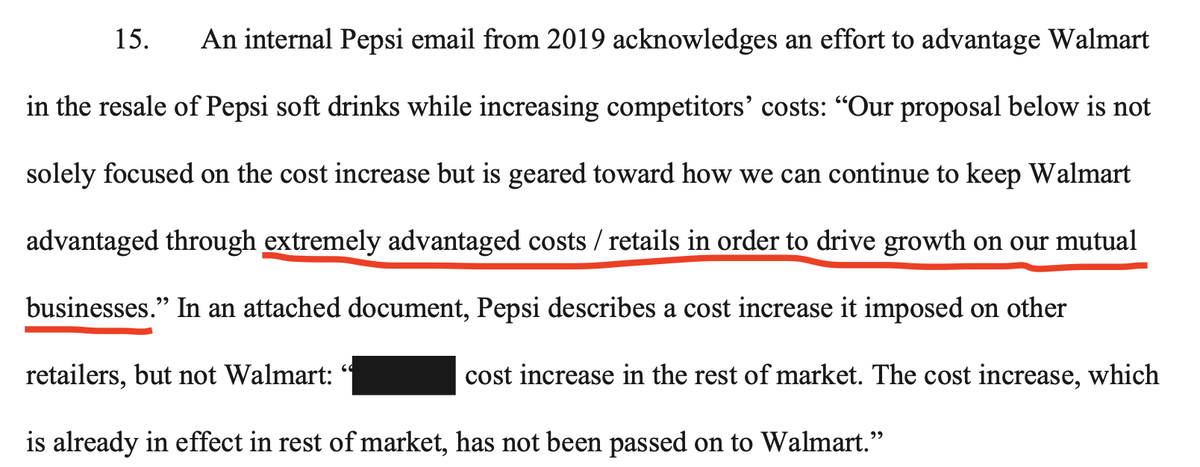
7. One other big reveal in the evidence is that Walmart appears to have violated the law too by pressuring Pepsi for illegal and unfair discounts.
8. I am so appalled that @AFergusonFTC dropped this case. Local independent grocery stores are being driven out of business — and their customers forced to pay higher prices — by two powerful companies who've been told, in effect, that they can violate the law with impunity.
@AFergusonFTC 9. This now-defunct case was brought by the FTC under @linamkhan with Commissioners @BedoyaUSA @RKSlaughterFTC — they deserve huge credit for this investigation and for their commitment to the law and to the fairness it proscribes.
@AFergusonFTC @linamkhan @BedoyaUSA @RKSlaughterFTC 10. There's good reason for some hope though — state AGs are starting to take a hard look price discrimination with an eye toward bring actions. And a few states, including NY, are introducing bills. Follow ILSR if you want to keep abreast! ilsr.org/independent-bu…
• • •
Missing some Tweet in this thread? You can try to
force a refresh

1. This is now unsealed. The FTC filing shows Pepsi worked closely with Walmart to force other retailers to raise their prices on Pepsi products. The Khan-era FTC brought the case; Trump/Ferguson dropped it as “weak.” It looks anything but. It directly targets high prices.
2. The evidence shows that Pepsi punished Walmart’s competitors if they discounted Pepsi products. Pepsi would increase their wholesale cost or eliminate promotional payments to force Walmart's rival to raise its price to consumers.
3. This was done to maintain Walmart’s “price gap.” The purpose of the price gap is to provide Walmart an advantage over other retailers. Pepsi documents describe this as a “foundational commitment” that aligns with the company’s strategy.
1. ILSR has filed a motion in federal court to unseal the FTC’s antitrust complaint against PepsiCo. The case bears directly on high grocery prices & food deserts—and would've marked a crucial revival of the neglected Robinson-Patman Act. But the public may never get to see it.
2. Most of the complaint is heavily redacted, including the name of the favored retailer (reportedly Walmart). The complaint alleges that Pepsi gave a favored big-box retailer illegal price breaks — while raising prices to competing independent grocers and their customers.
3. In antitrust cases, complaints are often temporarily sealed. But courts generally move quickly to remove the redactions, so the public can see the evidence and understand what’s at stake.
1. My colleague Ron Knox just published a killer guide to resisting monopolies. It shows that fighting monopoly power isn't just a job for the government — it's something regular people can do every day in their communities and workplaces. microcosmpublishing.com/catalog/zines/…
2. Resist Monopolies! — published by the great folks at Microcosm — weaves together the stories of people across the country pushing back against corporate domination — and winning.
3. The book brilliantly connects today’s struggles to our long, rich history of anti-monopoly activism — and the heroes, then and now, leading the way. It’s an essential read. microcosmpublishing.com/catalog/zines/…
1. How strong are your state’s antitrust laws? Does your state AG have all the tools s/he needs to go after corporate abuse? What can your state legislature do to fight monopolies? ILSR has new resources for you, created by my colleague @ronmknox: ilsr.org/independent-bu…
2. Back in the 19th century, states were the first on the scene when corporations started to amass too much power. They came up with the first antitrust laws, which inspired federal law.
3. Today, states are playing a pivotal role in reviving antimonopoly law. They’re blocking mergers that would hurt workers, investigating landlord collusion to raise prices, suing to break up Big Tech, going after the PBMs that kill pharmacies, and more. ilsr.org/articles/state…
1. Big news! The FTC took action today to end Walmart’s stranglehold on the grocery market. The agency filed suit against Pepsi for giving illegal and unfair price advantages to Walmart while charging competing grocery retailers higher prices. ilsr.org/articles/stacy…
2. It is a violation of the Robinson-Patman Act for a large supplier to collaborate with a big retail chain to help it drive smaller retailers out of business and dominate the market. But for the last 40 years — until now — the FTC declined to enforce the law.
3. Walmart has deftly exploited the lack of enforcement. For decades, it has strong-armed suppliers, demanding special deals while forcing suppliers to hike their prices to competing chains and independent retailers.
1. A hallmark of the dark ages of antitrust was that the agencies often went after small players for collusion if they banded together to survive against a dominant corporation. @linakhanFTC just undid part of that legacy & offered a critique of it. ftc.gov/news-events/ne…
2. During the dark years, antitrust enforcers treated anything that might be deemed collusion among small businesses or other small players as a cardinal sin — even as they viewed the exercise of market power by a single large dominant corporation as benign or even beneficial.
3. The result was a lot of absurdity. Like Monty Python level absurdity. In 2012, for example, the DOJ's Antitrust Division went after book publishers who had attempted to collectively counter Amazon’s near-total monopoly over e-books. ilsr.org/articles/dojs-…