CHATGPT-5.2 JUST TURNED LEARNING INTO A PAYWALL-FREE
People are still buying courses, sitting through playlists, and bookmarking “learn later” links while ChatGPT-5.2 can design a personalized curriculum, teach you in real time, test your understanding, and adapt on the fly
for literally any skill if you know how to prompt it correctly.
Here’s how:
1/ BUILD YOUR “AI DEGREE” IN 30 SECONDS
Pros don’t ask “teach me X”.
They ask for the full roadmap.
Prompt to steal:
“Create a complete learning curriculum for [skill].
Break it into beginner, intermediate, and advanced modules.
Add exercises, real world projects, weekly goals, and skill checkpoints.”
2/ THE “TEACH ME LIKE I’M LAZY” METHOD
If the roadmap feels heavy, compress it.
Prompt to steal:
“Summarize this topic in 10 key principles.
Then give me examples so I never forget the concepts.”
This is the cheatcode for retention.
3/ THE RAPID SKILL DOWNLOAD
Want mastery without fluff?
Tell ChatGPT to cut the nonsense.
Prompt to steal:
“Give me the 20 percent of [topic] that drives 80 percent of results.
Be brutally practical.”
This is the Pareto move.
4/ THE PERSONAL TUTOR MODE
This is where it gets insane.
Prompt to steal:
“Ask me 10 questions to diagnose what I don’t understand about [topic].
Then reteach the weak spots with examples.”
This feels like hiring a $200 per hour tutor.
5/ THE PROJECT MODE
Skills don’t stick unless you build.
Prompt to steal:
“Give me 5 real world projects to practice this.
Then guide me step by step through the first one.”
You’ll learn faster than any passive course.
AI makes content creation faster than ever, but it also makes guessing riskier than ever.
If you want to know what your audience will react to before you post, TestFeed gives you instant feedback from AI personas that think like your real users.
It’s the missing step between ideas and impact. Join the waitlist and stop publishing blind.
OPENAI, ANTHROPIC, AND GOOGLE KNOW SOMETHING
about prompting that most creators don’t.
Steal these 6 techniques and your outputs won’t look human anymore 👇
Technique 1: Constraint-Based Prompting
Most prompts are too open-ended. Engineers add hard constraints that force the model into a narrower solution space, eliminating 80% of bad outputs before they happen.
Template:
Generate [output] with these non-negotiable constraints:
- Must include: [requirement 1], [requirement 2]
- Must avoid: [restriction 1], [restriction 2]
- Format: [exact structure]
- Length: [specific range]
Example:
Generate a product description for wireless headphones with these constraints:
- Must include: battery life in hours, noise cancellation rating, weight
- Must avoid: marketing fluff, comparisons to competitors, subjective claims
- Format: 3 bullet points followed by 1 sentence summary
- Length: 50-75 words total
Technique 2: Multi-Shot with Failure Cases
Everyone uses examples. Engineers show the model what NOT to do. This creates boundaries that few-shot alone can't establish.
Template:
Task: [what you want]
Good example:
[correct output]
Bad example:
[incorrect output]
Reason it fails: [specific explanation]
Now do this: [your actual request]
Example:
Task: Write a technical explanation of API rate limiting
Good example:
"Rate limiting restricts clients to 100 requests per minute by tracking request timestamps in Redis. When exceeded, the server returns 429 status."
Bad example:
"Rate limiting is when you limit the rate of something to make sure nobody uses too much."
Reason it fails: Too vague, no technical specifics, doesn't explain implementation
I TESTED PERPLEXITY AI FOR 48 HOURS TO MAKE VIRAL CONTENT
The results blew my mind.
Here are 3 mega prompts prompts that will help you make viral content using @perplexity_ai :
1/ THE DEEP DIVE PROMPT
Most people ask Perplexity tiny questions.
Winners ask it to synthesize entire ecosystems.
Technique:
Tell @perplexity_ai to scan experts, forums, newsletters, academic sources, then merge insights into a single map.
Prompt to steal:
“Scan the top experts, forums, and niche communities discussing [topic].
Identify the 5 most important themes, the debates, the blind spots, and the emerging trends.
Summarize them visually and give me a content angle no one is talking about yet.”
2/ THE CONTENT GAP PREDICTOR
Perplexity is insane at identifying what audiences want but aren’t getting.
Technique:
Tell it to compare the highest performing posts vs the unanswered questions across platforms.
Prompt to steal:
“Analyze top performing posts on Twitter, Reddit, YouTube, and LinkedIn about [topic].
Identify:
• what creators keep repeating
• what people keep asking but never get real answers
• the hidden insights experts avoid mentioning
Turn this into 10 high-impact content ideas.”
You can now use Perplexity AI to track markets, break down earnings, and forecast trends all with one prompt.
Let me giveaway my mega prompt to help you become a pro analyst ↓
Here's the prompt:
"You are my AI financial research analyst.
Your job:
Act as a Bloomberg terminal + McKinsey consultant hybrid.
I’ll give you a company, sector, or theme — you’ll produce institutional-grade research reports.
Your output format must always include:
1. EXECUTIVE SUMMARY
- Core insights in bullet points (5-8 max)
- Key metrics and recent trends
2. COMPANY OVERVIEW
- Core business model, revenue streams, valuation
- Latest financials, growth rates, P/E, debt ratios
3. MARKET CONTEXT
- Competitive landscape and positioning
- Key macroeconomic or regulatory drivers
- Industry tailwinds/headwinds
5. SENTIMENT & NEWS FLOW
- Analyst upgrades/downgrades
- Media sentiment (positive/negative/neutral)
- Major events impacting stock price
6. AI SYNTHESIS
- 5 key takeaways investors should know
- 3 action ideas (buy/hold/sell rationale)
- 2 contrarian insights missed by mainstream coverage
Formatting:
- Use concise paragraphs and data-backed statements.
- Include links to credible financial sources (e.g., SEC filings, Reuters, company reports).
- Prioritize insight density over filler.
- When I ask for comparisons, use a side-by-side table format.
Tone:
Objective, precise, and analytical — like a Goldman Sachs or Morgan Stanley equity analyst.
Example query:
“Analyze NVIDIA vs AMD Q3 2025 performance and AI hardware dominance.”"
I just reverse-engineered how OpenAI’s internal team actually prompts GPT. Here are 12 prompts that literally bend the model to your will:
1. The impossible cold DM that opens doors
Prompt:
"You are a master closerscript writer. Given target name, role, one sentence on their company, and my one-sentence value proposition, write a 3-line cold DM for LinkedIn that gets a reply. Line 1: attention with unique detail only a researcher would notice. Line 2: one-sentence value proposition tied to their likely metric. Line 3: tiny, zero-commitment ask that implies urgency. Then provide three variations by tone: blunt, curious, and deferential. End with a 2-line follow-up to send if no reply in 48 hours."
2. Steal the signal - reverse-engineer a competitor’s growth funnel
Prompt:
"You are a growth hacker who reverse-engineers funnels from public traces. I will paste a competitor's public assets: homepage, pricing page, two social posts, and 5 user reviews. Identify the highest-leverage acquisition channel, the 3 conversion hooks they use, the exact copy patterns and CTAs that drive signups, and a step-by-step 7-day experiment I can run to replicate and improve that funnel legally. Output: 1-paragraph summary, a table of signals, and an A/B test plan with concrete copy variants and metrics to watch."
🔥 Holy shit… China just built the first AI that understands why the universe works not just how.
Most science compresses reasoning into conclusions. We get the what, but not the why. Researchers call this missing logic the “dark matter” of knowledge the invisible reasoning chains connecting every concept.
Their solution? Absolutely wild. 🤯
A Socrates AI agent that generates 3M first-principles questions across 200 courses each solved by multiple LLMs and cross-validated for correctness.
The result: a verified Long Chain-of-Thought (LCoT) knowledge base where every concept traces back to first principles.
And they didn’t stop there.
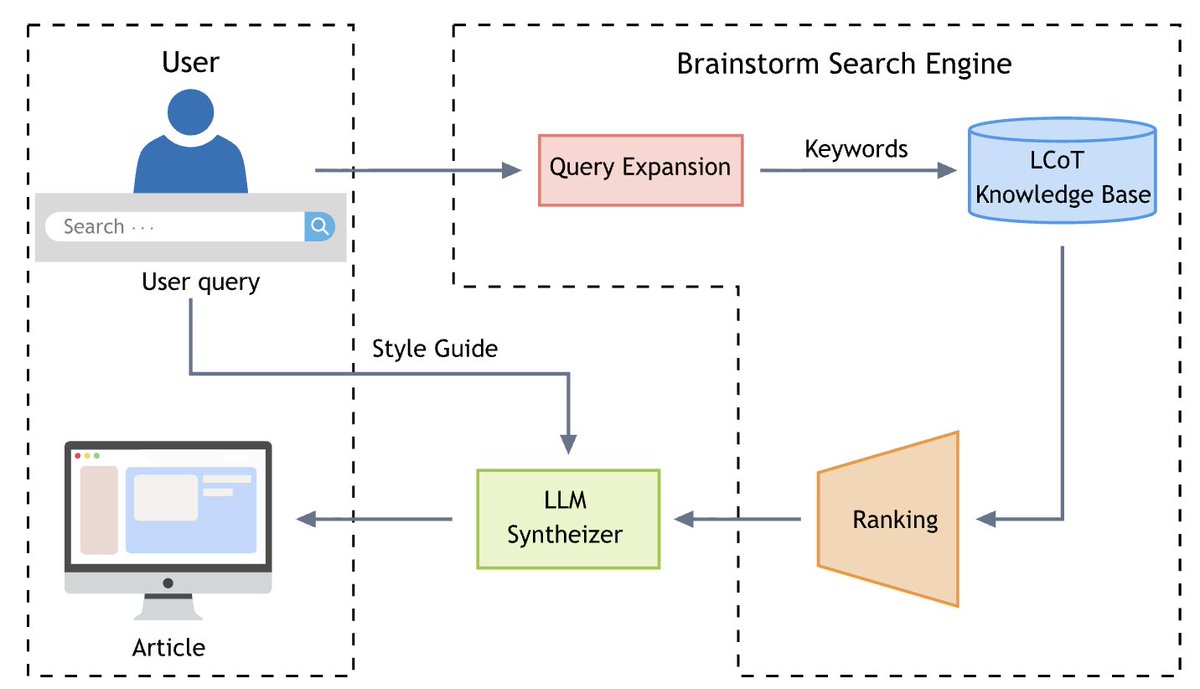
They built a Brainstorm Search Engine for inverse knowledge search.
Instead of asking “What is an Instanton?” you retrieve every reasoning chain that derives it, from quantum tunneling to Hawking radiation to 4D manifold theory.
They call it:
“The dark matter of knowledge finally made visible.”
SciencePedia now covers 200K verified entries across math, physics, chemistry, and biology.
50% fewer hallucinations. Far denser reasoning than GPT-4.
Every claim is traceable. Every connection is verifiable.
This isn’t just better search.
It’s the invisible logic of science made visible.
Comment “Send” and I’ll DM you the paper.
The pipeline is genius.
A Planner generates problem thumbnails. A Generator expands them into specific questions with verifiable answers. Then multiple independent Solver agents (different LLMs) attack the same problem.
Only answers with consensus survive. Hallucinations get filtered automatically.
This is the architecture that changes everything.
User query → Keywords extraction → LCoT Knowledge Base retrieval → Ranking by cross-disciplinary relevance → LLM Synthesizer weaves verified chains into coherent articles.
"Inverse knowledge search" discovers HOW concepts connect, not just WHAT they are.