Encyclopaedia Britannica Profile picture
Dec 18, 2025 7 tweets 3 min read Read on X
All I want for Christmas is…a painting of a mouse riding a lobster.

Christmas cards during the Victorian Era tended to be rather unusual, reflecting an offbeat sense of humor before Christmas iconography had solidified into what it is today.

Let’s shake this tree down. 🧵⬇️ Painting of a mouse riding a lobster
Queen Victoria, whose mother and husband were born in Germany, is credited with bringing German holiday traditions like Christmas trees and card-giving to England in the 1830s.
The first Christmas card is thought to have been designed in England in 1843, the EXACT SAME YEAR that Charles Dickens wrote ‘A Christmas Carol.’

Christmas (snow, big feasts, family cheer) was becoming a thing.

1,000 hand-colored copies of the card were sold in London. The first Christmas card, featuring a family and a sign reading "A Merry Christmas and a Happy New Year to You"
With the advancement of printing processes, cards became cheaper and more accessible.

Card companies began commissioning artists to create designs specifically for Christmas cards.

To keep up with competition, the designs became more original. A Christmas card featuring a family of birds pushing a stroller and walking in the snow
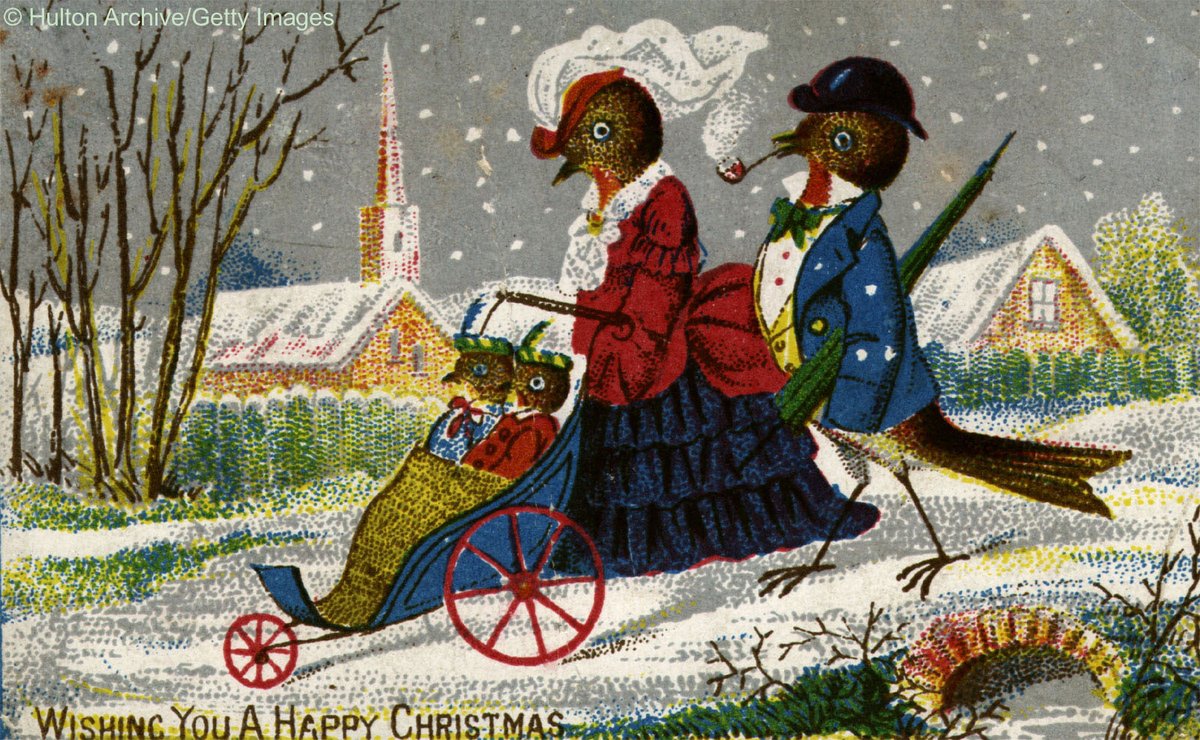
Although the church and rigid social codes dominated Victorian culture, there are remarkably few religious themes.

Instead, dark humor found its way into the designs. A Christmas card featuring four pigs carrying a hog's head on a tray
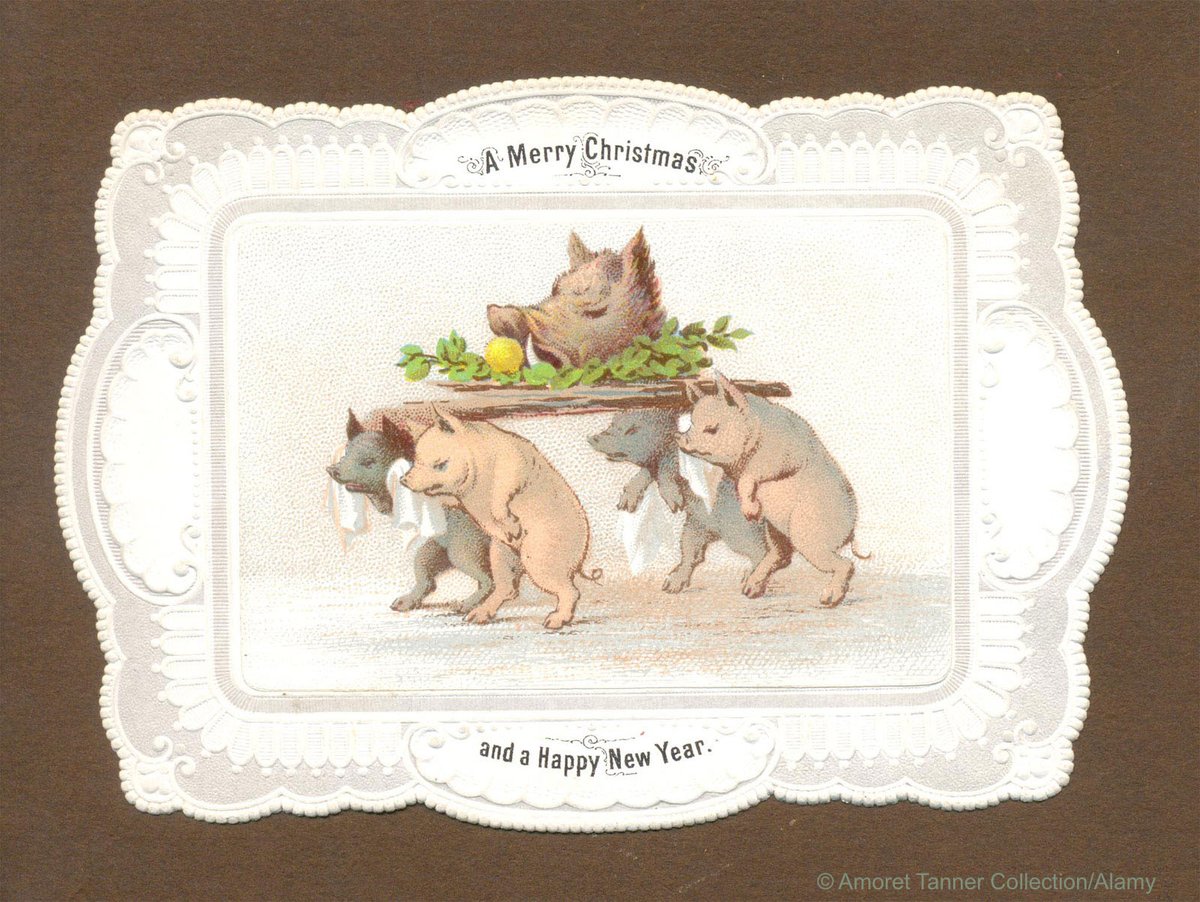
The increased popularity of novelty cards also meant that middle-class families could own a piece of art to display in their homes.

And who wouldn’t want a coy boot-wearing onion hanging on your wall?? A Christmas card featuring a human-like onion carrying a sign that reads "With the Season's Greetings"
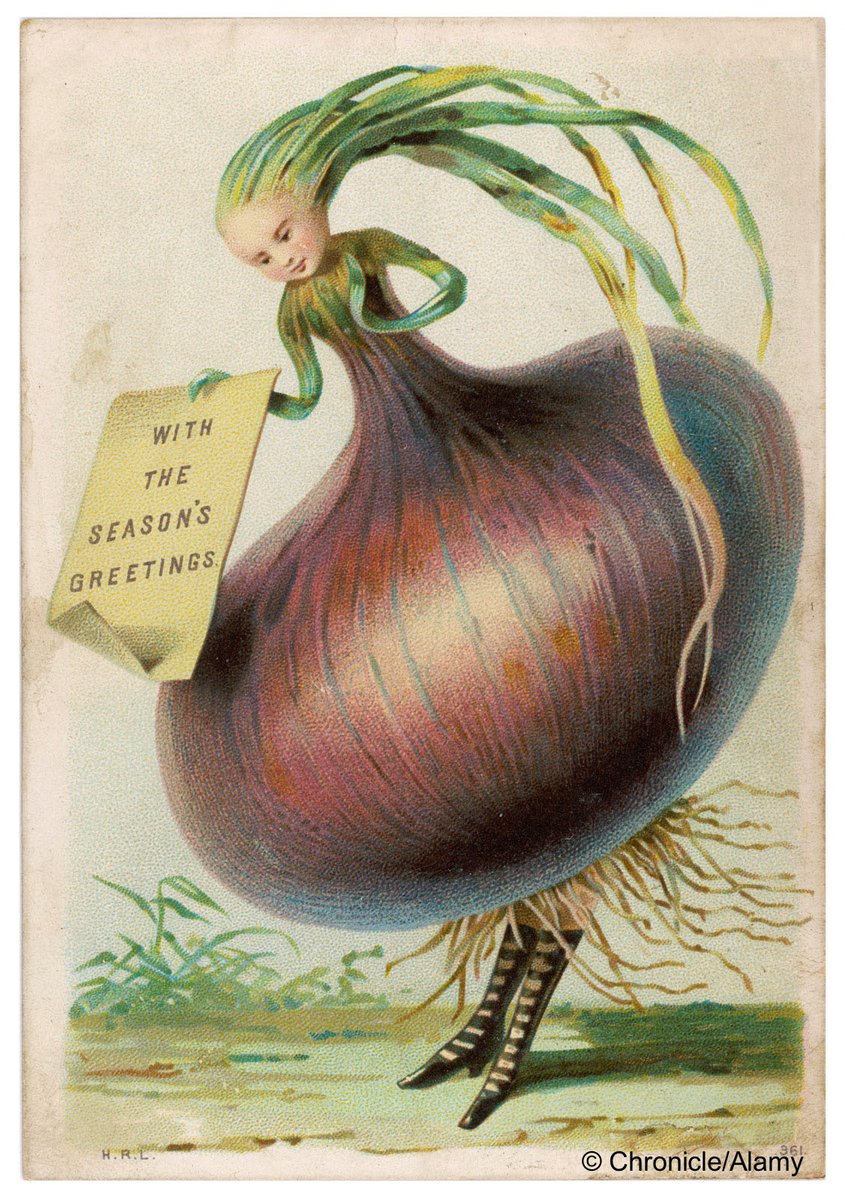
During the height of the Victorian era, many Brits delighted in the bizarre and macabre, even during the holidays.

We have them to thank for the quintessentially odd Christmas cards that still delight (and freak us out) today.

God bless us, everyone. Christmas card that reads "A Merry Christmas to you," featuring a dead frog with a knife in its chest and another frog running away from the scene with a bag of money.
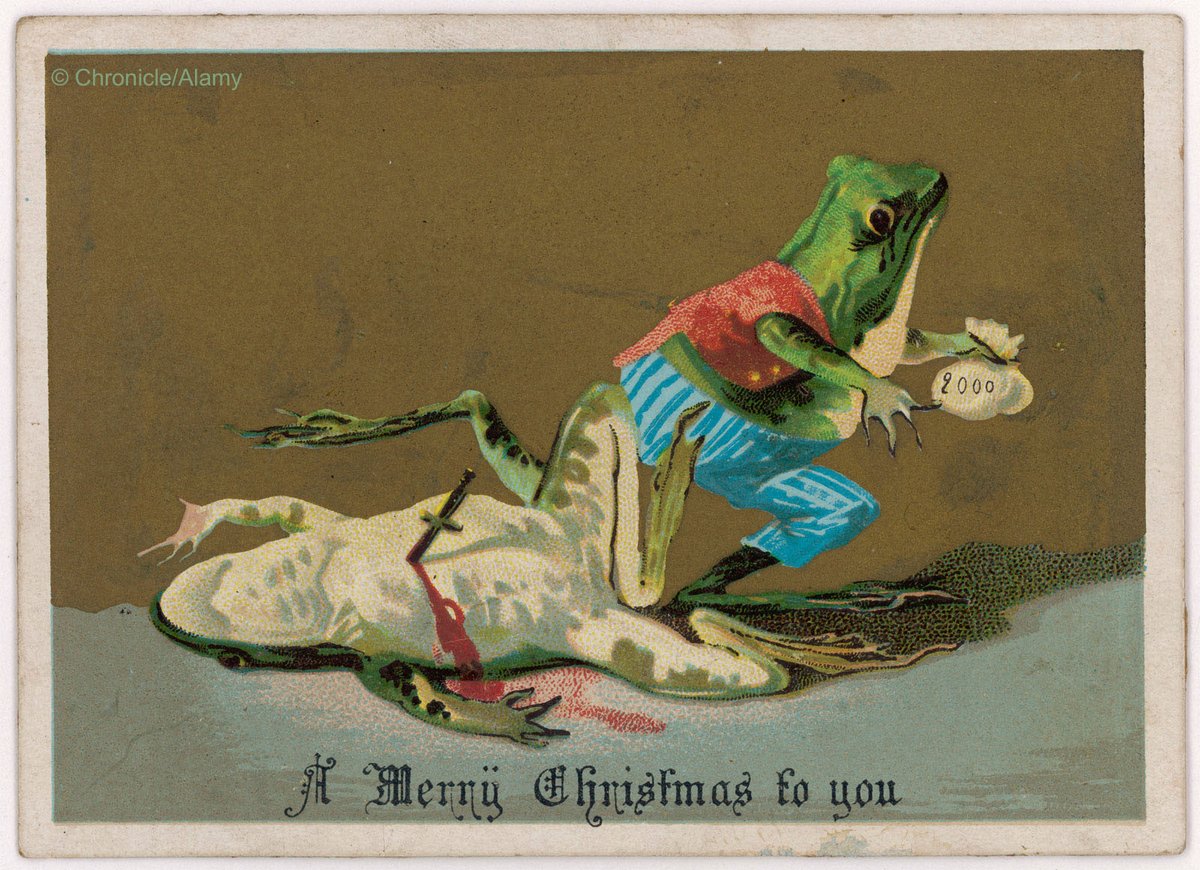
• • •

Missing some Tweet in this thread? You can try to force a refresh

 

Keep Current with Encyclopaedia Britannica

Encyclopaedia Britannica Profile picture

Stay in touch and get notified when new unrolls are available from this author!

Read all threads

This Thread may be Removed Anytime!

PDF

Twitter may remove this content at anytime! Save it as PDF for later use!

Try unrolling a thread yourself!

how to unroll video
  1. Follow @ThreadReaderApp to mention us!

  2. From a Twitter thread mention us with a keyword "unroll"
@threadreaderapp unroll

Practice here first or read more on our help page!

More from @Britannica

Apr 9
In 1309, the Pope moved from Rome to Avignon, France.

This 68-year period is known as the ‘Avignon papacy.’

Why did the move happen, and what did this period represent? 🧵⬇️
Pope Boniface VIII, who was pope from 1294 to 1303, had many disputes with France’s King Philip IV.

Boniface was a formidable character who engaged heavily in non-church politics, often threatening his enemies with excommunication.
Philip did not react well to the pope intervening in political affairs, and the conflict between the two escalated.

Ultimately, Philip had Boniface kidnapped and tortured.

The pope died a month after being released, in 1303, likely from his treatment while imprisoned.
Read 11 tweets
Mar 24
“Led by a corgi across highways and fields.”

Why are we not surprised??

Here’s what makes the Welsh Corgi so special. 🧵⬇️
The Welsh Corgi refers to either of two breeds (Pembroke or Cardigan) of affectionate dogs developed in Wales specifically to herd animals.
The Pembroke Welsh Corgi, which this leader of the pack seems to be, is descended from dogs brought to Wales between the 10th and 12th centuries, possibly by Vikings.

So you know exploring is in their blood.
Read 5 tweets
Mar 14
In honor of World Sleep Day (March 14), here are some of our favorite facts about sleep:

1. In the days before a full moon, people tend to go to bed later and sleep less.

Scientists have not determined a reason for the shift. 🧵⬇️
2. For many Elizabethans in the 17th century, night sleep was divided into 'first' and 'second' sleeps.’

In between these two, people would wake up and take part in activities like reading, praying, or socializing.
3. Today, 75% of us dream in color.

Before color television, only 15% of us did.
Read 4 tweets
Mar 3
Keep a handkerchief on hand for this one.

Your eyes produce three types of tears:
- basal tears
- reflex tears
- emotional tears 🧵⬇️
Basal tears keep your eyes lubricated and are present all the time.

They help protect your corneas, keep away debris, and help you see clearly.
Reflex tears form when you get dirt or debris in your eyes.

They help wash away irritants and have antibodies to fight bacteria.
Read 5 tweets
Feb 24
Plot twist: 67 was a mathematically significant number long before it became a meme.

Here’s what makes it cool:

It is a prime number (can only be divided by itself and 1). But it’s not just ANY prime number. 🧵⬇️
It’s a super prime.

A super prime is a prime number whose position in the ordered list of prime numbers is ITSELF prime.

67 is the 19th prime number, and 19 is also prime.

Super.
It’s a Chen prime.

A prime number (p) is called a Chen prime if p + 2 is either prime or the product of exactly two prime factors.
For 67,

67 + 2 = 69 = 3 x 23
Read 7 tweets
Jun 25, 2025
The Michelin company is responsible for both rubber tires and restaurant guides.

How they got there is an interesting trip. 🧵⬇️
The tire company was founded in 1888 by the Michelin brothers, André and Édouard, in a small French town.

At that time, there were fewer than 3,000 cars in France, total.

This begged the question: How do you sell tires when no one is driving?
The solution? Get people excited about road trips.

More driving = more tire sales

The company created the first pocket-sized “Red Guide” in 1900, which contained helpful info for drivers, like maps, instructions on how to change a tire, and locations of mechanics and hotels.
Read 8 tweets

Did Thread Reader help you today?

Support us! We are indie developers!


This site is made by just two indie developers on a laptop doing marketing, support and development! Read more about the story.

Become a Premium Member ($3/month or $30/year) and get exclusive features!

Become Premium

Don't want to be a Premium member but still want to support us?

Make a small donation by buying us coffee ($5) or help with server cost ($10)

Donate via Paypal

Or Donate anonymously using crypto!

Ethereum

0xfe58350B80634f60Fa6Dc149a72b4DFbc17D341E copy

Bitcoin

3ATGMxNzCUFzxpMCHL5sWSt4DVtS8UqXpi copy

Thank you for your support!

Follow Us!

:(



