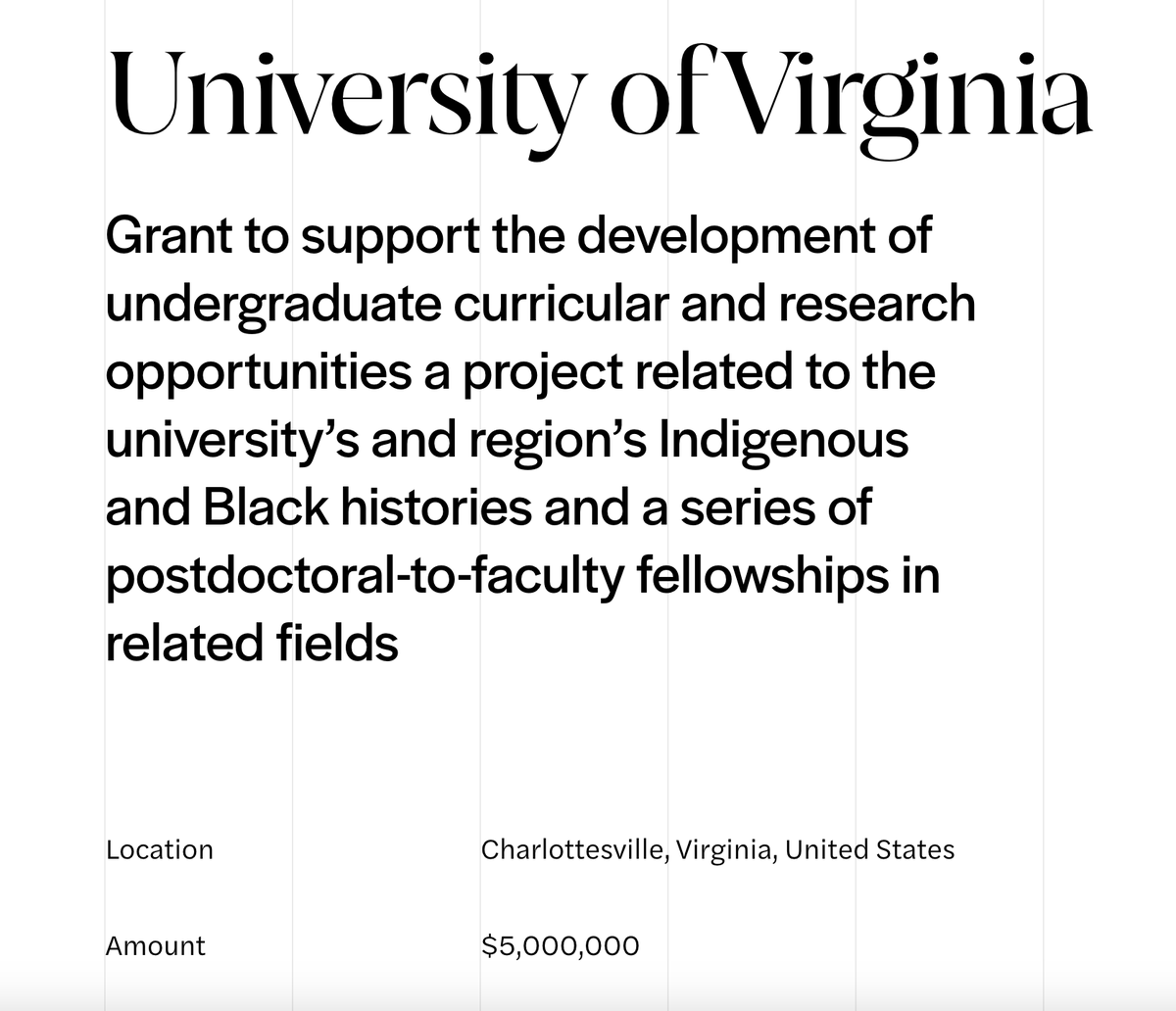
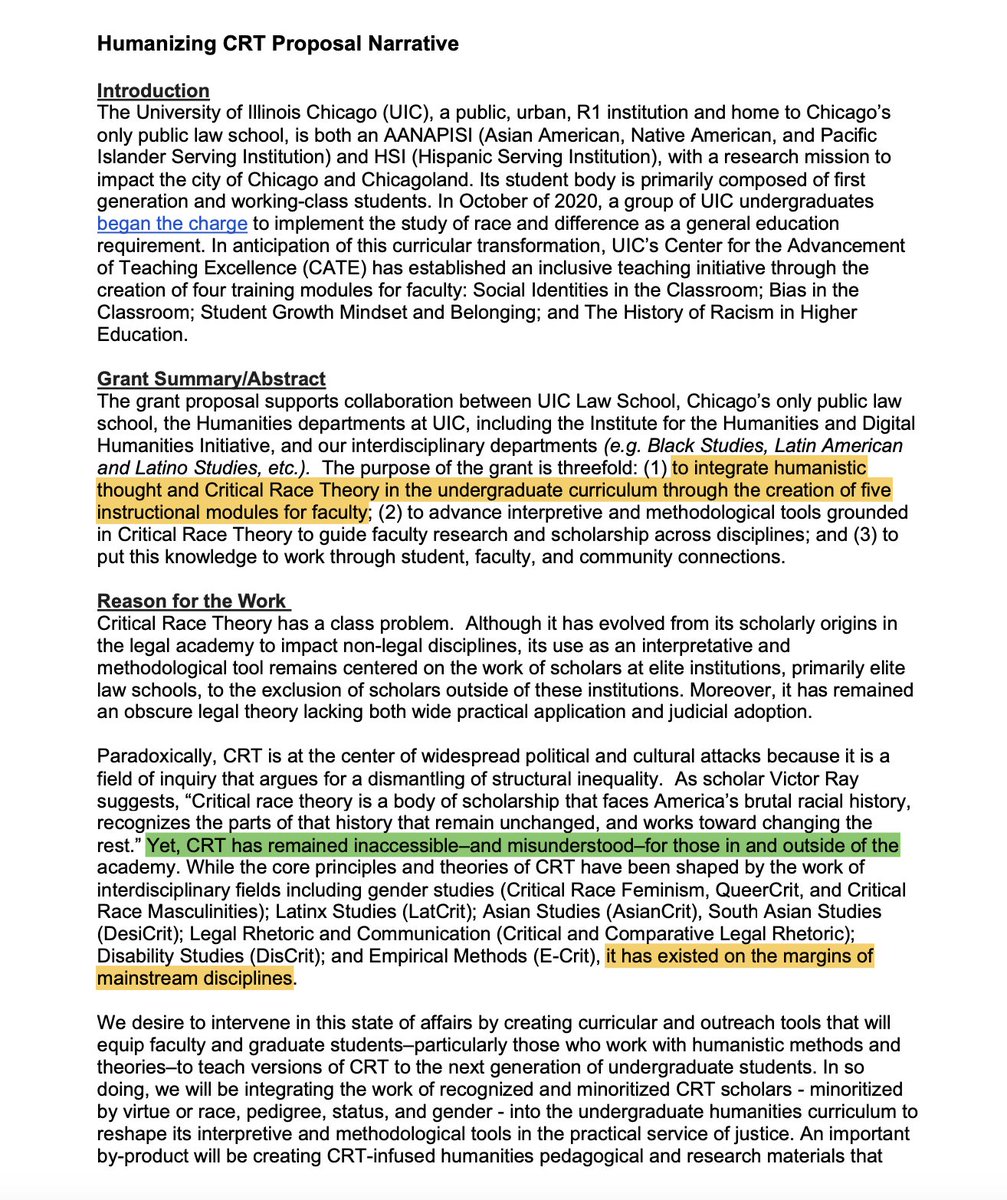
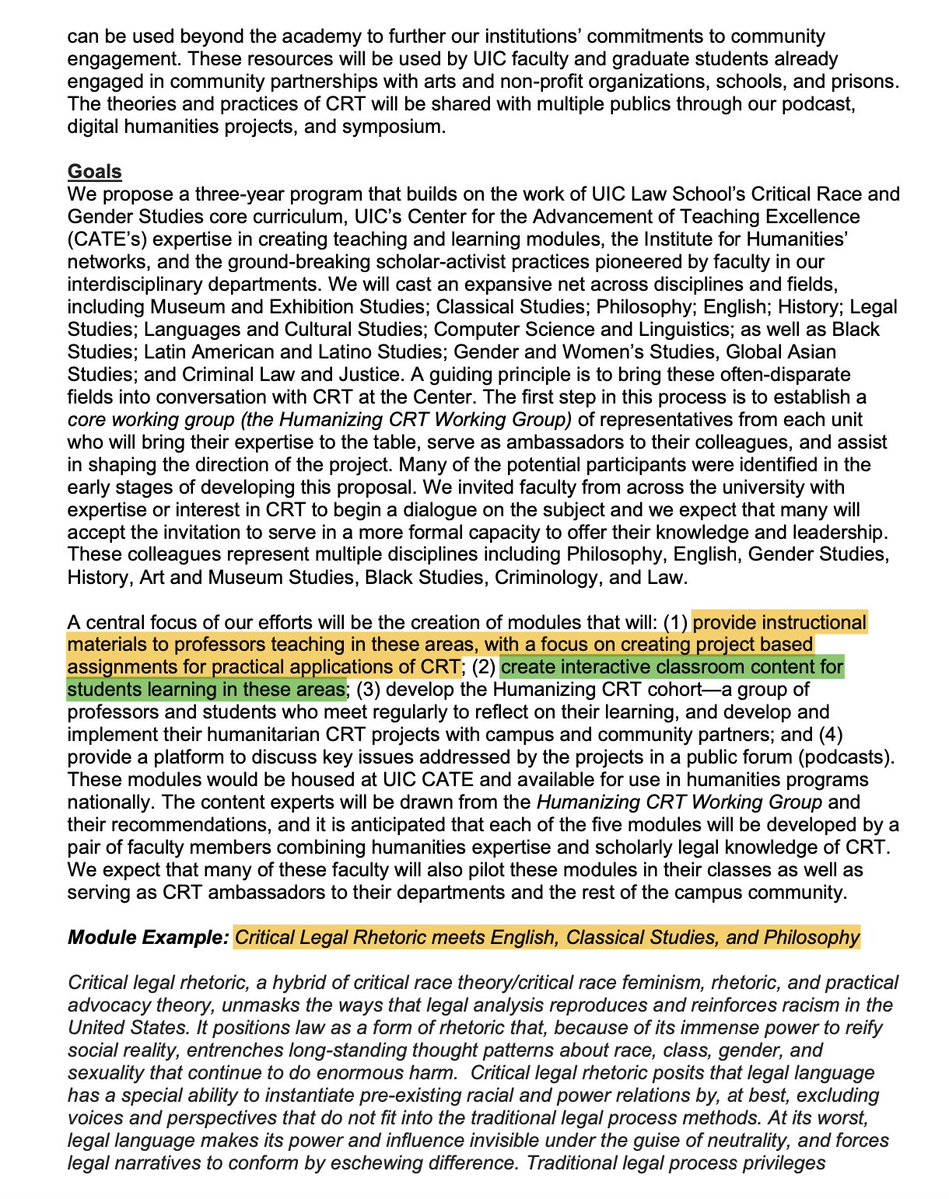
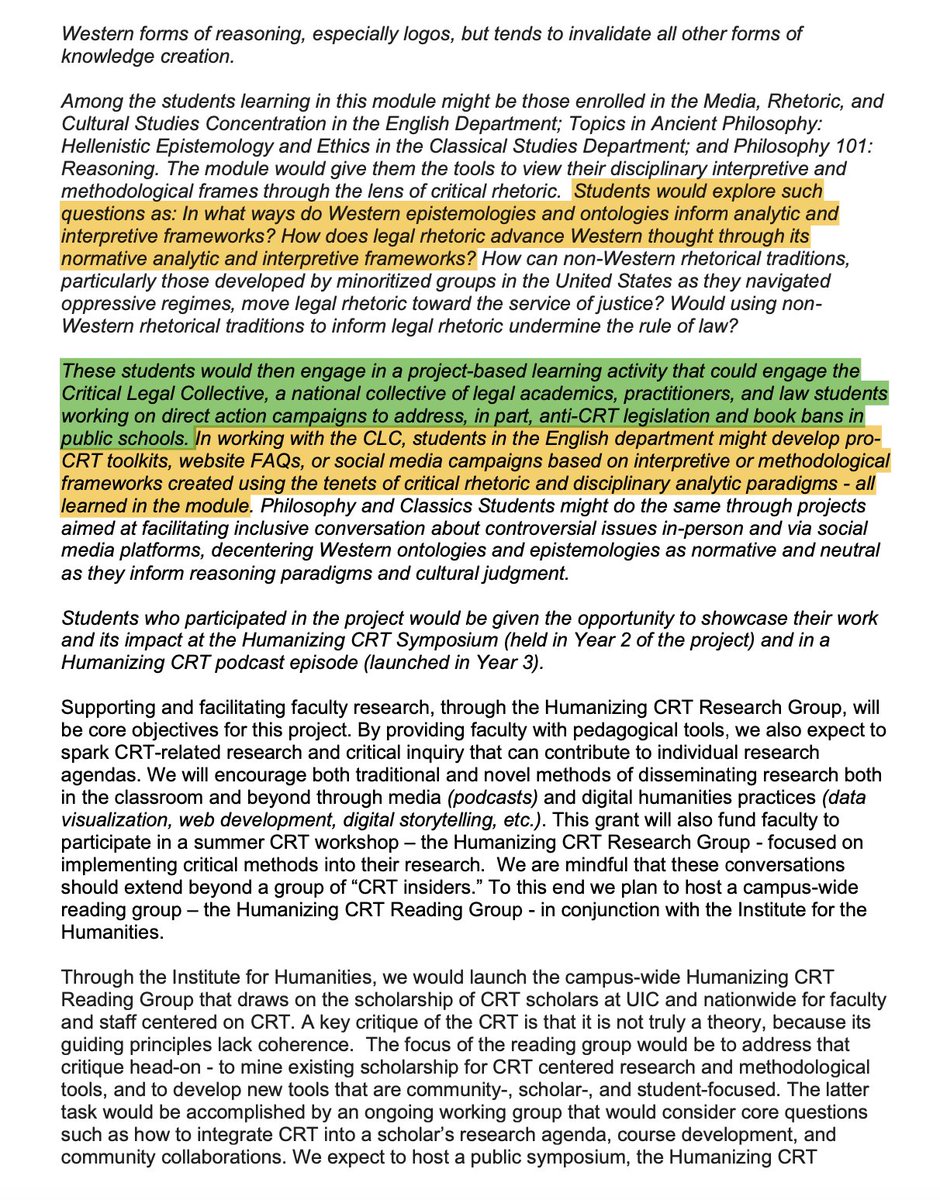
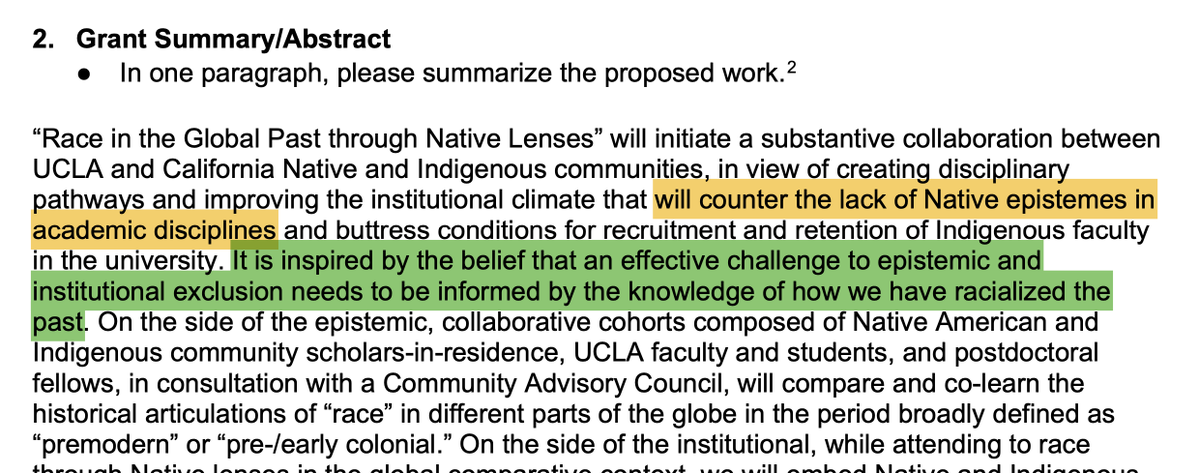
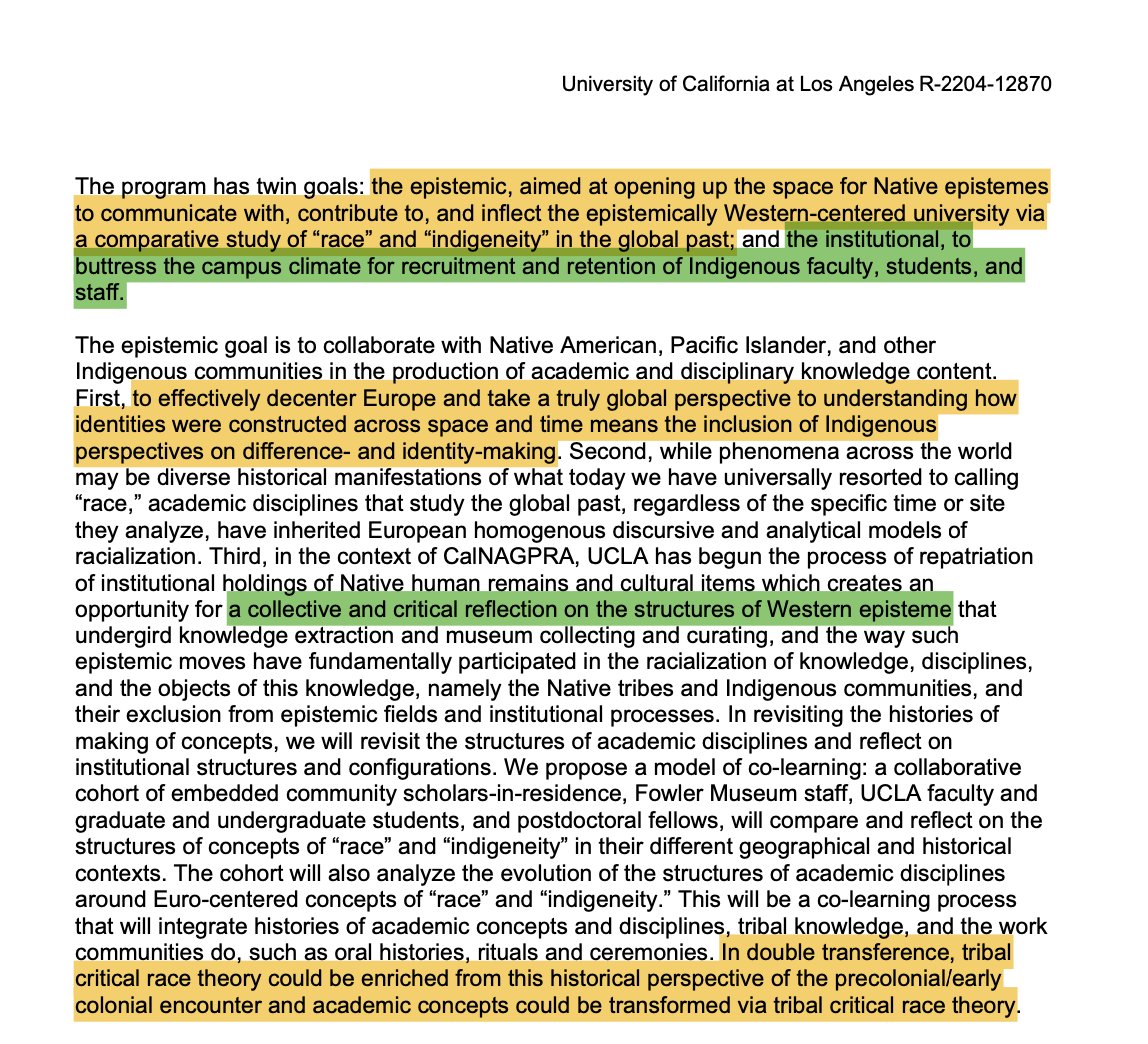
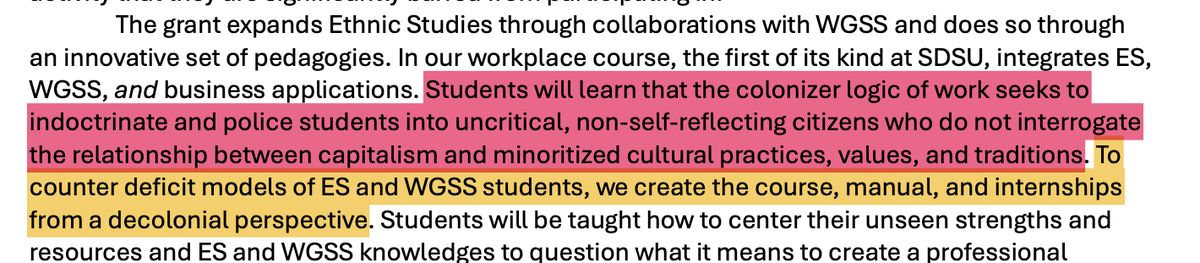
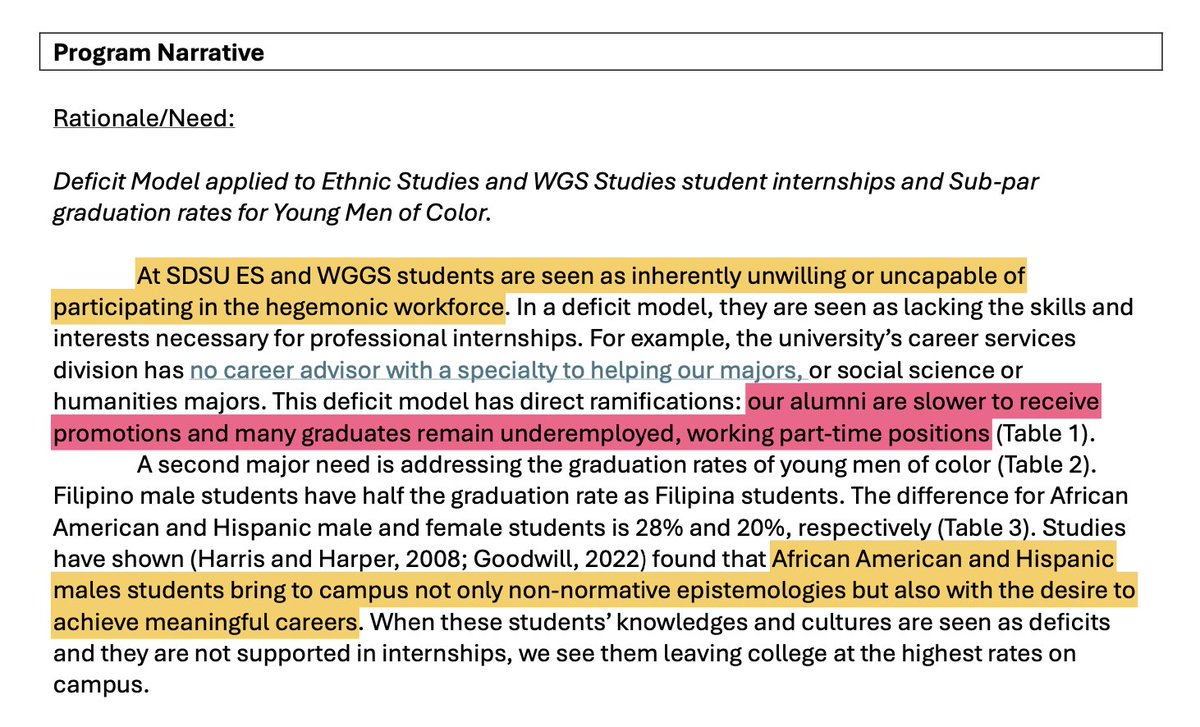
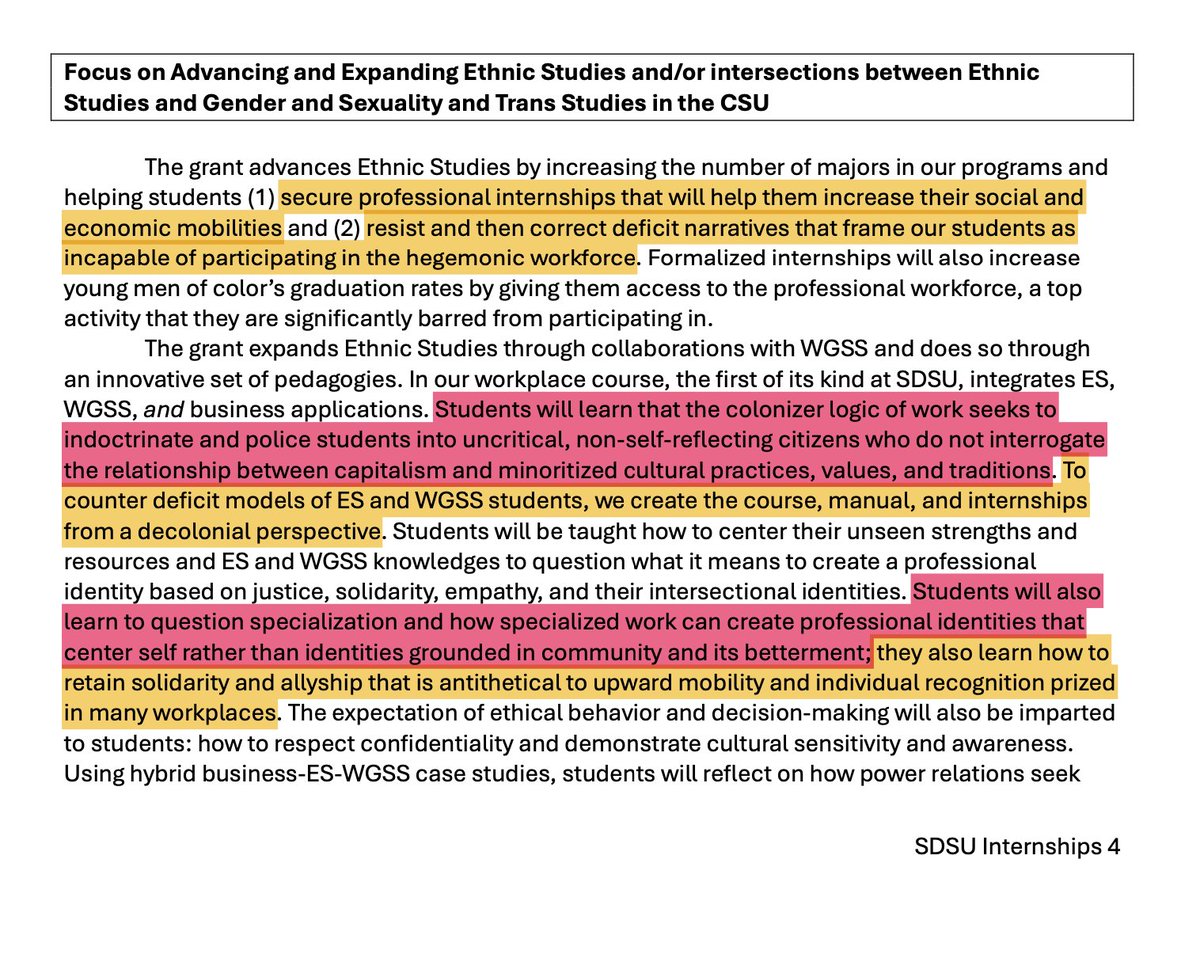
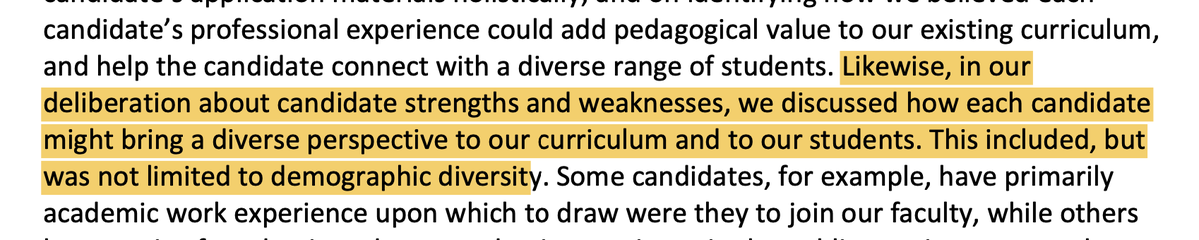
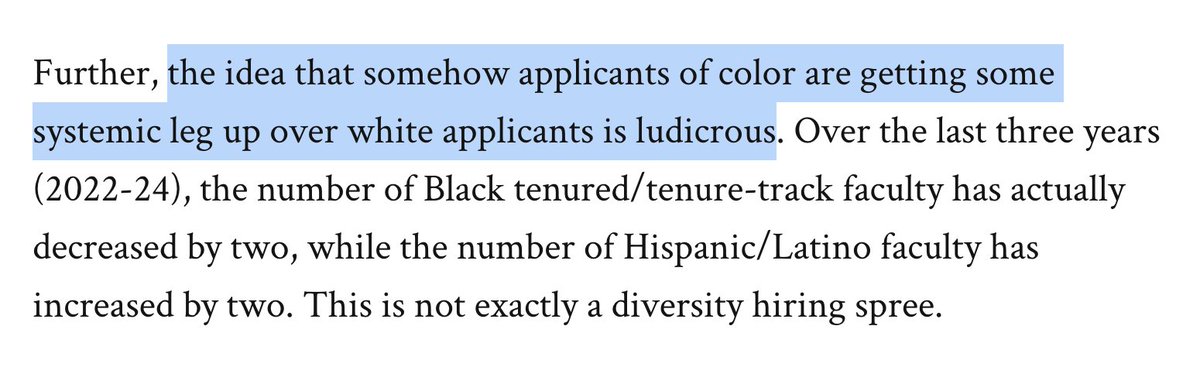
The remarkable thing about discrimination in higher ed: so much of it was documented. Approved in official records. Talked about in emails. All subject to FOIA.
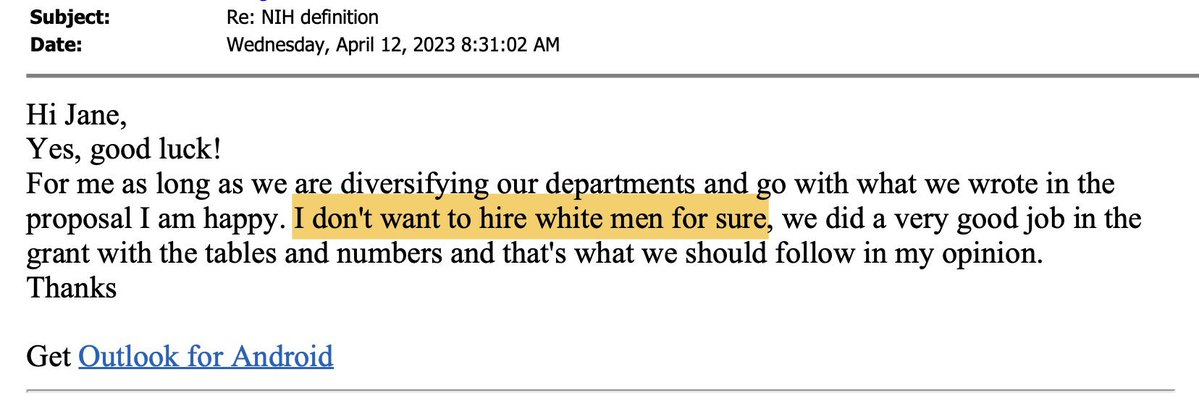
Like this email, where a University of New Mexico professor just says: "I don't want to hire white men for sure."
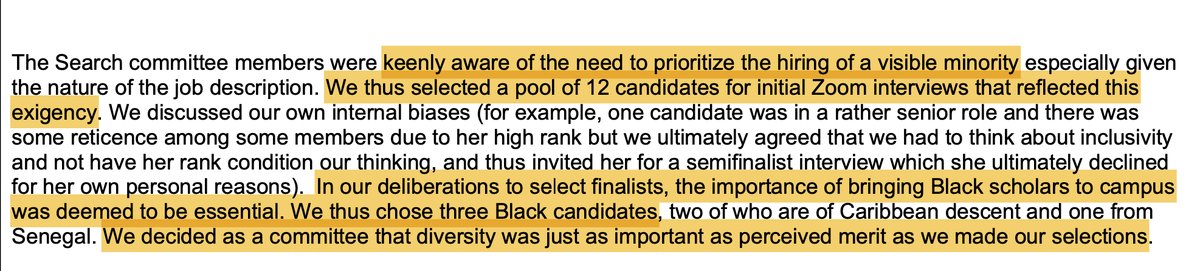
Here's a search committee report from Ohio State saying: "We decided as a committee that diversity was just as important as perceived merit as we made our selection."
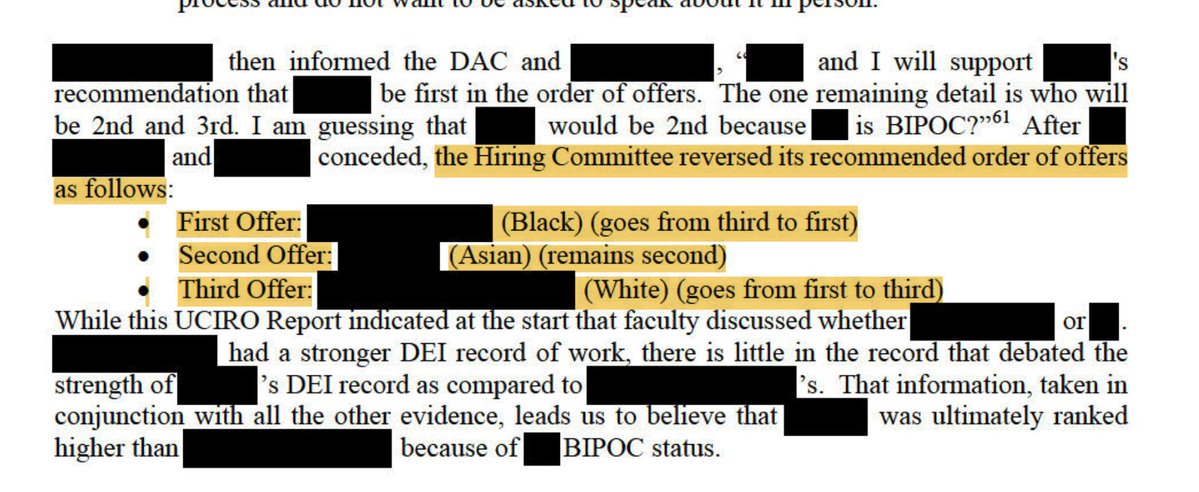
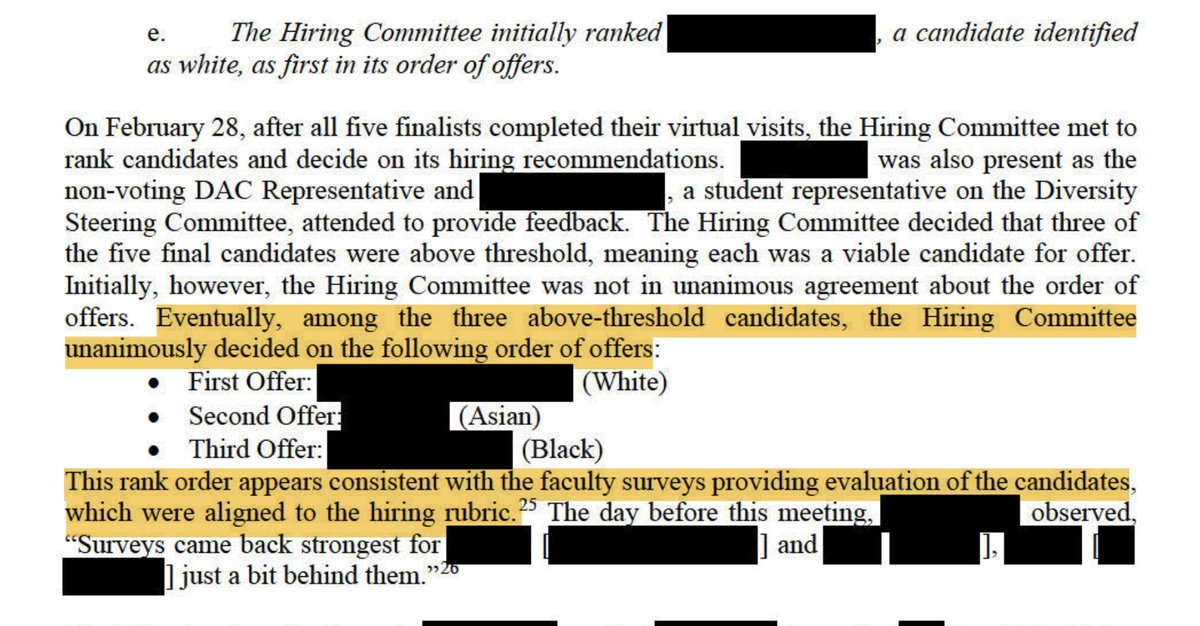
Here's an report from the University of Washington which concluded that its psychology department just blatantly discriminated by re-ranking finalists so the first choice wouldn't be a white woman.
Here's one of many hiring proposals from the University of Colorado making explicit race-based hiring goal: "to hire a Black, Indigenous, or Latinx faculty member."

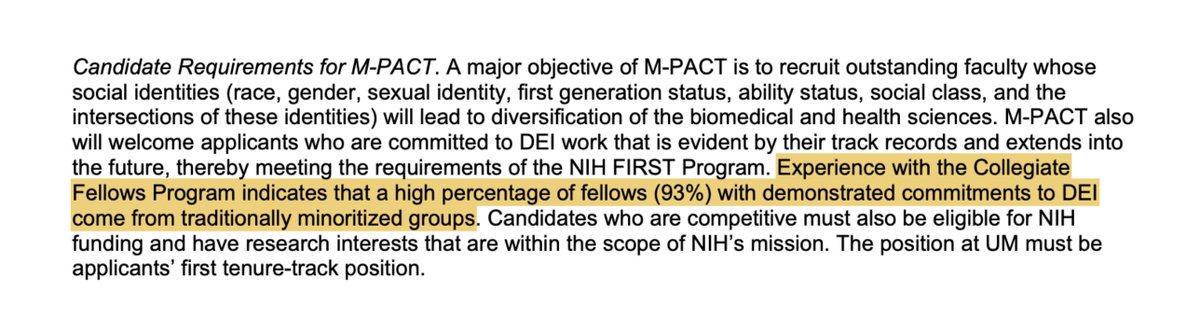
Here's the University of Michigan noting that a key diversity hiring program was successful because, despite using ostensibly race-neutral criteria, 93% of its hires were "from traditionally minoritized groups."
Here's a dean at OSU telling a search committee: “Diversity of the candidates has to be as high of a priority as the scholarship.”
Here's another hiring proposal from University of Colorado. "Our commitment... is to hire someone from the BIPOC community."

Here's a former dean at the University of Michigan describing how she would reject finalist slates if they didn't have the proper racial makeup.
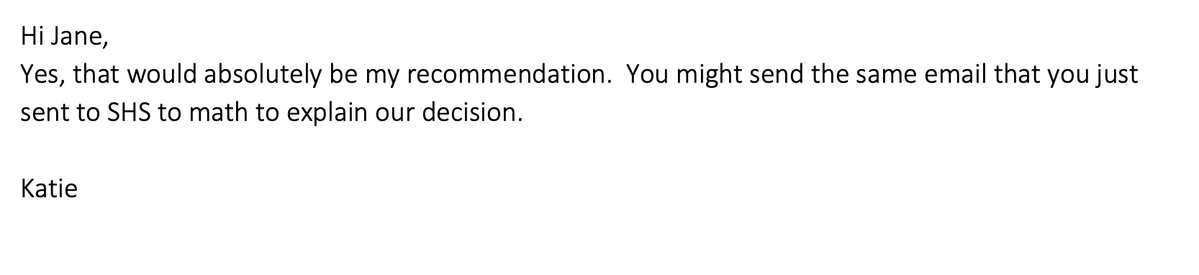
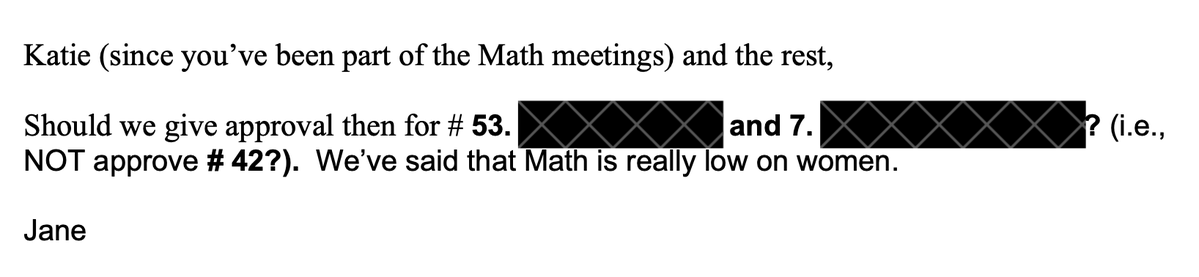
Here's a UNM hiring team rejecting a job candidate because he wasn't an underrepresented minority and the math department is "really short on women."
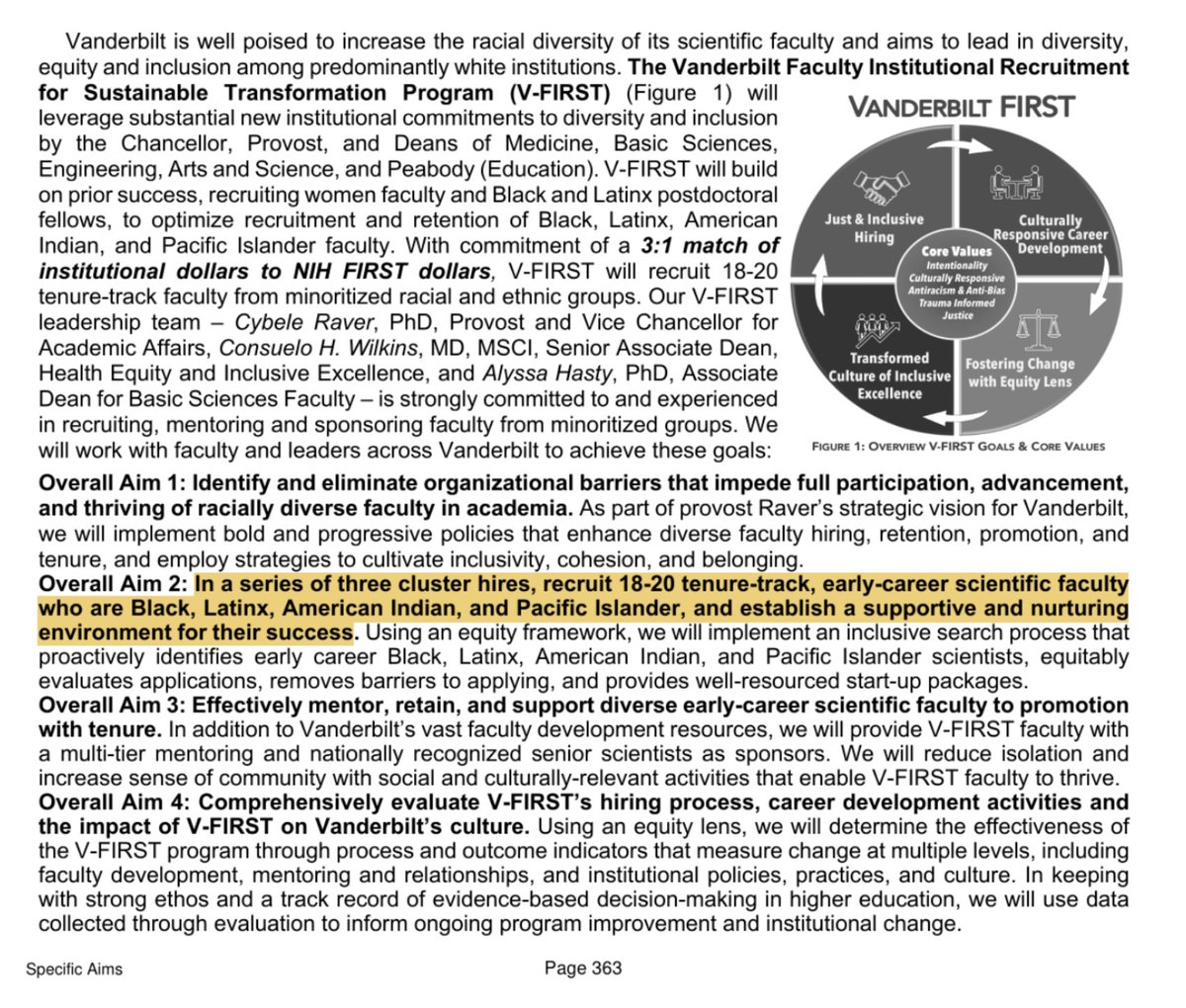
Here's Vanderbilt describing a 18-20 person hiring program reserved exclusively for "Black, Latinx, American Indian, and Pacific Islander" faculty.
• • •
Missing some Tweet in this thread? You can try to
force a refresh

NEW: During one hiring cycle at Ohio State, 60% of new arts and humanities faculty jobs fell in the “DEI” category, according to emails I obtained.
This was after OSU announced it would hire “100 underrepresented and BIPOC hires in all fields of scholarship.”
🧵on my latest.
In 2021, Ohio State’s then-president Kristina Johnson announced an initiative to hire 50 scholars focused on “social equity” and 100 “underrepresented and BIPOC” hires in all disciplines.
Documents I’ve acquired, reported in @CityJournal, shed light on how that played out.
@CityJournal The documents reveal how administrators were keeping tabs on the hiring spree.
In November 2022, an OSU diversity dean said over email that she wanted to meet with the finalists for a DEI-focused faculty job: professor of “indigenous knowledges.”
Last week, the DOJ released guidance for federal funding recipients.
The memo—which clarifies how nondiscrimination law should be applied—is a huge development for universities. A lot of their worst policies are looking more fragile than ever. 🧵
2/ The DOJ specifically highlights the use of racial proxies. Hiring on the basis of "cultural competence" or using diversity statements is unlawful if the purpose is to give an advantage to specific racial groups.
This is an even bigger deal than it might seem.
3/ Universities often take on large-scale hiring programs that select for an emphasis on "equity."
Inevitably the programs recruit ideologues. More importantly, this criteria is justified because it's seen as a way to favor minorities. It's right there in their own documents ⬇️
NEW: Around the country, college deans monitor finalist slates, shortlists, and applicant pools for faculty jobs. If a list isn't "diverse," a search can be outright cancelled.
I've acquired a trove of records that show who bankrolled this practice: the federal government.
🧵
As I’ve previously reported, these checkpoints give administrators diversity-based veto power in hiring (see ⬇️⬇️⬇️ for examples).
But the practice didn’t emerge organically. At many universities, it was adopted as direct result of National Science Foundation (NSF) funding.
Here’s what those grants look like.
In 2003, Case Western Reserve University received one of the early NSF ADVANCE grants ($3.5 million).
As a part of the grant, “deans could send a list back to the department if it did not reflect the diversity of the national pool.”
NEW: Universities across the U.S. have embraced diversity checkpoints in faculty hiring.
Administrators monitor the demographics of applicants throughout the process, with consequences for searches that don't "pass muster"—according to a trove of records I've obtained.
🧵
In one email—acquired via a records request—UT Austin professor Carma Gorman asked diversity-dean John Yancey whether her search committee’s pool was sufficiently diverse to advance.
The dean said yes, but if the numbers dropped “then things don’t look good anymore.”
At the University of Illinois at Urbana-Champaign (UIUC), the Human Resources director would send weekly “diversity of the pool reports,” which would continue up to the selection of finalists.
If the makeup was deemed “insufficient,” more administrators would get involved.
DOCUMENTS: At Cornell, search committees that were hiring biomedical scientists had to pass four "checkpoints" to make sure their pools were "sufficiently diverse."
"That certainly looks like a Title VII violation," one legal expert told me when discussing the program.
🧵
In 2021, Cornell received a $16 million NIH grant for the Cornell FIRST hiring program—aiming, in the proposal’s words, to "increase the number of minoritized faculty" at Cornell and beyond.
I acquired a trove of documents that show how this played out.
According to a proposal and set of progress reports, the program's leadership team screened applicants at four separate stages—the initial pool, longlist, shortlist, and finalist slate—to ensure “as diverse a pool as possible.”