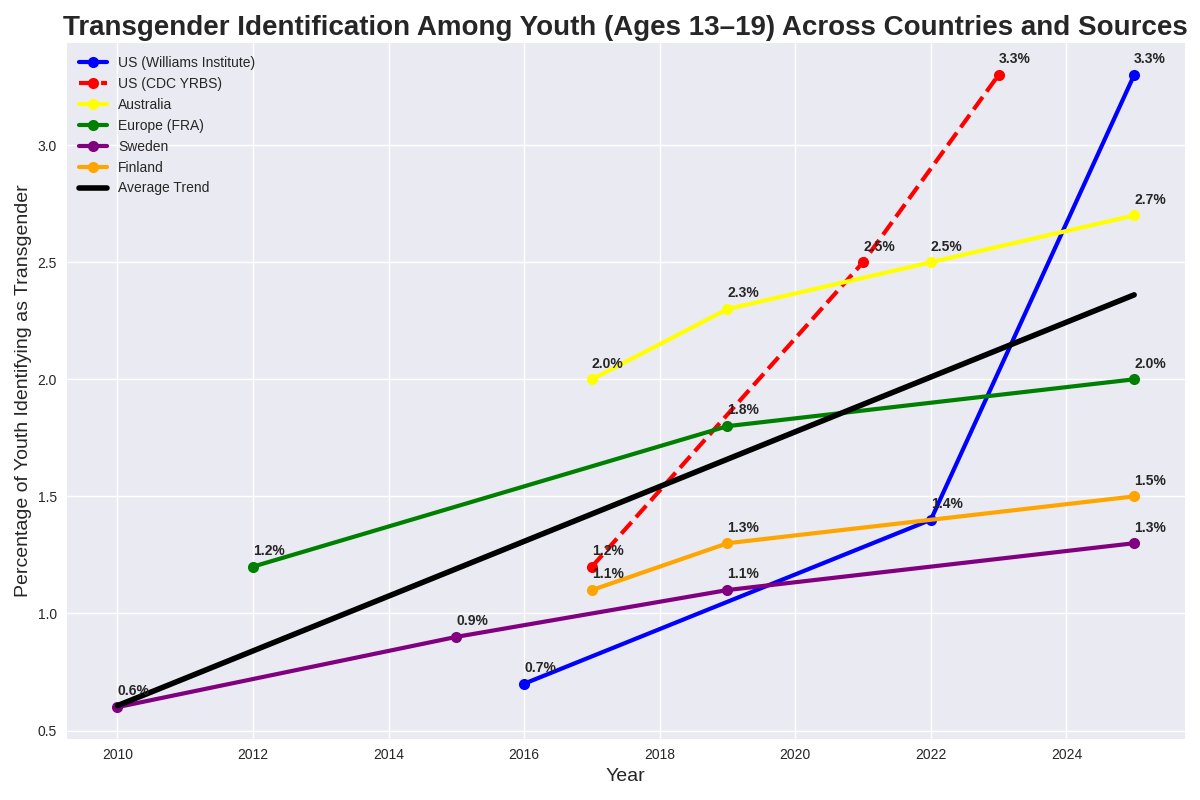
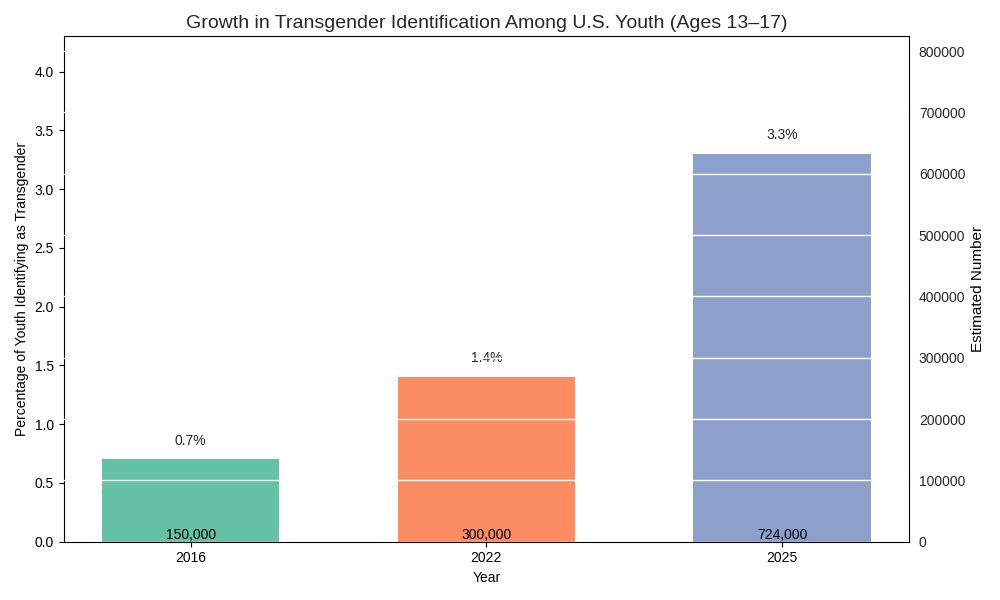
Asking: is the self a performative costume we swap out at will, or a sedimented structure built through lived experience?
Identity that ignores this (like trans) becomes like a thin shell: endlessly customizable, visually striking, but prone to fracture under pressure. Thread below 🧵
Identity that ignores this (like trans) becomes like a thin shell: endlessly customizable, visually striking, but prone to fracture under pressure. Thread below 🧵
Details here:
Asking: is the self a performative costume we swap out at will, or a sedimented structure built through lived experience?
Below is one way to frame that using classic depth psychology, then juxtapose it with late‑modern “identity manufacture,” with Pinker and Byung‑Chul Han as bridges.
1. Core claim: self emerges from experience, not the other way around
On a depth-psychology view, you don’t start with a fully formed “Self” that then goes out to have experiences. Instead, your sense of self is gradually generated by how you meet reality: caregivers, limits, losses, triumphs, shame, love, embodiment, time.
The process is roughly:
Biology gives potentials and constraints. Temperament, affective reactivity, cognitive style, etc., are there from the beginning. Pinker would call these part of our evolved psychological “toolkit,” not a blank slate.
Relational experience organizes those potentials. Attachment patterns, mirroring, attunement/misattunement, cultural narratives—all shape how those potentials are integrated or split off.
Narrative and meaning consolidate the self. Over time, we weave experiences into a story (“who I am”) that becomes the baseline of identity. That story is constrained by what has actually happened and how we’ve metabolized it, not just by what we wish to perform.
So: self is enacted and sedimented across time. Identity is a derivative—a way this underlying structure gets named, expressed, and socialized.
Asking: is the self a performative costume we swap out at will, or a sedimented structure built through lived experience?
Below is one way to frame that using classic depth psychology, then juxtapose it with late‑modern “identity manufacture,” with Pinker and Byung‑Chul Han as bridges.
1. Core claim: self emerges from experience, not the other way around
On a depth-psychology view, you don’t start with a fully formed “Self” that then goes out to have experiences. Instead, your sense of self is gradually generated by how you meet reality: caregivers, limits, losses, triumphs, shame, love, embodiment, time.
The process is roughly:
Biology gives potentials and constraints. Temperament, affective reactivity, cognitive style, etc., are there from the beginning. Pinker would call these part of our evolved psychological “toolkit,” not a blank slate.
Relational experience organizes those potentials. Attachment patterns, mirroring, attunement/misattunement, cultural narratives—all shape how those potentials are integrated or split off.
Narrative and meaning consolidate the self. Over time, we weave experiences into a story (“who I am”) that becomes the baseline of identity. That story is constrained by what has actually happened and how we’ve metabolized it, not just by what we wish to perform.
So: self is enacted and sedimented across time. Identity is a derivative—a way this underlying structure gets named, expressed, and socialized.
2. How the classic traditions ground self in experience
Adler: striving, inferiority, and life-style
For Adler, the core is not a static essence but a style of life: your characteristic way of moving through the world, formed early via how you respond to felt inferiority and social context.
Inferiority and compensation: The child experiences smallness, dependency, humiliation; in response, they develop compensatory patterns—striving for mastery, power, belonging.
Style of life as experiential pattern: That style is not chosen from a menu; it crystalizes out of repeated experiences of success, failure, encouragement, or discouragement.
Social embeddedness: Identity (e.g., “helper,” “rebel,” “achiever”) is an expression of this life-style in a social field, not a free-floating label.
Self, here, is teleological and relational: formed in and through striving in a real world that pushes back.
Jung: individuation and symbolic experience
Jung gives you both an innate architecture and a heavy emphasis on lived symbolic experience.
Archetypal potential, experiential activation: Archetypes are structural potentials; they only become personal through specific experiences—encountering shadow, anima/animus, wise old man, etc., in dreams, relationships, crises.
Individuation as lived process: The Self (big-S) is not a costume; it’s the ongoing integration of previously split-off contents, achieved through confronting concrete life issues, not through purely discursive identity claims.
Symbols as condensations of experience: Symbols that organize the self (e.g., “warrior,” “healer”) have power because they emerge from real conflicts, wounds, and tasks.
Identity here is a surface articulation of deeper experiential and symbolic work.
Existential: self as choice under constraint
Existential thinkers emphasize that the self is forged in decisions made under real conditions—finitude, freedom, responsibility, and contingency.
Thrownness: You’re thrown into a particular body, history, family, culture. You don’t choose these; they set the initial canvas.
Choice and commitment: Who you become is shaped by how you respond to this thrownness—what you commit to, what you refuse, what you endure.
Authenticity vs. role-playing: “Bad faith” is when identity becomes purely a role or mask that evades genuine confrontation with anxiety, guilt, and limitation.
So self is a history of choices within a given world, not an infinitely rewriteable profile.
Psychodynamic: internalization, conflict, and structure
Psychodynamic theories (Freud, object relations, self psychology) are the most explicit about structure emerging from experience:
Internal objects and self-representations: Early interactions become internalized as “object relations” and self-images (“I am lovable/unlovable,” “others are safe/dangerous”).
Ego structure from managing conflict: The ego grows by learning to regulate drives, affects, and reality demands. This capacity for regulation is built through repeated, real experiences of being held, frustrated, recognized, and limited.
Stable character as crystallized history: “Character” is the solidified pattern of defenses, capacities, and relational expectations. Identity labels are the social face of that character.
Here, a “sense of self” is literally the organized pattern of how experience has been processed over time.
Adler: striving, inferiority, and life-style
For Adler, the core is not a static essence but a style of life: your characteristic way of moving through the world, formed early via how you respond to felt inferiority and social context.
Inferiority and compensation: The child experiences smallness, dependency, humiliation; in response, they develop compensatory patterns—striving for mastery, power, belonging.
Style of life as experiential pattern: That style is not chosen from a menu; it crystalizes out of repeated experiences of success, failure, encouragement, or discouragement.
Social embeddedness: Identity (e.g., “helper,” “rebel,” “achiever”) is an expression of this life-style in a social field, not a free-floating label.
Self, here, is teleological and relational: formed in and through striving in a real world that pushes back.
Jung: individuation and symbolic experience
Jung gives you both an innate architecture and a heavy emphasis on lived symbolic experience.
Archetypal potential, experiential activation: Archetypes are structural potentials; they only become personal through specific experiences—encountering shadow, anima/animus, wise old man, etc., in dreams, relationships, crises.
Individuation as lived process: The Self (big-S) is not a costume; it’s the ongoing integration of previously split-off contents, achieved through confronting concrete life issues, not through purely discursive identity claims.
Symbols as condensations of experience: Symbols that organize the self (e.g., “warrior,” “healer”) have power because they emerge from real conflicts, wounds, and tasks.
Identity here is a surface articulation of deeper experiential and symbolic work.
Existential: self as choice under constraint
Existential thinkers emphasize that the self is forged in decisions made under real conditions—finitude, freedom, responsibility, and contingency.
Thrownness: You’re thrown into a particular body, history, family, culture. You don’t choose these; they set the initial canvas.
Choice and commitment: Who you become is shaped by how you respond to this thrownness—what you commit to, what you refuse, what you endure.
Authenticity vs. role-playing: “Bad faith” is when identity becomes purely a role or mask that evades genuine confrontation with anxiety, guilt, and limitation.
So self is a history of choices within a given world, not an infinitely rewriteable profile.
Psychodynamic: internalization, conflict, and structure
Psychodynamic theories (Freud, object relations, self psychology) are the most explicit about structure emerging from experience:
Internal objects and self-representations: Early interactions become internalized as “object relations” and self-images (“I am lovable/unlovable,” “others are safe/dangerous”).
Ego structure from managing conflict: The ego grows by learning to regulate drives, affects, and reality demands. This capacity for regulation is built through repeated, real experiences of being held, frustrated, recognized, and limited.
Stable character as crystallized history: “Character” is the solidified pattern of defenses, capacities, and relational expectations. Identity labels are the social face of that character.
Here, a “sense of self” is literally the organized pattern of how experience has been processed over time.
3. Self as baseline of identity, stability, and resilience
Putting those strands together:
Self as baseline structure: Your sense of self is the relatively enduring way you experience “me” across contexts—feeling of continuity, agency, worth, and coherence. It’s built from repeated experiences that either confirm or disrupt that continuity.
Identity as expression and interface: Identity (roles, affiliations, descriptors: “brother,” “therapist,” “queer,” “introvert,” etc.) is how that baseline self gets articulated and negotiated socially.
Resilience from integrated history: Stability and resilience come from having:
A coherent story that can hold pain, conflict, and contradiction.
Emotional and relational capacities forged in real stressors.
Internalized others and narratives that support enduring meaning.
Depth traditions say: if identity is not anchored in this experiential, structured self, it becomes brittle—susceptible to collapse whenever reality doesn’t mirror the performance.
Putting those strands together:
Self as baseline structure: Your sense of self is the relatively enduring way you experience “me” across contexts—feeling of continuity, agency, worth, and coherence. It’s built from repeated experiences that either confirm or disrupt that continuity.
Identity as expression and interface: Identity (roles, affiliations, descriptors: “brother,” “therapist,” “queer,” “introvert,” etc.) is how that baseline self gets articulated and negotiated socially.
Resilience from integrated history: Stability and resilience come from having:
A coherent story that can hold pain, conflict, and contradiction.
Emotional and relational capacities forged in real stressors.
Internalized others and narratives that support enduring meaning.
Depth traditions say: if identity is not anchored in this experiential, structured self, it becomes brittle—susceptible to collapse whenever reality doesn’t mirror the performance.
3. Self as baseline of identity, stability, and resilience
Putting those strands together:
Self as baseline structure: Your sense of self is the relatively enduring way you experience “me” across contexts—feeling of continuity, agency, worth, and coherence. It’s built from repeated experiences that either confirm or disrupt that continuity.
Identity as expression and interface: Identity (roles, affiliations, descriptors: “brother,” “therapist,” “queer,” “introvert,” etc.) is how that baseline self gets articulated and negotiated socially.
Resilience from integrated history: Stability and resilience come from having:
A coherent story that can hold pain, conflict, and contradiction.
Emotional and relational capacities forged in real stressors.
Internalized others and narratives that support enduring meaning.
Depth traditions say: if identity is not anchored in this experiential, structured self, it becomes brittle—susceptible to collapse whenever reality doesn’t mirror the performance.
Putting those strands together:
Self as baseline structure: Your sense of self is the relatively enduring way you experience “me” across contexts—feeling of continuity, agency, worth, and coherence. It’s built from repeated experiences that either confirm or disrupt that continuity.
Identity as expression and interface: Identity (roles, affiliations, descriptors: “brother,” “therapist,” “queer,” “introvert,” etc.) is how that baseline self gets articulated and negotiated socially.
Resilience from integrated history: Stability and resilience come from having:
A coherent story that can hold pain, conflict, and contradiction.
Emotional and relational capacities forged in real stressors.
Internalized others and narratives that support enduring meaning.
Depth traditions say: if identity is not anchored in this experiential, structured self, it becomes brittle—susceptible to collapse whenever reality doesn’t mirror the performance.
5. Pinker: against the total plasticity of identity
Steven Pinker, from a very different angle, pushes back against the idea that humans are infinitely malleable social constructions. In The Blank Slate, he argues:
Human nature is not a blank slate: The mind comes with evolved structures—preferences, emotions, cognitive biases—that constrain how culture and experience can shape us.
Critique of radical social constructionism: The claim that identity is purely written by culture and discourse ignores genetic and evolutionary contributions to behavior, personality, and cognition.
Limits on manufactured selves: Because of this evolved architecture, not every identity script is equally livable or psychologically sustainable. There are real constraints from aggression, attachment needs, status dynamics, sex differences, etc.
While Pinker isn’t a depth psychologist, he converges with them in rejecting a fantasy of total self-construction. There is always:
An underlying architecture (nature).
A long developmental history (nurture as experienced).
Constraints on what kinds of identities can be stably inhabited.
Steven Pinker, from a very different angle, pushes back against the idea that humans are infinitely malleable social constructions. In The Blank Slate, he argues:
Human nature is not a blank slate: The mind comes with evolved structures—preferences, emotions, cognitive biases—that constrain how culture and experience can shape us.
Critique of radical social constructionism: The claim that identity is purely written by culture and discourse ignores genetic and evolutionary contributions to behavior, personality, and cognition.
Limits on manufactured selves: Because of this evolved architecture, not every identity script is equally livable or psychologically sustainable. There are real constraints from aggression, attachment needs, status dynamics, sex differences, etc.
While Pinker isn’t a depth psychologist, he converges with them in rejecting a fantasy of total self-construction. There is always:
An underlying architecture (nature).
A long developmental history (nurture as experienced).
Constraints on what kinds of identities can be stably inhabited.
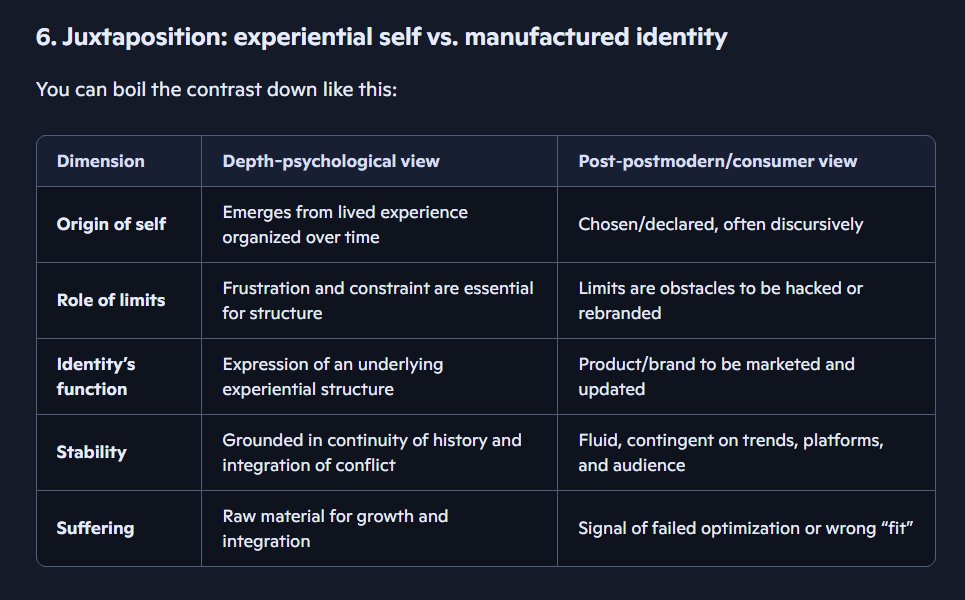
6. Juxtaposition: experiential self vs. manufactured identity.
Han highlights how this manufactured, market‑driven identity generates burnout because the subject must constantly reinvent and perform itself with no stable ground. Pinker reminds us that beneath all this, humans remain embodied creatures with relatively stable psychological needs and propensities that can’t simply be overwritten.Wikipedia+1
From an Adler/Jung/existential/psychodynamic standpoint, resilience and genuine flexibility come precisely from having a self that is:
Rooted in real history, not just in narrative experimentation.
Structured enough to withstand disconfirmation.
Deep enough to metabolize suffering rather than immediately rebranding it.
Identity that ignores this becomes like a thin shell: endlessly customizable, visually striking, but prone to fracture under pressure.
- END
Han highlights how this manufactured, market‑driven identity generates burnout because the subject must constantly reinvent and perform itself with no stable ground. Pinker reminds us that beneath all this, humans remain embodied creatures with relatively stable psychological needs and propensities that can’t simply be overwritten.Wikipedia+1
From an Adler/Jung/existential/psychodynamic standpoint, resilience and genuine flexibility come precisely from having a self that is:
Rooted in real history, not just in narrative experimentation.
Structured enough to withstand disconfirmation.
Deep enough to metabolize suffering rather than immediately rebranding it.
Identity that ignores this becomes like a thin shell: endlessly customizable, visually striking, but prone to fracture under pressure.
- END
• • •
Missing some Tweet in this thread? You can try to
force a refresh