Happy New Year! 🎊🎆 My first morning of 2026 has been dedicated to digging deeper into research used to support the choice-based models growing in popularity in the US. 🤓 ☕️ 📖
Here we go.
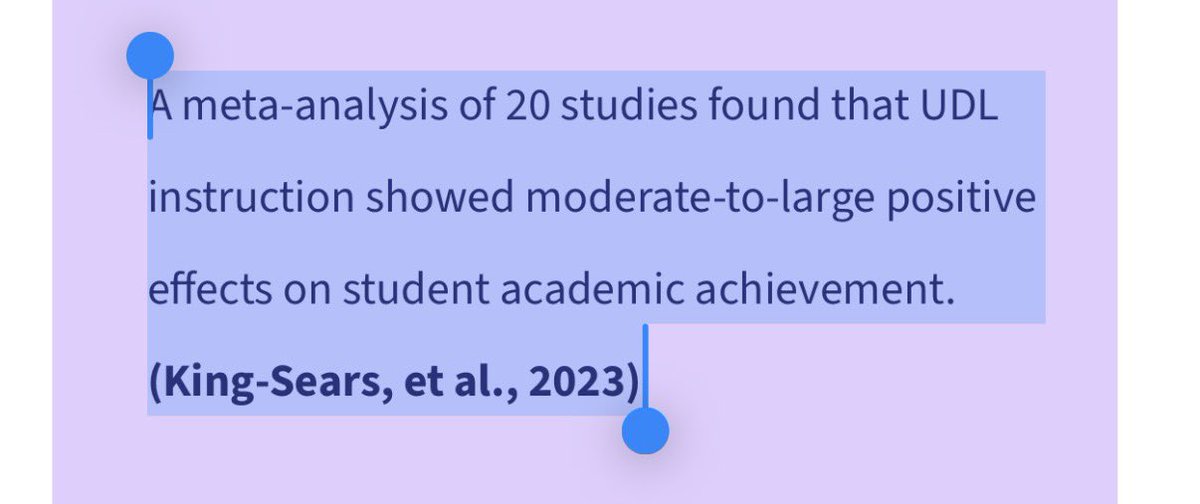
King-Sears et al. (2023) is the meta-analysis CAST often cites when saying UDL “supports” student learning outcomes not necessarily that it improves them. That wording matters. 🧵🚩
🚩 CAST summarizes King-Sears et al. (2023) by saying UDL shows “moderate-to-large positive effects” on student achievement. That sounds decisive but a closer look at the meta-analysis reveals several important red flags.
2/7
🚩 Replication red flag in King-Sears et al. (2023): only about half of the UDL studies described their instruction clearly enough for someone else to repeat it. If we can’t repeat it, we can’t be confident the results will hold up.
3/7
🚩 The authors also note that many studies didn’t clearly describe what teachers actually did. When instruction isn’t spelled out, it’s hard to know what’s being supported or how to replicate it.
4/7
🚩 The meta-analysis reports a positive average association, but results vary widely across studies. That pattern supports a cautious claim (“UDL may support learning”) not a strong one (“UDL reliably improves outcomes”).
5/7
🚩 Important detail from King-Sears et al. (2023) itself: many included studies used only 1–3 UDL guidelines, or didn’t clearly report UDL alignment at all. That’s a real limitation the authors acknowledge.
6/7
🚩 So when CAST highlights “moderate-to-large effects” on its site, it’s worth remembering what’s inside the study they cite. King-Sears et al. (2023) points to possible support but with real limitations that matter for practice.
To think critically about a Civil War soldier’s letter, students need factual/conceptual knowledge: Who fought for what? What the both sides believed. What battles were happening. Without that background, critical thinking is just guessing. Knowledge makes analysis possible. 🧵
Students can’t “analyze” a graph of declining global birth rates without prior knowledge: what fertility rate means, why education access matters, what urbanization does. Without that conceptual base, they’re not analyzing—they’re eyeballing lines. Knowledge drives the thinking.
Students can’t critically read a map of top refugee-origin countries without prior knowledge: what conflicts people are fleeing, regional geography, and how persecution works. Without that, they’re just naming places on a map—not analyzing patterns. Knowledge unlocks the insight.
A thread about why I told a student no when she asked if we could “do something totally different” today and what that moment says about working memory, novelty, and the engagement trap many students and teachers fall into. 🧵1/10
A student asked me today:
“What are we doing in class?”
I said, “The usual.”
She paused. “Can we do something totally different for once?”
2/10
It was a fair question.
She wasn’t being difficult. She was voicing something many schools in the U.S. have accidentally trained students to expect: novelty and engagement=learning
🚨Making learning stick isn’t about cramming more in. It’s about how it’s sequenced. One of the most powerful ways I’ve found is sequencing my lessons using the elaboration theory model. This approach completely changed how I plan units and how students retain what they learn. 🧵
Elaboration theory, developed by Reigeluth, is built on a simple idea: start with a broad, meaningful overview of the content, called the epitome, then elaborate by adding more detail, depth, and complexity over time. In other words, we need to zoom out before we can zoom in.
Elaboration theory uses epitomes and summarizers to make learning stick. An epitome is a simple, overarching model students can keep in mind. Summarizers revisit key points at the end of a lesson or unit, reinforcing the connections between details and the epitome.
A major impact of cognitive science on my instruction is the lens through which I plan a lesson. Previously, I was always hyper-focused on the WHAT and a little bit of the HOW. That’s flipped completely. When I create a lesson I’m now organically using 10 HOW questions…🧵👇
🎯How will I break new information into small chunks that naturally build cohesively?
🎯How will I activate necessary prior knowledge to effectively assimilate the new information?
🎯How will I establish a meaningful cognitive structure for new information to stick to?
🎯How will I maintain attention and energy during the presentation of new information?
🎯How will I provide opportunities for students to rehearse their understanding of the new information?
🎯How will I strategically check all students understanding of the new information?
As an experienced teacher, one of the most enriching parts of studying cognitive science is how it gives meaning and context to different situations I have seen play out in my classroom hundreds, if not thousands, of times over the years. For example, assimilation theory…👇🧵
One of these insights I recently came across: meaningful forgetting vs forgetting through interference depends on how well the new learning was initially assimilated. I’ve seen it play out so many times this way—Student A retains a “residue of the new meaning”, Student B doesn’t.
It makes me think about how effectively, or not, my instruction is at promoting high quality assimilation during the initial phases of learning a new concept and to what degree it supports students building real bodies of knowledge as opposed to islands of disconnected knowledge.