🇻🇪 How popular was Trump’s move to intervene militarily to depose Maduro among Venezuelans?
Two pre-intervention surveys suggested a sharp split between Venezuelans inside the country and those abroad, with deep opposition at home and high support in the diaspora.
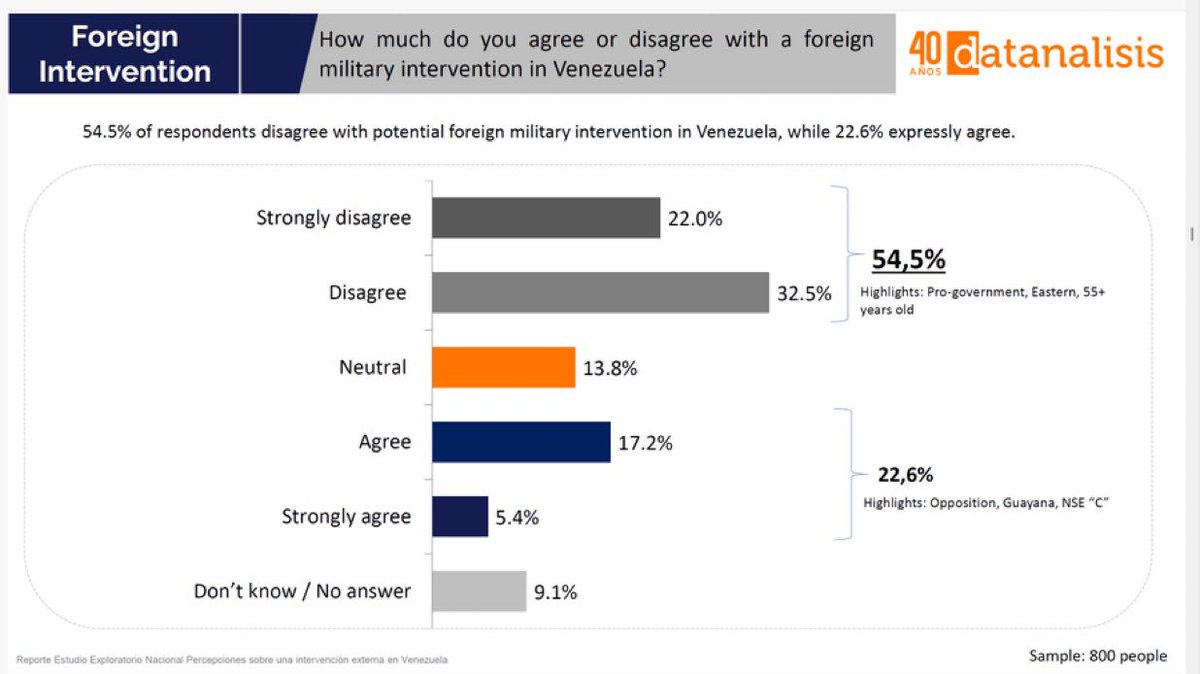
1. Datanálisis poll, Dec 2025
(Caracas-based firm)
▪️ Foreign military intervention (inside Venezuela)
➤ 55% opposed
➤ 23% supported
➤ 22% unsure / other
▪️Political alignment of those polled
➤ 60% politically unaffiliated
➤ 13% support the government
➤ 19% support the opposition
Page 1/5.
Thread continues below ⬇️
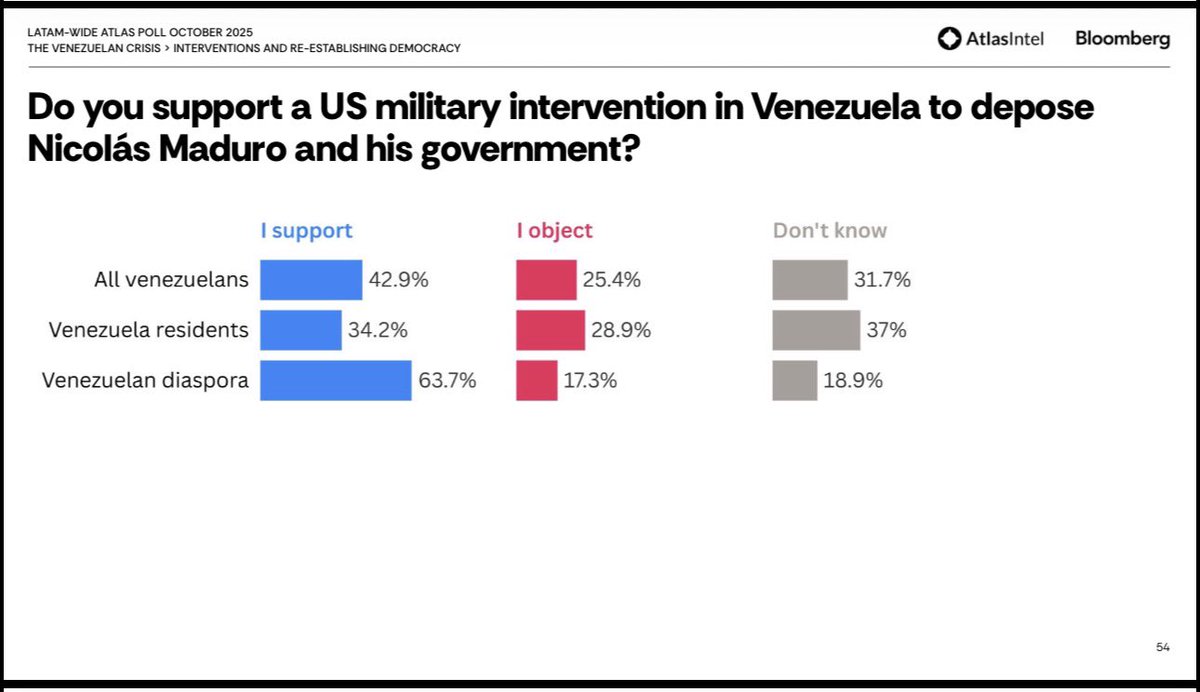
2. AtlasIntel Intel Poll, October 22-28, 2025, published by Bloomberg
(Brazil-based polling firm)
▪️ Support for U.S. military intervention
➤ 64% support among Venezuelans abroad
➤ 34% support among Venezuelans living in the country
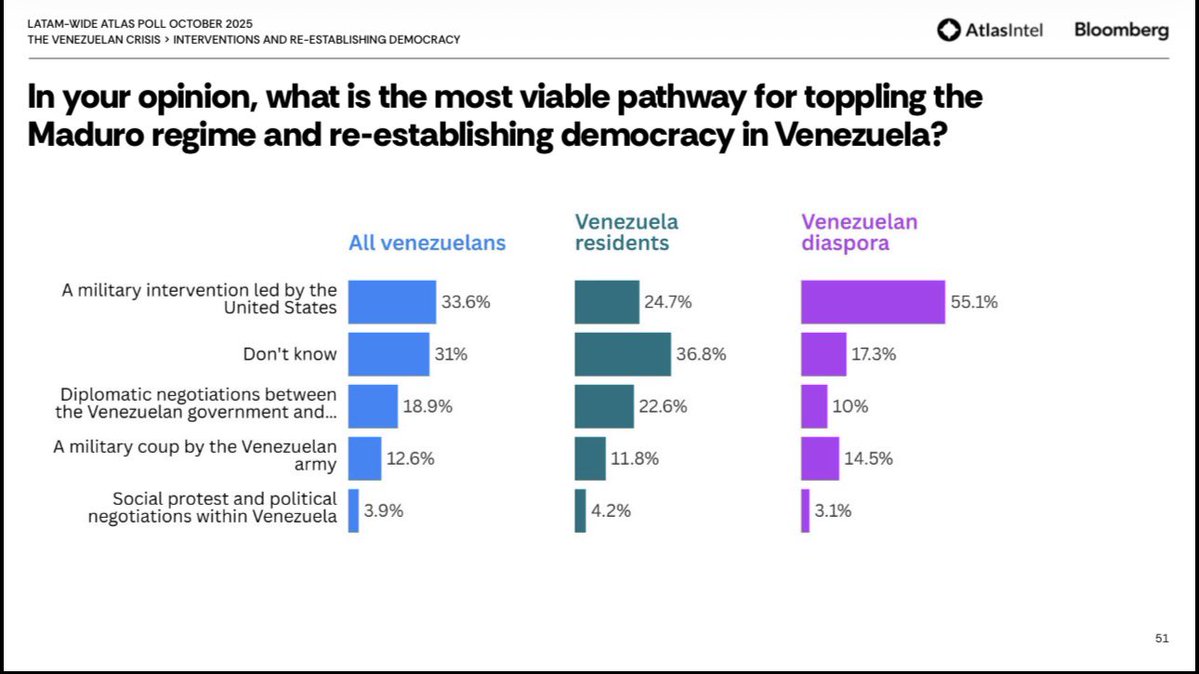
3. AtlasIntel Intel Poll, October 22-28, 2025
▪️ Is US intervention the “most viable pathway for topping the Maduro regime and re-establishing democracy?”
➤ 55% of migrants say yes
➤ Only 25% of those in Venezuela say yes
4. AtlasIntel Intel Poll, October 22-28, 2025
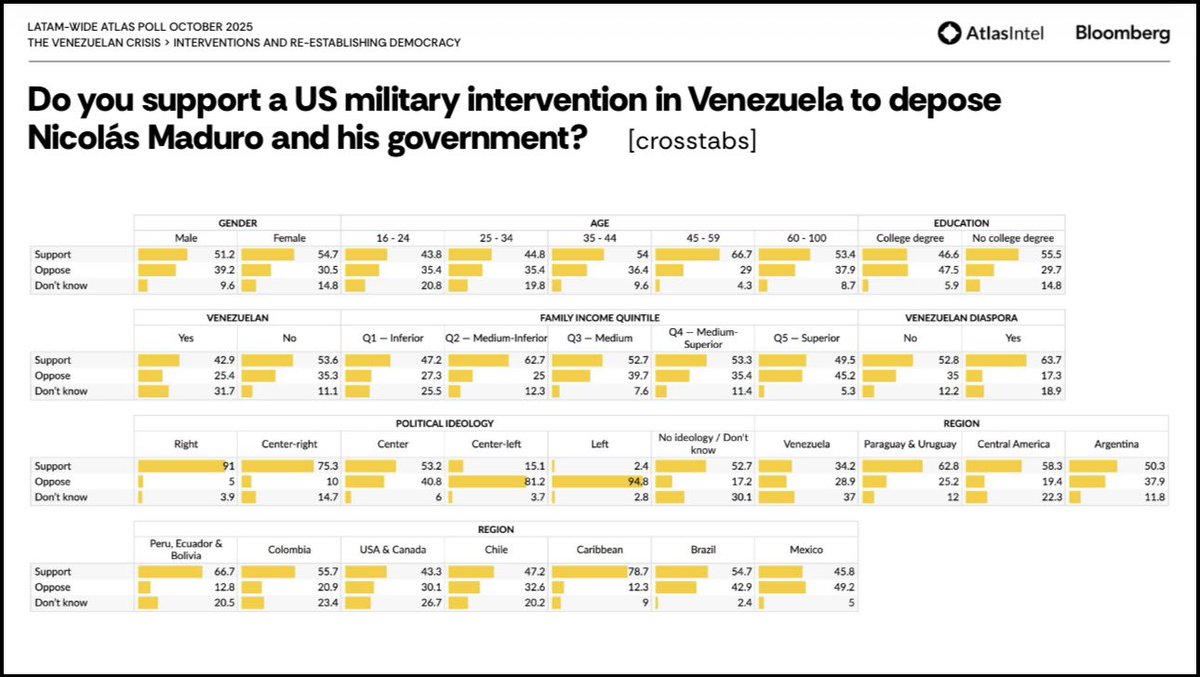
Unlike earlier polls that surveyed only Venezuelans or the Venezuelan diaspora, this survey captures views across Latin America, with Venezuelans analyzed as a distinct subgroup within a broader regional sample. 👇🏼
▪️Support for U.S. military intervention rises sharply with right-wing ideology, higher income, and diaspora status. And is higher among males.
It is strongest among the political right, weaker at the center, and nearly nonexistent on the left.
Younger respondents show more uncertainty; older groups lean more toward intervention. Regionally, support is higher outside Venezuela than within it.
Regionally, support peaks in Central America and parts of the Caribbean.
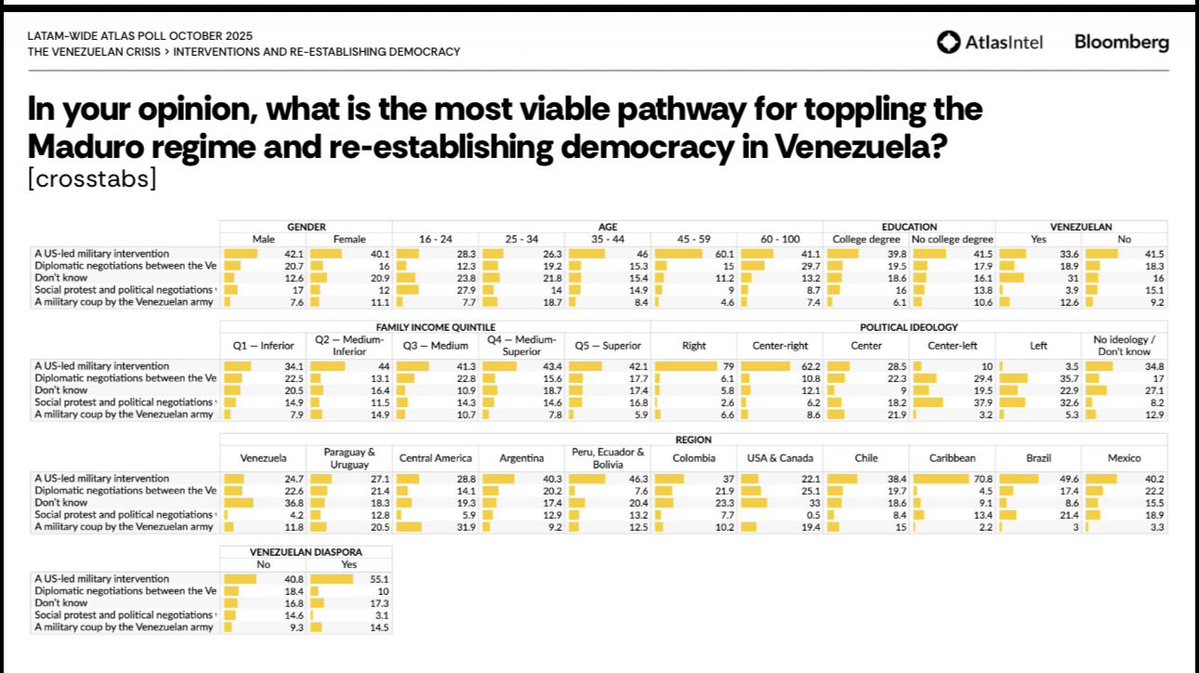
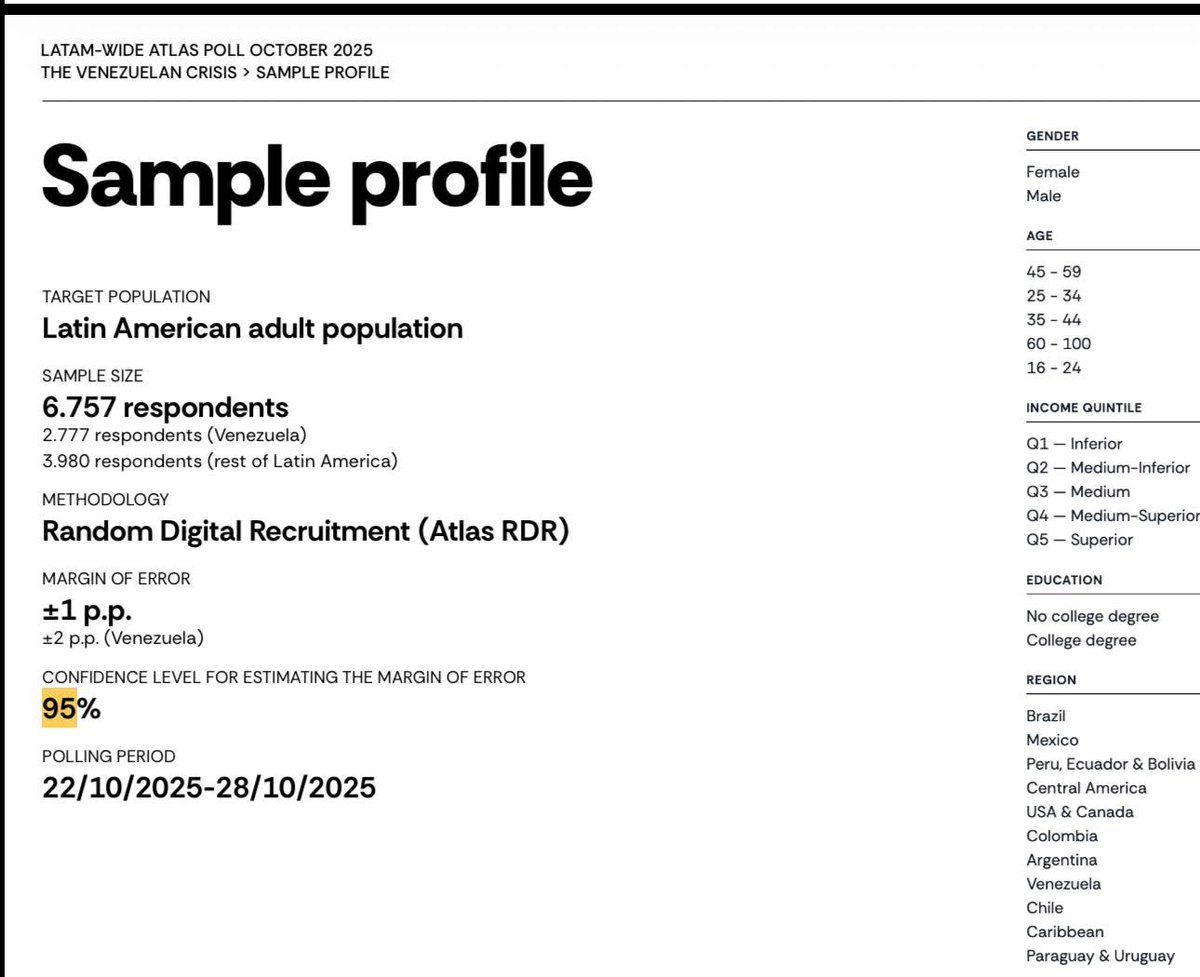
Note: The poll conducted by AtlasIntel from Oct. 22–28, 2025 surveyed 6,757 adults across Latin America, as well as Latin Americans living in the U.S. and Canada. The sample includes 2,777 Venezuelans (including those living abroad) and 3,980 non-Venezuelan Latin Americans.
• • •
Missing some Tweet in this thread? You can try to
force a refresh

🚨 BREAKING: New footage shows explosions around Caracas, Venezuela, as parts of the city’s south near a major military base lost electricity. Low-flying aircraft were seen and heard from across the capital, according to Reuters.
Agence France-Presse and Associated Press said the blasts were heard around 2 a.m. local time, with an AP reporter counting at least seven explosions over several neighborhoods. Residents rushed into the streets, some watching the sky as aircraft flew at low altitude. The site of the explosions remains unclear, and Venezuelan authorities have not issued an official explanation or confirmed any casualties.
🧵 THREAD: What Day 81 of the Gaza ceasefire shows, according to field data shared with Drop Site by sources inside Hamas
⭕️ A daily field monitoring report submitted to mediators by Hamas recorded 22 Israeli military violations of the Gaza ceasefire on Dec. 31, 2025 (Day 81), with two people killed — including a 5-year-old child — and multiple injuries reported across Gaza.
⭕️ The report cites 1152 injuries since the ceasefire began, with “all of the wounded were targeted inside the yellow line, without exception.”
⭕️ The thread below details casualties, military activity, aid entry, and overall compliance with agreed terms after 81 days 🧵👇🏼
1️⃣ Killings under the ceasefire
➤ 422 people killed since the agreement began
➤ 53.5% are children, women, or elderly
➤ 91.7% are civilians
➤ 96.4% were killed inside the “yellow line”, an area meant to be protected
➤ 2 people killed on Dec. 31 alone
2️⃣ Injuries
➤ 1,152 people wounded over 80 days
➤ 58.1% are children, women, or elderly
➤ 99.1% are civilians
➤ 100% injured inside the yellow line
Every recorded injury occurred west of the yellow line, in areas that should have been shielded by the ceasefire.
NEW: Internal Hamas document shows Israel has violated Gaza ceasefire every day for 80 days
Despite President Trump’s claim yesterday that Israel was “100%” compliant with the ceasefire he brokered, a detailed internal report shared with Drop Site by sources within Hamas documents daily, systematic Israeli violations of the Gaza ceasefire.
1) What this document is
▪️ A day-80 violations report compiled through daily monitoring across Gaza
▪️ Tracks killings, injuries, military activity, aid access, and withdrawal compliance
▪️ Hamas says it has consistently transmitted this data to mediators overseeing the ceasefire
2) Killings since the ceasefire began
▪️ 420 Palestinians killed over 80 days
▪️ 53.3% were children, women, or elderly
▪️ 91.6% of those killed were civilians
▪️ 96.4% killed inside the designated “yellow line”
3) Wounded civilians
▪️ 1,145 Palestinians wounded
▪️ 99.1% civilians
▪️ All injuries occurred inside the yellow line, according to the report
▪️ Children, women, and elderly make up 58.3% of the wounded
🟢 Hamas is publicly challenging Israel and its U.S. backers to allow an open, impartial international investigation into October 7—rejecting Israeli claims about civilian targeting, killing of children, and raping of women.
In a new political document, Hamas says that “during the Al-Aqsa Flood operation on October 7, the resistance did not target any hospital, school, or house of worship; it did not kill a single journalist or any member of ambulance crews,” and adds: “We challenge the entity to prove otherwise.”
The movement calls for “an impartial international investigation into the claims of Israeli civilian deaths on October 7,” alongside a parallel probe into Israeli crimes committed during Israel’s war on Gaza.
The demand appears in a 42-page narrative released by Hamas today, laying out its account of October 7, Israel’s subsequent war on Gaza, and its view of the current political moment and what comes next.
Here’s the full section:
Celebrated Israeli-British historian and University of Oxford professor Avi Shlaim notes that Hamas has long said it would accept an International Criminal Court or other independent investigation and punish violations, while Israel continues to bar international journalists from Gaza and rejects any independent probe into the events of Oct. 7 or its conduct over more than two years of military operations in Gaza.
After more than two years of Israel’s genocidal war on Gaza, Al Araby TV hosted a rare on-air debate from the ruins of Al-Shifa Hospital, between Hamas spokesperson Hazem Qassem, Fatah spokesperson Munther Hayek, and veteran Palestinian writer and lawyer Mustafa Ibrahim. They discuss October 7, resistance, governance, unity, and the political “day after.”
In the opening exchange, host Islam Badr frames the central question facing Palestinians following two years of annihilation: who has the authority to decide war and peace. Hamas’ Qassem explains that Hamas has long sought a collective national decision through elections, reconciliation, and joint resistance structures, agreeing that decisions about how to confront Israel should be made through a unified Palestinian institution, not by any single faction.
@islambader_1988 | @AlarabyTV
Full discussion in thread below 🧵
Fatah spokesperson Munther Hayek pushes back, arguing that Fatah’s turn to negotiations was taken through the PLO’s national institutions, not unilaterally. He says Hamas, since the internal split, has made decisions of war on its own — pointing to the devastation surrounding them at Al-Shifa Hospital as the outcome.
Hayek stresses that while armed resistance is a legitimate right in principle, direct military confrontation with Israel has repeatedly produced catastrophic results, citing the Second Intifada, Arafat’s killing, and the construction of the apartheid wall. He calls for an “honest review” of strategy, warning that failing to account for the regional and international balance leaves Palestinians paying the highest price.
Palestinian writer and legal researcher Mustafa Ibrahim widens the frame, grounding the debate in the history of Palestinian national liberation. He argues that resistance in all its forms is legitimate under occupation — but that the real crisis is political fragmentation, not ideology.
Ibrahim says October 7 initially enjoyed broad Palestinian support, but what followed exposed the deep political rupture dating back to 2006–07. With Israel now imposing new frameworks — disarmament demands, Trump’s “peace” proposal, backed by a Security Council resolution — he argues Palestinians face an urgent need for a new national agreement, not just tactical debates.
🇺🇳 UN Secretary General’s Office:
“Over the past 24 hours, and despite the ceasefire, the UN has continued to receive reports of air strikes, shelling and gunfire in all 5 governorates of the Gaza Strip.”
The UN says attacks in the past 24 hours have resulted in casualties and disruptions to humanitarian operations. A rescue mission to reach an injured person in Gaza City was denied yesterday.
➤ Shelter crisis worsening in winter conditions:
With a severe lack of shelter, families are staying in partially or heavily damaged buildings to survive the cold and rain. Over the weekend, multiple buildings collapsed during storms, causing casualties, according to humanitarian partners.