Venezuela is often reduced to a single statistic: the world’s largest oil reserves.
That headline number conceals a far more complex reality.
Venezuelan oil cannot simply “return” to global markets overnight. We need more than that.
Let's analyze 🧵
That headline number conceals a far more complex reality.
Venezuelan oil cannot simply “return” to global markets overnight. We need more than that.
Let's analyze 🧵
https://twitter.com/KobeissiLetter/status/2007823029846372858
Venezuela’s oil is among the most technically challenging, capital-intensive, and institutionally demanding resources on Earth.
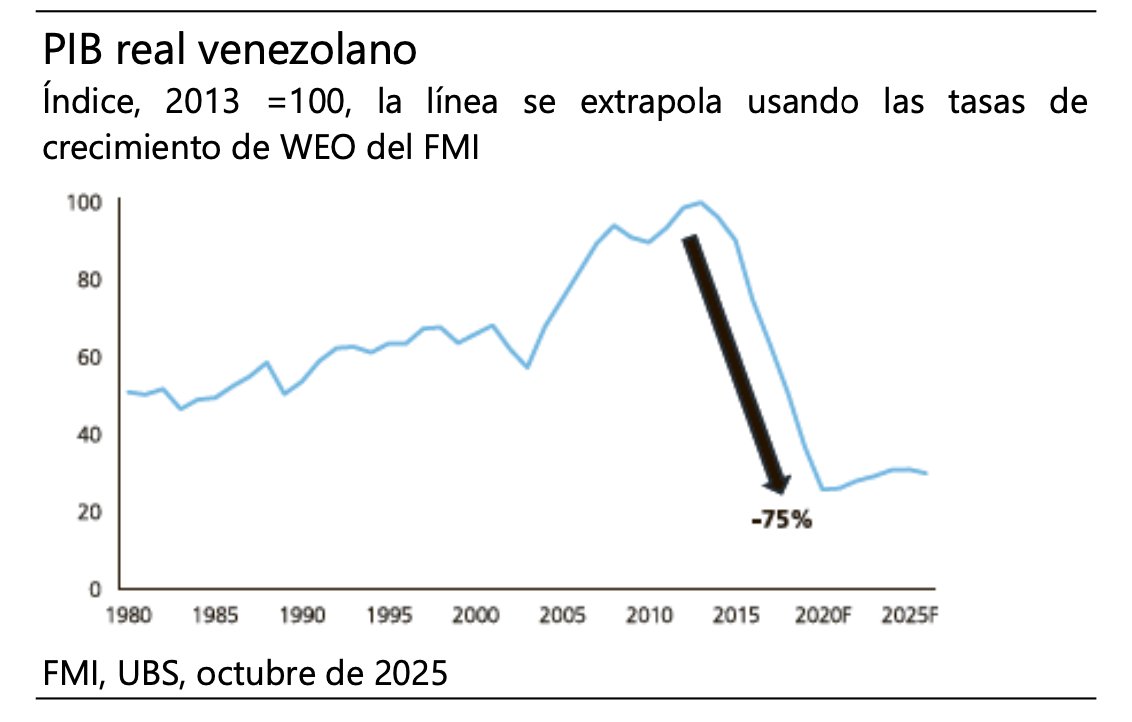
Years of socialism, corruption, and state collapse transformed immense geological wealth into a totally wasted opportunity.
Years of socialism, corruption, and state collapse transformed immense geological wealth into a totally wasted opportunity.
https://x.com/JraissatiJorge/status/1990457479315038314?s=20
Roughly three quarters of Venezuela’s oil reserves are extra-heavy crude from the Orinoco Belt, which can only be processed in highly specialized refineries.
This crude has very low API gravity, high sulfur and metal content, and extreme viscosity.
This crude has very low API gravity, high sulfur and metal content, and extreme viscosity.
https://x.com/Object_Zero_/status/2007488498132021249?s=20
Venezuela’s production system is unprepared to handle this challenge.
The country has not meaningfully modernized its pipeline network in three decades.
In the past decade, the reservoir management and surface facilities have been totally neglected.
The country has not meaningfully modernized its pipeline network in three decades.
In the past decade, the reservoir management and surface facilities have been totally neglected.
The institutional collapse of PDVSA driven by its politicization and corruption has eliminated much of its capacity to sustain operations.
PDVSA's corruption has been documented by @RyanBergPhD, @AdamOxsen, @APjoshgoodman and @ArmandoInfo, among others.
PDVSA's corruption has been documented by @RyanBergPhD, @AdamOxsen, @APjoshgoodman and @ArmandoInfo, among others.
https://x.com/AdamOxsen/status/1915791088876654929?s=20
As a result, Venezuela today produces roughly 30 percent of the oil it produced fifteen years ago. This is a tragedy for the country. 
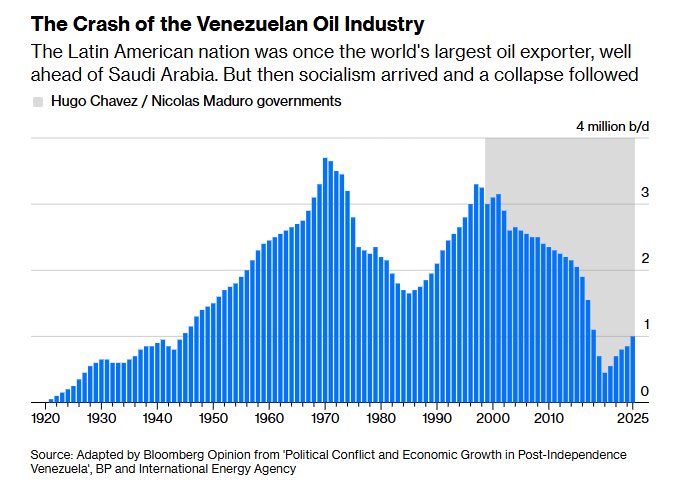
Returning to production levels near 3 million barrels per day would require close to a decade.
It would also cost $60 billion in sustained capital expenditure under stable political and regulatory conditions, according to @LeoNelissen.
It would also cost $60 billion in sustained capital expenditure under stable political and regulatory conditions, according to @LeoNelissen.
https://x.com/LeoNelissen/status/2007588722565423458?s=20
Unlike Canada, the country from which the United States sources most of its heavy crude oil, Venezuela operates no steam-assisted gravity drainage projects.
https://x.com/shashj/status/2007824909443965243?s=20
This means Venezuela lacks the technology used to efficiently extract very heavy oil by injecting steam underground to reduce viscosity and allow the oil to flow
Without this method, production relies on simpler techniques with much lower recovery rates and slower output growth
Without this method, production relies on simpler techniques with much lower recovery rates and slower output growth
As explained by @RazorOil, Venezuela relies on cold production with inherently low recovery factors, supplemented by diluents, polymers, and other enhanced recovery techniques that depend on capital, imported inputs, and reliable logistics.
https://x.com/RazorOil/status/2007805825025519828?s=20
For these reasons, the notion that Venezuelan oil can rapidly flood global markets is detached from geological, technical, and financial reality.
cc: @WallStreetMav, @KobeissiLetter et al.
cc: @WallStreetMav, @KobeissiLetter et al.
https://x.com/WallStreetMav/status/2007556509249466830?s=20
If the coming weeks mark a genuine political inflection point for our country, we Venezuelans may finally begin a process of institutional and economic reconstruction.
This does not mean we have everything to succeed, but it will take time.
This does not mean we have everything to succeed, but it will take time.
One last thing. Any scenario of a substantial increase in oil production and foreign investment has something in common:
The need for the @WhiteHouse to be involved in guaranteeing the physical security of all energy investments in Venezuela, from the personnel to the equipment.
The need for the @WhiteHouse to be involved in guaranteeing the physical security of all energy investments in Venezuela, from the personnel to the equipment.
• • •
Missing some Tweet in this thread? You can try to
force a refresh