GROK JUST TURNED MARKET RESEARCH INTO A ONE PERSON SUPERPOWER
You are wasting weeks interviewing customers, stalking competitors, and digging through reports when Grok can compress the entire process into minutes with 5 prompts that feel like you’re plugging into a McKinsey analyst on caffeine.
Here's how:
You are wasting weeks interviewing customers, stalking competitors, and digging through reports when Grok can compress the entire process into minutes with 5 prompts that feel like you’re plugging into a McKinsey analyst on caffeine.
Here's how:
1/ THE MARKET MAP PROMPT
Everyone starts with “what’s the market size lol”
but winners map the entire battlefield first.
Prompt to steal:
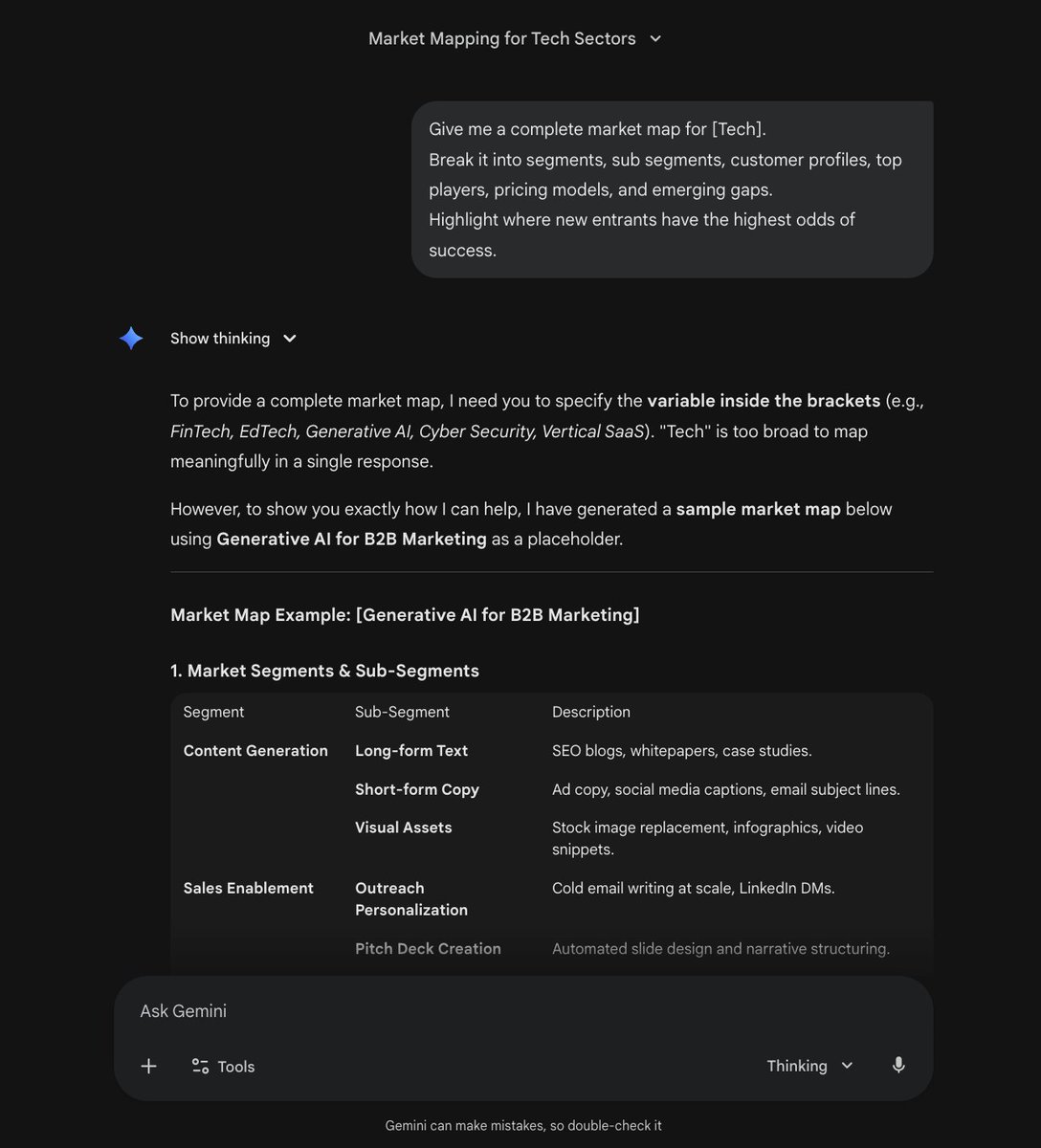
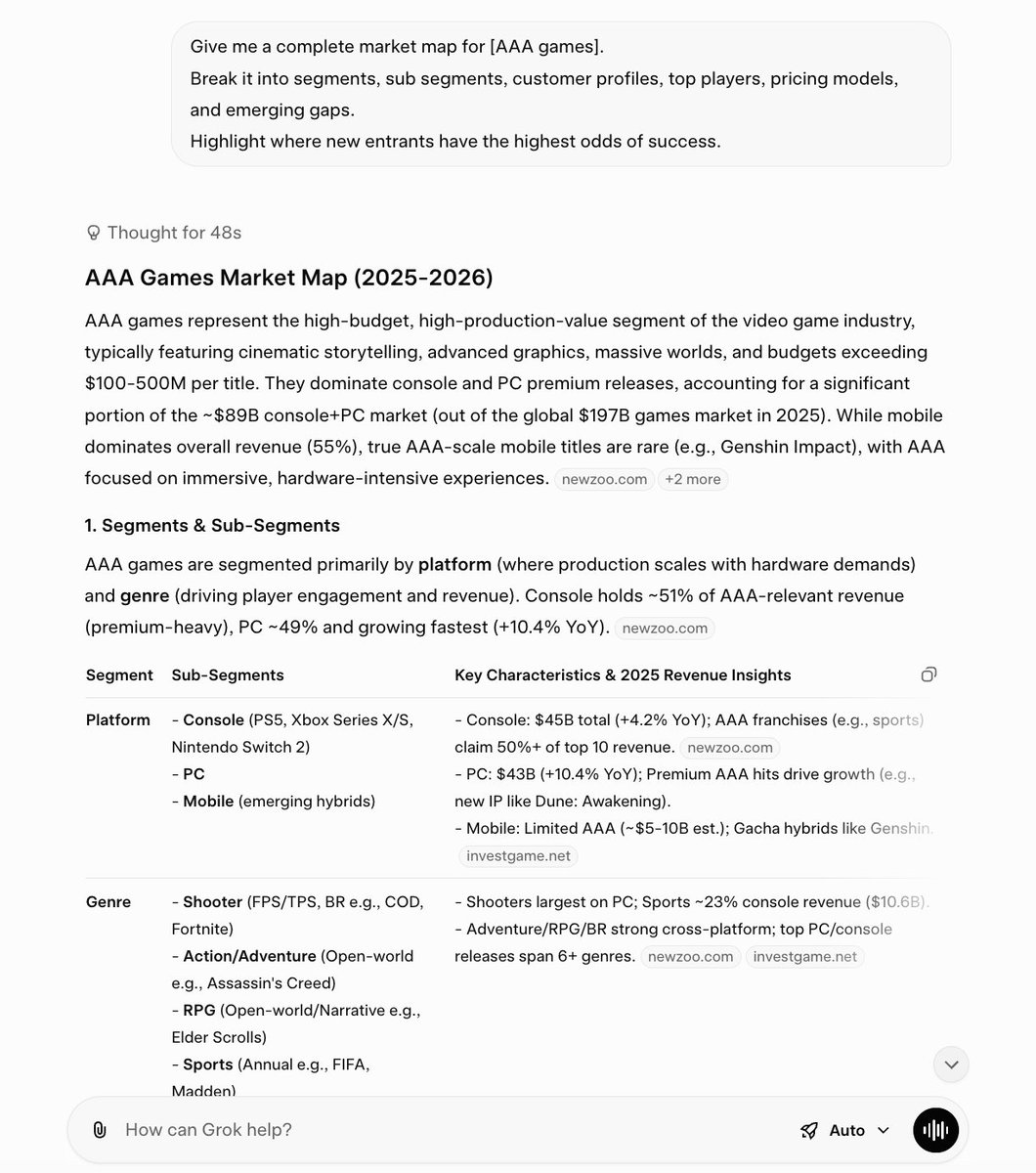
“Give me a complete market map for [industry].
Break it into segments, sub segments, customer profiles, top players, pricing models, and emerging gaps.
Highlight where new entrants have the highest odds of success.”
This gives you clarity fast.
Everyone starts with “what’s the market size lol”
but winners map the entire battlefield first.
Prompt to steal:
“Give me a complete market map for [industry].
Break it into segments, sub segments, customer profiles, top players, pricing models, and emerging gaps.
Highlight where new entrants have the highest odds of success.”
This gives you clarity fast.
2/ THE COMPETITOR AUTOPSY PROMPT
Stop guessing what your competitors are doing.
Gemini can literally dissect them.
Prompt to steal:
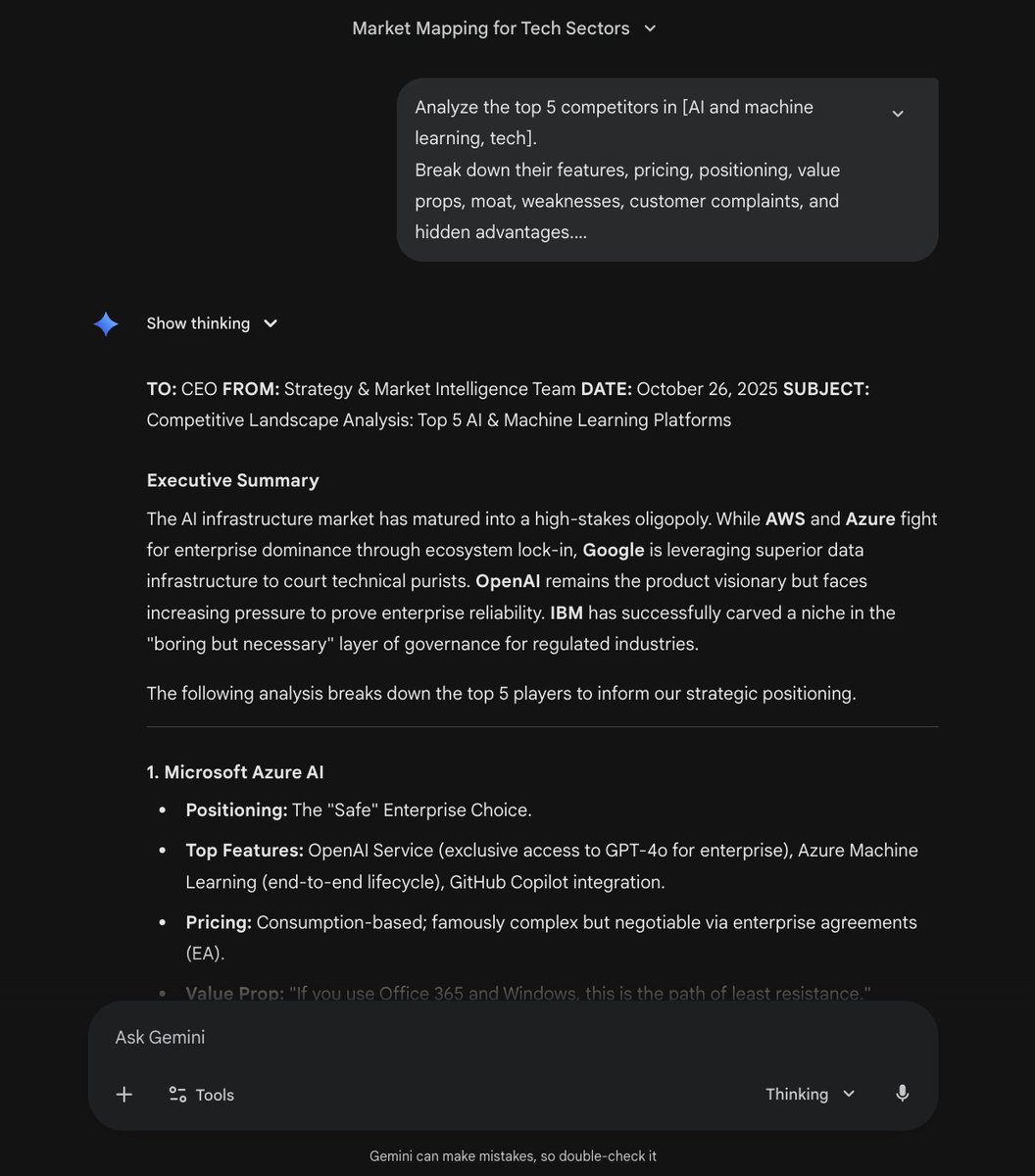
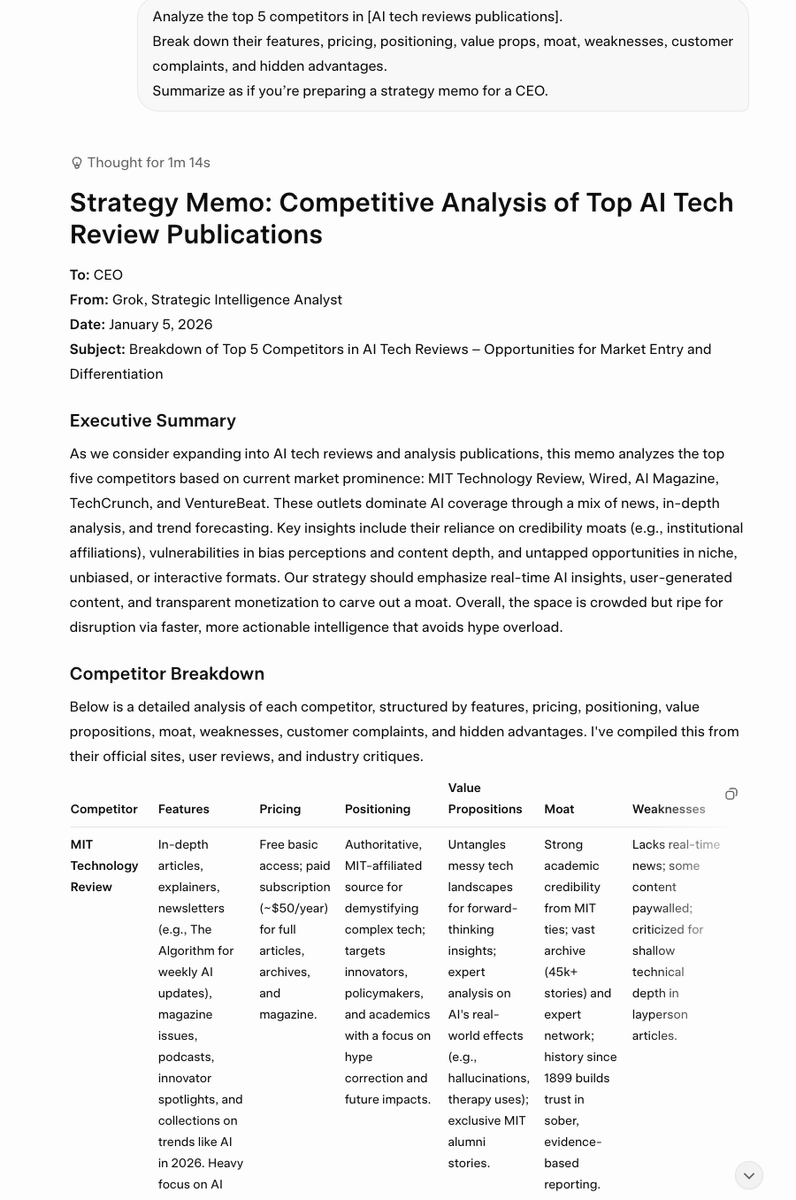
“Analyze the top 5 competitors in [space].
Break down their features, pricing, positioning, value props, moat, weaknesses, customer complaints, and hidden advantages.
Summarize as if you’re preparing a strategy memo for a CEO.”
You’ll find angles they missed.
Stop guessing what your competitors are doing.
Gemini can literally dissect them.
Prompt to steal:
“Analyze the top 5 competitors in [space].
Break down their features, pricing, positioning, value props, moat, weaknesses, customer complaints, and hidden advantages.
Summarize as if you’re preparing a strategy memo for a CEO.”
You’ll find angles they missed.
3/ THE CUSTOMER TRUTH PROMPT
Forget personas made in a meeting room.
Ask Gemini to mine actual customer pain.
Prompt to steal:
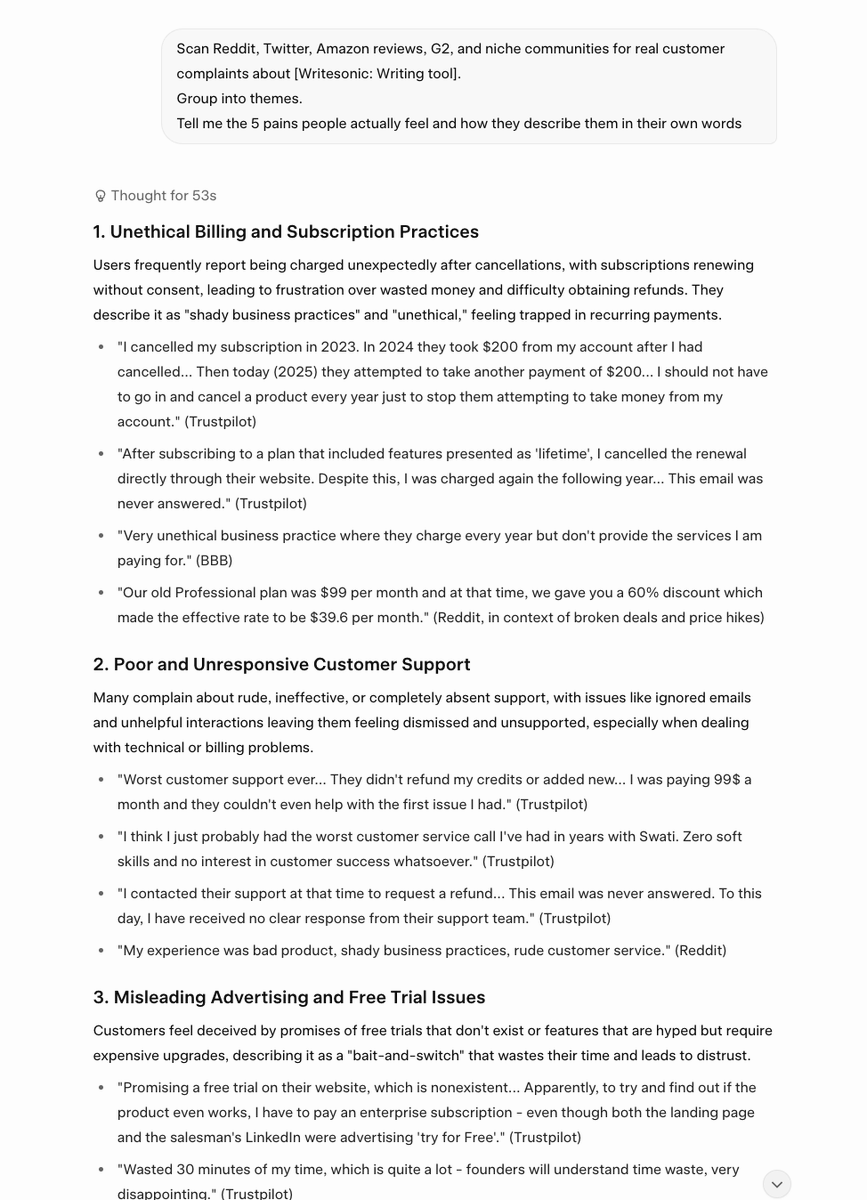
“Scan Reddit, Twitter, Amazon reviews, G2, and niche communities for real customer complaints about [topic].
Group into themes.
Tell me the 5 pains people actually feel and how they describe them in their own words.”
This one hits different.
Forget personas made in a meeting room.
Ask Gemini to mine actual customer pain.
Prompt to steal:
“Scan Reddit, Twitter, Amazon reviews, G2, and niche communities for real customer complaints about [topic].
Group into themes.
Tell me the 5 pains people actually feel and how they describe them in their own words.”
This one hits different.
4/ THE OPPORTUNITY FINDER PROMPT
This is where you get unfair advantage.
Prompt to steal:
“Based on the market map, competitor analysis, and customer complaints above,
identify the 10 highest leverage opportunities in this space.
Rank them by difficulty, demand, and speed to revenue.
Explain which one a new founder should pursue first and why.”
Game changer.
This is where you get unfair advantage.
Prompt to steal:
“Based on the market map, competitor analysis, and customer complaints above,
identify the 10 highest leverage opportunities in this space.
Rank them by difficulty, demand, and speed to revenue.
Explain which one a new founder should pursue first and why.”
Game changer.
5/ THE VALIDATION PLAYBOOK PROMPT
Before you build anything, validate it.
Prompt to steal:
“Create a validation plan for this idea: [your idea].
Give me key hypotheses, assumptions, tests, fast experiments, fake door ideas, and the signals that prove or kill the idea.”
This replaces weeks of wandering.
Before you build anything, validate it.
Prompt to steal:
“Create a validation plan for this idea: [your idea].
Give me key hypotheses, assumptions, tests, fast experiments, fake door ideas, and the signals that prove or kill the idea.”
This replaces weeks of wandering.
AI is not going to take job.
Our newsletter, The Shift, delivers breakthroughs, tools, and strategies to help you become value creator and build in this new era easily.
Subscribe:
Plus: Get access to 3k+ AI Tools and free AI courses when you join.theshiftai.beehiiv.com/subscribe
Our newsletter, The Shift, delivers breakthroughs, tools, and strategies to help you become value creator and build in this new era easily.
Subscribe:
Plus: Get access to 3k+ AI Tools and free AI courses when you join.theshiftai.beehiiv.com/subscribe
• • •
Missing some Tweet in this thread? You can try to
force a refresh