Today in @ScienceMagazine my colleagues and I address the mystery of why opioid overdoses in the US and Canada suddenly began dropping dramatically. We assemble traditional and novel evidence to point to an illicit drug supply disruption, probably in China. 1/8
Any given locality might experience a drop because say, the police took down a big drug gang, EMS got a new ambulance crew, a methadone clinic opened. But why did overdoses drop suddenly across two nations *even in places that didn’t do these things*? 2/8

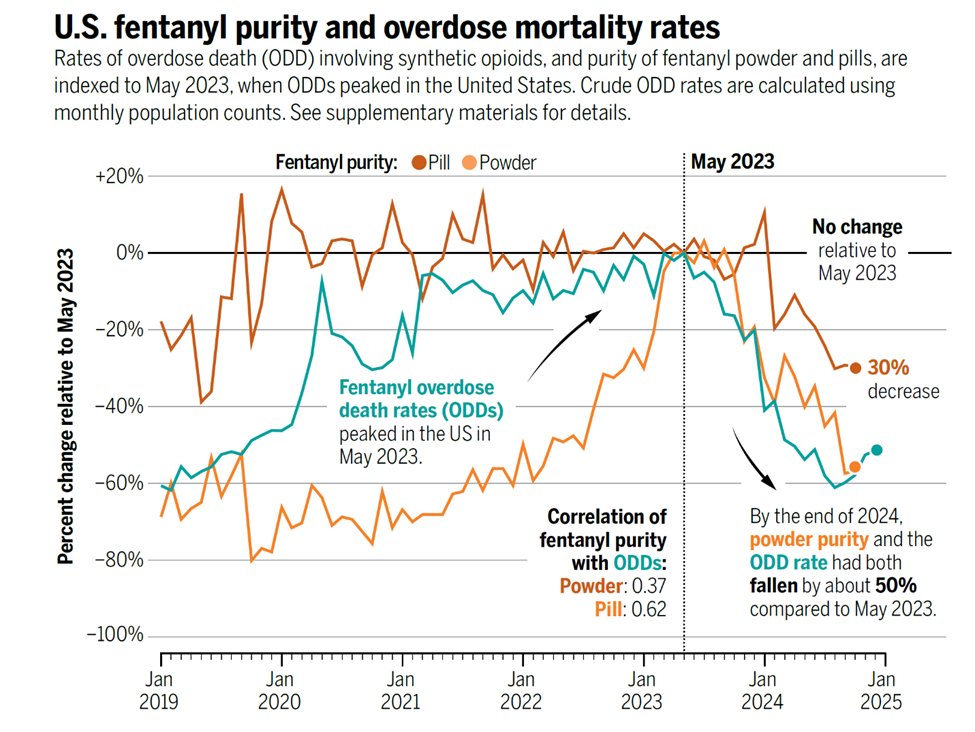
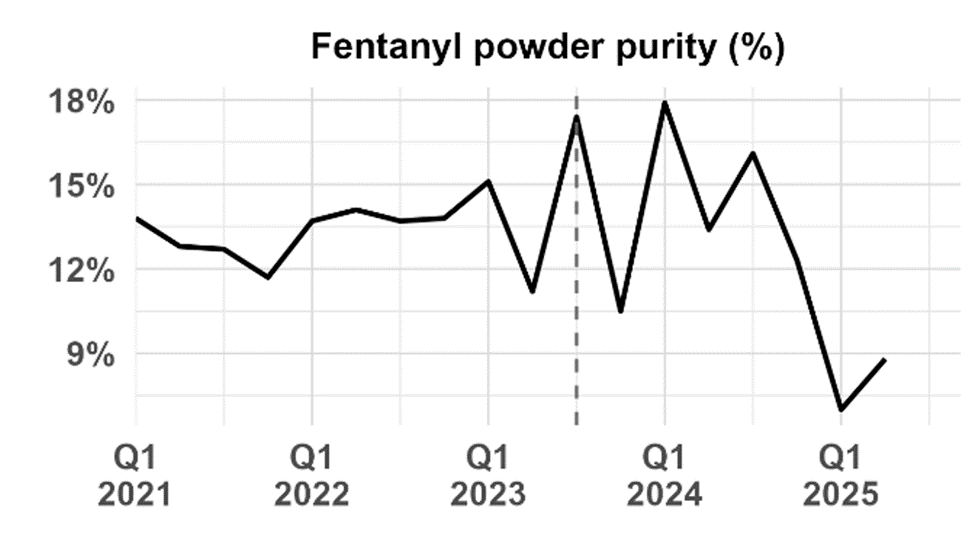
First, our team analyzed U.S. drug seizures. The purity of both fentanyl powder and pills began dropping in mid-2023, and overdoses dropped in tandem. People were buying 50% weaker fentanyl by the end of 2024, and the dose makes the poison. 3/8
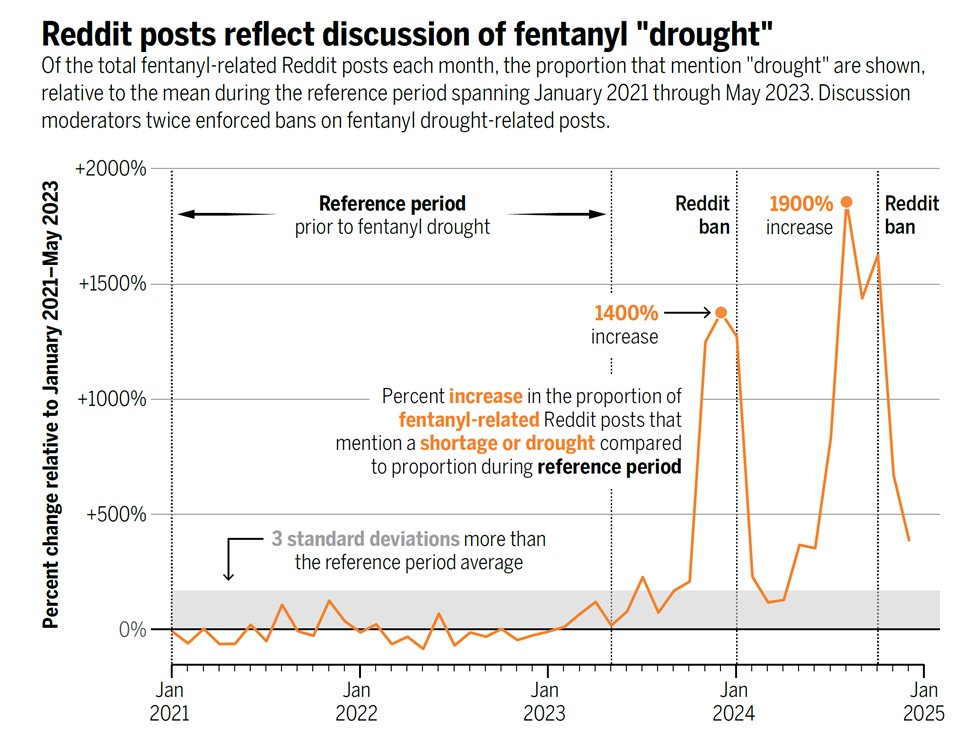
Second, we did something novel and looked at Reddit sublists to record how often people mentioned shortages/weaker fentanyl. There was a 14-fold spike of these conversations in mid-2023. The moderator then banned the topic, but it soon surged back 19-fold baseline.4/8
So something disrupted the fentanyl supply, but at what point in the chain? China sends precursor chemicals to Mexican cartels who process it into fentanyl and ship it north, but Canadian drug gangs process precursors themselves for domestic sale. So let’s look at Canada. 5/8

It turns out that again in mid-2023, the purity of the Canadian fentanyl supply suddenly gets volatile and then declines through 2024. Critical point: If the fentanyl supply has been disrupted in Mexico we would not have expected this to happen. 6/8
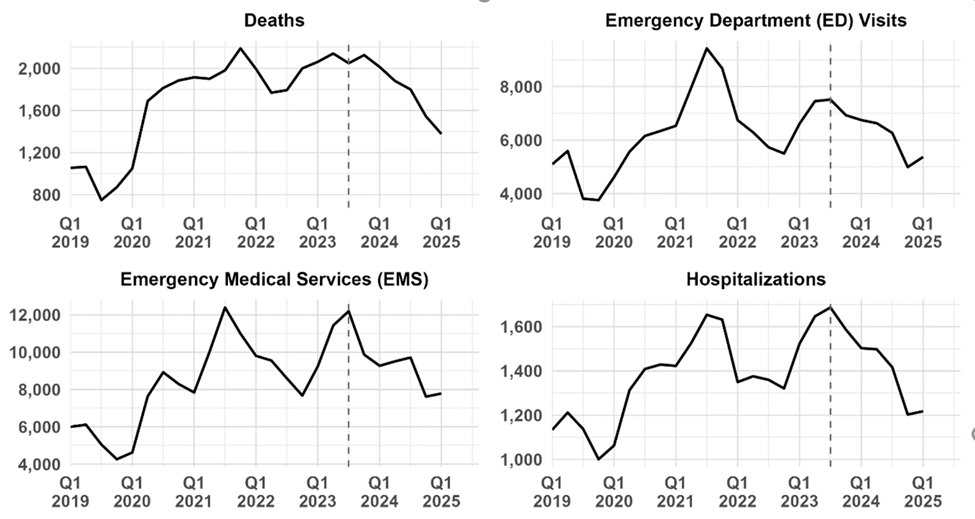
Lots of other opioid problem indicators in Canada also declined following again the pattern of the U.S. Since Mexican interdiction/disruption would not have affected both countries we look higher up the supply chain to China. 7/8
And indeed, China began warning chemical/pharma companies, closing down websites & tightening chemical controls in 2023. It is likely if not certain that China’s actions disrupted the fentanyl trade in both the US and Canada, Paper link below 8/8. science.org/doi/10.1126/sc…
• • •
Missing some Tweet in this thread? You can try to
force a refresh

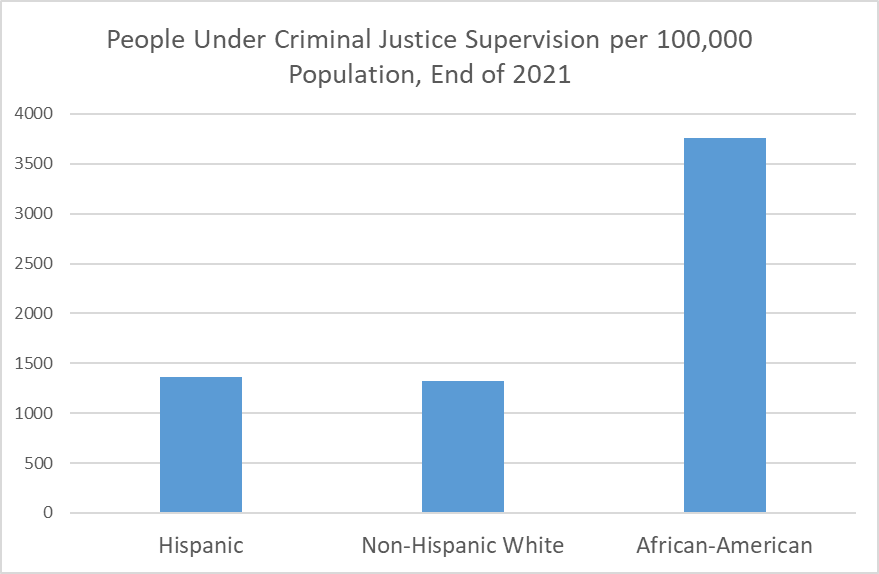
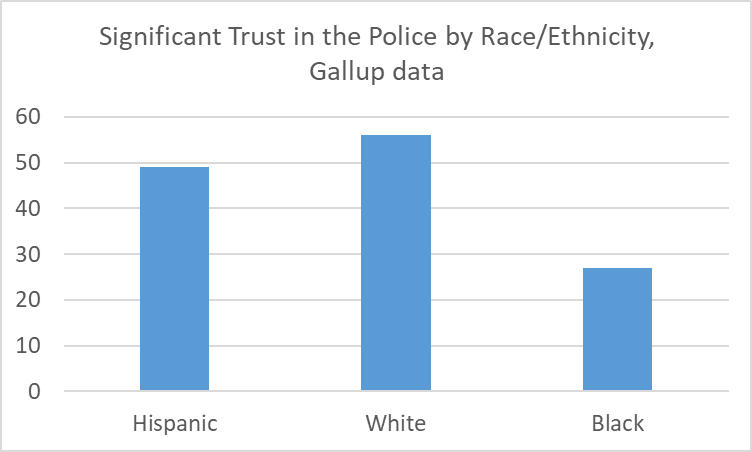
People often refer to how the criminal justice system treats “Black and Brown people”, but my latest piece @washingtonpost shows how Hispanics and whites are now treated similarly and both are comparably distant from Blacks. A thread on surprising data. 1 washingtonpost.com/opinions/2023/…
This is the newest Bureau of Justice Statistics data on who is on parole, probation, in jail or in prison. Whites and Hispanics are near identical and both are about 1/3 African-American rate. 2
Here is Gallup poll data on trust in the police, very low among Blacks, higher and fairly similar among Hispanics and whites. 3
I have a piece up at @mattyglesias’s site Slow Boring on how we will lose the significant progress we have made in reducing incarceration and advancing the well-being of Black Americans if we don’t squelch the rise in violent crime. 1/6 slowboring.com/p/to-reduce-ma…
The good news (see reports from @CouncilCJ) is that incarceration has been falling for over a decade and that this fall has been fastest among Black Americans. But the rise in violence can take all that away, through two routes. counciloncj.org/racial-dispari… 2/6
First violent crimes result in people going to prison. as @abgelb recently pointed out, 2020 homicide spike alone is enough to results in sentences that would fill forty two 500-bed prisons for a year. 3/6 usatoday.com/story/opinion/…
A change in academia that still shocks me is how comfortable some people have become openly discussing the putative value of withholding some accurate study findings in light of imagined political consequences. Once you go down this road, there is no route back to public trust.
Many people have asked for examples, it's hard to give them without breaking people's privacy, but here are the sorts of things that bother me (all disguised).
Reviewer of a paper says "This epidemiological study shows a cluster of deaths due to a new drug. It's a good study but
the cops would use this to stir up drug war panic, so I recommend rejection.
Or -- said in a public meeting with no shame -- "My study showed the treatment X didn't work, so I didn't publish it because that would lead to service budget cuts."
These things are little deaths of
Later this year, many liberal democracies will face a massive cultural, political and health challenge: Everyone who wants a vaccine will have had one (willingness below, US is about 56%) but it won’t be enough to reach population herd immunity. What then? THREAD 1/9
At this point, EVERYONE will want the economy/society opened because they think they’re safe, either because they’re vaccinated against COVID or because they think it’s a myth or they’ve been against lockdown all along. So everything opens way up and COVID-19 or one of its 2/9
faster spreading, deadlier variants explodes among the unvaccinated. By definition, this population is skeptical of public health and government intervention more generally. Many won’t wear masks or socially distance and as for test, trace, and isolate…forget it. 3/9
The New York Times upheaval may indicate that US newspapers are becoming more British. Most UK newspapers are unapologetically partisan. It’s always been a way they compete for readers. NYT might turn into something like The Guardian, a national left-wing UK newspaper. 1/8
In most UK newspapers, the classically liberal goal of airing all views isn’t the orienting vision. Commentary has an explicit, unidirectional, political tilt. For the NYT, this would require replacing their centrist & conservative columnists/guest writers with left wing ones 2/8
UK newspapers also don’t have the “church and state”-like separation between editorial and reporting than most US newspapers venerate. Reporting is infused with commentary consistent with each newspaper’s overall political slant, and no one pretends otherwise. 3/8
I attended Michigan State University when it had an annual, increasingly famous, increasingly violent block party called Cedar Fest. One year, when the police cordoned off the apartment complex where it was held and checked IDs 1 lansingstatejournal.com/story/news/201…
It turned out that many of the would-be revelers didn't live in the complex, indeed many of them didn't live in the city or state. This was a non-political event -- a party -- but once it got a reputation for violence it still drew outsiders 2
Which taught me that there are sadly some people who are drawn to violence per se, excited by it and want to participate in it. And this experience also showed how such people foster false perceptions (e.g., about "those awful MSU students") about locals. 3