Termsheetinator Profile picture
Jan 18 1 tweets 1 min read Read on X

• • •

Missing some Tweet in this thread? You can try to force a refresh
 

Keep Current with Termsheetinator

Termsheetinator Profile picture

Stay in touch and get notified when new unrolls are available from this author!

Read all threads

This Thread may be Removed Anytime!

PDF

Twitter may remove this content at anytime! Save it as PDF for later use!

Try unrolling a thread yourself!

how to unroll video
  1. Follow @ThreadReaderApp to mention us!

  2. From a Twitter thread mention us with a keyword "unroll"
@threadreaderapp unroll

Practice here first or read more on our help page!

More from @termsheetinator

Dec 29, 2025
STOP GUESSING WHY YOUR B2B DISCOVERY CALLS SUCK.

since sept, I've personally fixed 150+ mistakes across more than a dozen students.

use these 5 powerful prompts with your meeting transcripts to identify deal-killing MISTAKES:
1. The Timeline Collapse Detector

"Analyze this sales call transcript: [paste transcript].

Timeline setting is the core mechanism of sales leadership. A timeline is not a vague 'next step' - it's a specific event with a defined date, clear ownership of actions, and mutual accountability.

Timelines create leadership because they demonstrate you're organized, accountable, and in control of a structured process. When timelines collapse, deals stall indefinitely because there's no forcing function to move the prospect forward.

There are two types of timelines you should be setting:

1* Macro timelines govern the overall deal process - from discovery to proposal to decision.

2* Micro timelines govern immediate next steps between conversations.

Your job is to review this transcript and identify:

Golden opportunities where I could have set a timeline but failed to - where topics ended without a clear date, action, or accountability structure. (If appropriate to context)

1* Every place where I was vague about next steps - using phrases like 'I'll follow up soon' or 'let me know when you're ready' instead of anchoring a specific event

2* Every instance where the prospect was allowed to leave without committing to a date or action - meaning they retained all control and I gave up leadership

3* Every missed opportunity to set a micro timeline - where I could have created a short-term accountability loop (24-72 hours) to maintain momentum between major milestones

For each failure you identify, prescribe exactly what I should have said instead. Give me the specific language I should have used to anchor the timeline, assign ownership, and create mutual accountability.

Show me how to rebuild this conversation so the prospect can't leave without a structured next step that demonstrates my leadership and their commitment."
2. The Risk Mitigation Audit

"Review this sales call: [paste transcript].

Risk mitigation is the foundation of professional sales execution. Most salespeople think objections are obstacles to overcome in the moment - but that's reactive and creates adversarial dynamics. Real risk mitigation is proactive, systematic, and collaborative.

It's about creating an environment where the prospect feels safe surfacing every concern, uncertainty, and fear they have about moving forward, and then working together to dissolve each one methodically.

When prospects raise concerns during discovery, they're giving you intelligence. They're telling you exactly what will kill the deal later if left unaddressed.

Your job is not to deflect, minimize, or 'handle' these concerns in the conversation. Your job is to document them, categorize them by severity, and build a scope or proposal that directly addresses each one as part of the solution architecture.

The most effective salespeople don't close deals by convincing prospects to ignore risk - they close deals by systematically de-risking the engagement until saying yes becomes the obvious path forward.

This requires creating feedback loops where the prospect invests time reviewing, refining, and shaping the proposal with you. When they invest that time, they're co-creating the solution and de-risking it for themselves.

Your job is to review this transcript and identify:

1** First, extract every single concern, objection, uncertainty, or hesitation the prospect raised during the call. This includes explicit objections like 'I'm worried about budget' and implicit signals like 'we've tried this before and it didn't work' or 'I'm not sure my team will adopt this.' Capture the exact language they used.

2** Second, categorize each concern on a scale from one to ten, where one represents minor tactical concerns that are easy to address and ten represents existential deal-killers that could completely collapse the engagement if left unmanaged. Be honest about severity - this ranking will determine your mitigation priority.

3** Third, for each concern you identified, suggest specific ways I could address it inside the draft scope or proposal I create. These shouldn't be vague reassurances - they should be structural elements of the engagement design.

For example, if the concern is about team adoption, the scope might include a phased rollout with early wins, training sessions, or a pilot program that reduces risk before full commitment.

4** Fourth, educate me on what the most common conventional approaches are for handling these types of concerns in B2B sales, and then show me how to think radically differently. Instead of trying to resolve concerns through persuasion during the call, show me how to create a process where the prospect invests time after the call to help me refine the proposal.

This might look like scheduling a follow-up specifically to review how I've addressed their concerns in the draft scope, asking them to mark up the proposal with additional questions, or creating a structured feedback loop where we iterate together until every concern is dissolved.

The goal is not to give me scripts or hard prescriptions.

The goal is to help me see where I missed opportunities to document risk, create collaborative de-risking processes, and design proposals that systematically address every concern the prospect surfaced.

Make me one percent better at recognizing these patterns and building the muscle to turn concerns into co-creation opportunities rather than obstacles to dodge."
Read 6 tweets
Sep 9, 2025
[Redacted] joined our program a week ago.

Cold-email agency with bad positioning and low retainers.

He came in with a deal in his pipeline at the pre-proposal stage, he was going to charge a small retainer.

We haven't even started the program and he's already seeing results.

Our A.I prompts + P.A.RM™ closing framework helped him pivot. Without being repositioned as a firm - he still got approval for $20,000 upfront.

Here's the 12 page doc + A.I prompts so you can do the same - link + prompts below.

You can find your deal anchor, build the offer and proposal with these 3 prompts.

Mini-thread.Image
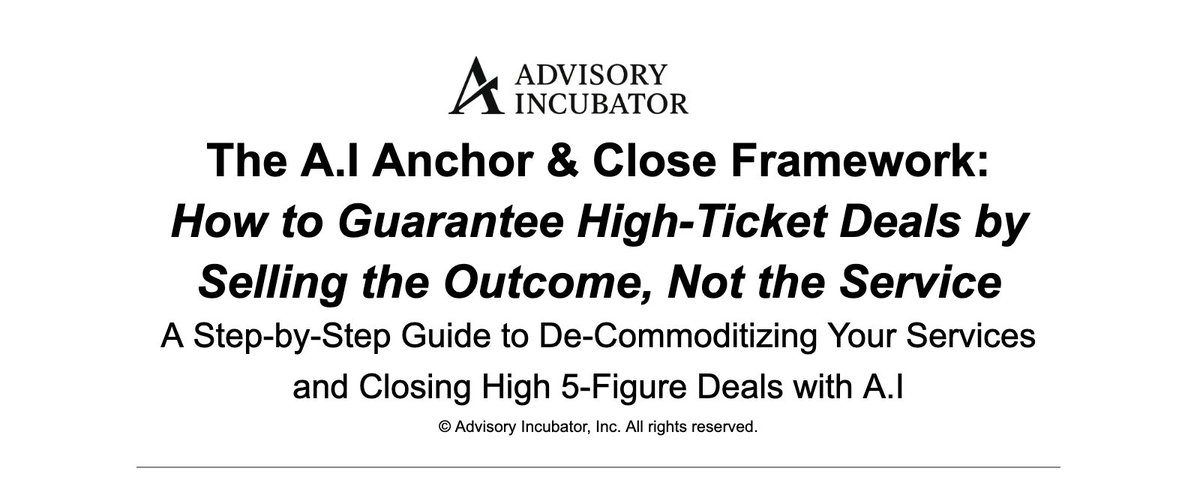
Here's the 12 page document:

A.I Prompts included.

I would recommend downloading the PDF and importing into your choice of A.I and then using the prompts that are included at the bottom of the document.

docs.google.com/document/d/1R1…Image
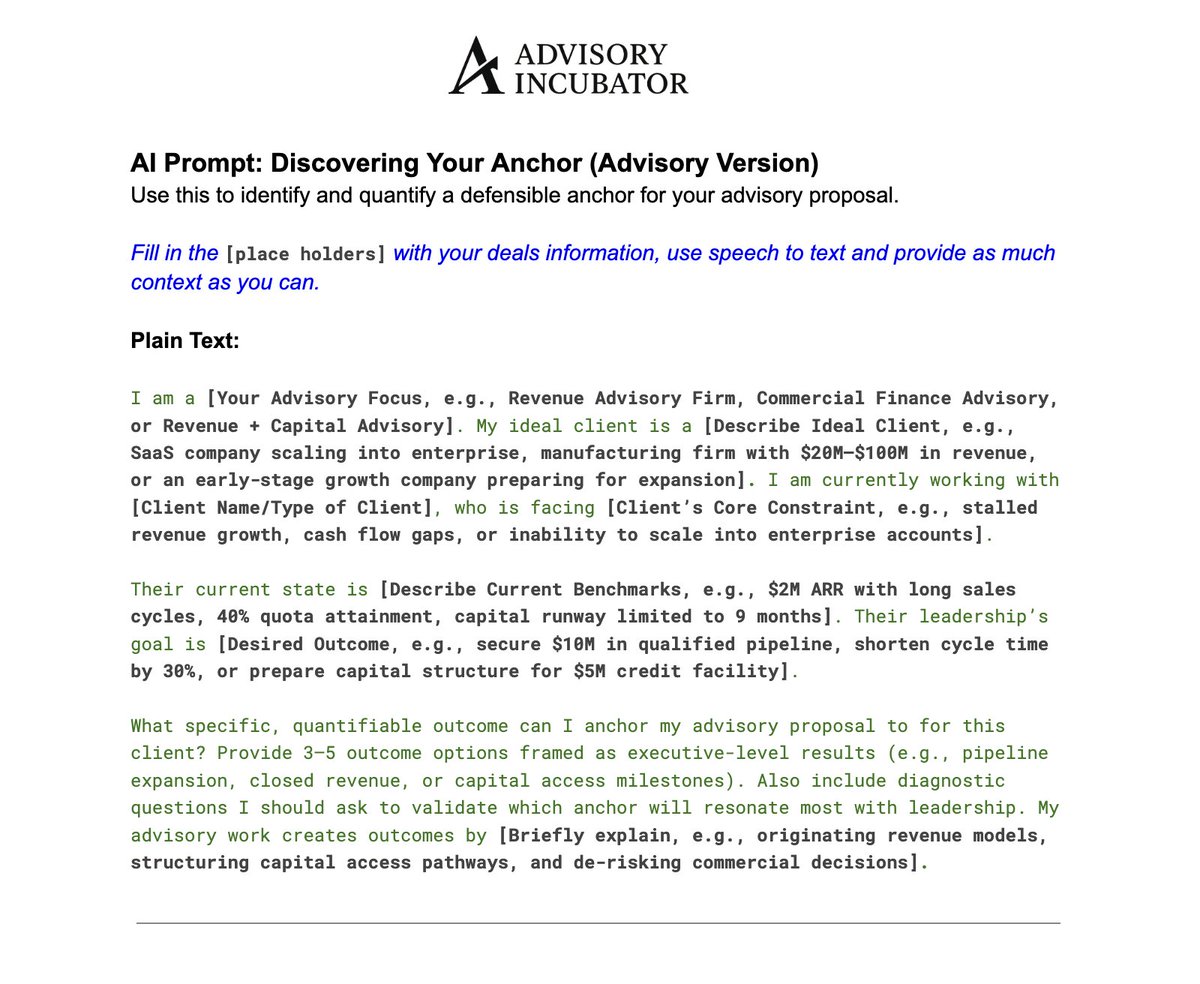
AI Prompt: Discovering Your Anchor (Advisory Version)
Use this to identify and quantify a defensible anchor for your advisory proposal.

Fill in the [place holders] with your deals information, use speech to text and provide as much context as you can.

Plain Text:

I am a [Your Advisory Focus, e.g., Revenue Advisory Firm, Commercial Finance Advisory, or Revenue + Capital Advisory]. My ideal client is a [Describe Ideal Client, e.g., SaaS company scaling into enterprise, manufacturing firm with $20M–$100M in revenue, or an early-stage growth company preparing for expansion]. I am currently working with [Client Name/Type of Client], who is facing [Client’s Core Constraint, e.g., stalled revenue growth, cash flow gaps, or inability to scale into enterprise accounts].

Their current state is [Describe Current Benchmarks, e.g., $2M ARR with long sales cycles, 40% quota attainment, capital runway limited to 9 months]. Their leadership’s goal is [Desired Outcome, e.g., secure $10M in qualified pipeline, shorten cycle time by 30%, or prepare capital structure for $5M credit facility].

What specific, quantifiable outcome can I anchor my advisory proposal to for this client? Provide 3–5 outcome options framed as executive-level results (e.g., pipeline expansion, closed revenue, or capital access milestones). Also include diagnostic questions I should ask to validate which anchor will resonate most with leadership. My advisory work creates outcomes by [Briefly explain, e.g., originating revenue models, structuring capital access pathways, and de-risking commercial decisions].Image
Read 5 tweets

Did Thread Reader help you today?

Support us! We are indie developers!


This site is made by just two indie developers on a laptop doing marketing, support and development! Read more about the story.

Become a Premium Member ($3/month or $30/year) and get exclusive features!

Become Premium

Don't want to be a Premium member but still want to support us?

Make a small donation by buying us coffee ($5) or help with server cost ($10)

Donate via Paypal

Or Donate anonymously using crypto!

Ethereum

0xfe58350B80634f60Fa6Dc149a72b4DFbc17D341E copy

Bitcoin

3ATGMxNzCUFzxpMCHL5sWSt4DVtS8UqXpi copy

Thank you for your support!

Follow Us!

:(