Marc Andreessen on the untapped potential of AI agents:
"You could have an AI bot that basically raises money to make a movie and then spends the money on image generation and sound generation."
"Maybe even hiring actors... set designers or graphic artists or... sound effects people, musicians."
"Or let's take a more serious case... you could have an AI bot that's doing protein folding and literally coming up with cures, doing personalized medicine for cancer patients."
"You could easily imagine having an economic mechanism for that... hypothetically, you could have the equivalent of like a GoFundMe, but on the blockchain, for people to basically be able to pay an AI bot to cure their cancer."
@pmarca
• • •
Missing some Tweet in this thread? You can try to
force a refresh

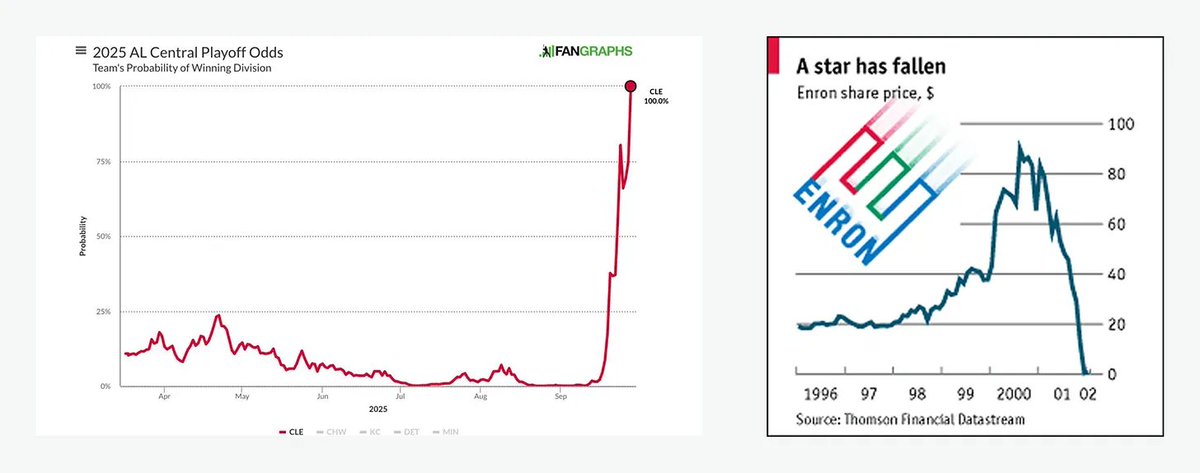
1/ PREDICTION PATH SCREENSHOTS: A NEW KIND OF MEME
By @Alex_Danco
In the mid-2010s, a new visual content format started popping up around elections, sports games and playoff races: the “probabilities changing over time” graph.
These graphs were a compelling content format because they told a fascinating story: what was supposed to happen, and then what did.
2/ You can tell amazing stories with these images.
Just by looking at changing probabilities, you could tell a story about collapse, about redemption, or about an underdog beating the odds.
These images are a kind of meme: they compress a lot of information into a tiny space, and faithfully transmit the story intact when shared.
3/ The limitation: they didn’t really exist outside of politics, sports, or financial markets.
For these graphs to work, you needed predictive odds that were broadly accepted and legal to use.
The format of “story shapes” could not spread any more deeply into popular culture.
Here are highlights of some of our big ideas for the year ahead.
👇
@aleximm: The end of Google’s search monopoly is near, as AI-native search engines gain traction with personalized, ad-free, conversational experiences.
@astrange: Compliance is ripe for new software, with opportunities for LLMs to transform this business from labor-intensive to more straightforward and efficient.
Pricing a new product or service can be confusing, and founders are often unsure how much time they should be spending on pricing strategy. 👇
Pricing can be particularly tricky for B2B fintech companies, which have multiple paths to monetization (e.g., some combination of SaaS vs. transactional revenue, or freemium vs. subscription).
@seema_amble and @mandrusko1 talked to dozens of fintech companies and came to realize that simplicity is the key when it comes to pricing, especially at the earliest stages.
When it comes to executive equity compensation, the decisions you make early on could impact your business down the line—and influence your ability to retain and reward high-performing executives.
Three key considerations 🧵
Your executives’ equity should not be predominantly vested.
Since vesting is a critical lever to retain talent, high-performing execs are no longer incentivized to stay at your company once the shares have vested.
Double-trigger vesting can encourage retention and high performance.
Double-trigger vesting allows you to tie your first trigger to continued employment, while the second trigger can relate to a liquidity event—encouraging executives to work toward a successful IPO.
It’s hard to understand new software infrastructure technologies without using them. At least, that’s what the a16z infrastructure team has found— and because so many of us started our careers as programmers, we’re often learning by doing. 👇
This has particularly been the case with the generative AI wave. So to better understand the field ourselves, the team has been building projects around large language models (LLMs), large image models, vector databases, and the like.
We’ve noticed there really aren’t good frameworks for getting started quickly. Every project requires a bunch of boilerplate code and integration. Frankly, it’s a pain.