
What an insane bunch of cherry-picked metrics, cobbled together to try and argue that trans-identifying males should be in female sport.
bjsm.bmj.com/content/early/…
bjsm.bmj.com/content/early/…
There are little-to-no controls for physical fitness in the individual studies.
Yet they conclude: “transgender women do not exhibit significant differences in upper-body strength, lower-body strength or maximal oxygen consumption relative to cisgender women after 1–3 years of GAHT.”
You haven’t controlled for fitness!!!
Yet they conclude: “transgender women do not exhibit significant differences in upper-body strength, lower-body strength or maximal oxygen consumption relative to cisgender women after 1–3 years of GAHT.”
You haven’t controlled for fitness!!!
Their "performance" data. Can you see one study that really sticks out as an outlier? 
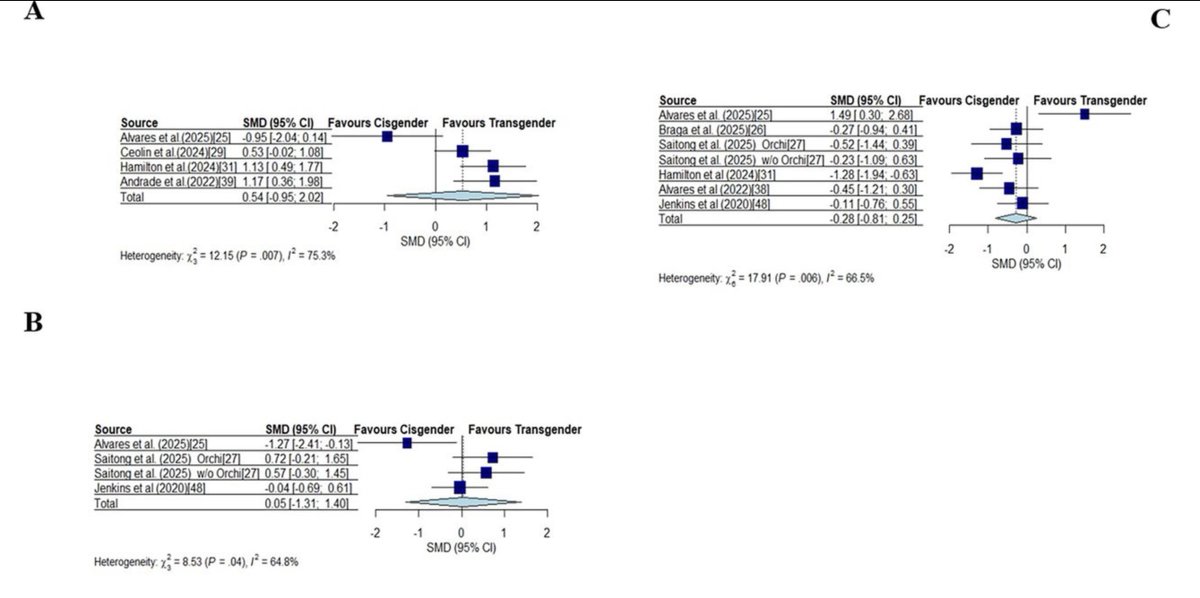
Alvares 2025, a study of 7 self-selected, trans-identifying males, who were 5cm shorter than the female comparators. Which is weird. The authors note this.
Also, they played lower level volleyball for about 30% of the hours put in by the female cohort. The authors consider that training volume and competitive level is, indeed, a confounder.
Also, they played lower level volleyball for about 30% of the hours put in by the female cohort. The authors consider that training volume and competitive level is, indeed, a confounder.
It's interesting when assessing lower body strength, this recent paper uses only jump heights and seems to ignore explosive power measurements.
That is, while acknowledging low-to-no control for fitness, they use a "fitness"" output instead of raw data like muscular power.
Why might unfit people not jump very well? Hmmm.
That is, while acknowledging low-to-no control for fitness, they use a "fitness"" output instead of raw data like muscular power.
Why might unfit people not jump very well? Hmmm.
A spectacular pair of sentences.
Manipulating stats by adjusting for a sex difference is dishonest.
The bit about "not accompanied by increased functionality" is just riffing. They haven't provided evidence that functionality is impaired because they haven't compared like-for-like in terms of fitness.
Manipulating stats by adjusting for a sex difference is dishonest.
The bit about "not accompanied by increased functionality" is just riffing. They haven't provided evidence that functionality is impaired because they haven't compared like-for-like in terms of fitness.
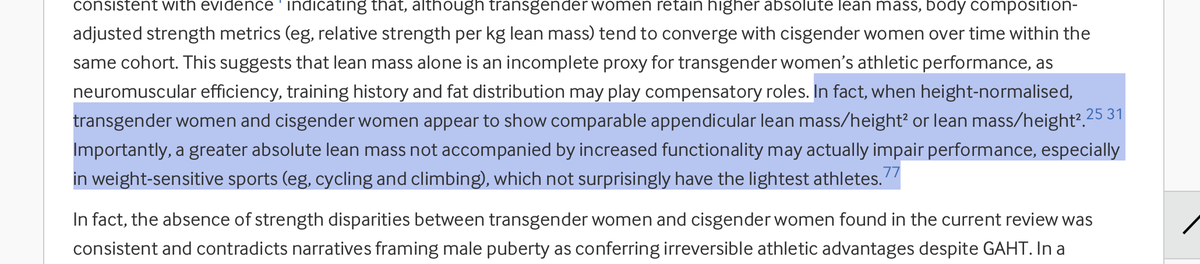
I dispute "absence". Especially when you've ignored metrics like power (peak and relative).

They apparently ignore the second paper (Chiccarelli 2023) on an expanded USAF cohort, that showed advantages in push ups and sit-ups remain after two years.
Perhaps this tells us something about the cohort/type of data? Hmmm.
Perhaps this tells us something about the cohort/type of data? Hmmm.

My friends, there is power data out there. Including in some of the papers you use.

• • •
Missing some Tweet in this thread? You can try to
force a refresh






