Women are not inferior to men – they are capable of doing everything men can do. Take the case of Kosovo, were president Vjosa Osmani convincingly demonstrates that for the sake of a political career she can be just as spineless as her male colleagues. ⬇️
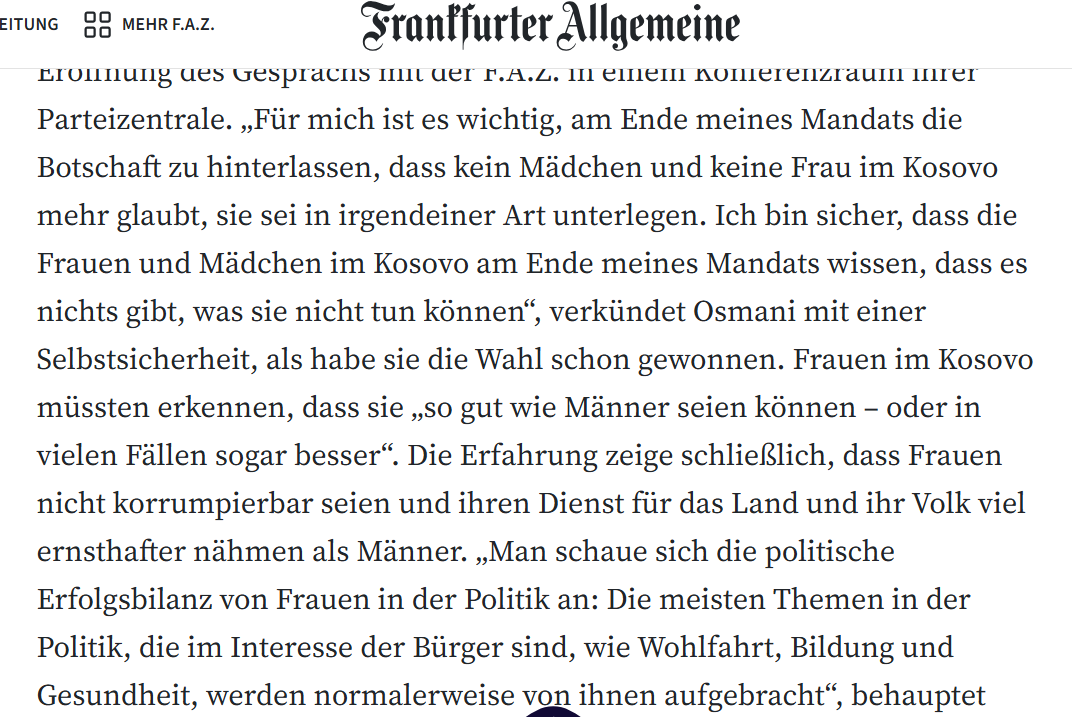
In a 2019 interview with the Frankfurter Allgemeine Zeitung (FAZ), the future Kosovar president Vjosa Osmani talked a lot about her (legitimate and important) goal to strengthen the role of women in Europe´s youngest state. Among other things, Mrs. Osmani said:
“For me, it is important that at the end of my term I leave behind the message that no girl and no woman in 🇽🇰will ever again believe she is in any way inferior. … I am sure that by the end of my term, the women and girls in 🇽🇰will know that there is nothing they cannot do.” 
Seven years on, one of the messages President Osmani indeed leaves behind at the end of her presidential mandate is that in the game of putting personal ambition over self-respect and the interest of an entire country, she is in no way inferior to male politicians.
Recently, President Osmani managed to ensure that Kosovo was admitted as a founding member to Donald Trump’s “Peace Council”, the American president’s latest ego-toy.
president-ksgov.net/en/madam-presi…
president-ksgov.net/en/madam-presi…
According to unofficial information from Pristina, Osmani made her move without coordinating with Kosovo’s Prime minister Albin Kurti. Instead, two sources claim independently from each other that it was Albanian Prime Minister Edi Rama who secured Osmani the entrée to Trump.
In an interview with the BBC, Ms. Osmani explained the background to her solo run in Davos by reminding the audience of the time when Kosovo was still under Serbian occupation, Albanians at that time received nothing from the United Nations but words, she said:
“What we were hearing at that time were UN-Assembly resolutions, it was pieces of paper, it was words, but zero action. Until the US same along and rallied the world behind to come to our rescue.” Fair point. Most Albanians and foreign observers will agree with this analysis.
Osmani went on to say that, historically, it was always the right decision for Kosovo Albanians to align with the U.S.: “We trust in the leadership of the United States”. Fair point.
president-ksgov.net/en/president-o…
president-ksgov.net/en/president-o…
Indeed: Without U.S. leadership in 1999 (the NATO war against Serbia) and 2008 (the declaration of independence), there would be no independent Kosovo. Perhaps there would hardly be any Albanians left in Kosovo at all.
However, Osmani was evasive on another BBC-question: Whether Kosovo, a country with a shrinking population of only about 1.6 million, would pay the one-billion-dollar ransom fee Trump demands for permanent membership in his “Peace Council.”
But the fact remains: Kosovo can afford even less than other small European states to offend the old egomaniac in the White House. Some people therefore argue that with her uncoordinated solo move in Davos, President Osmani pursued reasonable Realpolitik for Kosovo.
But this praise does not apply to other steps taken by the president and her entourage. One example is the case of Osmani’s husband, Prindon Sadriu, a not so diplomatic diplomat whose intellectual capacity does not always keep pace with his remarkable ambition.
Sadriu recently suggested to Trump on X that the former “Grand Hotel” in Pristina (an ugly ruin in the city center dating back to Yugoslav times) be converted into a “Trump Hotel.”
x.com/search?q=from%…
x.com/search?q=from%…
While that was dismissed as a bizarre curiosity or a minor embarrassment, the same cannot be said of the president’s decision to host a reception for the Pristina premiere of the “Melania” biopic on Trumps wife:
https://x.com/kos_data/status/2017671670765408397
According to Osmani, the film’s director, Brett Ratner, (known from the Epstein files), delivered a “bold portrayal of the American presidential family” as well as of the “extraordinary, impactful leadership” (sic) of Melania Trump.
bbc.com/news/articles/…
bbc.com/news/articles/…
While there was some understanding for the Davos episode, many asked themselves after the Melania-event: Are statements like these also wise realpolitik – or are they, at best, unnecessary, if not downright servile or spineless? From many Kosovars, you will hear the latter.
Which opens up the main question: Why all this? The answer (or part of it): Osmani’s presidential term expires in March. She wants another mandate and for this needs support in the Kosovar parliament. But she does not have that support currently.
For years, Osmani has failed to make many friends in parliament. Or anywhere. Pristina is full of people who describe her as personally challenging. Many close aides, as her former chief of staff Blerim Vela, did not last too long with her.
koha.net/en/arberi/jep-…
koha.net/en/arberi/jep-…
To make up for the lack of domestic support, Osmani has been preparing for weeks to present herself as “Trump’s candidate.” The calculation: the U.S. is such a crucial factor in Kosovo that this label could secure her re-election over any other candidate.
Osmani presents herself to the public as Trump’s favorite, indirectly threatening members of parliament, who elect the president, with her (allegedly) good contacts to the Trump clan, wielding them like a club.
The threat is: “If you don’t re-elect me as president, you’ll have trouble with the U.S.” A few years ago, such a calculation might have worked. After all, Kosovo, for understandable reasons, is the most pro-American country in the world.
But the love of Kosovo-Albanians for the US is not blind. People understand that Trump’s USA is no longer the USA of Bill Clinton or George W. Bush. One piece of evidence that the US trump card no longer automatically wins is the recent Kosovar parliamentary election.
Kurti’s party Vetëvendosje won a triumphant 51.1%, and the losers accepted the result without fuss, as in any functioning democracy. 51.1% despite the fact that Kurtis relationship with Trump, partly due to his tactically questionable decisions, is poor.
euronews.al/en/pm-kurti-in…
euronews.al/en/pm-kurti-in…
So Osmani’s attempt to push through her re-election by branding herself as “Trump’s candidate” is risky at best. Other solutions might be more realistic, even though everything is still open. For the full text, see the F.A.Z.
• • •
Missing some Tweet in this thread? You can try to
force a refresh