The border debate is often framed as a failure of competence. That’s a mistake. At bottom, it is a clash over regime ends: the public wants order, the managerial elite wants mobility - a Regime of Flow.
Those are different visions of the good. Incompatibly so.
Those are different visions of the good. Incompatibly so.
In classical terms, politics aims at a just polis — a bounded community capable of self-rule. Our administrative regime instead aims at frictionless flows of labor, capital, goods, and people. Borders become inconveniences, not principles.
From this perspective, illegal migration is not a policy “bug.” It is a system feature. It supplies cheap labor, bureaucratic discretion, and moral cover (“humanitarianism”) while dispersing costs onto ordinary citizens.
This tracks closely with what I’ve written about globalism: governance by networks rather than nations, markets rather than peoples, and experts rather than citizens.
Immigration policy reflects that architecture.
Immigration policy reflects that architecture.
Public-choice logic deepens the story. The benefits of large illegal populations are concentrated among powerful actors — big employers, agribusiness, construction, hospitality, major metros, NGOs, and parts of finance.
These groups are organized, wealthy, and politically active. They lobby constantly, shape elite consensus, and dominate the donor ecosystem of both parties.
By contrast, the costs fall on the middle and working classes through wage competition, school crowding, housing pressure, strained local services, and cultural dislocation. These costs are diffuse and politically fragmented.
Result: the “ruling class” reliably follows concentrated interests, even when polls show clear public demand for stricter enforcement. Democracy is filtered through managerial incentives.
There is also an economic model at stake. Since the 1990s, the U.S. has relied on a high-immigration, low-wage growth pattern that props up low-margin sectors and suburban sprawl.
A real crackdown — including policies that would encourage self-deportation — would mean higher wages for many blue-collar jobs, but also higher food and construction costs and short-term disruption.
Elites prefer smoothness.
Volatility is risk.
Elites prefer smoothness.
Volatility is risk.
Hence the preference for management over resolution: tough rhetoric, episodic enforcement, but a system that keeps cheap labor circulating and legal gray zones intact.
Partisan dynamics reinforce this. Many Republican donors like cheap labor even as GOP politicians campaign on control; many Democratic institutions like permanent mobility even as activists speak the language of compassion.
Same structure, different moral vocabularies - and zero actual morality. One side invokes markets; the other invokes mercy. Neither wants to upend the underlying regime of flows.
The obvious answer; incentives for self-deportation via benefit removal, strict workplace verification, and real interior enforcement — would be genuinely political rather than managerial.
Real politics (the search for the Just City and protection of a way of life) is abandoned.
Real politics (the search for the Just City and protection of a way of life) is abandoned.
It would reassert that sovereignty and order outrank economic convenience. That is precisely why it unsettles elite coalitions across party lines.
In Straussian terms: today’s “noble lie” is that mass illegal migration is both inevitable and humane. The reality is simpler: the system serves those who profit from disorder while moralizing at everyone else.
What the public intuits is not merely “fewer migrants,” but something deeper: a desire for a republic again, not a managed space of global flows.
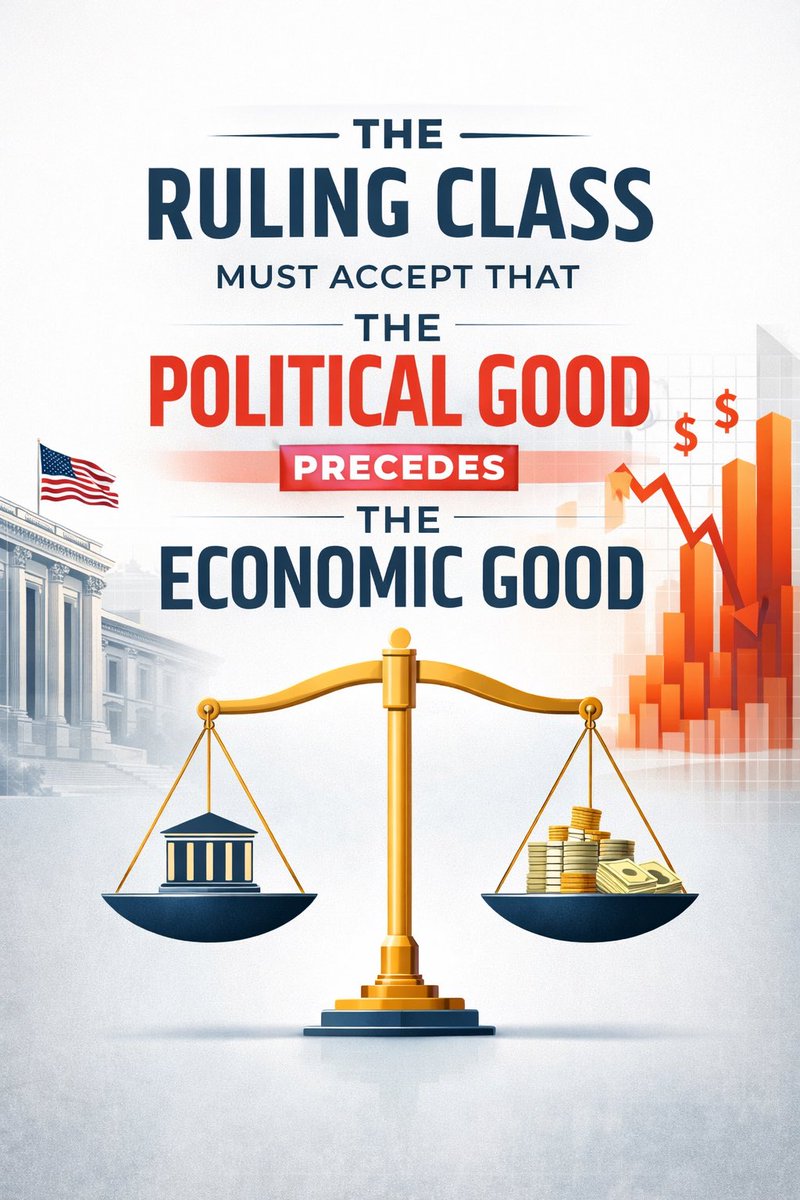
Until the ruling class accepts that the political good precedes the economic good, we will keep getting border theater rather than settlement of the question.
And that won't happen without real politics.
And that won't happen without real politics.
• • •
Missing some Tweet in this thread? You can try to
force a refresh