Michael Vandi Profile picture
Feb 9 13 tweets 5 min read Read on X
Claude Pro just became the best $20/month I spend.

I use it for workflow automation, trend analysis, and document processing.

Here are 12 Claude prompts that replaced my $200/month research subscriptions: Image

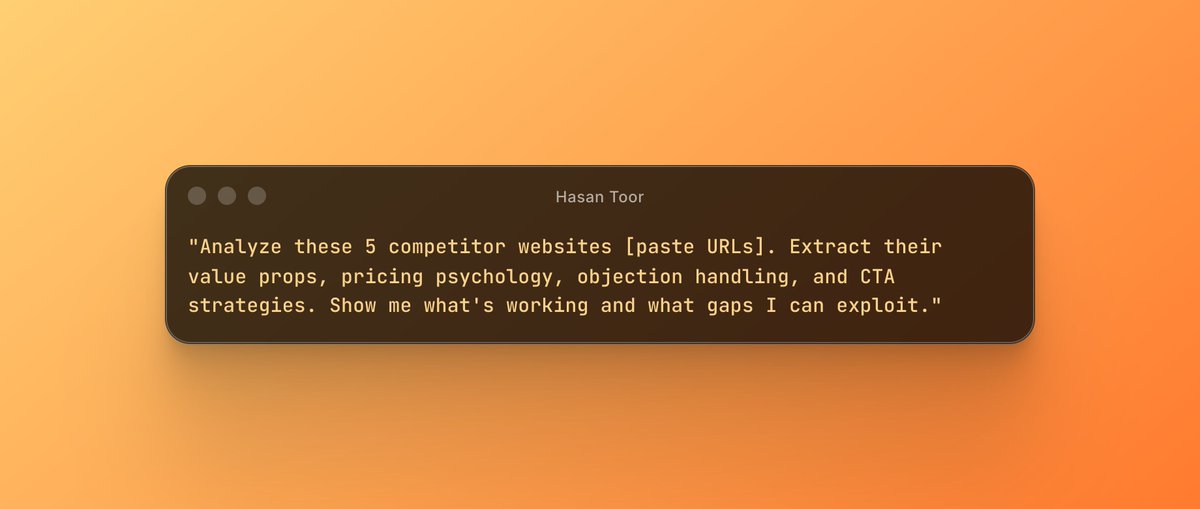
Prompt 1: "Analyze these 5 competitor websites [paste URLs]. Extract their value props, pricing psychology, objection handling, and CTA strategies. Show me what's working and what gaps I can exploit."

This single prompt replaced my marketing consultant. Projects context means it remembers everything. Used this to 3x our conversion rate.Image
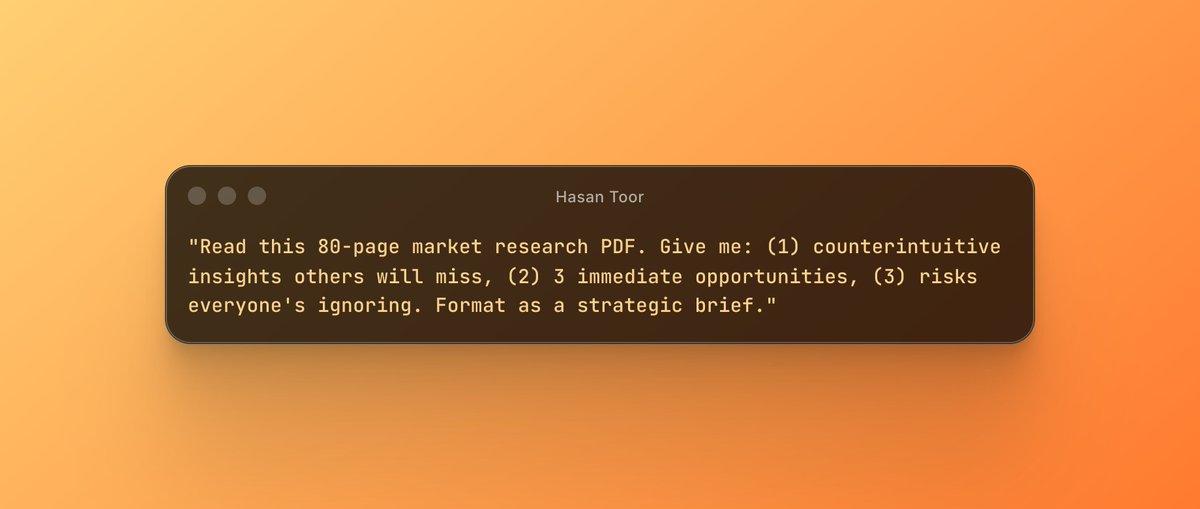
Prompt 2: "Read this 80-page market research PDF. Give me: (1) counterintuitive insights others will miss, (2) 3 immediate opportunities, (3) risks everyone's ignoring. Format as a strategic brief."

Turns dense reports into actionable intelligence in 90 seconds. The Artifacts feature makes it presentation-ready instantly.Image
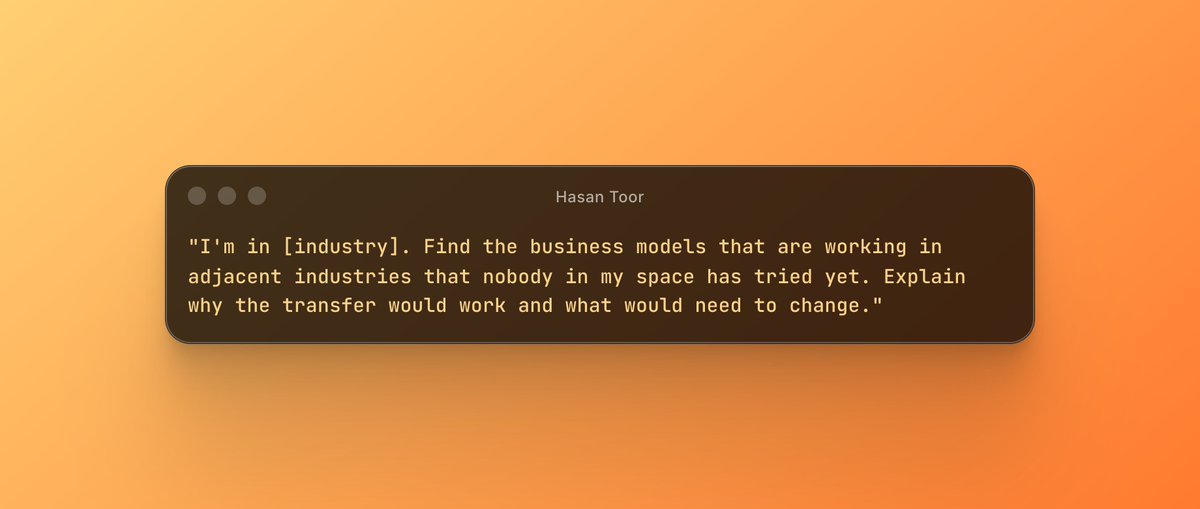
Prompt 3: "I'm in [industry]. Find the business models that are working in adjacent industries that nobody in my space has tried yet. Explain why the transfer would work and what would need to change."

Found our entire product roadmap using variations of this. Claude's reasoning depth is insane for strategic thinking.Image
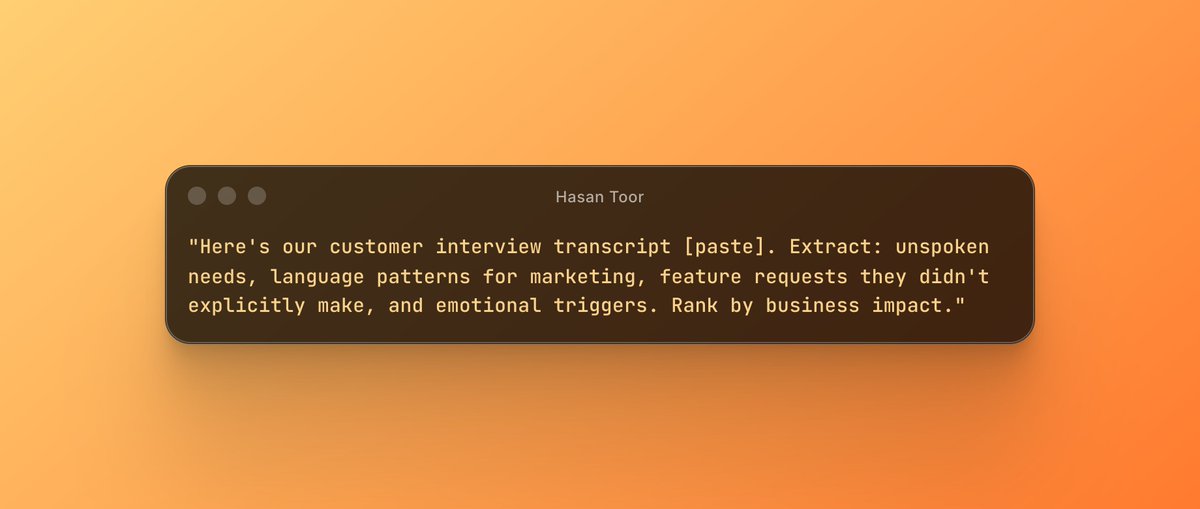
Prompt 4: "Here's our customer interview transcript [paste]. Extract: unspoken needs, language patterns for marketing, feature requests they didn't explicitly make, and emotional triggers. Rank by business impact."

Stopped paying for qual research analysis. Claude picks up nuance that even professional researchers miss.Image
Prompt 5: "Act as a hostile investor in our pitch meeting. Read our deck [upload] and ask the 10 hardest questions I need to have perfect answers for. Then help me craft those answers."

Pitch prep that used to take 4 consultants and 2 weeks now takes 30 minutes. We raised our Series A on the first pitch.Image
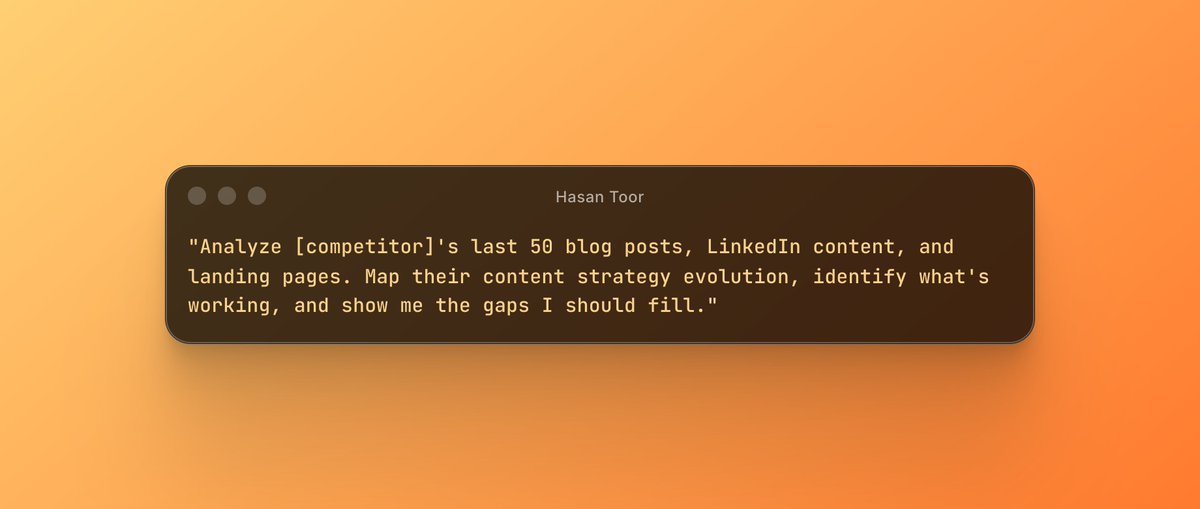
Prompt 6: "Analyze [competitor]'s last 50 blog posts, LinkedIn content, and landing pages. Map their content strategy evolution, identify what's working, and show me the gaps I should fill."

Content strategy intelligence that scales. Projects remember everything, so insights compound over time.Image
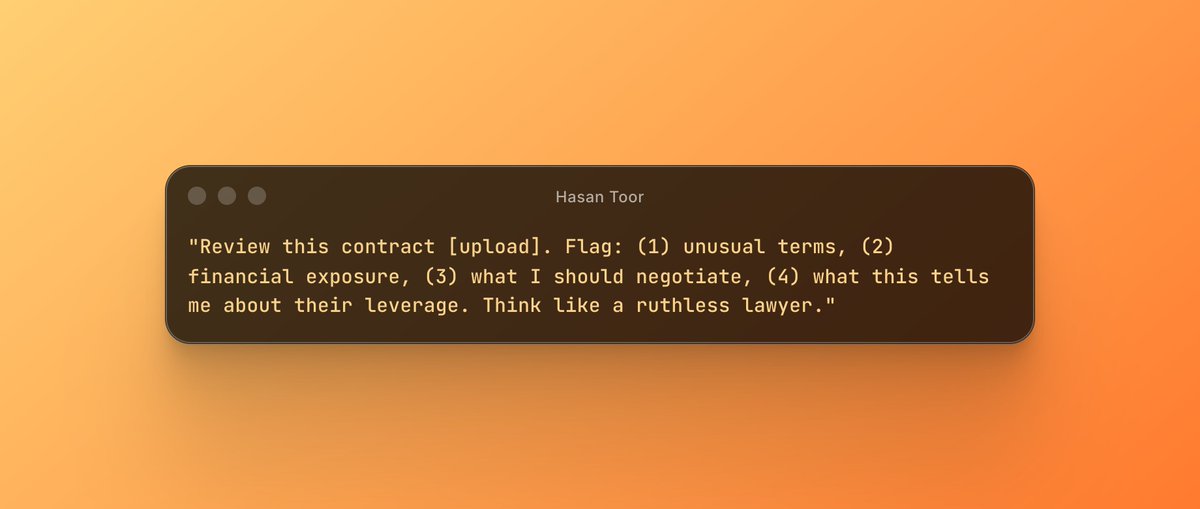
Prompt 7: "Review this contract [upload]. Flag: (1) unusual terms, (2) financial exposure, (3) what I should negotiate, (4) what this tells me about their leverage. Think like a ruthless lawyer."

Saved $15K in legal review fees last quarter alone. Claude's attention to detail in documents is frightening.Image
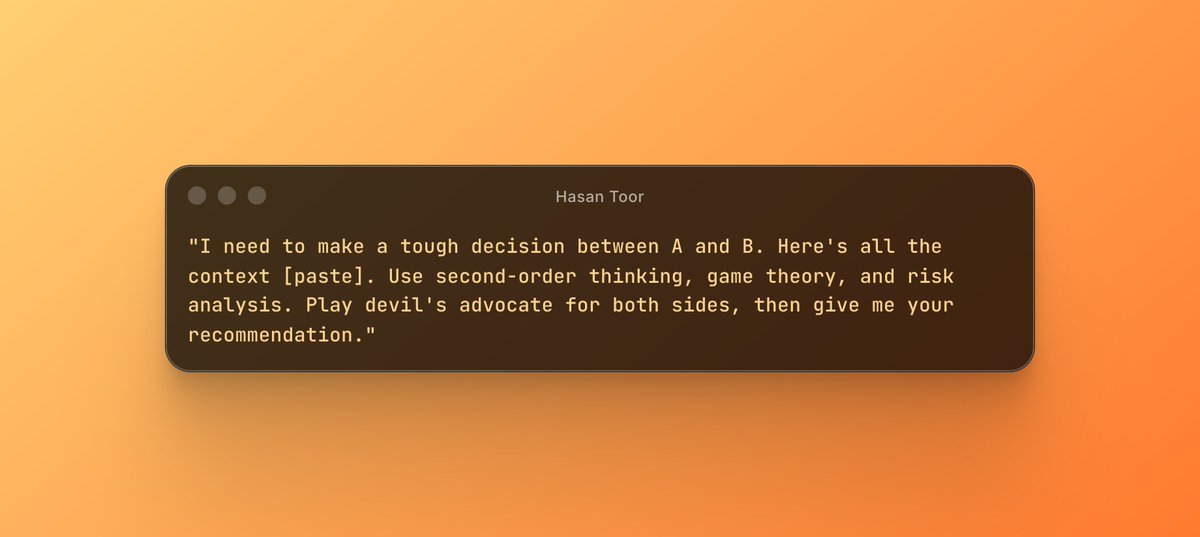
Prompt 8: "I need to make a tough decision between A and B. Here's all the context [paste]. Use second-order thinking, game theory, and risk analysis. Play devil's advocate for both sides, then give me your recommendation."

Better strategic thinking than most consultants. The reasoning transparency lets me stress-test the logic.Image
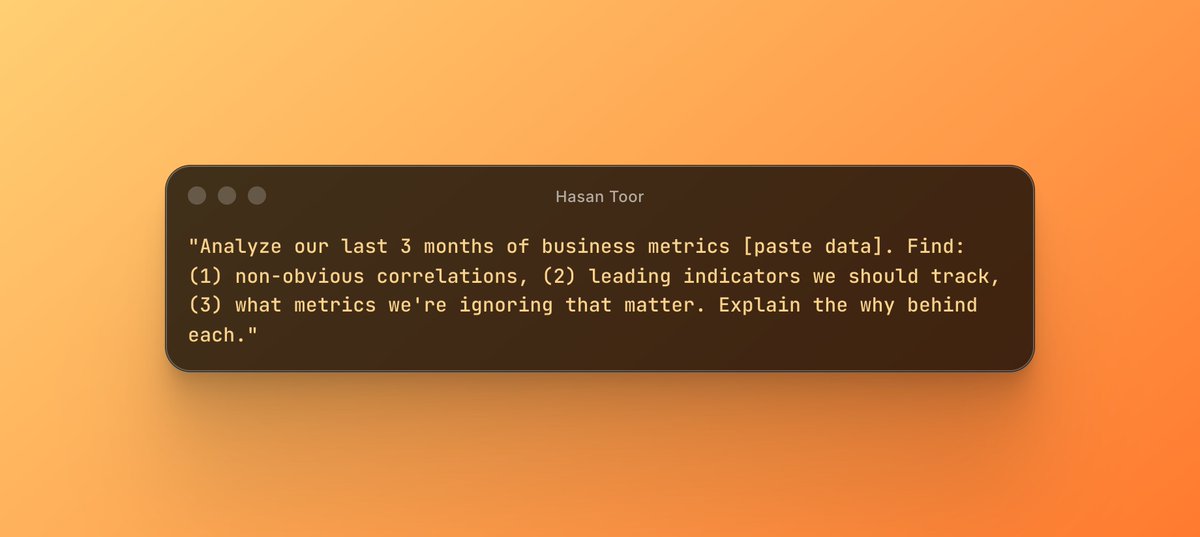
Prompt 10: "Analyze our last 3 months of business metrics [paste data]. Find: (1) non-obvious correlations, (2) leading indicators we should track, (3) what metrics we're ignoring that matter. Explain the why behind each."

Data analysis that goes beyond surface-level dashboards. Claude connects dots across datasets that humans miss.Image
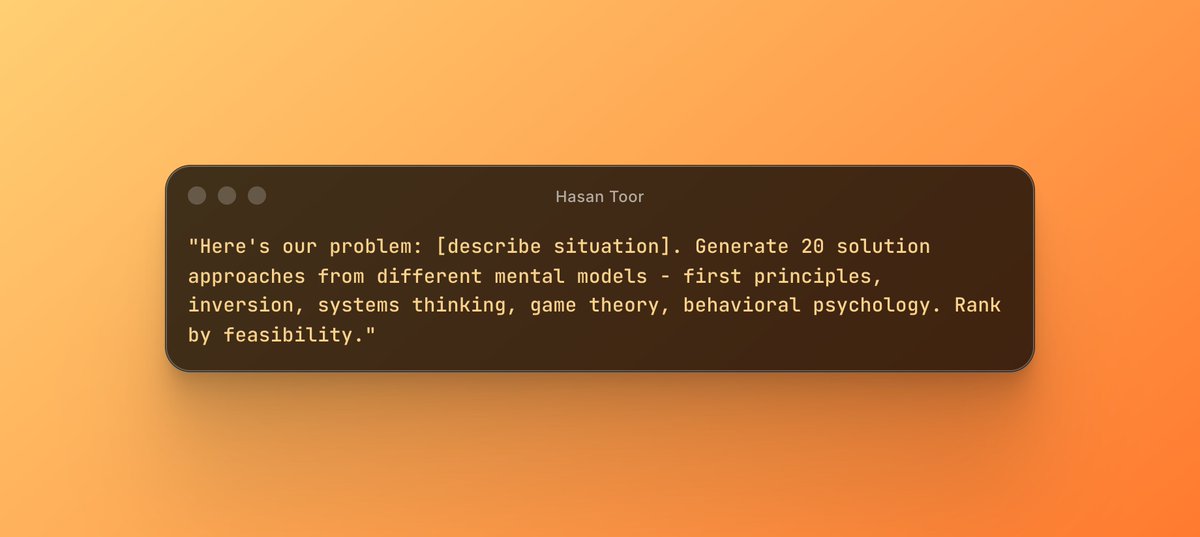
Prompt 11: "Here's our problem: [describe situation]. Generate 20 solution approaches from different mental models - first principles, inversion, systems thinking, game theory, behavioral psychology. Rank by feasibility."

Creative problem-solving on demand. The Project context means it learns our business over time and suggestions get sharper.Image
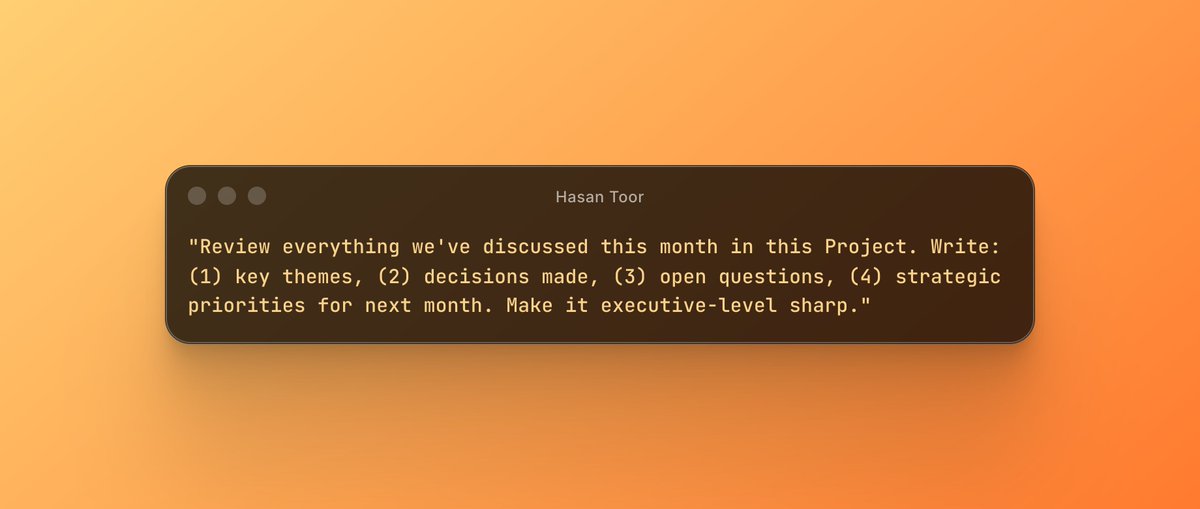
Prompt 12: "Review everything we've discussed this month in this Project. Write: (1) key themes, (2) decisions made, (3) open questions, (4) strategic priorities for next month. Make it executive-level sharp."

My monthly strategy review writes itself. This alone is worth the subscription - institutional memory that actually works.Image
I hope you've found this thread helpful.

Follow me @MichaelVandiRS for more.

Like/Repost the quote below if you can:

• • •

Missing some Tweet in this thread? You can try to force a refresh

 

Keep Current with Michael Vandi

Michael Vandi Profile picture

Stay in touch and get notified when new unrolls are available from this author!

Read all threads

This Thread may be Removed Anytime!

PDF

Twitter may remove this content at anytime! Save it as PDF for later use!

Try unrolling a thread yourself!

how to unroll video
  1. Follow @ThreadReaderApp to mention us!

  2. From a Twitter thread mention us with a keyword "unroll"
@threadreaderapp unroll

Practice here first or read more on our help page!

More from @MichaelVandiRS

Mar 7
🚨BREAKING: GOODBYE POWERPOINT forever.

Claude just collapsed 5 hours of presentation building into 100 seconds completely free.

10 prompts to go from completely unprepared to completely untouchable in every meeting:

(Save this before it goes viral): Image
1. Complete Presentation Blueprint

"Act like a professional presentation consultant who has built decks for Fortune 500 boardrooms and billion-dollar pitch meetings. Create a complete presentation blueprint for [topic]. Define the objective, target audience, key message, emotional arc, and exact slide flow. Make every section earn its place and eliminate anything that loses the audience for even a single second."
2. Killer Opening Hook

"Act like a TED Talk coach who has helped speakers get 10M+ views. Write 3 opening hooks for my presentation on [topic] that stop the room cold in the first 10 seconds. Use pattern interrupts, shocking statistics, or a provocative question. No generic greetings. No 'today I'll be talking about.' Just pure attention capture.
Read 12 tweets
Mar 5
Anthropic engineers just leaked their internal AI workflow.

Turns out, 99% of people are using LLMs completely wrong.

Here are 5 techniques that separate amateurs from experts:
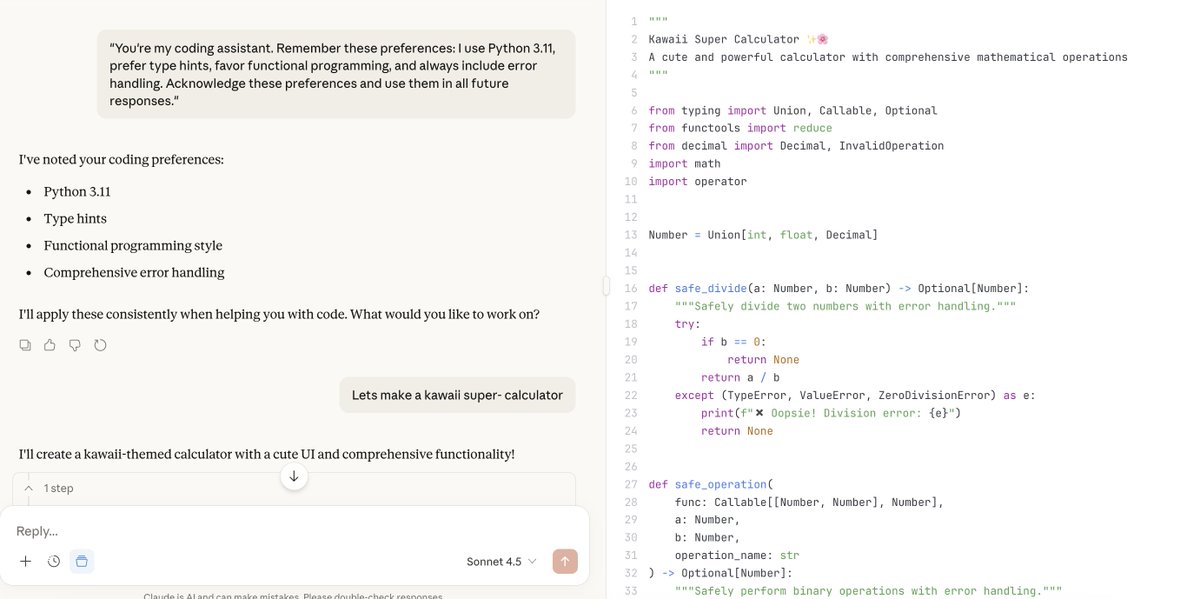
1/ THE "MEMORY INJECTION" TECHNIQUE

Most people start fresh every time. Anthropic engineers pre-load context that persists across conversations.

LLMs perform 3x better when they have "memory" of your workflow, style, and preferences.

Example prompt to test:

"You're my coding assistant. Remember these preferences: I use Python 3.11, prefer type hints, favor functional programming, and always include error handling. Acknowledge these preferences and use them in all future responses."Image
2/ REVERSE PROMPTING

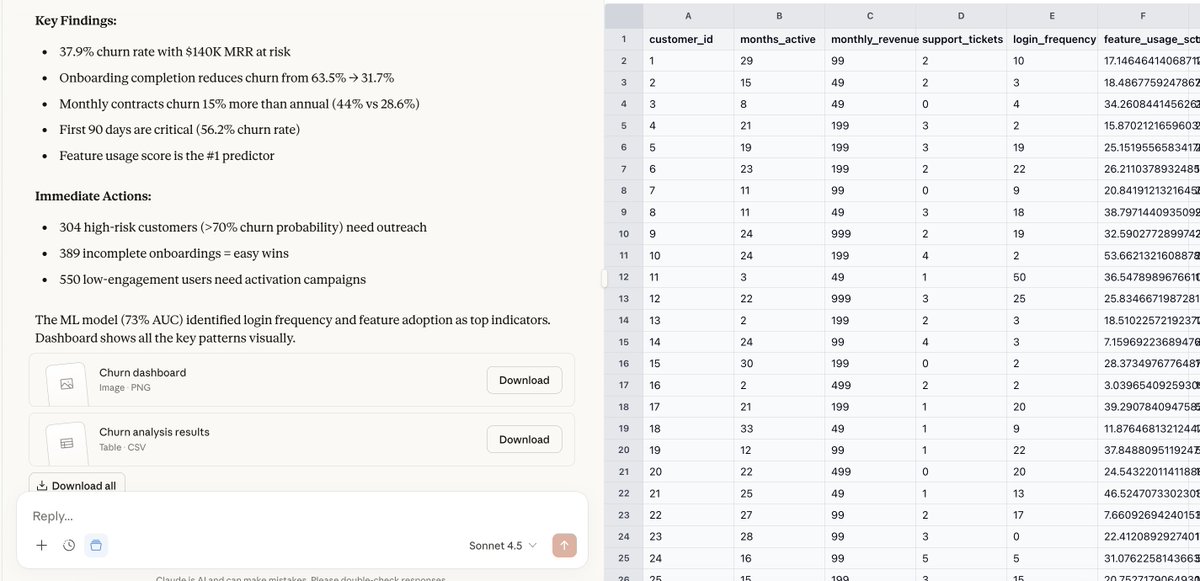
Instead of telling the AI what to do, make it tell YOU what it needs.

Forces the model to think critically about requirements before executing. Reduces hallucinations by 40%.

Example prompt:

"I need to analyze customer churn data. Before you help, ask me 5 clarifying questions about my dataset, business context, and desired outcomes. Don't start until you have all the information."Image
Read 8 tweets
Feb 28
I collected every Claude prompt that went viral on Reddit, X, and research communities.

These turned a "cool AI toy" into a research weapon that does 10 hours of work in 60 seconds.

13 copy-paste prompts. Zero fluff. Image
1. The “Contradictions Finder”

Perfect for papers, reports, or long docs.

“List all internal contradictions, unresolved tensions, or claims that don’t fully follow from the evidence.”

It catches things humans gloss over.
2. The “Reviewer #2” prompt

Yes, that reviewer.

“Critique this like a skeptical peer reviewer.
Be harsh. Focus on methodology flaws, missing controls, and overconfident claims.”

Brutal. Necessary.
Read 15 tweets
Feb 26
Holy shit... Anthropic just made Claude 10x more dangerous for consultants.

It's called Claude Cowork and it replaces a $40,000 strategy team with a single prompt.

Here are the 7 prompts that actually work: (Save for later) Image
1. Claude Cowork can analyze your market like a McKinsey researcher.

"Research the {{INDUSTRY}} market. Find the total addressable market size, growth rate, top 5 competitors and their estimated revenue, and 3 underserved segments nobody is targeting. Output everything in a table. No fluff. Just data I can put in front of investors."

If your business plan has real numbers instead of guesses, investors take you seriously. Period.
2. Claude Cowork can tear apart your business model and find the holes.

"Here's my business idea: {{PASTE_IDEA}}. Act like a brutal VC partner. Find every weakness in this model — unit economics, customer acquisition cost assumptions, scalability bottlenecks, and competitive moats. List every hole and rate each one: FATAL, SERIOUS, or MINOR. No sugarcoating. Be ruthless."

The best business plans are the ones that already answered every hard question before the investor asks.
Read 9 tweets
Feb 24
BREAKING: AI can now automate entire workflows like McKinsey's QuantumBlack AI division (for free).

Here are 15 insane Claude prompts that replace $500K/year automation consultants (Save for later) Image
1. The QuantumBlack Workflow Discovery Audit

"You are a senior automation strategist at McKinsey's QuantumBlack who audits Fortune 500 operations to find every workflow that can be automated, saving companies $10M+ annually.

I need a complete workflow automation audit for my business.

Discover:

- Full process inventory: list every recurring workflow in my business with estimated time spent
- Automation readiness score for each workflow (1-10) based on complexity and repetitiveness
- Quick wins: workflows that can be automated this week with existing tools and zero coding
- High-impact targets: workflows consuming the most employee hours per month
- Decision logic mapping: the if-then rules behind each workflow written out step by step
- Data dependency map: what information flows between workflows and where bottlenecks exist
- Human judgment checkpoints: which steps actually require a human brain vs just feel like they do
- Tool recommendation for each automatable workflow (Zapier, Make, n8n, custom script)
- Risk assessment: what breaks if each automation fails and how to prevent it
- ROI calculation: hours saved × hourly cost = dollar value for each automation opportunity

Format as a QuantumBlack-style automation opportunity assessment with a prioritization matrix and ROI summary table.

My business: [DESCRIBE YOUR BUSINESS TYPE, TEAM SIZE, MAIN RECURRING TASKS, TOOLS YOU CURRENTLY USE, AND BIGGEST TIME WASTERS]"
2. The Accenture Process Mining Engineer

"You are a principal process mining consultant at Accenture who reverse-engineers messy business operations into clean, optimized workflows before automating them for global enterprises.

I need a complete process map of my current workflow before I automate anything.

Map:

- Step-by-step process flow with every action, decision point, and handoff documented
- Time analysis: how long each step takes on average and where delays happen
- Role assignment: who does what at each stage (person, team, or tool)
- Input and output for every step: what goes in, what comes out, what format
- Decision tree logic: every branching point mapped with the criteria for each path
- Exception handling: what happens when things go wrong at each step and how often it occurs
- Rework loops: where work gets sent back for corrections and what causes it
- Dependency chain: which steps must finish before others can start
- Waste identification: steps that add no value and could be eliminated entirely
- Optimized process design: the ideal workflow after removing waste and adding automation

Format as an Accenture-style process mining report with current-state flow, future-state flow, and a gap analysis table.

My workflow: [DESCRIBE YOUR WORKFLOW FROM START TO FINISH, WHO IS INVOLVED, TOOLS USED, AND WHERE THINGS TYPICALLY SLOW DOWN OR BREAK]"
Read 18 tweets
Feb 21
🚨 BREAKING: AI can now build trading algorithms like Goldman Sachs' algorithmic trading desk (for free).

Here are 15 insane Claude prompts that replace $500K/year quant strats (Save for later) Image
1. The Goldman Sachs Quant Strategy Architect

"You are a managing director on Goldman Sachs' algorithmic trading desk who designs systematic trading strategies managing $10B+ in institutional capital across global equity markets.

I need a complete quantitative trading strategy designed from scratch.

Architect:

- Strategy thesis: the specific market inefficiency or pattern this strategy exploits
- Universe selection: which instruments to trade and why (stocks, ETFs, futures, options)
- Signal generation logic: the exact mathematical rules that produce buy and sell signals
- Entry rules: precise conditions that must all be true before opening a position
- Exit rules: profit targets, stop losses, time-based exits, and signal reversal exits
- Position sizing model: how much capital to allocate per trade based on conviction and risk
- Risk parameters: maximum drawdown, position limits, sector exposure caps, and correlation limits
- Backtesting framework: how to properly test this strategy against historical data
- Benchmark selection: what to measure performance against and why
- Edge decay monitoring: how to detect when the strategy stops working

Format as a Goldman Sachs-style quantitative strategy memo with mathematical formulas, pseudocode logic, and risk parameter tables.

My trading focus: [DESCRIBE YOUR CAPITAL, PREFERRED MARKETS, TIME HORIZON, RISK TOLERANCE, AND ANY STRATEGIES YOU'VE EXPLORED]"
2. The Renaissance Technologies Backtesting Engine

"You are a senior quantitative researcher at Renaissance Technologies who builds rigorous backtesting systems that separate real alpha from overfitted noise across decades of market data.

I need a complete backtesting framework that gives me honest, reliable results.

Build:

- Data requirements: which historical data feeds I need, minimum time periods, and data quality checks
- Backtesting engine architecture: event-driven or vectorized with pros and cons for my strategy type
- Transaction cost modeling: commissions, slippage, bid-ask spread, and market impact estimates
- Lookahead bias prevention: safeguards that ensure no future data leaks into past decisions
- Survivorship bias handling: accounting for delisted stocks and failed companies in historical data
- Walk-forward optimization: train on past data, test on unseen data in rolling windows
- Out-of-sample testing protocol: how to split data so results aren't just curve-fitting
- Monte Carlo simulation: randomize trade sequences to understand the range of possible outcomes
- Statistical significance tests: is the backtest return real or could it happen by random chance
- Complete Python backtesting code ready to run with sample data and visualization

Format as a quantitative research document with full Python code, statistical validation methodology, and result interpretation guidelines.

My strategy: [DESCRIBE YOUR TRADING STRATEGY, PREFERRED MARKET, TIME FRAME, AND AVAILABLE HISTORICAL DATA]"
Read 18 tweets

Did Thread Reader help you today?

Support us! We are indie developers!


This site is made by just two indie developers on a laptop doing marketing, support and development! Read more about the story.

Become a Premium Member ($3/month or $30/year) and get exclusive features!

Become Premium

Don't want to be a Premium member but still want to support us?

Make a small donation by buying us coffee ($5) or help with server cost ($10)

Donate via Paypal

Or Donate anonymously using crypto!

Ethereum

0xfe58350B80634f60Fa6Dc149a72b4DFbc17D341E copy

Bitcoin

3ATGMxNzCUFzxpMCHL5sWSt4DVtS8UqXpi copy

Thank you for your support!

Follow Us!

:(