BREAKING DOWN THE #UGC EQUITY REGULATIONS CONTROVERSY: Why the protests against anti-discrimination rules reveal deep casteist resistance to constitutional equality.
The SC stayed the UGC Equity Regulations 2026 before they could even be implemented, citing "reverse discrimination" concerns. But here's what's conveniently forgotten: These regulations emerged from the tragic suicides of Rohith Vemula & Dr. Payal Tadvi due to caste persecution. 2/10
SHOCKING: CJI Surya Kant made blatantly casteist remarks in open court:
"Do you want to take the country back to the old days?"
"Did Brahmins create caste in Muslims, Christians?"
"Even after becoming IAS/CJI, if someone thinks they're oppressed, it's their own mindset, not Brahmins' fault." 3/10
THE IRONY: The same Supreme Court in Sukanya Shantha (2024) & PUDR (1982) recognised the judiciary's DUTY to "take an active stand" against caste discrimination. Yet now it's undermining regulations designed precisely for that purpose—before they're even tested! 4/10
LEGAL HISTORY REPEATS: In 1951's Champakam Dorairajan case, the SC struck down reservations as "unconstitutional." It took 17 years for the Court to admit this error in Golaknath (1967), calling it a setback to "progressive jurisprudence by one and a half decades." Are we repeating this mistake? 5/10
THE CONSTITUTION IS CLEAR: Article 15 specifically PROHIBITS discrimination based on caste. Article 17 abolishes untouchability. Article 46 mandates protecting SC/ST from "social injustice and exploitation." These aren't suggestions—they're constitutional obligations. The Equity Regulations simply enforce this. 6/10
THE "MERIT" LIE EXPOSED: Upper-caste protests claim regulations undermine merit & create "reverse discrimination." But UGC data shows 118.4% RISE in caste-discrimination cases in 5 years. The 2012 advisory-only guidelines failed completely. Enforceable rules are essential, not optional. 7/10
WHO'S REALLY BEHIND THIS? #Hindu right-wing groups & #RSS-affiliated student organisations led the agitation, claiming SC/ST/OBC students will file "motivated complaints." This reveals the real fear: accountability for discrimination they've practiced with impunity for decades. 8/10
THE DEFINITION CONTROVERSY: Protestors claim defining "caste-based discrimination" to protect SC/ST/OBC is "divisive." But Article 15 exists BECAUSE caste discrimination is a historical reality against these communities specifically. Equality doesn't mean ignoring who faces systematic oppression. 9/10
As Dr. Ambedkar said when burning #Manusmriti in 1927: "If you do not knock the door, none opens it." The UGC Regulations knock on the door of caste privilege in academia. The violent resistance proves exactly why these regulations are necessary. Constitutional equality cannot wait for casteist approval. 10/10
@threadreaderapp unroll
• • •
Missing some Tweet in this thread? You can try to
force a refresh

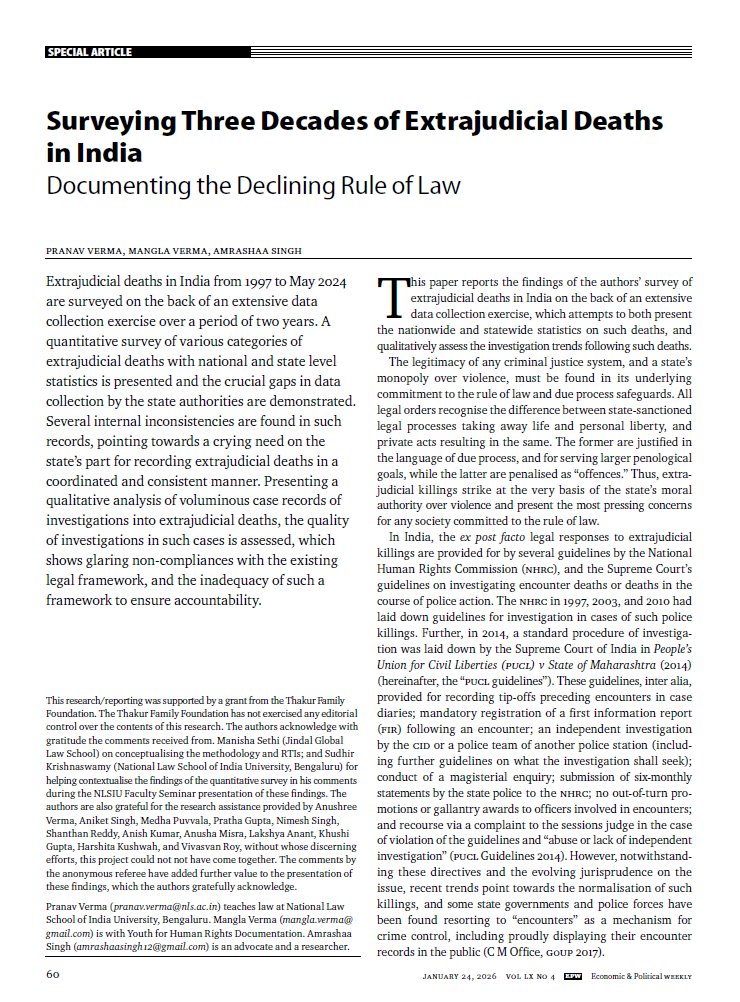
A recent study just exposed how India investigates its #police killings.
->Fabricated evidence.
->Dead victims named as "accused."
->Investigations lasting ≈7 years that go nowhere.
This is what encounter justice looks like.🧵1/15
👍🏽to @pranavverma17 @ManglaVerma @amrshasng
Here's the criminological truth most won't say: high encounter rates don't signal effective policing. They expose investigative failure. When police can't solve crimes scientifically, they resort to bullets as shortcuts. 2/15
Researchers spent two years filing RTIs with #NHRC, all State Human Rights Commissions, and state police. They analysed quantitative and qualitative data which exposed patterns that should alarm anyone who believes in due process of law. 3/15
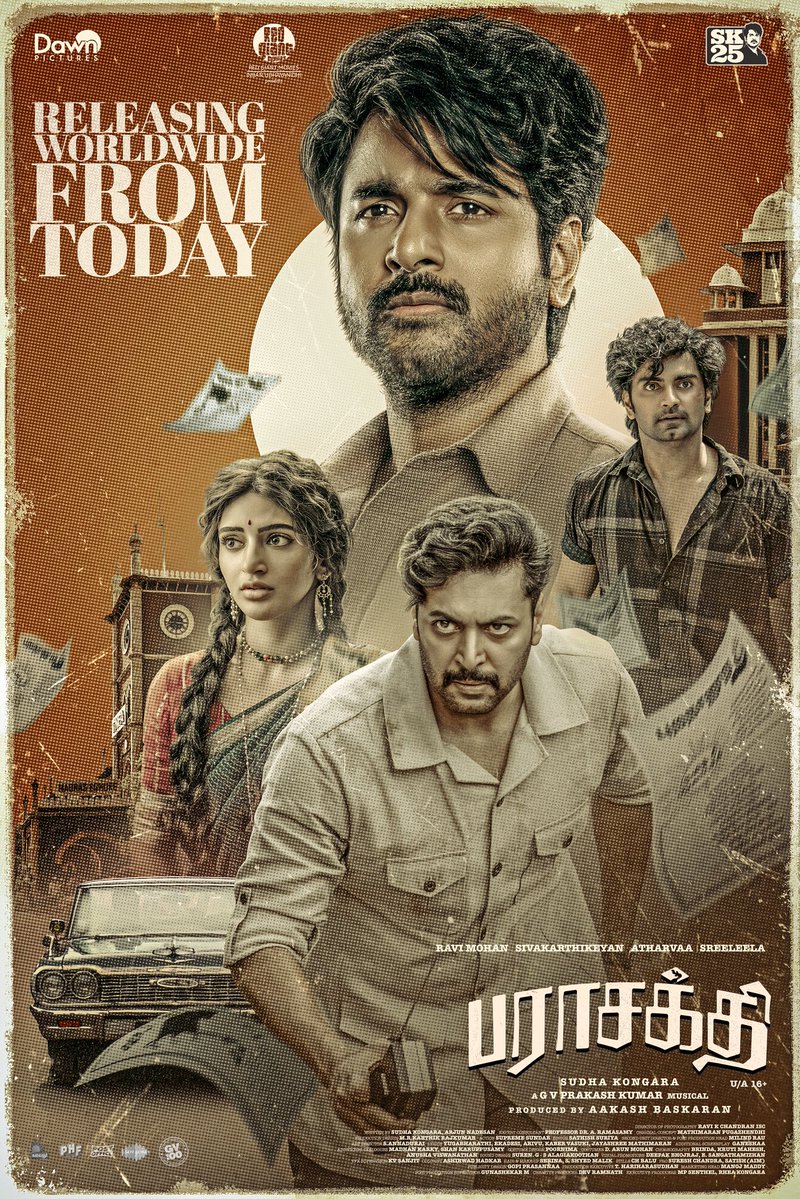
People celebrate the fictionalised fiery student movements in #Parasakthi, reliving 1960s anti-Hindi agitations on screen.
As an alumnus of age-old TN state university, I pity the ignorant: they cheer the fire while ignoring today's zero space for real movements in public institutions! 1/8
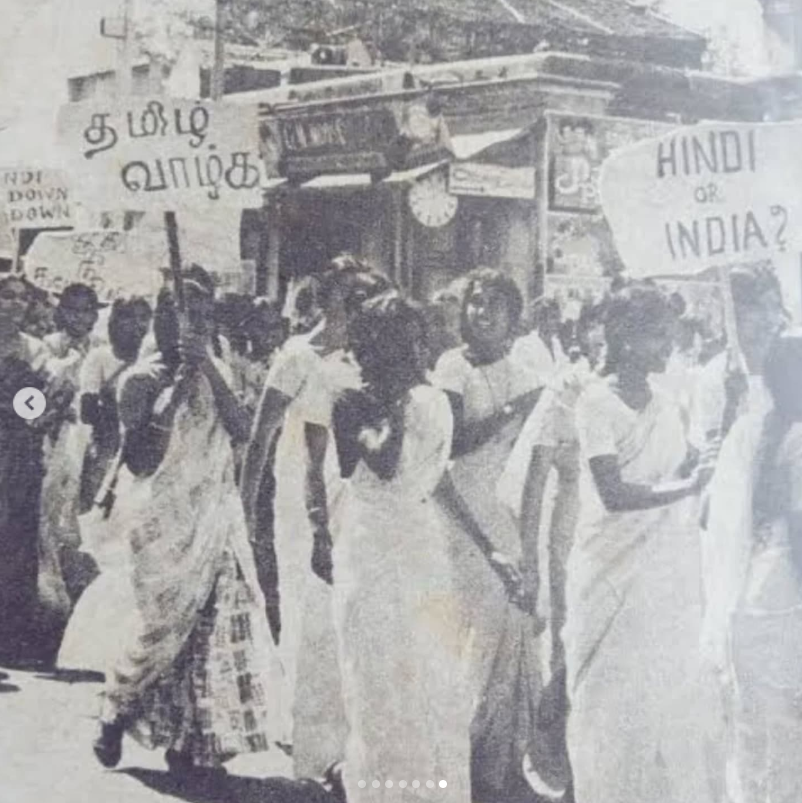
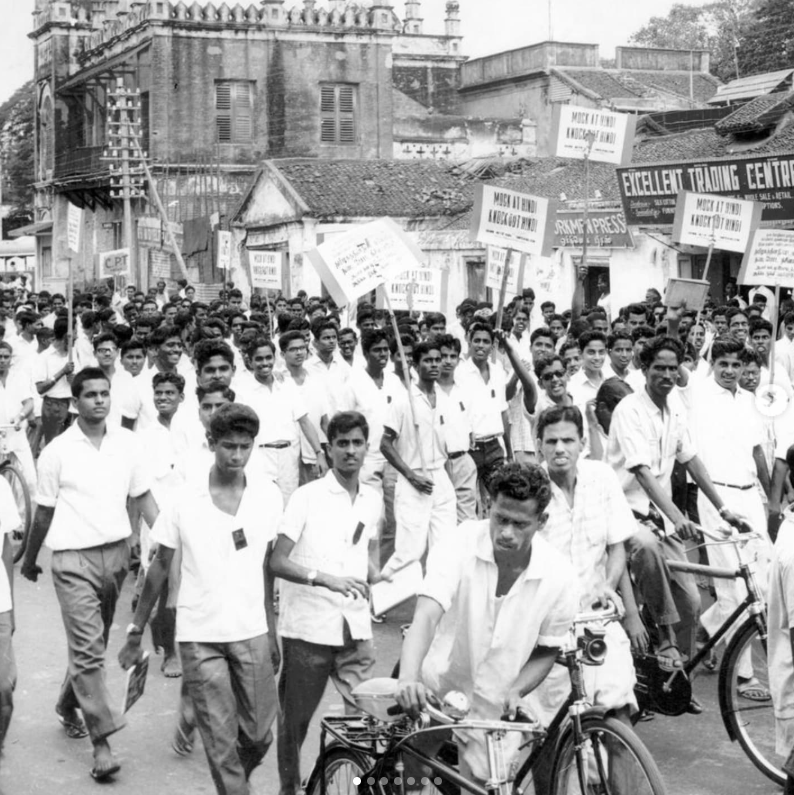
In 1965, students marched, protested & sacrificed lives to defend #Tamil pride against #Hindi imposition, igniting a political revolution that propelled the #DMK to power on student idealism.
Yet fans glorify this fictionalised fire on screen, leaving behind the reality where rapid growth of deemed-to-be & private universities sidelines public ones, snuffing out that spirit of student movement.
The irony is painful! 2/8
Look at this raw energy from the 1960s: students not just studying, but forging history.
Today, moviegoers celebrate that fictionalised passion on screen, but abandon the grim truth of decreasing research quality in state universities starving innovation, with no room for students to rise up.
Albert Einstein in 1949: “Is it OK for a non-economist like me to speak on socialism?” Yes, because economic “laws” are mixed with conquest, class and priesthood, not pure science. Today’s economics still reflects humanity’s predatory phase. 1/10
Current economic science tells us little about a future socialist society. Socialism aims to overcome the predatory stage of human development that Veblen described. Today’s “laws” only apply inside that stage. 2/10 monthlyreview.org/articles/why-s…
Socialism is first of all an ethical goal. Science can supply means, not ends. Ends come from people with high moral ideals and the masses who adopt them. Experts do not own the right to decide how society should be organised. 3/10
US investigators solve 8-year-old double murder of Indian mother & son through DNA from suspect's laptop. Nazeer Hameed charged after years of refusing DNA samples. This case exemplifies investigative persistence & scientific rigor. 1/9 ndtv.com/world-news/201…
The victim, Sasikala Narra (38) from Vijayawada & her 6-year-old son Anish, were brutally murdered in New Jersey in 2017. The suspect, a colleague of the victim's husband, fled to India immediately after. But justice has a long memory. 2/9
Key breakthrough: When Hameed refused DNA samples repeatedly, US investigators obtained court order to seize his company laptop. DNA extracted from it matched blood at crime scene. Locard's principle proven again: "Every contact leaves a trace." 3/9
Tamil Nadu’s withdrawal of general consent to CBI restricts Union’s interference in regular matters, but it doesn’t curtail constitutional oversight. The higher judiciary, under Articles 32 and 142, remains empowered to act when justice and citizen rights demand intervention. (1/15)
Labeling this as “judge-made law” misconstrues constitutional tradition. Judicial review is part of India’s basic structure. Courts interpret where statutes fall silent, bridging legislative gaps to preserve liberty. That’s constitutional guardianship, not judicial overreach. (2/15)
If courts lacked authority to intervene when state investigations risk bias, fundamental rights would become ornamental. The judiciary exists to correct structural inequities. Supervising or transferring an investigation protects justice, not disrupts federal balance. (3/15)
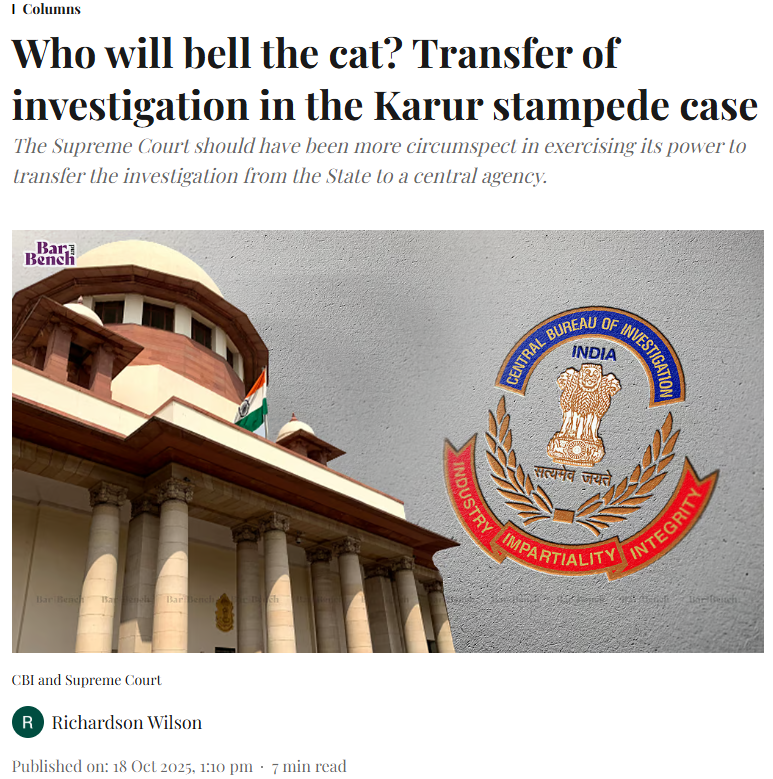
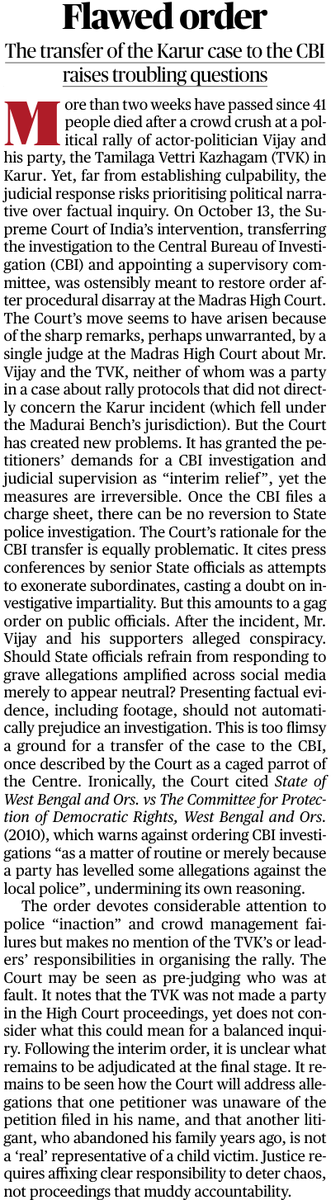
The Hindu’s “Flawed Order” editorial misreads what the SC actually said about the #KarurStampede probe. Let’s look at how the SC’s observations have been twisted into claims the Court never made. 🧵1/10
❗️Before reading this 🧵, YOU SHOULD READ @the_hindu’s editorial 👇🏽
The editorial calls SC’s reasoning amounts a “gag order” on officials. FALSE.
The Court never barred statements, it said cops’ & senior officials’ media remarks could create doubt about probe fairness. That’s caution, not censorship.
Anyone familiar with how justice works knows that conclusive public remarks by a senior police officer can compromise the integrity of an ongoing investigation. 2/10
The Court cited West Bengal v. CPDR (2010) but used its “extraordinary power” because of high political sensitivity, procedural confusion, and cries for credibility. This fits exceptions, not routine transfers. SC acted to restore consistency in conflicting orders from MHC.
Therefore, this editorial's reference to the above ruling is irrelevant and misleading. 3/10