PaulsCorner-VerseQuest Profile picture
Feb 10 5 tweets 12 min read Read on X
Christians Who Want a Crown Without a Cross

Glory comes after suffering, not before.

Introduction

There is a brand of Christianity in this generation that wants the applause of heaven while living like the world. It wants the crown but not the cross, the reward but not the reproach, the shout but not the shame, the resurrection power but not the dying daily. It wants a Savior who carries everybody and a Christianity that never cuts, never confronts, never crosses the flesh, and never costs anything. That religion sells well, fills buildings, and makes men rich, but it does not make saints strong. It produces Christians who are offended by trials, confused by opposition, and shocked when obedience gets expensive. They thought the Christian life was a cruise ship. God wrote it as a war. “Yea, and all that will live godly in Christ Jesus shall suffer persecution” (2 Timothy 3:12).

The Bible never promised you a crown for smiling in a pew. It promised you a cross for following Christ. It never told you that suffering means you missed God. It told you suffering often means you hit the target. The Lord Jesus Christ did not come down here to show you how to avoid pain. He came down here to show you how to obey the Father when pain is the price. “Though he were a Son, yet learned he obedience by the things which he suffered” (Hebrews 5:8). That verse wrecks the soft religion of comfort. If the spotless Son learned obedience through suffering, what do you think God is going to do with a spoiled Christian who thinks holiness should be convenient?

So this essay is for the believer who keeps trying to crown himself in the mirror while refusing to crucify the flesh in the closet. It is for the church crowd that wants victory without battle, reward without labor, revival without repentance, and glory without suffering. God’s order has never changed. The cross comes first, then the crown. The grave comes first, then the resurrection. The suffering comes first, then the glory. “If we suffer, we shall also reign with him” (2 Timothy 2:12). Not if we pose, not if we perform, not if we complain, but if we suffer.

1. The Cross Is Not Optional

The first thing the Lord said about discipleship was not comfort, it was a cross. “If any man will come after me, let him deny himself, and take up his cross daily, and follow me” (Luke 9:23). That is not a suggestion for the extra dedicated Christian. That is the entrance requirement for following Christ. Deny yourself means your feelings do not get the vote, your pride does not get the microphone, your appetite does not get the steering wheel, and your convenience does not get to be king. A cross is not a decoration, it is an execution. You do not carry a cross to improve your life. You carry a cross to end a life, the old life that wants to run the show.

This generation has been trained to treat the cross like jewelry and treat the Christian life like a social club. They hang crosses on walls, wear crosses on chains, put crosses on logos, then live like the devil Monday through Saturday. They want Jesus as a brand, not Jesus as Lord. But Jesus did not die to become your mascot. He died to become your Master. “Ye are not your own… For ye are bought with a price” (1 Corinthians 6:19-20). Bought people do not get to rewrite the terms. The cross means God gets to tell you no. The cross means God gets to offend you. The cross means God gets to put His finger on what you love and demand you surrender it.

And the moment you accept that, you find out why so many Christians are weak. They are trying to live a crucified life without crucifixion. They are trying to walk in the Spirit while feeding the flesh. They are trying to have peace while refusing repentance. They are trying to have power while avoiding the price. The Lord said it plainly, “For whosoever will save his life shall lose it: but whosoever will lose his life for my sake, the same shall save it” (LukeImage
9:24). A crown without a cross is a lie. It is spiritual theft. It is trying to cash a check you never earned.

2. The Crown-Now Gospel Is a Counterfeit

Any message that promises you the crown now is a counterfeit gospel for carnal people. It sounds good because it strokes the flesh. It sounds spiritual because it uses Bible words. It sells because it promises what sinners already want. But it is the same lie Satan used in Eden: you can have the blessing without obedience, the reward without submission, the glory without God’s order. The devil always offers a shortcut to the throne. He even offered it to Christ. He showed Him the kingdoms of the world and said, take them without the cross (Matthew 4:8-10). Christ refused because He will not reign without righteousness and He will not take what the Father has not given. The shortcut is always satanic.

The crown-now gospel produces Christians who measure God by circumstances instead of Scripture. If the bills are paid, they think God is good. If trouble comes, they think God failed. That is childish. The Bible says, “We must through much tribulation enter into the kingdom of God” (Acts 14:22). The Bible says, “In the world ye shall have tribulation” (John 16:33). The Bible says, “Think it not strange concerning the fiery trial which is to try you” (1 Peter 4:12). Not strange. Normal. Expected. Scheduled. So when a preacher tells you God’s main job is to keep you comfortable, he is not preaching Christ, he is selling a product.

The truth is that God will let you hurt because He loves you. He will let you be pressed because He is shaping you. He will let you be opposed because He is proving you. If you could get everything you wanted with no resistance, you would never pray, never fast, never study, never repent, never depend on God, and never grow. You would become a religious spoiled brat with a Bible in your lap and hell in your heart. That is why God says, “My son, despise not thou the chastening of the Lord… For whom the Lord loveth he chasteneth” (Hebrews 12:5-6). The crown-now gospel hates chastening because it hates anything that crosses the flesh. But the Father does not raise soldiers with candy and cartoons. He raises soldiers with discipline.

3. Christ’s Pattern Is Suffering Then Glory

If you want God’s pattern, look at God’s Son. The Lord Jesus Christ is not only your substitute, He is your example. He is not only the Lamb who died for you, He is the Captain you follow. And His life had a clear order: humiliation, then exaltation. “Let this mind be in you, which was also in Christ Jesus… he humbled himself, and became obedient unto death, even the death of the cross. Wherefore God also hath highly exalted him” (Philippians 2:5-9). The word “wherefore” matters. Exaltation came after humiliation. Glory came after obedience. The crown came after the cross.

Paul understood that order and preached it without apology. He said the Spirit testified that bonds and afflictions waited for him (Acts 20:23), and he did not treat that as failure. He treated it as normal Christian service. He called his sufferings a fellowship. “That I may know him… and the fellowship of his sufferings” (Philippians 3:10). Fellowship means participation. It means you are walking where He walked. The American church wants fellowship dinners and conference selfies. Paul wanted fellowship with Christ in suffering. That is why Paul had power. Weak Christianity hates suffering. Strong Christianity uses suffering as a ladder to deeper communion with Christ.

And when believers complain that suffering is unfair, the Lord points them to the cross and says, look again. You were not promised fair. You were promised faithful. You were not promised easy. You were promised eternal. “For I reckon that the sufferings of this present time are not worthy to be compared with the glory” (Romans 8:18). Notice the comparison. Present suffering, future glory. That is God’s
order. You can reject it, but you cannot change it. The cross is not an interruption of the Christian life. It is the center of it. If your Christianity has no cross in it, it is not Christianity, it is a club.

4. Crowns Are Earned in the Furnace

God does not hand crowns to spectators. He crowns overcomers. The Bible says, “Be thou faithful unto death, and I will give thee a crown of life” (Revelation 2:10). Faithful unto death is not a casual phrase. That is endurance under pressure, fidelity under threat, holiness under temptation, truth under ridicule. That is a saint who refuses to bow because he already bowed to Christ. James says, “Blessed is the man that endureth temptation: for when he is tried, he shall receive the crown of life” (James 1:12). Crowns are connected to trials. If you hate trials, you are hating the place where God prepares rewards.

A lot of Christians want to talk about their “calling” while avoiding the furnace that proves the calling. They want to be used by God but never wounded by God. They want to lead but never learn. They want platform without pressure. But God does not entrust His work to soft men. When a man cannot endure correction, he cannot endure ministry. When a man cannot endure hardship, he cannot endure leadership. That is why the Holy Ghost told Timothy, “Thou therefore endure hardness, as a good soldier of Jesus Christ” (2 Timothy 2:3). Not as a spoiled child, not as a church tourist, but as a soldier. Soldiers get bruised. Soldiers get tired. Soldiers get tested.

And the furnace does something the spotlight never can. It exposes motives. It burns off hypocrisy. It proves whether you love Christ or love comfort. When everything is going well, anyone can “praise the Lord.” When the bills hit, the health breaks, the friends leave, and the door closes, then you find out what you really worship. Job said, “Though he slay me, yet will I trust in him” (Job 13:15). That is crown talk. That is cross talk. That is a man who fears God more than he fears pain. The Christian who wants a crown without a cross is basically saying, Lord, reward me without proving me. God does not run His kingdom like that.

5. The Flesh Hates the Cross, So It Invents Excuses

The reason people chase a crown without a cross is simple. The flesh hates crucifixion. The flesh will do anything to avoid dying. It will dress cowardice up as wisdom. It will call compromise “love.” It will call laziness “rest.” It will call disobedience “boundaries.” It will call surrender to sin “struggle.” The flesh is a lawyer. It argues. It negotiates. It bargains. That is why God never told you to educate the flesh. He told you to crucify it. “And they that are Christ’s have crucified the flesh with the affections and lusts” (Galatians 5:24). Not comforted it. Not managed it. Crucified it.

So when the Lord puts a cross in your path, your flesh starts talking. It says, you deserve better. It says, that is too extreme. It says, nobody else does that. It says, God understands. It says, you have been through enough. And if you listen to it long enough, you will start thinking disobedience is self care. That is demonic psychology. The Bible says, “For the flesh lusteth against the Spirit, and the Spirit against the flesh” (Galatians 5:17). That is a war inside you. If you pretend it is not a war, you will lose by default.

And here is the dangerous part. The flesh will even use Bible words to protect itself. It will talk about grace while refusing holiness. It will talk about liberty while feeding lust. It will talk about mercy while dodging repentance. It will talk about forgiveness while refusing to confess. But God’s grace is not permission to stay carnal. “For the grace of God… teaching us that, denying ungodliness and worldly lusts, we should live soberly, righteously, and godly” (Titus 2:11-12). Real grace teaches denial. Denial is a cross word. If a man says he loves grace but refuses denial, he loves an imaginary grace that
the Bible never preached.

6. The Cross You Carry Becomes the Witness You Leave

A Christian who carries his cross is a living sermon. The world can argue with your words, but it cannot argue with your endurance. When believers suffer well, they preach loud without speaking. That is why Peter told suffering saints to rejoice, not because pain is fun, but because pain can be a testimony. “Rejoice, inasmuch as ye are partakers of Christ’s sufferings” (1 Peter 4:13). Partakers means you are sharing in it, joining in it, representing Him. There is a kind of Christian joy that only shows up when the world thinks you should collapse. That joy is supernatural, and the world notices it.

The cross also purifies your witness. A man who will not pay a price for truth is not really committed to truth. A man who bends every time it costs him something is not a disciple, he is a consumer. But when a saint stands firm, when he refuses to lie, when he refuses to compromise, when he refuses to bow, and he suffers for it, the devil learns he cannot buy him. The world learns it cannot intimidate him. And weak Christians learn there is still a spine left in the body of Christ. “But none of these things move me,” Paul said, “neither count I my life dear unto myself” (Acts 20:24). That is cross language. That is crown preparation.

And the cross keeps your eyes on eternity. People who chase crowns now are usually blind to the judgment seat of Christ. They think life is about building a reputation on earth. But the Bible says every believer will give account. “For we must all appear before the judgment seat of Christ” (2 Corinthians 5:10). Every hidden motive, every wasted day, every compromised moment, every fear of man, every surrendered conviction will be reviewed. And the only thing that will matter then is what you did for Christ. “If any man’s work shall be burned, he shall suffer loss: but he himself shall be saved” (1 Corinthians 3:15). A saved man can still suffer loss. That loss is often tied to avoiding the cross.

7. The Day of Crowning Is Coming, So Do Not Quit Now

There is a real crown. There is a real reward. There is a real day when God will honor what men mocked. The Christian life is not endless suffering with no purpose. It is suffering with an appointment. “For our light affliction, which is but for a moment, worketh for us a far more exceeding and eternal weight of glory” (2 Corinthians 4:17). Affliction works for you when you endure it in faith. It builds something eternal. That is why Paul could say, “Henceforth there is laid up for me a crown of righteousness” (2 Timothy 4:8). Laid up. Stored. Reserved. Waiting. Not handed out in this life as trophies for popularity, but prepared for faithful endurance.

So do not quit because you got tired. Do not quit because you got lonely. Do not quit because you got wounded. Do not quit because people misunderstood you. If you are carrying a cross, people will misunderstand you. If you are standing for truth, people will call you extreme. If you are separating from sin, people will say you are judgmental. If you are preaching the Book, people will say you are old fashioned. That is the price of discipleship. “Marvel not, my brethren, if the world hate you” (1 John 3:13). Hate is not a sign you failed. Sometimes hate is a sign you hit the nerve.

And remember the Lord’s warning and promise. “Hold that fast which thou hast, that no man take thy crown” (Revelation 3:11). That verse assumes a crown can be lost in the sense of reward forfeited. You cannot lose salvation if you are in Christ, but you can lose reward. You can trade eternal honor for temporary comfort. You can sell your crown for a bowl of soup like Esau, and plenty of Christians do it every day with their eyes open. They take the easy road, keep quiet, blend in, stay neutral, avoid confrontation, avoid sacrifice, avoid prayer, avoid holiness, and then expect God to crown them like conquerors. God crowns fighters, not fakers.
Conclusion

If you want a crown without a cross, what you really want is Christianity without Christ. You want the benefits without the Person, the reward without the relationship, the glory without the God who owns it. But the Lord settled it long ago. “Whosoever doth not bear his cross, and come after me, cannot be my disciple” (Luke 14:27). Cannot means cannot. It is not complicated. It is just offensive to the flesh. The flesh wants to be praised. The cross demands you die. The flesh wants to be comfortable. The cross demands you obey. The flesh wants to be seen. The cross demands you follow Christ even when nobody claps.

So the call is simple and it is sharp. Stop crowning yourself in a world that is dying. Stop chasing applause from people who will be gone in a hundred years. Stop building a comfortable religion that cannot withstand pressure. Take up your cross. Deny yourself. Obey the Book. Stand for truth. Live clean. Pray hard. Love Christ more than your reputation. If God puts suffering in your path, do not call it strange. Ask what He is forging in you. Ask what He is burning out of you. Ask what kind of weight of glory He is building through that pain (2 Corinthians 4:17).

And if you are saved, remember this. You are not suffering to earn heaven. You are suffering because you are headed there, and this world is not your home. “For here have we no continuing city, but we seek one to come” (Hebrews 13:14). The crown is real, but it is not here. It is ahead. The glory is real, but it is after. So do not envy the crown-now crowd. They may have their reward. But when the smoke clears and the books open, the Lord will honor the saints who carried the cross without flinching, and the glory will come exactly the way God promised, after suffering, not before. “For I reckon that the sufferings of this present time are not worthy to be compared with the glory” (Romans 8:18).

• • •

Missing some Tweet in this thread? You can try to force a refresh

 

Keep Current with PaulsCorner-VerseQuest

PaulsCorner-VerseQuest Profile picture

Stay in touch and get notified when new unrolls are available from this author!

Read all threads

This Thread may be Removed Anytime!

PDF

Twitter may remove this content at anytime! Save it as PDF for later use!

Try unrolling a thread yourself!

how to unroll video
  1. Follow @ThreadReaderApp to mention us!

  2. From a Twitter thread mention us with a keyword "unroll"
@threadreaderapp unroll

Practice here first or read more on our help page!

More from @TNTJohn1717

Feb 10
Whosoever Was Not Found - Revelation 20:15
Individual Accountability - Not Group Condemnation

Introduction

Revelation 20 ends with a sentence so plain a child can read it, yet so heavy it can crush a man’s pride like wet paper. “And whosoever was not found written in the book of life was cast into the lake of fire” (Revelation 20:15). That is not poetry. That is not symbolism. That is not a devotional thought to print on a coffee mug. That is a courtroom verdict followed by an immediate execution. It is the last word of God on the last judgment of the lost, after a thousand years of Christ’s reign, after Satan’s final revolt, after the last deception, after the last fire from heaven. When you reach this verse, you are not dealing with religion anymore. You are dealing with the Judge.

The modern pulpit hates this verse because it destroys the two idols of the age: sentimental theology and collective excuses. The first idol says God is too “loving” to judge. The second idol says guilt is always somebody else’s fault, society’s fault, your parents’ fault, your church’s fault, your trauma’s fault, your government’s fault, your “system’s” fault. Revelation 20:15 does not argue with your sociology. It does not care about your narrative. It does not consult your therapist. It does not check your denominational paperwork. It says “whosoever.” It says “was not found.” It says “written.” It says “book of life.” It says “cast.” It says “lake of fire.” That verse will not bend for you.

And the fear of it is not that God will condemn people in groups like a tyrant with a quota. The fear of it is the opposite. The fear is that He will deal with you as an individual, with your own name, your own record, your own light rejected, your own conscience violated, your own sins committed, your own Christ refused. “So then every one of us shall give account of himself to God” (Romans 14:12). You can hide in a crowd on earth. You cannot hide in a crowd at the great white throne. You will not be “one of the unfortunate masses.” You will be you, standing there with nothing but the truth.

1. The Last Line of the Last Courtroom

Revelation 20:11 tells you the setting. “And I saw a great white throne, and him that sat on it, from whose face the earth and the heaven fled away” (Revelation 20:11). In that moment, the props are removed. Whatever men used to distract themselves, the sky, the lights, the seasons, the rhythms, the horizons, the noise of life, the commerce, the entertainment, the politics, it is all gone. There is no hiding behind the created order when the Creator takes the bench. The creation itself steps aside. You are left with God and the truth. That alone should make a man stop joking about judgment.

Then the Holy Ghost says, “And I saw the dead, small and great, stand before God” (Revelation 20:12). There is no “VIP section” at this throne. There is no rich man’s exemption, no poor man’s sympathy card, no celebrity pass, no academic loophole. Small and great stand there the same way, dead and exposed, and the Judge does not ask them what the polls said. He does not ask them what their friends thought. He does not ask them how sincere they were in their delusion. He judges them with books. “And the books were opened” (Revelation 20:12). When God opens books, the talking stops.

That is why Revelation 20:15 is the final nail. It is not God losing His temper. It is God closing the case. People talk about “harshness” as if this is some outburst. It is not. The sentence comes after evidence, after records, after every mouth is stopped. Romans 3 tells you how it ends: “that every mouth may be stopped, and all the world may become guilty before God” (Romans 3:19). The great white throne is not group condemnation. It is the end of every excuse.

2. “Whosoever” Means Your Name, Not Your Crowd

The word “whosoever” is a sword. Men love “whosoever” when it is in the invitations. “For whosoever shall call uponImage
the name of the Lord shall be saved” (Romans 10:13). They like that because it feels broad, warm, open. But the same God who wrote Romans 10 wrote Revelation 20. And “whosoever” at the end is just as personal as “whosoever” at the beginning. It means any man. Every man. It means the moral man and the immoral man. It means the religious man and the atheist. It means the man who lived in a church building and the man who cursed God in a prison cell. “Whosoever” is God saying, I am not judging a class. I am judging persons.

That one word destroys the whole modern game of hiding behind identities. Some hide behind family. Some hide behind nation. Some hide behind denomination. Some hide behind “I’m not as bad as them.” Some hide behind “we were raised this way.” Some hide behind “everybody in my town believes this.” Some hide behind “my church taught me.” Some hide behind “my pastor said.” The Lord does not put your church on the throne. He puts you there. “For we must all appear before the judgment seat of Christ” (2 Corinthians 5:10) applies to saved men for rewards, but the principle is the same across the board: God deals with persons. Even in the Old Testament, the Lord said, “The soul that sinneth, it shall die” (Ezekiel 18:4). He did not say, The group that sinneth. He said, The soul.

And you learn something else from “whosoever.” God is not interested in your comparison chart. Men love to grade on a curve. They want to stand next to a worse sinner and feel holy. God does not compare you to your neighbor. He compares you to His own righteousness. “As it is written, There is none righteous, no, not one” (Romans 3:10). If you try to enter that courtroom with “I’m basically a good person,” you have already confessed you do not know what goodness is. You do not know what holiness is. “Be ye holy; for I am holy” (1 Peter 1:16). The standard at the great white throne is not “better than average.” The standard is God.

3. The Books and the Book

Revelation 20:12 is specific for a reason. “And the books were opened: and another book was opened, which is the book of life” (Revelation 20:12). Notice the plural and the singular. There are books, records, documentation, the details of deeds, words, motives, opportunities, warnings, light given, light refused. Jesus said, “But I say unto you, That every idle word that men shall speak, they shall give account thereof in the day of judgment” (Matthew 12:36). Men talk like their words evaporate. God writes them down. Men forget their lies. God does not forget. Men justify their cruelty. God records it.

But then there is “another book,” and it is not about deeds. It is about life. It is the book of life. That tells you the issue at the bottom of the pit is not merely that a man did wrong. The issue is that he never received God’s life. He remained dead toward God. “And you hath he quickened, who were dead in trespasses and sins” (Ephesians 2:1). A dead man cannot produce life by doing. A dead man can only receive life by grace. The book of life is the line between the redeemed and the lost. It is why Jesus could say, “He that heareth my word, and believeth on him that sent me, hath everlasting life, and shall not come into condemnation” (John 5:24). If you have everlasting life, you do not show up at this throne to be condemned. You show up at Christ’s judgment seat to have your works tried for reward, not to determine heaven or hell (2 Corinthians 5:10).

That is why Revelation 20:15 is not teaching “group condemnation.” It is teaching personal exclusion from life. “Whosoever was not found written in the book of life was cast into the lake of fire” (Revelation 20:15). Not found means searched. It means examined. It means looked for. Men talk about God being unfair. They do not read what the Bible says. God opens books. God opens the book of life. There is a search. There is a finding. And the horror is not that God is careless. The horror is that God is exact.
4. Works Prove Guilt, They Do Not Purchase Life

Revelation 20:12 says the dead “were judged out of those things which were written in the books, according to their works” (Revelation 20:12). Works matter, but not the way religious people want them to matter. The lost man wants his works to be a ladder to heaven. The Lord uses his works as evidence in a trial. Religion says, Do and live. The gospel says, Live and then do. The gospel gives life first, then produces good works after. “For by grace are ye saved through faith; and that not of yourselves: it is the gift of God: Not of works, lest any man should boast” (Ephesians 2:8-9). Then it says, “For we are his workmanship, created in Christ Jesus unto good works” (Ephesians 2:10). Works follow salvation. They do not cause it.

At the great white throne, the books do not open to find a man’s good deeds so God can let him in. They open to prove a man’s guilt so God can shut his mouth. That is why Paul could say, “By the deeds of the law there shall no flesh be justified in his sight” (Romans 3:20). If you bring your works to God as payment, you are insulting the blood of Christ. You are saying the cross was not enough. You are saying God can be bribed. You are saying your filthy rags can purchase what only Christ’s righteousness can provide. Isaiah nailed it: “all our righteousnesses are as filthy rags” (Isaiah 64:6). Men get offended at that because they are proud of their rags.

But the books still matter, and they matter for another reason. They show that judgment is personal, measured, just. The Judge does not lump all sinners into one undifferentiated pile like a mob. He judges “according to their works” (Revelation 20:12). That implies degrees of guilt and degrees of punishment. Jesus talked like that when He said it would be “more tolerable” for some than for others (Matthew 11:22-24). That does not soften hell. It proves God’s righteousness. Even in wrath, He is exact. Even in condemnation, He is fair. Nobody will go to the lake of fire because they were “unlucky.” They will go because they are guilty and because their name is not in the book of life.

5. No Group Ticket, No Family Pass, No Church Receipt

This is where Revelation 20:15 cuts straight through the modern American religion factory. People live their whole lives thinking they are safe because they are part of something. They are part of a church. They are part of a family. They are part of a tradition. They are part of a nation that “believes in God.” They are part of a conservative movement. They are part of an activist movement. They are part of a race, a class, a tribe, a circle. They assume association equals salvation. But the Bible says, “whosoever.” Not “whatsoever group.” Not “whatsoever institution.” Not “whatsoever movement.” Whosoever.

Jesus broke people of that delusion while He was on earth. The Jews thought being Abraham’s seed made them safe. Jesus told them, “Ye are of your father the devil” (John 8:44). John the Baptist said, “And think not to say within yourselves, We have Abraham to our father” (Matthew 3:9). God does not accept your ancestry as a substitute for a new birth. “Ye must be born again” (John 3:7). Your parents cannot be born again for you. Your church cannot be born again for you. Your pastor cannot be born again for you. Your wife cannot be born again for you. You must be born again.
Read 5 tweets
Feb 10
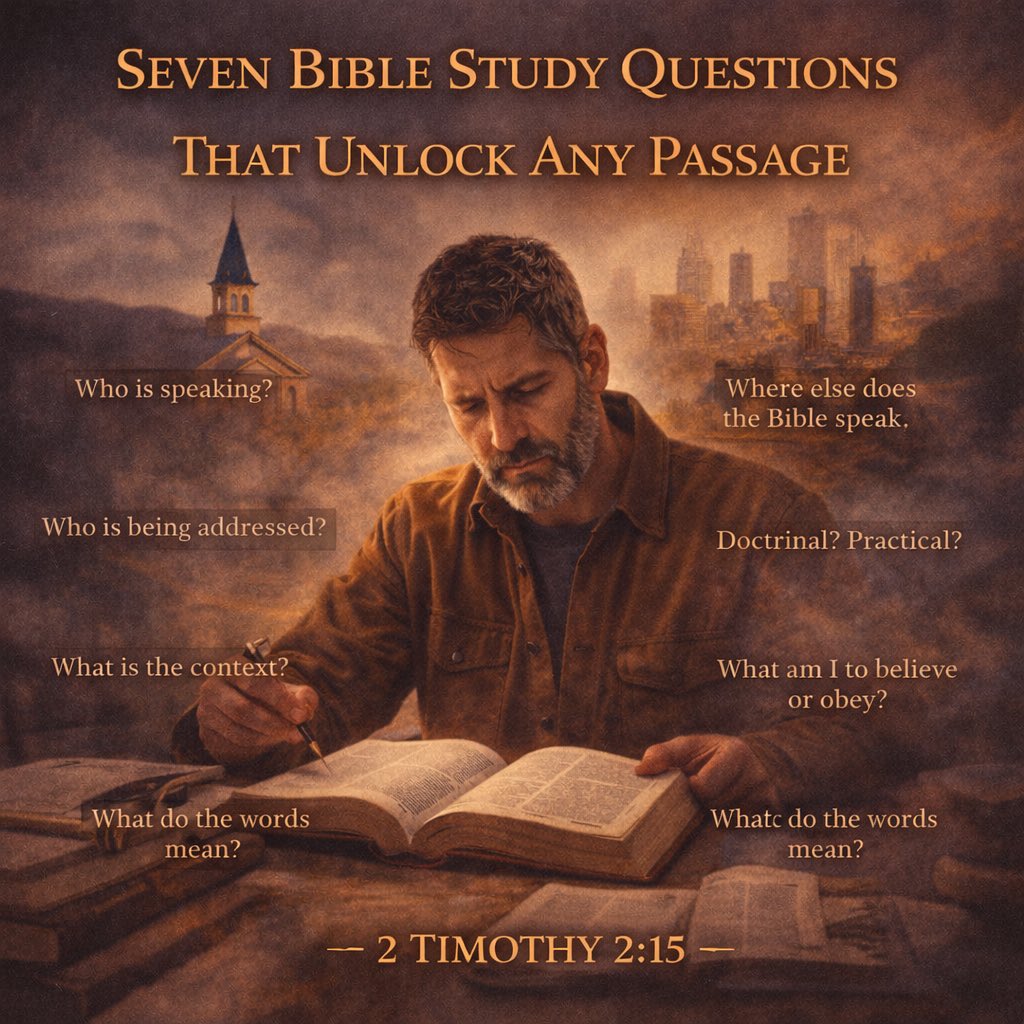
Seven Bible Study Questions That Unlock Any Passage

Main Text: “Study to shew thyself approved unto God, a workman that needeth not to be ashamed, rightly dividing the word of truth” (2 Timothy 2:15).

INTRODUCTION

Most of the “hard” Bible passages aren’t hard because God hid them, they are hard because people won’t slow down long enough to read them like God wrote them. They skim, assume, import their denomination, and then act shocked when the verse does not salute their tradition. The Book was not written to entertain your curiosity, it was written to govern your life. “Thy word is a lamp unto my feet, and a light unto my path” (Psalm 119:105). A lamp doesn’t work if you refuse to turn it on, and the Bible doesn’t “open up” to a man who won’t do what it says.

The average Christian’s method is panic reading. He opens the Bible only when life catches fire, then he grabs a verse like a drowning man grabbing driftwood, and he calls that “study.” Study is work, and God expects workmen. “Study to shew thyself approved unto God” (2 Timothy 2:15) is not a suggestion, it is a command, and it was written because God knows the devil can twist a careless reader into knots. A man can sit under preaching for twenty years and still not know what to do with a passage if he never learns how to ask the right questions.

So here is the key. You don’t need a secret code, a new translation, or a guru. You need a set of Bible questions that force your mind to submit to the text instead of forcing the text to submit to your mind. The Bereans did not need a seminary, they needed honesty and Scripture. “They received the word with all readiness of mind, and searched the scriptures daily, whether those things were so” (Acts 17:11). These seven questions will unlock any passage because they keep you in the Book, keep you in context, keep you rightly divided, and keep you from the most common traps that wreck Christians in study.

1. WHO IS SPEAKING IN THIS PASSAGE

The first question is simple, and most confusion starts when you ignore it. Who is talking here. Is it God speaking directly, is it a prophet repeating what God said, is it a king writing in distress, is it an apostle teaching doctrine, or is it a devil lying through someone’s mouth. The Bible records truth, but it also records lies that God wants exposed as lies. Satan spoke to Eve, and the words are written down, but that doesn’t make them doctrine for you. “Now the serpent was more subtil than any beast of the field” (Genesis 3:1). If you do not identify the speaker, you can end up preaching the serpent like he is the Holy Ghost.

When God speaks, the authority is absolute. When men speak, you must watch the context and the intent. Sometimes a man speaks by inspiration, and sometimes a man speaks by fear, anger, or unbelief. Elijah said, “It is enough; now, O LORD, take away my life” (1 Kings 19:4). That is the language of depression, not the language of doctrine. God wrote it down to show you the struggle, not to give you permission to quit. So you ask, who is speaking, and then you ask, is the Bible approving what is said or exposing it.

This question also protects you from worshipping personalities. The Bible is not a collection of human opinions with God sprinkled on top. “Holy men of God spake as they were moved by the Holy Ghost” (2 Peter 1:21). That means when the Holy Ghost is speaking, you submit. When a man is speaking out of his flesh, you learn from the warning. Identifying the speaker is like putting the right label on the medicine bottle. Take the wrong dose from the wrong voice and you will get spiritual sickness every time.Image
2. WHO IS BEING ADDRESSED

The second question is the one that destroys half the sermon material on the internet. To whom is this being spoken. The Bible is written for you, but not everything in it is written to you, and if you don’t learn that distinction you will live confused, fearful, and doctrinally unstable. God speaks to Adam one way, to Israel another way, to the Church another way, and to the Tribulation saints another way. A man who refuses to see audiences is a man who will mix instructions until nothing fits.

The Bible itself tells you there are differences. Jesus said, “I am not sent but unto the lost sheep of the house of Israel” (Matthew 15:24). That is not a “nice thought,” that is a direct statement of audience and mission in His earthly ministry. Paul says he is “the apostle of the Gentiles” (Romans 11:13). If you blur those lines, you will force passages to say what they do not say, and you will take a verse meant for Israel under the law and try to shove it onto a Christian under grace, then wonder why you cannot make it work.

This is why the Holy Ghost tells you to divide. “Rightly dividing the word of truth” (2 Timothy 2:15) means you respect who is being addressed. It will also keep you from spiritual panic. A man reads a judgment passage meant for rebels and applies it to a saved believer, then he lives under a cloud. But the Bible says, “There is therefore now no condemnation to them which are in Christ Jesus” (Romans 8:1). Ask who is being addressed, and you stop letting the devil steal your peace by misaddressed mail.

3. WHAT IS THE CONTEXT BEFORE AND AFTER

The third question is what saves you from verse snatching. What is the context. What comes before and what comes after. Most false doctrine is a single verse ripped out of its neighborhood and used like a weapon. The devil loves lonely verses because lonely verses can be made to sound like anything. But God wrote Scripture in sentences, paragraphs, chapters, and books for a reason, and He expects you to read like an honest man reads.

Context means you identify the flow of thought. What problem is being addressed. What question is being answered. What rebuke is being given. What promise is being made, and what condition is attached to it. This is not complicated. It just requires humility and patience. “The entrance of thy words giveth light; it giveth understanding unto the simple” (Psalm 119:130). Notice it is the entrance of words, plural, not one word yanked out like a slogan.

Context also keeps you from emotional interpretation. A man can take a comfort verse meant for a repentant believer and hand it to a rebel as if God blesses rebellion, then wonder why nothing changes. God’s comfort is real, but it is not a license to sin. Read the whole passage. Let it say what it says. Then you will find the Bible is consistent, and the confusion was never in God’s writing. The confusion was in your shortcut.

4. WHAT DO THE KEY WORDS MEAN IN THE BIBLE

The fourth question is where real study begins. What do the words mean, and how does the Bible use them. People define Bible words by modern culture, denominational jargon, or their own emotions, and then they accuse God of being unclear. God is not unclear. The reader is sloppy. The Bible has its own vocabulary, and it defines its own terms if you will bother to look.
When Nehemiah’s day needed revival, the people did not need a concert. They needed Scripture explained plainly. “They read in the book in the law of God distinctly, and gave the sense, and caused them to understand the reading” (Nehemiah 8:8). That is the heart of good Bible study. Distinct reading and clear sense. If a word matters enough for the Holy Ghost to put it in the verse, it matters enough for you to define it correctly.

This is also where you stop being a slave to experts. You do not need a guru to tell you what “grace” means when Paul tells you, “By grace are ye saved through faith” (Ephesians 2:8). You do not need a philosopher to explain “faith” when God says, “Faith cometh by hearing, and hearing by the word of God” (Romans 10:17). Key words are keys. Study them the Bible way, and the passage starts opening like a door that was never locked in the first place.

5. WHERE ELSE DOES THE BIBLE TALK ABOUT THIS

The fifth question is the backbone of Bible interpretation. Where else does the Bible speak on this subject. Scripture interprets Scripture. God will not contradict Himself, so if your interpretation creates a contradiction, your interpretation is wrong. That is simple. The Bible even tells you the method: “Precept must be upon precept… line upon line… here a little, and there a little” (Isaiah 28:10). That is God’s study method, and it will do more for you than a thousand commentaries if you will practice it.

Cross references keep you balanced. One verse will guard you from legalism, another will guard you from laziness. One verse will warn you, another will comfort you, and together they make you stable. Paul said we speak “not in the words which man’s wisdom teacheth, but which the Holy Ghost teacheth; comparing spiritual things with spiritual” (1 Corinthians 2:13). That is Bible study, not religious guesswork.

This question also guards you from private interpretation. “No prophecy of the scripture is of any private interpretation” (2 Peter 1:20). That means you don’t get to invent meanings. You gather what God said across the Book until the Bible builds the doctrine, not your imagination. If you will chase a theme through Scripture, you will start seeing how perfectly the Book fits together, and your confidence will shift from men to God, where it belongs.

6. WHAT IS THE DOCTRINAL APPLICATION AND WHAT IS THE PRACTICAL APPLICATION

The sixth question is the one that keeps you from misusing passages. What is the doctrinal application, and what is the practical application. Some things are doctrinally addressed to Israel, but they are practically profitable for you. The Holy Ghost told you this plainly. “For whatsoever things were written aforetime were written for our learning” (Romans 15:4). Learning does not always mean direct command. Learning sometimes means you see God’s character, God’s ways, and God’s warnings, and you apply the lesson without stealing the covenant.

This is where right division becomes a blessing instead of a hobby. Right division does not remove the Old Testament from your life. It puts it in the right place. It keeps you from becoming a legalist, but it still lets you learn wisdom, fear of God, and the consequences of sin. The Bible says all Scripture is profitable (2 Timothy 3:16), but it is only profitable when it is handled correctly, not when it is mashed together like spiritual soup.

A struggling Christian often reads the wrong passages the wrong way and ends up afraid, guilty, or confused. This question pulls you back to sanity. You ask, what is this teaching doctrinally, and what can I learn practically. Then you can read the whole Bible with joy instead of fear, and you can be fed without being thrown into doctrinal chaos.

7. WHAT DOES GOD WANT ME TO BELIEVE, OBEY, OR CHANGE BECAUSE OF THIS

The seventh question is where study turns into power. What does God want me to do with this. The Bible is not given to make you a critic. It is given too
Read 4 tweets
Feb 8
Seven Mistakes Christians Make in Bible Study

INTRODUCTION

Most Christians do not have a Bible problem, they have a discipline problem. They own a King James Bible, they carry it to church, they set it on the table, and then they live on spiritual fumes all week because they never open the Book when nobody is watching. Then they wonder why their mind is a battlefield, why their emotions run wild, why every wind of doctrine knocks them over, and why they keep repeating the same sins with different excuses. God didn’t give you the Scriptures to decorate your coffee table. He gave you the Scriptures to renew your mind, feed your soul, correct your path, and arm you for war. “All scripture is given by inspiration of God, and is profitable for doctrine, for reproof, for correction, for instruction in righteousness” (2 Timothy 3:16). If you are not getting doctrine, reproof, correction, and instruction, then you are not using the Book the way God wrote it.

A Bible believer is supposed to be a student, not a spectator. The Lord never told you to skim, guess, and assume. He told you to study. “Study to shew thyself approved unto God, a workman that needeth not to be ashamed, rightly dividing the word of truth” (2 Timothy 2:15). Notice the words the Holy Ghost chose. Study is work. Approved is the goal. Ashamed is the warning. Rightly dividing is the method. If you refuse the method, you invite the shame. Most confusion in Christian living is not because the Bible is unclear, it is because the reader is careless.

So when you hear people say, “The Bible is hard to understand,” what they usually mean is, “I don’t want to slow down, think, compare Scripture with Scripture, and submit to what I find.” The Bible is not hard to understand in the places where it is meant to be obeyed, but it will humble a lazy man every time. If you want spiritual power, you will have to identify the mistakes that keep Christians weak, shallow, and deceived. Here are seven of the biggest mistakes Christians make in Bible study, and every one of them will either steal your blessing or shipwreck your faith if you keep doing it.

1. STUDYING WITHOUT BELIEVING WHAT YOU READ

The first mistake is studying the Bible like it is a museum piece instead of the living words of God. There are people who can quote Greek terms, argue about manuscripts, and recite historical trivia, but they do not believe what the Book says when it crosses their feelings, their tradition, or their denomination. That is not Bible study. That is religious entertainment. The Bible says, “For the word of God is quick, and powerful” (Hebrews 4:12). Quick means alive. If you approach it like it is dead, you will get dead results.

Faith is the doorway to light. God will not pour clarity into a heart that is proud and skeptical. Jesus rebuked the religious crowd because they could read the text and still miss the truth. “Ye do err, not knowing the scriptures, nor the power of God” (Matthew 22:29). Notice the connection. Not knowing Scripture leads to losing power. People want power without submission, knowledge without obedience, and truth without repentance. It does not work that way.

A man can sit under preaching for twenty years and still be a spiritual baby if he never believes the Book enough to obey it. James said, “Be ye doers of the word, and not hearers only, deceiving your own selves” (James 1:22). That word “deceiving” is deadly. The worst deception is self-deception. The first mistake is not intellectual, it is moral. The Bible will open up to you when you treat it like God talking, not like a debate prompt.Image
2. RIPPING VERSES OUT OF CONTEXT AND CALLING IT DOCTRINE

The second mistake is grabbing a verse like a fortune cookie and building a doctrine with no context. That is how cults are made, and that is how carnal Christians justify anything they want. The devil quoted Scripture to Jesus, but he quoted it crooked. “It is written” is not enough if you do not know what is written before it and after it. A verse has a setting. A verse has a speaker. A verse has an audience. A verse has a purpose. Ignore those things and you will make the Bible say what it never said.

The Bible commands you to pay attention to the whole counsel of God, not isolated fragments. Paul told the Ephesian elders, “I have not shunned to declare unto you all the counsel of God” (Acts 20:27). All counsel means you do not cherry-pick. When a man only studies his favorite topics, he becomes unbalanced. He majors on hobby horses and minors on holiness. He can argue prophecy and never control his tongue. He can fight about versions and never forgive anybody. That is not Bible maturity, that is Bible addiction.

Context is also how you keep promises in their proper place and warnings in their proper place. A man who ignores context will take tribulation passages written to Israel and put them on the Church, then he will live in fear because he thinks he is appointed to wrath. But the Bible says, “For God hath not appointed us to wrath, but to obtain salvation by our Lord Jesus Christ” (1 Thessalonians 5:9). Context keeps you from terror and keeps you from error.

3. REFUSING TO RIGHTLY DIVIDE AND MIXING WHAT GOD SEPARATED

The third mistake is refusing to rightly divide the word of truth. God wrote one Bible, but He wrote it to different people in different dispensations with different instructions. If you mix Israel and the Church, you will wreck doctrine. If you mix law and grace, you will wreck assurance. If you mix the kingdom program and the body of Christ, you will wreck prophecy. God told you what to do, and most Christians ignore it, then complain about confusion. “Rightly dividing the word of truth” (2 Timothy 2:15) is not optional for a workman.

The Bible itself shows you differences that must be respected. Jesus told His disciples, “But go rather to the lost sheep of the house of Israel” (Matthew 10:6). Paul says, “Christ sent me not to baptize, but to preach the gospel” (1 Corinthians 1:17). If you do not divide, you will twist one passage to cancel the other. You will turn the New Testament into a contradiction factory, when the problem is not the Book, it is the reader.

Right division is also how you keep your salvation clear. A man reads Hebrews, ignores the audience, ignores the warning context, and ends up doubting eternal life because he forced Jewish tribulation warnings onto the body of Christ. Then he lives under a cloud, afraid of losing what Christ already secured. The Bible says you are “sealed with that holy Spirit of promise” (Ephesians 1:13). Either that seal means something or it doesn’t. Right division keeps the seal where God put it and keeps the warnings where God put them.

4. MAKING THE BIBLE SAY WHAT YOUR DENOMINATION ALREADY DECIDED

The fourth mistake is coming to the Bible to prove what you already believe instead of coming to be corrected. That is not studying, that is propaganda. A lot of Christians do not read the Bible, they read their creed into the Bible. They treat their pastor’s opinion like the final court. They treat their tradition like Scripture. Jesus warned about that exact sin. “Thus have ye made the commandment of God of none effect by your tradition” (Matthew 15:6). If tradition cancels Scripture, tradition is your god.

This is why some people get furious when the Bible is plain. They are not angry at you, they are angry at the Book, because the Book exposes their system. The Bible says, “Let God be true, but every man a liar” (Romans 3:4). That includes your favorite teacher
if he contradicts Scripture. That includes your childhood tradition if it contradicts Scripture. That includes your own preferences if they contradict Scripture. When the Bible speaks, your job is not to negotiate, it is to submit.

The Bereans were called noble for one reason. “They received the word with all readiness of mind, and searched the scriptures daily, whether those things were so” (Acts 17:11). They checked the preacher. That is Bible Christianity. The Christian who refuses to test what he hears is not loyal, he is gullible. A man who cannot be corrected by Scripture is already defeated, because God cannot guide a man who will not bend.

5. STUDYING TO FEEL SMART INSTEAD OF STUDYING TO GET CLEAN

The fifth mistake is treating Bible study like an ego project. Some Christians read the Bible to win arguments, impress people, and build a reputation. They want to sound deep, so they collect facts and never apply truth. Knowledge without obedience is spiritual inflation. “Knowledge puffeth up, but charity edifieth” (1 Corinthians 8:1). Puffed up Christians are usually the most miserable people in the room because pride and peace do not live in the same house.

The Bible was given to change you, not just inform you. The Scripture says it is profitable “for reproof, for correction” (2 Timothy 3:16). Reproof means it tells you what is wrong. Correction means it tells you how to fix it. If your Bible reading never reproves you, you are either not reading honestly or you have learned how to dodge conviction like a professional hypocrite. A man can read ten chapters a day and still be filthy if he reads to check a box instead of bow his heart.

The right approach is David’s approach. “Search me, O God, and know my heart: try me, and know my thoughts” (Psalm 139:23). That is Bible study with the lights on. That is a man inviting correction. The Christian who studies to be clean will grow. The Christian who studies to look clever will become a critic, a cynic, and a spiritual corpse with a big vocabulary.

6. IGNORING CROSS REFERENCES AND BUILDING DOCTRINE ON ONE VERSE

The sixth mistake is refusing to let the Bible interpret itself. A Christian grabs one verse, builds a whole system, and never checks the rest of Scripture. That is how you get contradictions that are not real. The Bible teaches you the method: “Whom shall he teach knowledge?… precept must be upon precept… line upon line… here a little, and there a little” (Isaiah 28:9-10). God expects you to compare Scripture with Scripture.

The Bible is a self-referencing book. One passage sheds light on another. Prophecy in Isaiah opens up in Revelation. Types in Genesis explain doctrine in Romans. Psalms gives you the emotional language to endure what Paul explains doctrinally. When you ignore cross references, you become easy prey for slick teachers who can make a verse sound like anything. The devil loves isolated texts because isolation is where deception grows.

And cross references keep you from extremes. One passage will keep you from legalism, another will keep you from laziness. One passage will keep you from presumption, another will keep you from despair. When you study the Bible as a whole, you get balanced. When you study it as fragments, you get lopsided. “Thy word is a lamp unto my feet, and a light unto my path” (Psalm 119:105). A lamp works best when you do not cover it with selective reading.

7. READING WITHOUT PRAYER, WITHOUT THE HOLY GHOST’S HELP, AND WITHOUT OBEDIENCE

The seventh mistake is treating Bible study like a purely academic exercise. You can read the words and miss the voice. You can analyze the sentence and never hear God speaking to you. The Bible is spiritual, and it must be approached spiritually. “Open thou mine eyes, that I may behold wondrous things out of thy law” (Psalm 119:18). That is a prayer. David did not assume light. He asked for it.
Read 4 tweets
Feb 7
Seven Spiritual Lessons From Bible Animals

INTRODUCTION

God did not fill His Book with animals just so a Sunday School teacher could keep the kids quiet with a coloring page. The Lord uses animals like living parables because a man can argue with doctrine, but he can’t argue with a picture that stares him in the face. A sheep doesn’t pretend to be a wolf. A serpent doesn’t apologize for being subtle. An ant doesn’t complain about working while the sluggard sleeps. The Bible says, “Go to the ant, thou sluggard; consider her ways, and be wise” (Proverbs 6:6). That is God telling a grown man to sit down and learn from a bug.

The problem with modern Christians is they want “deep” truth while ignoring the plain truth sitting right in front of them. They want to chase charts, podcasts, and personalities, while God is saying, “Look at the lamb. Look at the lion. Look at the dove. Look at the ox.” There is nothing shallow about God’s object lessons. The Holy Ghost can teach you more through a sheep and a shepherd than a seminary professor can teach you in a year of lectures if that professor doesn’t believe the Book. Jesus Christ Himself preached with animals and nature because truth is not impressed with your vocabulary.

So this is for the Bible believer who wants practical spiritual instruction with teeth in it. These seven animals are not random. Each one is a mirror. Each one exposes something in you. Some of them comfort you, some of them rebuke you, and some of them warn you. And if you are honest, you will find yourself in every one of them at some point. God’s creatures become God’s classroom, and the man who refuses to learn from the Lord’s lessons stays childish, proud, and easily deceived.

1. THE LAMB AND THE LESSON OF SUBSTITUTION

The first animal God uses to teach you is the lamb, and the lesson is substitution. A lamb is innocent, harmless, and defenseless, and that is exactly why God chose it as the picture of the Saviour. When John the Baptist saw Jesus, he did not say, “Behold the philosopher,” or “Behold the moral example.” He said, “Behold the Lamb of God, which taketh away the sin of the world” (John 1:29). That is blood doctrine, not sentimental religion. God’s solution for sin was not education. God’s solution for sin was sacrifice.

All through the Old Testament, the lamb is tied to the blood. At Passover the Lord said, “Your lamb shall be without blemish” (Exodus 12:5), and then He commanded the blood to be applied, because the issue was not sincerity, it was satisfaction. God said, “When I see the blood, I will pass over you” (Exodus 12:13). He didn’t say, “When I see your good intentions.” He didn’t say, “When I see your church membership.” He said, “When I see the blood.” That is substitution. Something dies in your place so you can live.

That lesson will keep you from two deadly traps. It will keep you from pride, because you can’t brag about being saved when your salvation required a slaughtered Substitute. And it will keep you from despair, because if the blood paid for all your sin, then the devil’s accusations are just noise. “In whom we have redemption through his blood, the forgiveness of sins” (Colossians 1:14). The lamb teaches you that God does not forgive by pretending sin is small. He forgives by judging sin in a Substitute, and that Substitute is Jesus Christ.

2. THE LION AND THE LESSON OF AUTHORITY

The second animal is the lion, and the lesson is authority. The modern world tries to turn Jesus into a tame religious mascot, but the Bible presents Him as a King with a roar. The Scripture says, “Behold, the Lion of the tribe of Juda, the Root of David, hath prevailed” (Revelation 5:5). That Lion is not begging for votes. He is not running for office. He is not asking permission from culture. He has prevailed. That is authority.

A lion does not negotiate with prey, and Jesus Christ does not negotiate with truth. He speaks with final authority, and that it’sImage
why the world hates Him. The world will tolerate a “Jesus” who never corrects anything, but it cannot tolerate the Lion who says, “All power is given unto me in heaven and in earth” (Matthew 28:18). When you are struggling, you need that Lion. When you are afraid, you need that Lion. When your mind is full of chaos, you need the sound of a King who is not confused.

The lion also teaches you something about spiritual courage. Most Christians are bold in safe environments and cowardly in public. They’ll talk tough around friends and go silent around enemies. That is not lion behavior. The Bible says, “The wicked flee when no man pursueth: but the righteous are bold as a lion” (Proverbs 28:1). That boldness does not come from personality. It comes from being right with God and grounded in the Book. The lion teaches you to stop living like the devil is king. He isn’t. The Lion of Judah is.

3. THE SERPENT AND THE LESSON OF DISCERNMENT

The third animal is the serpent, and the lesson is discernment. The first creature in the Bible to speak to man was a serpent, and he spoke lies wrapped in half-truths. “Now the serpent was more subtil than any beast of the field” (Genesis 3:1). Subtlety is Satan’s art. He doesn’t usually come in a red suit with horns. He comes in a friendly voice, a spiritual tone, and a question mark aimed at the Word of God. “Yea, hath God said?” (Genesis 3:1) is the devil’s first sermon, and it is still his favorite.

The serpent teaches you that temptation often begins with conversation. Eve didn’t fall by tripping. She fell by listening. She entertained the dialogue. She let the serpent frame reality. That’s why the Bible commands you to be watchful. The devil will use media, friends, religious talk, and even “Christian” teachers to plant doubt. Paul warned, “I fear, lest by any means, as the serpent beguiled Eve through his subtilty, so your minds should be corrupted” (2 Corinthians 11:3). Notice where the serpent works. He works in the mind. That’s why a Christian who neglects Scripture becomes easy prey.

Now here is the part that will correct shallow thinking. Jesus said, “Be ye therefore wise as serpents, and harmless as doves” (Matthew 10:16). He is not telling you to be wicked. He is telling you to be alert. A wise Christian does not assume everything labeled “Christian” is safe. A wise Christian tests spirits, checks doctrine, and watches fruit. “Beloved, believe not every spirit, but try the spirits whether they are of God” (1 John 4:1). The serpent teaches you that discernment is not optional. It is survival.

4. THE DOVE AND THE LESSON OF SPIRITUAL TEMPERAMENT

The fourth animal is the dove, and the lesson is spiritual temperament. God uses the dove as a picture of purity, peace, and the Holy Spirit. At the baptism of Christ the Bible says, “The Spirit of God descending like a dove, and lighting upon him” (Matthew 3:16). That is not an accident. A dove is not a vulture. It does not feed on rot. The Holy Spirit does not feed on filth either. If you want fellowship with God, you do not cultivate garbage in your mind and call it liberty.

The dove also teaches you about peace. When Noah sent out the dove, it returned with “an olive leaf pluckt off” (Genesis 8:11). That was a sign of restoration after judgment. The world chases peace through distraction, but the Bible says peace is a fruit of the Spirit, not a product of circumstances. “The fruit of the Spirit is love, joy, peace” (Galatians 5:22). If you are always stirred up, always offended, always agitated, always looking for a fight, you may be zealous, but you are not walking like a dove.

And the dove corrects the Christian who thinks harshness is strength. Some people mistake a bad attitude for boldness. Jesus said to be harmless as doves, which means your spirit matters. Truth without love becomes cruelty. Love without truth becomes compromise. The dove doesn’t weaken the lion. It balances the lion. The believer needs courage with
gentleness, conviction with kindness, and firmness with the right spirit. “Let your moderation be known unto all men” (Philippians 4:5). The dove teaches you to keep your spirit clean while you keep your doctrine straight.

5. THE ANT AND THE LESSON OF DILIGENCE

The fifth animal is the ant, and the lesson is diligence. God actually calls the lazy man a sluggard and tells him to learn from an ant. “Go to the ant, thou sluggard; consider her ways, and be wise” (Proverbs 6:6). That is not poetry for children. That is a rebuke for adults. The ant has no boss yelling at her, no manager hovering over her, and no applause for her labor, yet she works because work is her nature.

The ant teaches you that preparation is spiritual. “Which having no guide, overseer, or ruler, provideth her meat in the summer, and gathereth her food in the harvest” (Proverbs 6:7-8). A Christian who only seeks God when trouble hits is like a man trying to store food after the famine begins. You don’t build spiritual strength during the crisis. You build it before the crisis. The ant prepares. She stores. She plans. That is wisdom, not anxiety.

And the ant will expose the modern addiction to comfort. The flesh loves ease, but the Bible honors labor. The Christian life is called a fight, a race, and a work for a reason. “Study to shew thyself approved unto God” (2 Timothy 2:15) is not written to lazy people who want microwaved truth. When you are struggling, diligence matters. Read when you don’t feel like reading. Pray when you don’t feel like praying. Serve when you don’t feel like serving. The ant teaches you to stop letting your mood dictate your obedience.

6. THE OX AND THE LESSON OF ENDURANCE IN SERVICE

The sixth animal is the ox, and the lesson is endurance in service. An ox is not glamorous. It does not get praise for pulling the load. It just keeps pulling. God uses that creature to teach you the dignity of faithful labor. “Where no oxen are, the crib is clean: but much increase is by the strength of the ox” (Proverbs 14:4). That means if you want everything neat and easy, you won’t get much done. Work is messy. Ministry is messy. Raising a family is messy. Serving God is messy. But there is increase by the strength of the ox.

The ox teaches you about the kind of Christian the Lord can use long term. Flashy Christians burn out. Faithful Christians endure. Paul said, “Be stedfast, unmoveable, always abounding in the work of the Lord” (1 Corinthians 15:58). That is ox language. Always abounding. Not when you feel appreciated. Not when people clap. Always. If your service depends on recognition, your service is about you. The ox teaches you to serve because it is right, not because it is noticed.

And the ox also teaches you that God cares about His laborers. The Bible says, “Thou shalt not muzzle the ox when he treadeth out the corn” (Deuteronomy 25:4). Paul applies that principle to ministry provision (1 Corinthians 9:9-11). God is not blind to the worker. If you are serving and struggling, the Lord sees it. “For God is not unrighteous to forget your work and labour of love” (Hebrews 6:10). The ox teaches you to keep pulling, and to trust that God will feed you while you work.

7. THE EAGLE AND THE LESSON OF RENEWAL AND PERSPECTIVE

The seventh animal is the eagle, and the lesson is renewal and perspective. The eagle flies above storms while lesser birds hide in the trees. That is a picture of what faith does for a believer. Faith does not pretend the storm is not real. Faith rises above it with a higher viewpoint. “They that wait upon the LORD shall renew their strength; they shall mount up with wings as eagles” (Isaiah 40:31). That verse is not about motivational slogans. It is about spiritual reality. Waiting on God renews strength.

The eagle also teaches you that God can carry you when you can’t carry yourself. When the Lord brought Israel out of Egypt, He said, “I bare you on eagles’ wings, and brought you unto
Read 4 tweets
Feb 7
The Cross Demands a Choice

You either bow to it or stumble over it, but you can’t ignore it.

Introduction

The cross is not a decoration, and it is not a slogan, and it is not a sentimental symbol for people who like religious jewelry. The cross is God’s public execution of man’s pride, and it is heaven’s announcement that your righteousness is filthy rags, and it is the sharp edge where eternity divides. Men want a Christianity that is soft enough to cradle their ego and broad enough to include their sin, but the cross will not cooperate with that program. The cross does not negotiate. It does not ask how you feel. It does not adjust itself to modern taste. It stands like a wooden verdict in the middle of history and forces every soul that passes by to decide what they will do with Jesus Christ. “For the preaching of the cross is to them that perish foolishness; but unto us which are saved it is the power of God” (1 Corinthians 1:18). That verse does not leave room for neutrality. If you are perishing, it is foolishness. If you are saved, it is power.

Most people try to avoid decisions that cost them something. They will postpone, compromise, redefine, rationalize, and distract themselves so they never have to bow. But the cross is a decision you cannot escape. You may ignore it in your mind, but you will meet it again at the judgment seat of Christ if you are saved, or at the great white throne if you are lost. The cross is the hinge upon which God swings His wrath and His mercy, and you do not get to walk around it as if it were a piece of furniture. The Lord Jesus Christ did not hang on that tree to become an inspirational story. He hung there to pay for sin, to satisfy justice, to crush the serpent, and to save sinners who could not save themselves. “Who his own self bare our sins in his own body on the tree” (1 Peter 2:24). That is not poetry. That is payment.

And here is the part that offends modern religion: the cross does not merely invite you. It confronts you. It says you are guilty, you are condemned, you are helpless, and you need a Savior outside yourself. It tells the moral man that his morality cannot erase one sin. It tells the religious man that his religion cannot wash away one stain. It tells the intellectual that his education cannot answer death. It tells the rebel that his rebellion is suicidal. The cross demands a choice because it is the place where God settled the issue of sin, and you either receive what Christ did or you reject it and bear your own judgment. “He that believeth on him is not condemned: but he that believeth not is condemned already” (John 3:18). Already. That is the present condition of every man outside Christ.

1. The Cross Exposes the Real Condition of Man

If you want to know what God thinks about human nature, look at the cross. God did not send His Son into the world to congratulate mankind. He sent His Son because mankind was lost. The cross is proof that man is not basically good. If man were basically good, he would not have murdered the only sinless man who ever lived. Yet when God walked among men in perfect holiness, the world cried, “Away with him” (John 19:15). Religion conspired with government, and the crowd demanded blood. That is not an accident of history. That is the revelation of the heart. “The heart is deceitful above all things, and desperately wicked” (Jeremiah 17:9).

The cross also exposes the bankruptcy of human righteousness. There were plenty of religious people standing around Calvary. There were priests, scribes, Pharisees, and a man with a title nailed above his head. And yet the only man on that hill who could save them was the one they were killing. The cross says you cannot climb up to God by effort, and you cannot scrub your conscience clean by rituals. “Therefore by the deeds of the law there shall no flesh be justified in his sight” (Romans 3:20). No flesh. That includes the most faithful churchgoer and the most disciplinedImage
moralist. If the law could save, Christ did not need to die. But He died, because you cannot.

And the cross exposes the seriousness of sin. Men treat sin like a mistake, a weakness, a preference, a personality trait. God treats sin like a crime. Sin is not an inconvenience; it is treason. Sin is what put nails through the hands of the Son of God. You can measure the ugliness of sin by the price required to pay for it. If sin could be dismissed with a shrug, God would have shrugged. If sin could be erased with a self-help plan, heaven would have published one. But sin required blood. “Without shedding of blood is no remission” (Hebrews 9:22). That is why the cross demands a choice. It tells you sin is deadly, and you must either take God’s remedy or die in it.

2. The Cross Declares God’s Holiness and God’s Love

Modern religion likes to talk about love while ignoring holiness. But at the cross, God’s holiness is not softened; it is satisfied. God does not overlook sin. God judges sin. He does not pretend justice doesn’t matter. He fulfills justice. “For the wages of sin is death” (Romans 6:23). Wages are earned. Death is not an accident; it is the paycheck of rebellion. And the cross is where God poured out His wrath on sin without pouring it out on the sinner who believes. He judged sin in the body of His Son. “Yet it pleased the LORD to bruise him; he hath put him to grief” (Isaiah 53:10). That sentence is not sentimental, but it is salvation.

At the same time, the cross is the loudest declaration of love in the universe. Not the love of a soft grandfather who winks at sin, but the love of a holy God who pays the full price to rescue rebels. “But God commendeth his love toward us, in that, while we were yet sinners, Christ died for us” (Romans 5:8). While we were yet sinners. Not after we improved. Not after we proved ourselves. Not after we deserved it. While we were sinners. The cross is love that bleeds, love that suffers, love that endures, love that pays.

And this is why you cannot ignore it. If you ignore the cross, you are ignoring the only place where holiness and love meet without contradiction. The world wants love without judgment, but that is not love; that is indulgence. The world wants mercy without holiness, but that is not mercy; that is corruption. At the cross, God remains just and becomes the justifier. “That he might be just, and the justifier of him which believeth in Jesus” (Romans 3:26). That is divine genius. God does not lower His standard. He meets it in Christ. So the cross demands a choice: will you trust what God provided, or will you cling to your own broken system?

3. The Cross Divides Humanity Into Two Camps

Men love the middle ground because it feels safe. But the cross destroys the middle ground. It creates two camps: those who bow and those who stumble. Scripture does not blush to say it. Jesus Christ is “a stone of stumbling, and a rock of offence” (1 Peter 2:8). Not because He is rude, but because He is righteous. He offends pride. He offends self-righteousness. He offends religious hypocrisy. He offends the idea that you can save yourself. He offends the world’s love for darkness. The cross is the offense because it says salvation is by grace, through faith, in Christ alone.

The same cross that saves the humble condemns the proud. Not because God enjoys condemning, but because pride will not come. The cross says, “Come empty.” Pride says, “I must contribute.” The cross says, “Believe.” Pride says, “I will do.” The cross says, “Receive.” Pride says, “I will earn.” That is why Paul said, “Where is boasting then? It is excluded” (Romans 3:27). The cross leaves no room for you to brag. A man who bows at Calvary has nothing to boast about except the blood. “God forbid that I should glory, save in the cross of our Lord Jesus Christ” (Galatians 6:14).
And the division is not merely theological; it is eternal. The cross divides your destiny. Either you take Christ’s death as your payment, or you face God with your sins unpaid. “He that hath the Son hath life; and he that hath not the Son of God hath not life” (1 John 5:12). There is no third category. No life in morality. No life in church membership. No life in religious effort. Life is in the Son. That is why you can’t ignore the cross. Ignoring it does not make it disappear. It only reveals which side you are already on.

4. The Cross Ends the Sales Pitch Religion

A great deal of modern “Christianity” is marketing. It is selling a lifestyle, selling inspiration, selling success, selling identity, selling community, selling a brand. But the cross is not a product. The gospel is not a pitch. The cross is a proclamation of truth that crushes man’s pride and rescues man’s soul. Paul said, “For I determined not to know any thing among you, save Jesus Christ, and him crucified” (1 Corinthians 2:2). That is not a clever strategy. That is spiritual warfare. The devil can mimic inspiration. He can mimic excitement. He can mimic entertainment. But he cannot mimic the blood.

When you turn the cross into a pitch, you remove the offense. You make it palatable. You make it friendly. You package it so men can consume it without bowing. That is not evangelism. That is betrayal. The cross is not meant to make people comfortable. It is meant to make them repent. It is not meant to elevate human potential. It is meant to kill human pride. That is why Paul warned about preaching “another gospel” (Galatians 1:6-9). Another gospel is any message that removes the necessity of the cross and the necessity of faith in Christ’s finished work.

And the cross exposes every counterfeit. If a preacher can preach without the blood, he is not preaching the gospel. If a church can fill a room without Christ crucified, it is running a program, not proclaiming salvation. If a man can be “Christian” without repentance and faith, he is a false convert. “And I, brethren, if I yet preach circumcision, why do I yet suffer persecution? then is the offence of the cross ceased” (Galatians 5:11). Where the cross is preached plainly, there will be offense, because it confronts man. When there is no offense at all, something is missing. The cross demands a choice, and choice always creates friction.

5. The Cross Calls the Believer to Die, Not Pose

The cross is not only the doorway of salvation; it is the pattern of discipleship. The believer is saved by grace, through faith, without works, but he is called to a life that carries the marks of death to self. “And they that are Christ’s have crucified the flesh with the affections and lusts” (Galatians 5:24). That is not poetic talk. That is war talk. The flesh does not get educated into holiness. The flesh gets crucified. That is why a Christian who refuses to die to self will live in constant misery. He will be forgiven but defeated. Saved but carnal. On his way to heaven but living like hell.

The Lord Jesus Christ did not say, “Take up your comfort.” He said, “If any man will come after me, let him deny himself, and take up his cross, and follow me” (Matthew 16:24). Deny himself. That is the part nobody wants. People want a Savior who denies nothing. But Christ calls for denial, because the cross is the end of your lordship. A man cannot truly bow to the cross for salvation and then live as his own master. Something is wrong when that happens. Grace does not excuse rebellion. Grace delivers from it.

And the cross crushes the religious actor. It kills the desire to be seen, to be praised, to be admired. The cross does not produce performers; it produces servants. It does not create celebrities; it creates witnesses. It does not create “platforms”; it creates pilgrims. Paul said, “I am crucified with Christ: nevertheless I live; yet not I, but Christ liveth in me” (Galatians 2:20). That is
Read 5 tweets
Feb 6
The Jubilee Misapplied

Leviticus 25:8–12

Introduction

The Year of Jubilee is one of the most hijacked passages in the entire Old Testament. You can’t mention “Jubilee” in modern Christian circles without somebody turning it into a money sermon, a debt-cancellation fantasy, or a political platform. Preachers use it like a spiritual crowbar to pry open people’s wallets or to push a social program. They talk about “your Jubilee season,” “your financial breakthrough,” “your release,” and they preach it like God wrote Leviticus 25 to guarantee modern believers a clean credit report. But the Bible never uses Jubilee that way. The Year of Jubilee was not given to the Church, it was given to Israel. It was not an economic ideology, it was a covenant statute. It was not a socialist dream, it was a prophetic type. And it was not designed to produce a utopian society, it was designed to protect God’s land allotments, restore God’s inheritance order, and point forward to the day when God restores Israel nationally in the Kingdom.

Leviticus 25:8–12 defines the Jubilee plainly. “And thou shalt number seven sabbaths of years unto thee… even forty and nine years. Then shalt thou cause the trumpet of the jubile to sound… in the day of atonement shall ye make the trumpet sound throughout all your land” (Leviticus 25:8–9). The Jubilee wasn’t announced by a motivational speaker. It was announced by a trumpet on the Day of Atonement. That alone tells you it is tied to redemption and covenant, not mere economics. The Lord continues: “And ye shall hallow the fiftieth year, and proclaim liberty throughout all the land unto all the inhabitants thereof: it shall be a jubile unto you” (Leviticus 25:10). People love to quote “proclaim liberty” and stop there, as if that’s the whole story. But in context, liberty was specifically tied to Israel’s land, Israel’s servants, and Israel’s inheritance. It was the resetting of a nation God personally planted in a land He personally owned.

The Church has no covenant claim to Palestine. The Church has no Levitical land allotments. The Church is not under Mosaic civil law. The Church’s inheritance is “incorruptible, and undefiled, and that fadeth not away, reserved in heaven” (1 Peter 1:4). So when modern preachers take Israel’s Jubilee statute and make it a financial freedom plan for the New Testament saint, they are not “applying” Scripture. They are misapplying it. They are stealing Israel’s promises, twisting Israel’s types, and using them as bait for carnal ears. The Jubilee points to something far bigger than a bank account. It points to a King, a Kingdom, and a national restoration that has not happened yet. And if you don’t rightly divide that, you will turn a millennial prophecy into a modern hustle.

Chapter 1: The Jubilee Was a Land Statute, Not a Feel-Good Season

The first doctrinal anchor in Leviticus 25 is ownership. God does not begin by talking about money. He begins by talking about land, rest, and His authority. “The land shall not be sold for ever: for the land is mine; for ye are strangers and sojourners with me” (Leviticus 25:23). That verse destroys every modern attempt to make Jubilee a universal economic policy. The Jubilee only makes sense in a context where God owns a specific land, assigns it to specific tribes, and then regulates its use through covenant law. Israel’s land inheritance was not a private capitalist free-for-all and it was not a socialist redistribution scheme. It was a theocratic stewardship model rooted in the fact that God owns the land and Israel occupies it under covenant.

Modern believers do not live under that covenant arrangement. We are citizens of heaven, not a theocratic nation-state. The Church was never commanded to enforce Jubilee laws in the Roman Empire, and the apostles never preached Jubilee as a financial reset. If the Jubilee was meant to be preached as a Church-age economic program, Paul would have told theImage
Corinthians to blow a trumpet every fifty years and cancel debts. Instead he told them to work with their hands and provide for needs (Ephesians 4:28), to pay what they owe (Romans 13:7–8), and to give freely, not under compulsion (2 Corinthians 9:7). That is not Jubilee. That is Christian stewardship under grace.

Jubilee was not a “season” you claim; it was a statute you obeyed. It was not an inner feeling; it was a national reset tied to land and inheritance. It did not promise everyone wealth. It promised everyone restoration to what God originally allotted. It was designed to prevent permanent loss of family inheritance in Israel. It was not designed to guarantee prosperity regardless of foolish decisions. The modern preacher sells Jubilee as a spiritual lottery ticket. God gave Jubilee as a covenant boundary.

Chapter 2: The Trumpet Was Blown on the Day of Atonement for a Reason

The timing of Jubilee is the first major clue that it is prophetic. “Then shalt thou cause the trumpet of the jubile to sound… in the day of atonement shall ye make the trumpet sound throughout all your land” (Leviticus 25:9). The Day of Atonement is not about economics. It is about blood. It is about national cleansing. It is about reconciliation. God tied Jubilee to that day because Jubilee points forward to a future national atonement for Israel, when God will restore His people after judgment.

This is why the New Testament interprets Israel’s restoration as future. Paul said, “Blindness in part is happened to Israel, until the fulness of the Gentiles be come in. And so all Israel shall be saved” (Romans 11:25–26). That is not the Church. That is Israel. That is national restoration after a period of judicial blindness. Jubilee belongs to that framework. It is tied to atonement because true liberty is never merely economic. True liberty is spiritual and covenantal. Jubilee was a shadow of a day when God restores Israel and returns her inheritance under Messiah.

People love to quote “proclaim liberty throughout all the land” (Leviticus 25:10) as if it were a political slogan. But in Scripture, liberty without atonement is shallow. If you cancel a debt and the man still dies in his sins, you didn’t give him liberty. You gave him temporary relief. Jubilee’s trumpet was sounded on Atonement Day because God was teaching that liberty is built on blood. No blood, no true release. That is why the greatest liberty ever proclaimed was not in Leviticus 25, but at Calvary, when Christ set captives free by paying sin’s debt with His own blood (Colossians 2:13–14).

So when modern preachers rip Jubilee away from Atonement Day and turn it into a “money miracle,” they sever the type from the doctrine. They take the trumpet but throw away the blood. They shout liberty but ignore atonement. That is backwards. Jubilee is not a financial gimmick. It is a prophetic trumpet tied to redemptive cleansing.

Chapter 3: “Proclaim Liberty” Was for Israel’s Inhabitants in Israel’s Land

Leviticus 25:10 is the favorite verse of people who want to sound spiritual while pushing political ideology. “And ye shall hallow the fiftieth year, and proclaim liberty throughout all the land unto all the inhabitants thereof.” But the verse does not stop there. It continues, “it shall be a jubile unto you; and ye shall return every man unto his possession, and ye shall return every man unto his family.” That is not a universal economic revolution. That is Israel returning to Israel’s allotments. Possession and family in this context are tribal inheritance and covenant identity.

The Jubilee addressed two primary problems in Israel’s national life: loss of land and bondage due to poverty. Over time, a man could sell land because of hardship. A man could become a hired servant or bondman because of debt. The Jubilee prevented permanent loss. It was God’s way of keeping the tribal allotments from being erased by generational poverty or corruption. It
reset the nation back to God’s original distribution. That is why it is tied to possession and family. It restored order.

The Church does not have that structure. We are not divided into tribes with land allotments. We are not given a parcel of covenant land in Canaan. The Church’s possessions are not protected by Jubilee laws. If a Christian makes foolish financial choices, God may discipline him, but He does not promise a Jubilee reset every fifty years. He promises grace, wisdom, and provision according to His will, but He does not promise to erase consequences. “Be not deceived; God is not mocked: for whatsoever a man soweth, that shall he also reap” (Galatians 6:7). Jubilee did not erase sowing and reaping either. It restored covenant inheritance.

So the misapplication happens when someone takes Israel’s national liberty in Israel’s land and preaches it as “your freedom plan.” That’s not Bible. That’s marketing. If you want doctrine, keep the context. Liberty in Leviticus 25 is covenant liberty for a covenant people in a covenant land. The Church’s liberty is spiritual liberty in Christ, not guaranteed financial ease.

Chapter 4: Jubilee Was Not Socialism; It Was Stewardship Under God’s Ownership

Socialists love Jubilee because they think it proves God endorses redistribution. Prosperity preachers love Jubilee because they think it proves God endorses guaranteed financial release. Both sides are wrong because both sides read the passage with an agenda instead of with doctrine. Jubilee was neither socialism nor a prosperity scheme. Jubilee was a stewardship statute rooted in God’s ownership and Israel’s covenant obligation.

God explicitly says the land is His (Leviticus 25:23). That means Israel was not free to permanently transfer ownership in a way that erased God’s allotments. Land sales were effectively leases until Jubilee. The price was adjusted based on how many years remained until the fiftieth year (Leviticus 25:15–16). That is not socialism. Socialism centralizes ownership in the state. Jubilee did not centralize land in the state. It restored land to families under God’s original distribution. The goal was not equal wealth. The goal was preservation of covenant order.

At the same time, Jubilee did not guarantee prosperity. A man could still be poor. He could still suffer consequences. He could still waste resources. But he could not permanently lose the inheritance God gave his family. That is a different concept. It is God protecting His covenant structure. It is not God promising everyone the same outcome. It is God ensuring that His land and His allotments remain intact.

The Church is not commanded to enforce that statute. Christians are commanded to give, help the poor, and care for brethren, but always voluntarily and under the guidance of the Spirit. The New Testament model is generosity, not government coercion. “Every man according as he purposeth in his heart, so let him give; not grudgingly, or of necessity” (2 Corinthians 9:7). Jubilee was necessity under law for national order. Giving in the Church is voluntary under grace for love’s sake. Confuse those, and you will weaponize Scripture for politics.

Chapter 5: Jubilee Is a Millennial Type of Israel’s Restoration

The clearest doctrinal placement of Jubilee is prophetic. It is a type of the coming Kingdom when Israel is restored under Messiah. The language of return, possession, liberty, and land fits the prophetic promises made to Israel repeatedly. God promised to regather Israel, restore her land, cleanse her, and establish her under David’s greater Son. “I will bring them again to this land… I will cleanse them from all their iniquity” (Jeremiah 32:37–38). “And they shall dwell in the land that I have given unto Jacob my servant… and my servant David shall be their prince for ever” (Ezekiel 37:25). That is restoration. That is Jubilee in its ultimate fulfillment.

Leviticus 25 ties Jubilee to the Day of
Read 5 tweets

Did Thread Reader help you today?

Support us! We are indie developers!


This site is made by just two indie developers on a laptop doing marketing, support and development! Read more about the story.

Become a Premium Member ($3/month or $30/year) and get exclusive features!

Become Premium

Don't want to be a Premium member but still want to support us?

Make a small donation by buying us coffee ($5) or help with server cost ($10)

Donate via Paypal

Or Donate anonymously using crypto!

Ethereum

0xfe58350B80634f60Fa6Dc149a72b4DFbc17D341E copy

Bitcoin

3ATGMxNzCUFzxpMCHL5sWSt4DVtS8UqXpi copy

Thank you for your support!

Follow Us!

:(